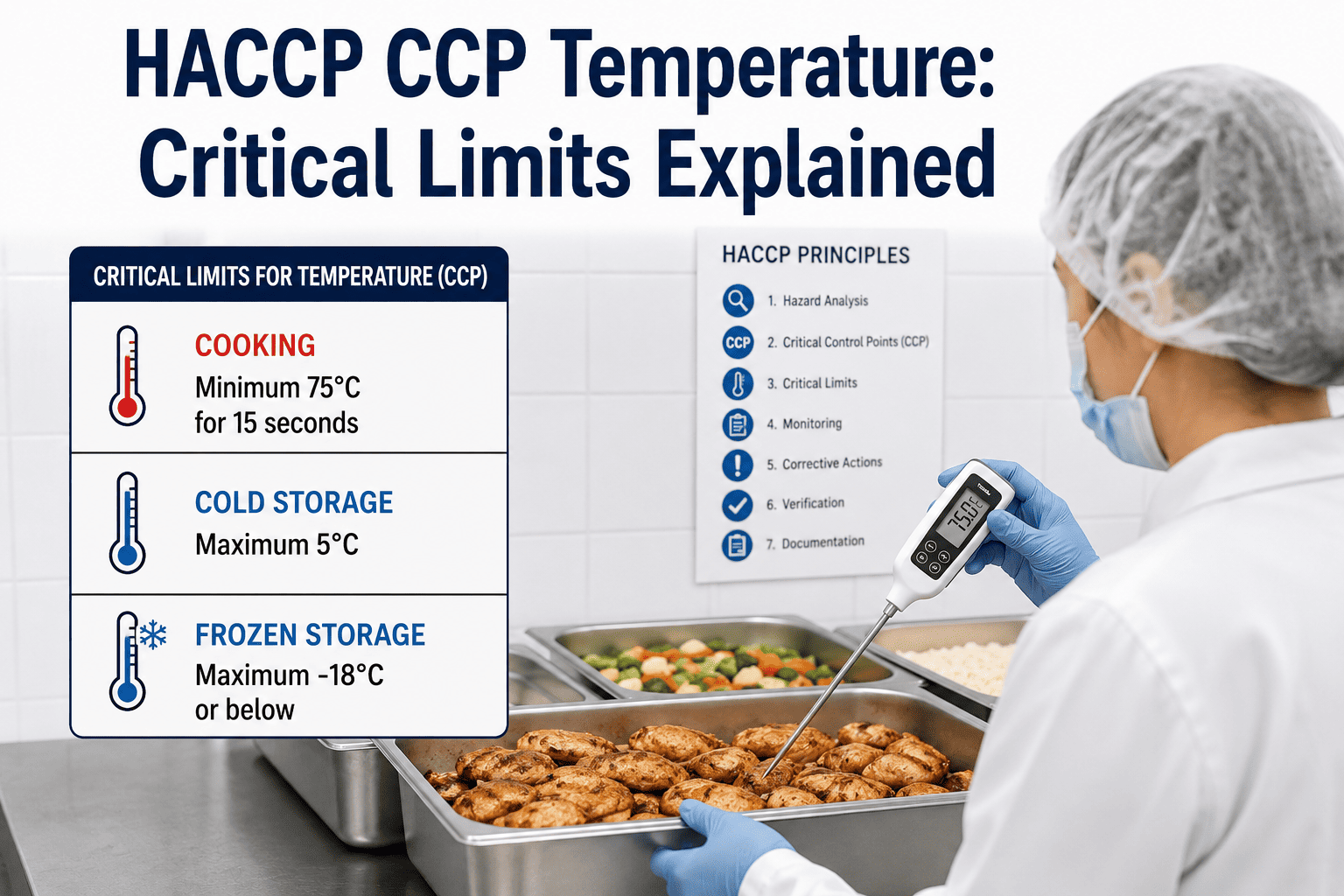
A Critical Control Point only functions as intended if the critical limit attached to it is specific, measurable, and actually monitored at the frequency the HACCP plan calls for — and for the large majority of food processing steps, that critical limit is a temperature. Cooking, cooling, hot holding, and cold storage steps all rely on a temperature threshold that separates a safe product from one that carries an unacceptable pathogen risk, which means the accuracy and consistency of temperature monitoring at each CCP is doing most of the real food safety work in the entire plan. Plants frequently treat critical limit monitoring as a paperwork exercise rather than the core safety mechanism it actually is, and that gap tends to surface only during an audit or, worse, after a deviation has already reached a customer. The sections below walk through how critical limits are set, how monitoring frequency should be determined, and what a defensible deviation response actually looks like, with further detail available in iFactory's support documentation.
01 / What Makes a Temperature Limit a True Critical Limit
A critical limit is not simply a target temperature — it is the specific boundary value at which a step stops being safe, backed by validated scientific data showing that the process achieves the required pathogen reduction at that exact value and holding time. A critical limit set too conservatively wastes production capacity and creates unnecessary rework, while one set too close to the actual risk boundary leaves no margin for the normal variability that every piece of production equipment exhibits. The distinction between a critical limit and an operating limit matters here — operating limits are set inside the critical limit as an early-warning buffer, giving operators room to adjust a process before it actually reaches the point of being unsafe rather than only reacting once a true deviation has already occurred. Plants that skip this buffer and monitor only against the critical limit itself tend to accumulate more true deviations over time, simply because there is no earlier signal prompting a correction while the process is still safely within range. Building the operating limit into daily monitoring, rather than treating it as an optional refinement, is one of the simplest changes a plant can make to reduce deviation frequency without changing the underlying critical limit at all.
02 / Choosing the Right Monitoring Frequency for Each CCP
Monitoring frequency should be set based on how quickly a process can drift out of control and how much product is at risk during that drift window, not based on what is administratively convenient for the staff assigned to record it. A continuous process such as a conveyorized oven with an automated temperature recorder can and should be monitored continuously, since the technology to do so exists and the consequence of a missed deviation affects every unit passing through during the gap. A batch cooking step monitored manually, by contrast, is typically checked at defined intervals timed to the batch cycle, which means the interval itself needs to be short enough that a deviation cannot fully develop and pass undetected between checks. Setting that interval requires understanding how quickly the specific process can drift — a large cook tank with high thermal mass changes temperature slowly and can tolerate a longer interval, while a smaller, faster-cycling process needs tighter monitoring to catch a deviation before an entire batch is affected. Reviewing actual process data periodically, rather than setting the interval once and never revisiting it, helps confirm the chosen frequency still matches how the equipment behaves as it ages.
03 / Building a Defensible Deviation Response Procedure
A deviation at a CCP is not itself a failure of the food safety system — an undocumented or inconsistent response to that deviation is what actually constitutes a failure during an audit or investigation. A properly built deviation procedure specifies exactly what happens the moment a reading crosses the critical limit, who has authority to hold the affected product, and what evidence needs to be gathered to support the eventual disposition decision. Vague language in this part of a HACCP plan — phrases like "appropriate action will be taken" without naming who takes it or how quickly — is one of the most common findings during external audits, precisely because it leaves room for inconsistent responses across different shifts and different staff members handling what should be an identical situation.
04 / Documentation and Recordkeeping Standards
Auditors and regulators evaluate a HACCP plan largely through its records, which means the documentation format matters almost as much as the monitoring itself — a reading that was taken correctly but recorded ambiguously creates the same audit exposure as a reading that was never taken at all. Records need to clearly show what was measured, when, by whom, against what limit, and what happened if the limit was exceeded, without gaps that require an auditor to ask clarifying questions about basic facts. Paper-based logs are especially prone to this problem, since handwriting inconsistencies, missed entries, and after-the-fact backfilling are difficult for an auditor to distinguish from genuinely contemporaneous records, which is why many facilities are moving toward digital logging that timestamps entries automatically and prevents retroactive editing of the original reading.
| Record Element | Why It Matters |
|---|---|
| Exact Reading and Time | Establishes precisely when and how far the process deviated from the limit |
| Operator or System ID | Confirms who or what recorded the reading for accountability and traceability |
| Applicable Critical Limit | Ties the reading directly to the validated threshold it is being checked against |
| Corrective Action Taken | Shows the plan was followed through to resolution, not just flagged and left |
| Product Disposition | Documents the final decision on affected product with supporting justification |
05 / Where CCP Monitoring Programs Most Commonly Break Down
Most CCP monitoring failures are not caused by an incorrect critical limit but by inconsistency in how that limit is monitored and enforced day to day, particularly across shifts and during periods of staff turnover. Recognizing these patterns in advance allows a plant to build safeguards into the monitoring program itself rather than discovering the same recurring gap after each new hire or each equipment change.
06 / Automating CCP Monitoring Without Losing Operator Judgment
Automated temperature monitoring at CCPs closes many of the gaps described above by removing manual recording error and enforcing consistent monitoring frequency regardless of shift or staffing levels, but automation works best when it is layered on top of trained operator judgment rather than replacing it entirely. The system should flag deviations immediately and route them to the person with authority to hold product, while still relying on trained staff to investigate root cause and determine appropriate corrective action, since these decisions depend on context an automated system cannot fully evaluate on its own. This layered approach also tends to improve staff trust in the monitoring system itself — operators are more willing to rely on automated alerts once they see the system consistently routing real deviations to the right person without generating a flood of false alarms that erode confidence over time.
07 / Preparing for an Audit Before One Is Scheduled
The facilities that handle HACCP audits most smoothly are the ones that treat every day as if an audit could happen tomorrow, keeping critical limit validation files, monitoring records, and deviation documentation organized and current rather than assembling them retroactively once an audit is announced. A quarterly internal review comparing actual monitoring records against the HACCP plan's stated frequency and limits catches gaps long before an external auditor does, and it gives the plant time to correct process issues rather than simply explaining them after the fact. This internal review is also the right time to confirm that the HACCP plan document itself still matches how the process actually runs, since equipment changes and process adjustments made over the course of normal operations sometimes drift away from what the original plan describes without anyone formally updating the paperwork to match.
08 / Conclusion — Critical Limits Are Only as Strong as the Monitoring Behind Them
A well-validated critical limit provides no protection if the monitoring behind it is inconsistent, poorly documented, or slow to trigger a response when a deviation occurs. Getting monitoring frequency right for each CCP, building a deviation response procedure that removes ambiguity about what happens next, and keeping documentation audit-ready year-round are what actually turn a HACCP plan from a document into a working food safety system. Book a demo to see how automated CCP monitoring supports this in practice.
Frequently Asked Questions — HACCP CCP Temperature Monitoring
A critical limit is the validated boundary beyond which the process no longer guarantees the required pathogen reduction, and crossing it triggers a mandatory deviation response with product hold and corrective action. An operating limit sits inside that boundary as an internal buffer, giving operators an early warning to adjust the process before it actually reaches the critical limit itself. Facilities that only monitor against the critical limit tend to experience more frequent true deviations, because there is no built-in trigger to catch and correct drift while it is still a minor issue rather than a full deviation requiring formal disposition.
Critical limits should be revisited any time there is a meaningful change to the product formulation, process equipment, or packaging that could affect how quickly or thoroughly pathogen reduction occurs, rather than left unchanged indefinitely on the assumption that the original validation still applies. Many facilities also build in a periodic revalidation cycle, commonly annual, as a baseline check even without an obvious triggering change, since equipment performance can shift gradually in ways that are not immediately obvious. iFactory's support documentation outlines a standard revalidation checklist covering the most common triggering events.
Hold authority should be assigned to a specific trained role — typically a quality assurance supervisor or shift lead — rather than left informal, because ambiguity about who can issue a hold is one of the most common reasons deviations are not acted on quickly enough. This authority needs to be effective across all shifts, including nights and weekends when senior staff may not be on-site, which means the deviation procedure should name a backup authority for every shift rather than assuming the primary person will always be reachable. Clear, unambiguous hold authority is one of the details auditors specifically look for when reviewing a HACCP plan's deviation procedure.
Automated systems can replace the manual act of taking and recording a reading, and they do this more reliably than manual checks because they remove the risk of a skipped or forgotten reading during a busy shift. What they generally cannot replace is the judgment involved in investigating root cause and determining product disposition once a deviation has occurred, since these decisions depend on process context, product knowledge, and sometimes information from outside the monitoring system itself. The most effective programs use automation to guarantee consistent monitoring and immediate flagging, while keeping trained staff in the loop for the investigation and disposition steps that follow.
The most frequently cited documentation gap is not the monitoring reading itself but the corrective action and disposition record that should follow a deviation — auditors regularly find deviations that were recorded but never traced through to a documented resolution. A second common gap is calibration verification records for the thermometers or sensors used to take critical limit readings, since a reading is only as trustworthy as the instrument that produced it. Building both of these into the standard monitoring workflow, rather than treating them as separate administrative tasks, closes most of the documentation gaps auditors typically find. Book a demo to see how this documentation trail is captured automatically.