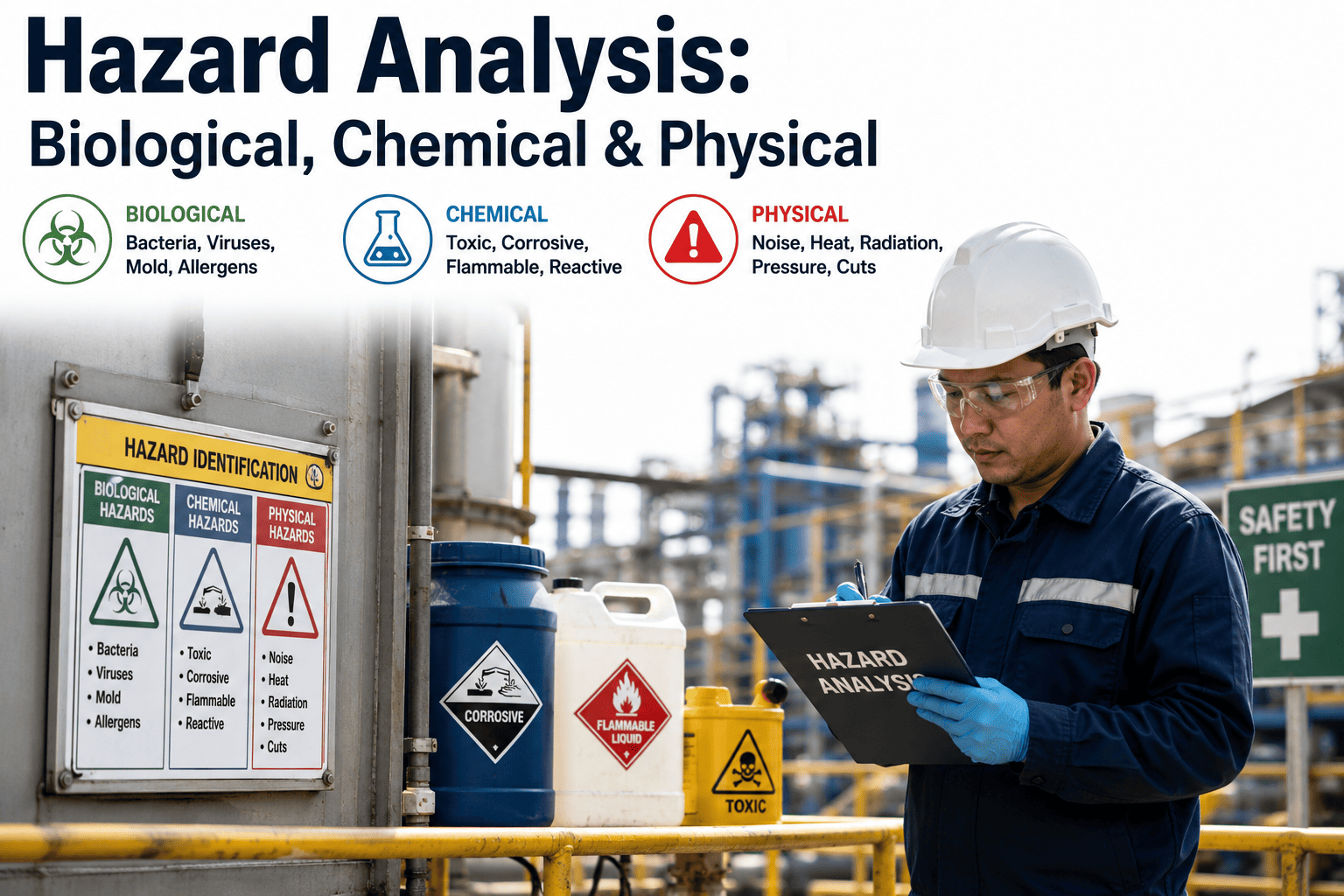
Every HACCP plan rests on a single foundational step that determines whether everything built on top of it actually protects consumers — hazard analysis. Get this step wrong, missing a genuine hazard or misjudging its severity, and no amount of downstream monitoring, corrective action procedure, or verification activity can fully compensate for the gap. Food safety teams conducting hazard analysis have to systematically work through four distinct hazard categories — biological, chemical, physical, and radiological — each with different sources, different detection challenges, and different control strategies, then judge both the likelihood and severity of each one honestly enough to determine which hazards genuinely require a critical control point. This isn't a paperwork exercise to satisfy an auditor; it's the analytical foundation that everything else in food safety management is built upon.
Why Hazard Analysis Is the Step Everything Else Depends On
A HACCP plan's critical control points, monitoring procedures, and corrective actions all exist to manage hazards that were identified during hazard analysis. If a genuine hazard is missed at this stage — an allergen cross-contact pathway, a pathogen growth risk during a specific process step, a foreign material source nobody considered — no amount of rigor in the rest of the plan will catch it, because the plan was never designed to look for it in the first place.
This is a structural characteristic worth sitting with, because it means the quality of a HACCP plan is capped by the quality of the hazard analysis underneath it, no matter how sophisticated the monitoring systems or how disciplined the corrective action procedures built on top. A team can execute every subsequent HACCP step flawlessly and still leave consumers exposed to a genuine hazard, simply because that hazard was never identified as something requiring control in the first place. This is exactly why regulatory inspectors and third-party auditors so often focus their most probing questions on the hazard analysis itself, rather than the downstream monitoring records — because a flawed hazard analysis represents a systemic gap that no amount of downstream diligence can close.
This is exactly why hazard analysis has to be a genuine, facility-specific analytical exercise rather than an adaptation of a generic industry template. Two facilities producing similar products can have meaningfully different hazard profiles depending on their specific equipment, layout, supplier base, and process design — which means a hazard analysis copied from a similar operation, without genuine facility-specific evaluation, risks both missing real hazards unique to your operation and flagging hazards that don't actually apply, diluting attention away from the risks that matter most.
Biological, Chemical, Physical, and Radiological — The Four Categories Explained
Food safety hazards are conventionally organized into four categories, each requiring a different analytical approach and a different set of control strategies. A comprehensive hazard analysis works through all four systematically for every process step, rather than defaulting to whichever category a team happens to be most familiar with. Teams with a strong food safety science background sometimes over-invest analytical attention in biological hazards while under-analyzing physical or chemical hazard sources, simply because biological hazard science tends to receive the most formal training emphasis — a pattern worth correcting deliberately during analysis planning. Book a demo to see how monitoring data supports hazard identification across all four categories.
Notice that these four categories are listed roughly in order of how frequently they actually drive real-world food safety incidents and recalls — biological hazards dominate the recall landscape, chemical hazards, particularly undeclared allergens, follow closely, physical hazards generate frequent but typically less severe consumer complaints, and radiological hazards remain rare enough that most facilities will document a low-likelihood determination for this category rather than an active control program. This ordering is a useful sanity check during analysis: a hazard analysis that spends disproportionate documentation effort on radiological hazards while treating allergen cross-contact superficially has likely misallocated its analytical attention relative to actual risk.
Biological Hazards — Where Pathogens Actually Enter the Process
Biological hazard analysis requires tracing pathogen introduction and growth risk through every stage of the process, since different pathogens present different risks at different points. A thorough analysis considers not just whether a pathogen could be present, but whether process conditions at each step would allow it to survive, grow, or be eliminated.
This last pathway — post-process recontamination — deserves particular attention because it's frequently the hardest for a hazard analysis to catch. Teams naturally focus scrutiny on the lethality step itself, since it feels like the obvious point where biological hazard control lives. But a facility can execute a flawless thermal process and still ship contaminated product if the post-lethality environment isn't equally well controlled, which is exactly the failure pattern behind many real-world Listeria-related recalls in ready-to-eat food categories.
Judging Severity and Likelihood — The Core of Risk-Based Hazard Evaluation
Identifying a hazard is only half the analysis. Determining whether that hazard is reasonably likely to occur, and how severe the consequences would be if it did, is what actually distinguishes hazards requiring a critical control point from those that can be managed through standard operating procedures alone. This step is where genuine judgment, informed by real facility data rather than generic assumption, matters most — an identical hazard can be a low-priority item in one facility and a critical control point in another, depending entirely on the specific process conditions, equipment, and historical experience each facility actually has. Book a demo to see how production and monitoring data can inform likelihood assessment with real facility data rather than assumption alone.
| Likelihood / Severity | Low Severity | Moderate Severity | High Severity |
|---|---|---|---|
| Low Likelihood | Monitor via standard procedures | Evaluate control adequacy | Likely requires CCP designation |
| Moderate Likelihood | Standard operating procedure control | Strong candidate for CCP | Requires CCP designation |
| High Likelihood | Process control review recommended | Requires CCP designation | Critical priority CCP |
This matrix is a useful reference framework, but it shouldn't be treated as a mechanical lookup table applied without judgment. The boundaries between categories are genuinely fuzzy in practice, and a team should feel comfortable erring toward stricter control when a hazard sits near a boundary between two cells, particularly for high-severity hazards where the consequences of underestimating likelihood are considerably worse than the cost of an unnecessary control measure.
Chemical and Physical Hazard Sources Worth Closer Attention
Chemical and physical hazards often receive less analytical rigor than biological hazards, partly because they feel more intuitive to identify. That intuition can be misleading — some of the most common chemical and physical hazard sources are easy to overlook precisely because they're embedded in routine operations rather than obvious contamination events.
A useful discipline when evaluating these hazard sources is to ask not just whether the hazard is possible, but whether the current control environment has actually been verified to work as intended, rather than assumed to work because it's part of standard operating procedure. A changeover cleaning procedure that looks thorough on paper may still leave measurable allergen residue if it was never validated against actual swab testing data, which is exactly the kind of gap a facility-specific hazard analysis is meant to surface rather than assume away.
Connecting Identified Hazards to Actual Control Measures
A hazard analysis that identifies risks without connecting each one to a specific, verifiable control measure provides documentation value but limited practical protection. The analytical work is only complete once each significant hazard has a clearly defined control strategy — whether that's a critical control point, a prerequisite program, or a standard operating procedure.
This documentation step is frequently underweighted relative to its actual importance. A hazard analysis that reaches sound conclusions but fails to document the reasoning behind them leaves a team unable to defend those conclusions convincingly during a regulatory inspection or third-party audit, and equally unable to revisit the reasoning confidently when process conditions change and the analysis needs updating. Clear documentation of the "why" behind every determination is what transforms a hazard analysis from a static compliance artifact into a living reference document the food safety team can actually use and trust over time.