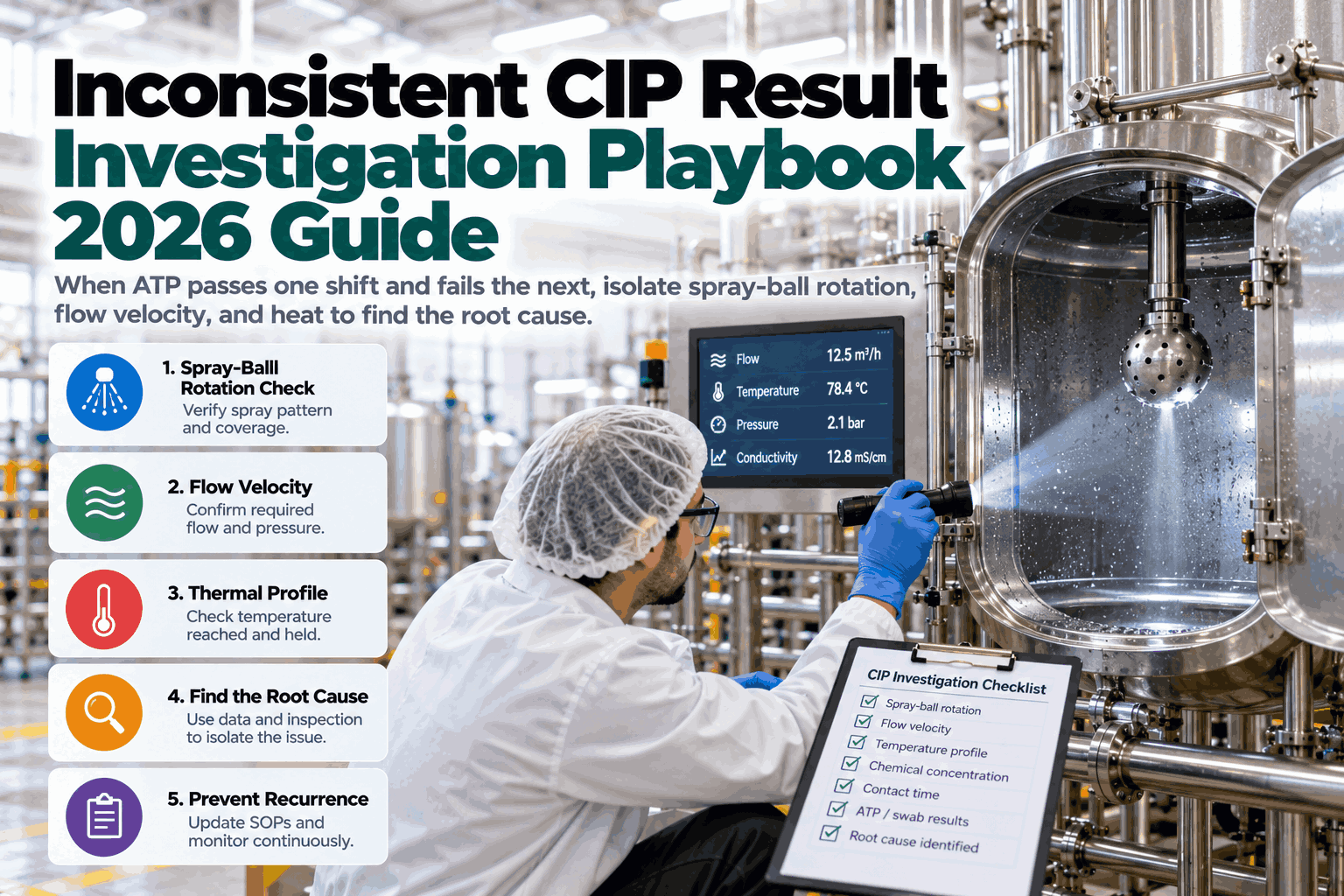
Same circuit, same recipe, same chemicals. Yet ATP passes on days and fails on nights. Inconsistent CIP results almost always have a physical cause, and it usually hides in flow, spray coverage, heat or timing. This playbook shows how to find it in order, fast. To work through a live case with us, book a CIP investigation call.
Inconsistent CIP Results: An Investigation Playbook
When cleaning passes one shift and fails the next, compare the cycles side by side, check spray devices, flow velocity and heat in order, and prove the fix with data instead of another round of re-cleans.
- The five usual suspects, and how to check each
- A step-by-step order that saves days
- How to tell if the test itself is the problem
Highlighted rows differ between shifts. Two real differences, flow and waiting time, are where the investigation starts. The rows that match can be set aside for now.
Why CIP Passes One Shift and Fails the Next
The recipe is the same. Something around it is not.
A CIP recipe fixes the steps. It does not fix what the plant is doing at the same time. Shared pumps, steam demand, product schedules and waiting times all change from shift to shift, and each one can weaken a clean without anyone touching the recipe. Our CIP support team can help you list what changes between your shifts.
Shared supply
Another circuit or line draws on the same pump or header, and flow falls.
Steam demand
Heat runs short at shift change or start-up, so caustic reaches the return cooler than the recipe expects.
Product schedule
Heavier or stickier products tend to run on one shift, so that shift always cleans the hardest soil.
Waiting time
Soil left to dry before CIP starts is much harder to remove, even with the same chemicals and heat.
Ask each shift
- What else runs while CIP is running?
- How long does equipment wait before CIP?
- Which products are made just before it?
- Are any steps skipped, held or restarted?
Look for in the data
- Failures grouped by shift, day or product
- Lowest flow and temperature, not averages
- Manual holds or restarts in the cycle log
- Slow drift over weeks, not just sudden changes
It is tempting to blame the people on the failing shift. Usually the data points elsewhere: to equipment, schedules or shared utilities. Start with the cycle data, and bring operators in as experts on what happens on their shift.
The Five Usual Suspects
Flow, spray, heat, chemistry and timing. Check them in that order.
Flow comes first because it causes the most problems and is quick to check from skid data. Spray devices come next, because a stuck or blocked head can leave whole areas of a tank untouched. To work through the list for your circuit, book a root cause session.
Flow velocity
Pipes need fast, turbulent flow, usually at least about 1.5 m/s. Check the lowest flow during each wash, not the average, and compare shifts. Most skids already log it.
Spray devices
Static balls can block. Rotating heads can stick or slow. Check pressure at the device, rotation, and coverage with a riboflavin test.
Heat
Check temperature at the return, not the supply. A long pipe run or short steam supply can leave the far end of the circuit too cool.
Chemistry
Check strength at the return, with temperature-corrected conductivity. Dilution from rinse water or weak make-up shows up here.
Timing and soil
Check run length, product and the wait before CIP. Long waits and heavy products make the same recipe much harder work, especially once soil starts to dry.
The test itself
Swab site, technique and timing can change an ATP result. Rule the test in or out before changing the clean, or you may fix something that was never broken.
Quick reference: what normal looks like
Spray device checks
- Pressure. At the device, during the wash.
- Rotation. Heard, seen or sensed on every cycle.
- Blockage. Holes clear after inspection.
- Coverage. Riboflavin test after changes.
Flow checks
- Lowest flow. Not just the average.
- Shared pumps. What else runs at the same time.
- Pump wear. Flow slowly falling over weeks.
- Air. Entrained air from a low tank level.
One Case, From Fail to Proof
Here is how the filler circuit 3 case closed: one cause found in the data, one fix, and enough clean cycles afterwards to prove it held.
Run the Investigation in Order
Change one thing at a time, and let the data, not a hunch, close the case.
Investigations drag on when several fixes go in at once, because nobody can tell which one worked, or whether one of them made something else worse. A simple order keeps the work short and the result defensible. If you want a second pair of eyes on a case, our engineers can help.
Frame it
Which circuit, which test points, which shifts, since when? Write it down in one sentence that everyone agrees on.
Pull the cycles
All passing and failing cycles for the same circuit, side by side, phase by phase.
Find what differs
Flow, temperature, strength, timing and product. Set aside anything that matches.
Check the hardware
Spray devices, pumps, valves and probes on the suspect circuit, checked against their specifications.
Fix one thing
The most likely cause first. Record what changed and when, so the result can be traced.
Prove it
Enough clean cycles on the failing shift to show the fix held, then close the case and share what was learned.
Problem statement, cycles compared, differences found, fix made, date, and the clean cycles that followed. One page per case. Over a year, these pages show which causes keep coming back, and where a lasting engineering fix will pay.
A re-clean protects the product you are about to make. It does not explain the failure. Log every re-clean against the case, so the pattern stays visible until the real cause is found.
Is the Test Telling the Truth?
Sometimes the clean is fine and the result is not.
ATP is fast and useful, but results move with swab site, pressure, surface and timing. Pass and fail limits should be set by each site, from replicate tests on surfaces cleaned to the standard you want. Before you change a recipe, make sure the test is steady. To review your verification set-up, book a verification check.
Make the test steady
- Same swab sites, marked on a drawing
- Same technique, trained and checked
- Same timing after CIP ends
- Limits set from your own replicate tests
- Re-swab a failed site before acting, and log both
- Ask your test supplier whether cleaning chemicals left on a surface can affect readings
Moving swab sites
A site a few centimetres away can give a very different reading. Mark each site and keep to it.
Different hands
Pressure and area vary between people. Train together and check technique on a known surface.
Different timing
Swabbing a wet surface straight after CIP and a dry one hours later are not the same test.
How iFactory Speeds Up CIP Root Cause
Days of chart-reading, done in minutes.
iFactory reads every CIP cycle from your skids and joins it with verification results, production schedules and the state of shared equipment. When results become inconsistent, it lines up passing and failing cycles, shows what differs, and ranks the likely causes. People still decide what the cause is and what to change, and every decision is logged with the case. Questions on fit go to our support desk.
Compare
Passing and failing cycles side by side, by shift, product and phase.
Rank
Differences ranked by how strongly they track with failures, with the evidence shown.
Track
Each fix logged, with the cycles that followed it.
Warn
Early alerts when flow, heat or rotation start to drift again.
Rules of thumb on this page, such as 1.5 m/s pipe flow and spray ball sizing, come from published equipment guidance. Your equipment maker's figures for each device come first.
Turnkey AI: Delivered, Connected and Live in 6–12 Weeks
You do not build this. It arrives ready.
iFactory ships as a pre-configured NVIDIA AI server, racked and ready, with the software pre-loaded. Rack it, plug in power and Ethernet, and the AI is live on your network.
Our team handles cabling, network setup, PLC and SCADA integration, operator training and 24×7 remote monitoring. The server sits inside your own network, so CIP and hygiene data stay on site. For a scope matched to your plant, request a turnkey quote.
Ship, network and data
Server installed. CIP skids, ATP results and production schedules connected.
Model training and pilot
Cycle history learned. First inconsistent circuit investigated with your hygiene team.
Go-live and training
Comparisons and drift alerts live for all circuits. Staff trained. 24×7 remote monitoring begins.
Frequently Asked Questions
Why does CIP fail ATP on one shift but not another?
Usually because something around the clean changes between shifts: shared pumps, steam demand, the products being run, or how long equipment waits before CIP. Compare passing and failing cycles side by side to find what differs. The recipe is rarely the cause, because it is the one thing that stays the same.
What flow velocity does CIP need?
For pipework, a common rule is at least about 1.5 m/s, roughly 5 ft/s, to get turbulent flow that scrubs the pipe wall. Check the lowest flow during the wash, since short dips can be enough to leave soil behind. Heat exchangers and spray devices have their own flow rules, so check your equipment maker's figures for those.
How do we check a rotating spray head is working?
Check it turns on every cycle, by sound, sight or a rotation sensor, and that pressure at the device is in its working range. After any change, a riboflavin coverage test shows whether every surface is being reached.
Should we just make the CIP longer?
Not before you know the cause. A longer cycle may hide a flow or spray problem without fixing it, and costs time, water and chemicals on every clean. Find the cause first, then decide. If you must extend a cycle while you investigate, record it as a temporary measure with an end date.
How should ATP pass and fail limits be set?
From your own surfaces. Clean to the standard you want, run several replicate tests per site, and set limits from the results. One recommended method uses the average as the pass limit and the average plus three standard deviations as the fail limit.
How many clean cycles prove a fix?
Enough on the failing shift to be confident. As a rough guide, many teams look for 15 to 20 cycles, depending on how often it failed before. The rarer the original failures, the more clean cycles you need. Keep watching the circuit for a few weeks after the case closes.
Can software find the cause on its own?
It can find the differences and rank them, which saves a lot of time. People still confirm the cause, choose the fix and sign it off. To see how that works on your data, contact our team.
Close the Case on Your CIP Failures
In thirty minutes we look at one circuit with inconsistent results, go through the five suspects with you, and point out what to check first. You keep the notes whether or not you go further with iFactory.
- 1ATP or swab results by date and shift
- 2Skid trends for passing and failing cycles
- 3Your swab site map and limits
- 4Spray device types and last inspection
- 5Production schedule for the same weeks