In the rapidly evolving landscape of pet food manufacturing, the convergence of artificial intelligence and extrusion technology is redefining quality control, operational efficiency, and regulatory compliance. Traditional methods of monitoring extruder parameters—such as temperature, moisture, and screw speed—rely on manual adjustments and reactive interventions, often leading to inconsistent kibble density, nutritional drift, and costly rework. By integrating AI-driven predictive analytics, plant managers can achieve real-time optimization of the extrusion process, ensuring that every batch meets precise nutritional specifications and AAFCO standards. This deep-dive guide explores how AI transforms pet food production, from raw material handling to final packaging, with a focus on extruder control, nutritional verification, density monitoring, palatability prediction, and compliance documentation. For a personalized demonstration of how iFactory's AI solutions can elevate your production line, Book a Demo today.
Transform Your Pet Food Production with AI
Achieve unparalleled consistency, compliance, and efficiency. Let iFactory's AI-driven analytics optimize your extrusion process from start to finish.
Pet food manufacturing demands rigorous control over every variable—from ingredient moisture content to extruder barrel temperature—to ensure product safety, nutritional accuracy, and palatability. AI-powered systems now offer a paradigm shift, enabling predictive adjustments that minimize waste and maximize throughput. This guide examines the critical intersection of AI and extrusion technology, providing actionable insights for plant managers striving for operational excellence.
Real-Time Extruder Parameter Control
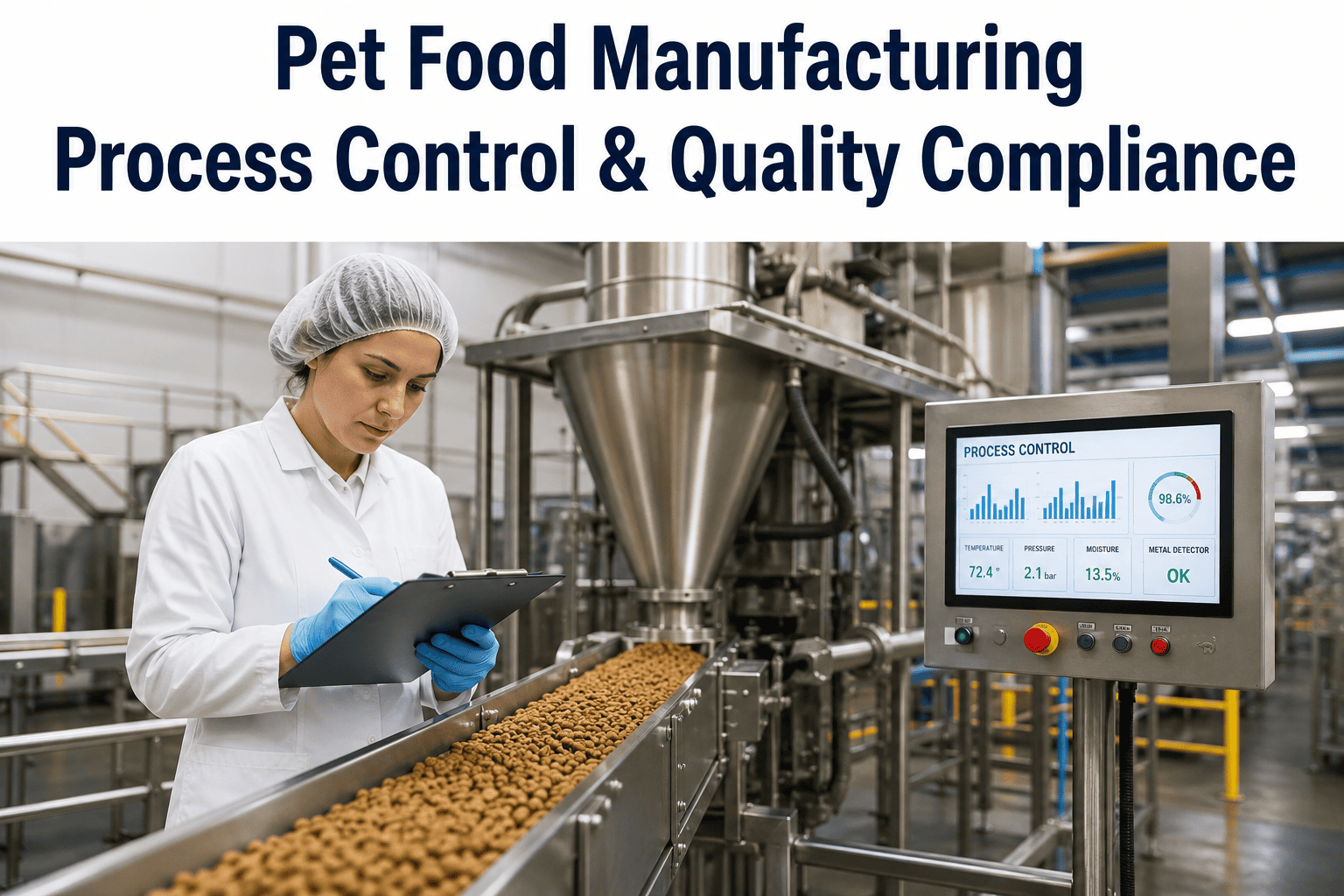
AI algorithms analyze hundreds of data points per second—including motor load, melt temperature, and die pressure—to adjust screw speed and water injection in real time. This ensures consistent kibble expansion and density, reducing variability by up to 40% compared to manual control.
Nutritional Analysis Verification
By integrating near-infrared (NIR) sensors with AI models, manufacturers can verify crude protein, fat, and fiber content inline. The system flags deviations from target formulations instantly, allowing corrective actions before the product reaches the dryer.
Kibble Density Monitoring
Computer vision systems paired with machine learning detect density variations in real time. AI models predict optimal density ranges based on recipe and moisture content, ensuring uniform kibble size and texture that meets pet owner expectations.
Palatability Prediction
AI analyzes historical palatability scores alongside process parameters to predict acceptance rates for new formulations. This reduces the need for costly taste trials and accelerates product development cycles.
AAFCO Compliance Documentation
Automated data logging and AI-driven audits generate compliance reports in minutes. The system cross-references production data with AAFCO nutrient profiles, flagging any discrepancies for immediate review.
Step 1: Raw Material Characterization
AI models ingest data from suppliers and in-house lab tests to predict optimal preconditioning parameters. This step ensures that incoming ingredients—such as meat meals, grains, and fats—are processed consistently, regardless of natural variability.
Step 2: Extruder Setup & Parameter Optimization
Using reinforcement learning, the AI system recommends initial screw speed, barrel temperature profile, and water injection rates. As production runs, the model continuously refines these parameters to maintain target metrics.
Step 3: Inline Quality Monitoring
NIR sensors, vision systems, and torque sensors feed data to the AI, which compares real-time measurements against specification limits. Any deviation triggers an alert or automatic adjustment, ensuring product stays within acceptable ranges.
Step 4: Post-Extrusion Drying & Coating
AI predicts optimal dryer temperature and retention time based on kibble moisture content. For coating applications, the system adjusts fat or flavor spray rates to achieve uniform coverage, enhancing palatability without overdosing.
Step 5: Final Inspection & Compliance Reporting
Automated vision inspection and NIR analysis confirm final product quality. The AI compiles a compliance package aligned with AAFCO guidelines, ready for submission to regulatory bodies or customers.
Ready to Optimize Your Extrusion Line?
Unlock the full potential of AI in pet food manufacturing. Book a demo to see how iFactory's platform integrates with your existing systems.
AI-Driven Extrusion Control: A Technical Deep Dive
Modern pet food extrusion involves complex interactions between raw material properties, machine settings, and environmental conditions. Traditional PID controllers struggle to adapt to rapid changes in ingredient moisture or ambient humidity, leading to suboptimal kibble expansion and density. AI models, particularly deep reinforcement learning, learn the nonlinear dynamics of the extrusion process by analyzing historical data from thousands of production runs. They can predict the effect of a 1% change in water injection on final density, or how a 5°C increase in barrel temperature affects protein denaturation. These models operate on edge devices directly connected to the extruder PLC, enabling millisecond-level adjustments without cloud latency. The result is a self-optimizing system that reduces scrap, energy consumption, and operator intervention. For plant managers, this translates to lower cost per ton and higher throughput, all while maintaining stringent quality standards.
Comparative Analysis: Traditional vs. AI-Enhanced Pet Food Production
| Parameter | Traditional Method | AI-Enhanced Method |
|---|---|---|
| Extruder Parameter Adjustment | Manual, based on operator experience | Real-time, predictive, automated |
| Nutritional Verification | Offline lab analysis (2-4 hours) | Inline NIR + AI (continuous) |
| Density Control | Sampling every 30 minutes | 100% inline vision inspection |
| Palatability Testing | Animal trials (weeks) | AI prediction (minutes) |
| Compliance Documentation | Manual data compilation | Automated, audit-ready reports |
Data Integration Challenges
Integrating AI into legacy extrusion lines requires careful sensor placement and data normalization. iFactory's platform supports OPC-UA, MQTT, and Modbus protocols, ensuring seamless connectivity with existing PLCs and SCADA systems. Our edge AI modules preprocess data locally to reduce bandwidth and latency, making deployment feasible even in remote facilities.
Model Training & Validation
AI models are trained on historical production data combined with controlled experiments. We use transfer learning to adapt base models to specific recipes and equipment configurations, reducing training time from weeks to days. Continuous validation against lab results ensures model accuracy remains above 95%.
Scalability & Multi-Line Management
Once proven on one line, the AI system can be replicated across multiple lines with minimal configuration. Centralized dashboards provide plant managers with a unified view of line performance, highlighting anomalies and optimization opportunities across the entire facility.
Frequently Asked Questions
How does AI handle different pet food formulations (e.g., dry, semi-moist, treats)?
AI models are trained on a wide range of formulations, each with unique extrusion characteristics. The system automatically adjusts control parameters based on the recipe ID entered at the start of the run. For semi-moist products, the AI prioritizes moisture retention and binding agent activation, while for dry kibble, it focuses on expansion and density. The model continuously learns from each run, improving its performance over time. For more details on how iFactory customizes models for specific product types, visit our support page.
What sensors are required for AI-driven extrusion control?
Essential sensors include barrel temperature thermocouples, melt pressure transducers, motor load sensors, and moisture analyzers. Optional sensors like NIR spectrometers and vision cameras provide additional data for nutritional and density verification. iFactory's platform is sensor-agnostic and can integrate with most industrial sensors via standard protocols. For a detailed list of compatible sensors and installation guidelines, contact our engineering team.
Can AI predict and prevent extruder blockages or wear?
Yes. AI models analyze trends in motor load, pressure, and temperature to predict conditions that lead to blockages, such as moisture spikes or die clogging. The system can automatically reduce feed rate or increase screw speed to prevent blockages. Additionally, vibration analysis and torque signatures help predict bearing wear and screw erosion, enabling predictive maintenance. To learn how iFactory's predictive maintenance module integrates with extrusion lines, Book a Demo.
How does AI ensure compliance with AAFCO nutrient profiles?
The AI system cross-references real-time NIR analysis results with the target AAFCO nutrient profile for the specific product. If crude protein or fat levels drift outside the allowable range, the system alerts the operator and suggests corrective actions, such as adjusting the ingredient ratio. All data is logged with timestamps and batch IDs, forming a complete audit trail. For a comprehensive overview of our compliance documentation features, explore our resources.
What is the ROI timeframe for implementing AI in pet food manufacturing?
Most facilities achieve a positive ROI within 6 to 12 months, driven by reductions in scrap, rework, and energy consumption. Additional savings come from increased throughput and reduced operator oversight. Specific ROI depends on line volume, current efficiency levels, and the complexity of formulations. To get a customized ROI estimate for your facility, Book a Demo.
Take the Next Step in Pet Food Manufacturing Excellence
Leverage AI to achieve unmatched consistency, compliance, and efficiency. Schedule a demo with iFactory today.