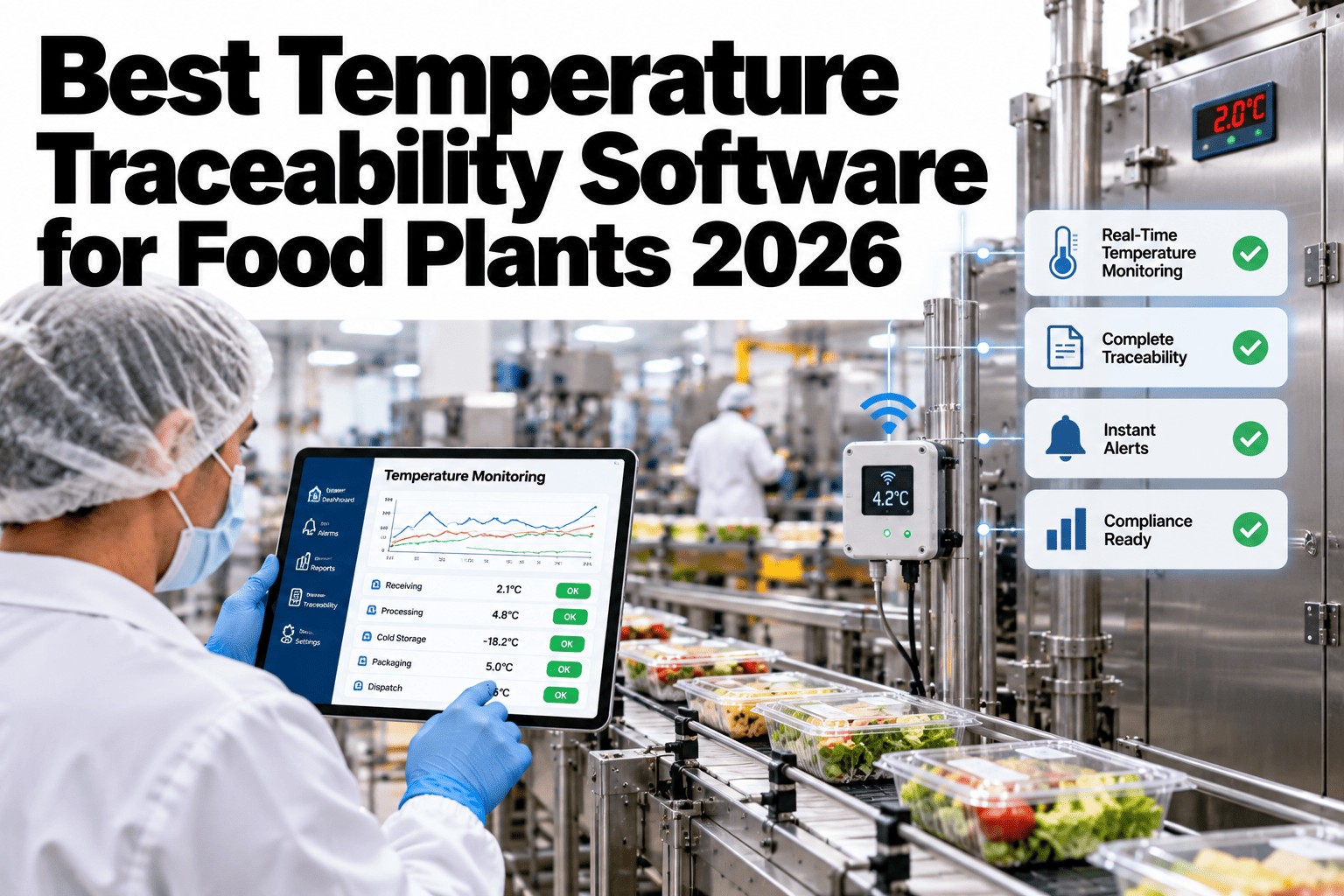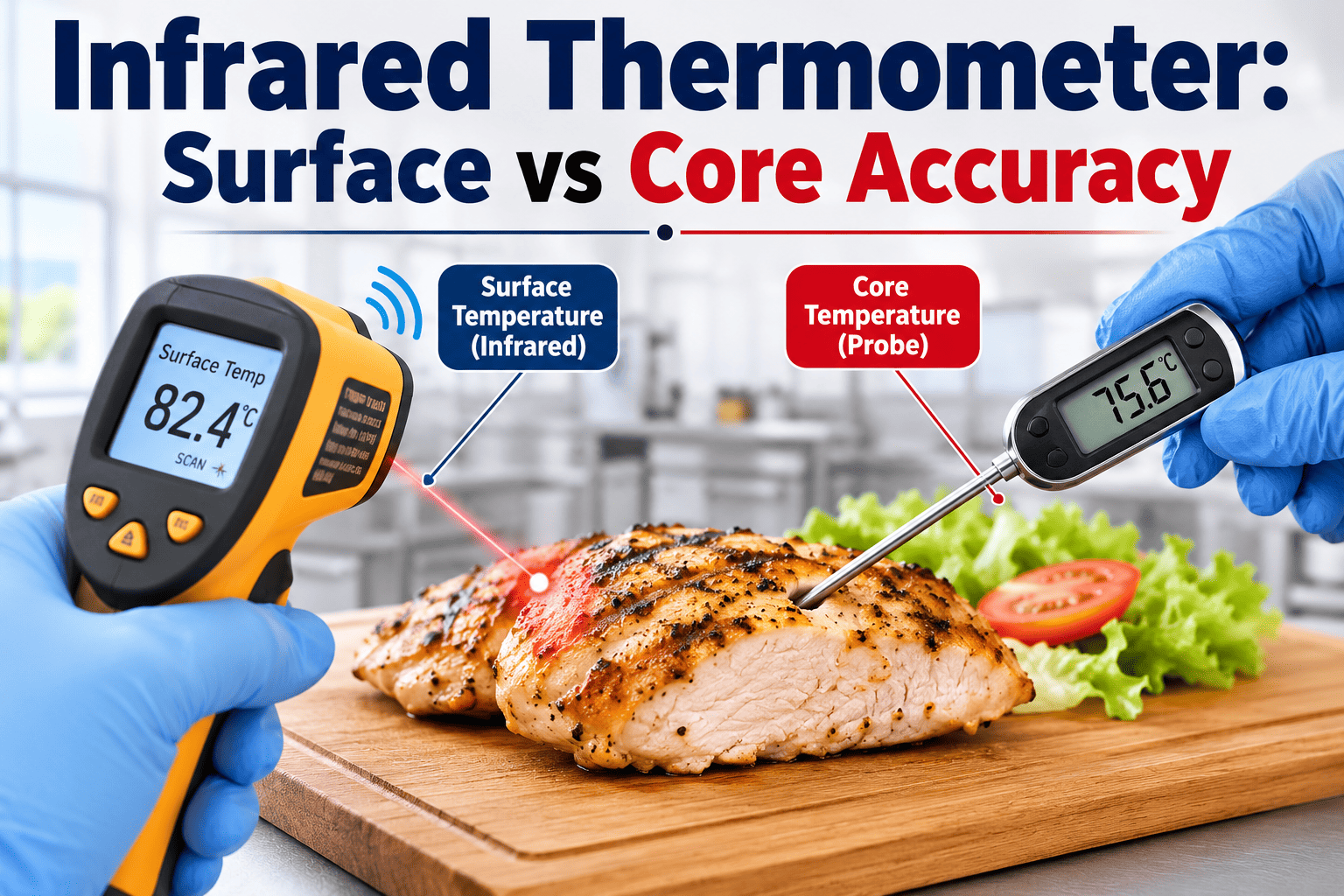
An infrared thermometer reads what's on the surface of a product, not what's happening inside it, and that distinction causes more food safety mistakes than almost any other piece of temperature equipment on a plant floor. A frozen chicken breast can show a perfectly acceptable surface reading seconds after coming out of a blast chiller while its core is still dangerously warm, or a hot-held product can look compliant at the surface while the center hasn't come close to a safe temperature. Infrared thermometers are fast, non-contact, and genuinely useful — but only when used for what they're actually designed to measure. This guide covers when surface temperature is the right measurement, when it isn't, and how a demo can show connected temperature monitoring that captures both surface and core data automatically.
What an Infrared Thermometer Actually Measures
An infrared thermometer detects the thermal radiation emitted from a surface and converts it into a temperature reading, without ever making physical contact with the product. That's the source of its biggest advantage — speed and zero risk of cross-contamination between products — and also its fundamental limitation: it can only ever report what's happening at the outermost layer it can see. Heat doesn't move through most food products instantly, so a surface that's been exposed to cold air, hot air, or ambient temperature for even a short time can show a reading meaningfully different from the product's actual internal temperature.
This gap matters most in exactly the situations food safety programs care about: cooking, cooling, and hot-holding, where the internal temperature is what actually determines whether pathogens have been controlled. A surface reading that looks compliant can mask a core that's still in the temperature danger zone, and relying on IR alone in these situations is one of the more common — and more serious — measurement mistakes found during food safety audits.
Emissivity: The Setting Most Operators Never Adjust
Every infrared thermometer assumes a fixed or adjustable emissivity value — a measure of how efficiently a surface emits thermal radiation compared to a perfect theoretical emitter. Most consumer-grade and even many industrial IR thermometers ship with a default emissivity setting around 0.95, which works reasonably well for matte, non-reflective, non-metallic surfaces like most cooked or raw food products. The problem shows up on shiny, wet, or metallic surfaces — stainless steel equipment, foil packaging, or a wet product surface — where the default setting can produce a reading that's off by several degrees in either direction, enough to matter at a CCP.
| Surface Type | Typical Emissivity | IR Reading Reliability |
|---|---|---|
| Cooked or raw food product (matte) | 0.90 – 0.98 | Generally reliable at default settings |
| Wet or moist surface | Variable, often lower | Can under-read due to reflectivity of moisture |
| Polished stainless steel | 0.10 – 0.20 | Unreliable without an emissivity adjustment or tape target |
| Foil or reflective packaging | Very low, near 0.05 | Not suitable for direct IR measurement |
Distance, Field of View, and the D:S Ratio
Every infrared thermometer has a distance-to-spot ratio, usually printed on the device or in its manual, that determines how large an area the sensor is actually averaging at a given distance. A thermometer with a 12:1 ratio held 12 inches from a target is averaging the temperature across a one-inch-diameter spot — and if that spot includes both the product and a cooler background surface behind or around it, the reading blends both into an average that reflects neither accurately. This is one of the most common sources of inconsistent readings between operators using the same thermometer on the same product: one holds it close and centered, another holds it further back and gets a diluted average.
Where IR Thermometers Are the Right Tool
None of this makes infrared thermometers unsuitable for food production — it just means they need to be applied to the measurements they're actually good at. Receiving inspections, equipment surface checks, and rapid screening across many products in a short time are exactly where IR earns its place, offering speed and zero cross-contamination risk that a probe simply can't match at that pace.
Where a Probe Reading Is Non-Negotiable
Any point in the process where a critical limit is being validated for food safety — a cook step, a cooling curve, hot-holding, or a CCP with a documented internal temperature requirement — needs a calibrated probe reading, not an infrared estimate. Regulatory guidance and most GFSI-recognized certification schemes are explicit about this distinction, and an auditor who sees IR readings logged against a CCP that specifies core temperature will flag it regardless of how consistent those readings look on paper. Support can help review which of your current CCPs should be using probe rather than IR measurement.
Calibration and Verification for Both Instrument Types
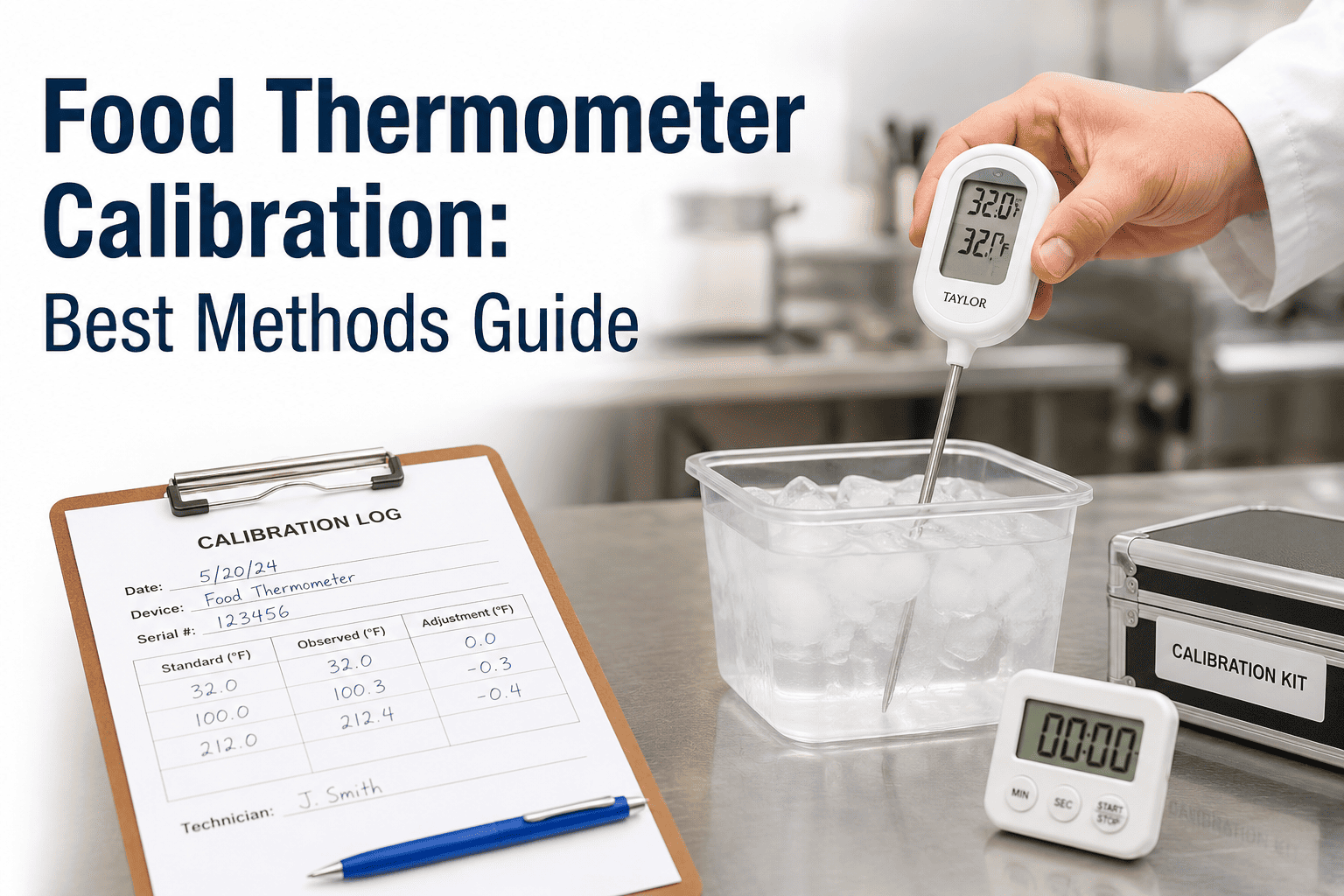
Both infrared and probe thermometers drift over time and need a defined calibration schedule, but the verification method differs. Probe thermometers are typically checked against an ice-point or boiling-point reference, a straightforward physical standard. Infrared thermometers are harder to verify this way since they can't be submerged, so verification usually relies on comparing IR readings against a known-good probe reading on a stable, appropriately-emissive surface, documented at a regular interval alongside the standard probe calibration schedule.