Choosing the right food safety certification in 2026 is one of the most consequential strategic decisions a Quality Director will make — the wrong standard creates audit fatigue, compliance gaps, and retailer friction, while the right one unlocks market access, builds buyer confidence, and drives operational excellence across every production shift. This in-depth comparison of SQF vs BRC vs FSSC 22000 vs IFS gives food safety professionals the structured intelligence they need to match their facility profile to the correct GFSI-benchmarked standard. If you're evaluating which standard fits your current production environment, Book a Demo with the iFactory team to see how analytics-driven compliance management simplifies certification across all four frameworks.
What Are GFSI-Benchmarked Food Safety Standards and Why Do They Matter?
The Global Framework Behind SQF, BRC, FSSC 22000, and IFS
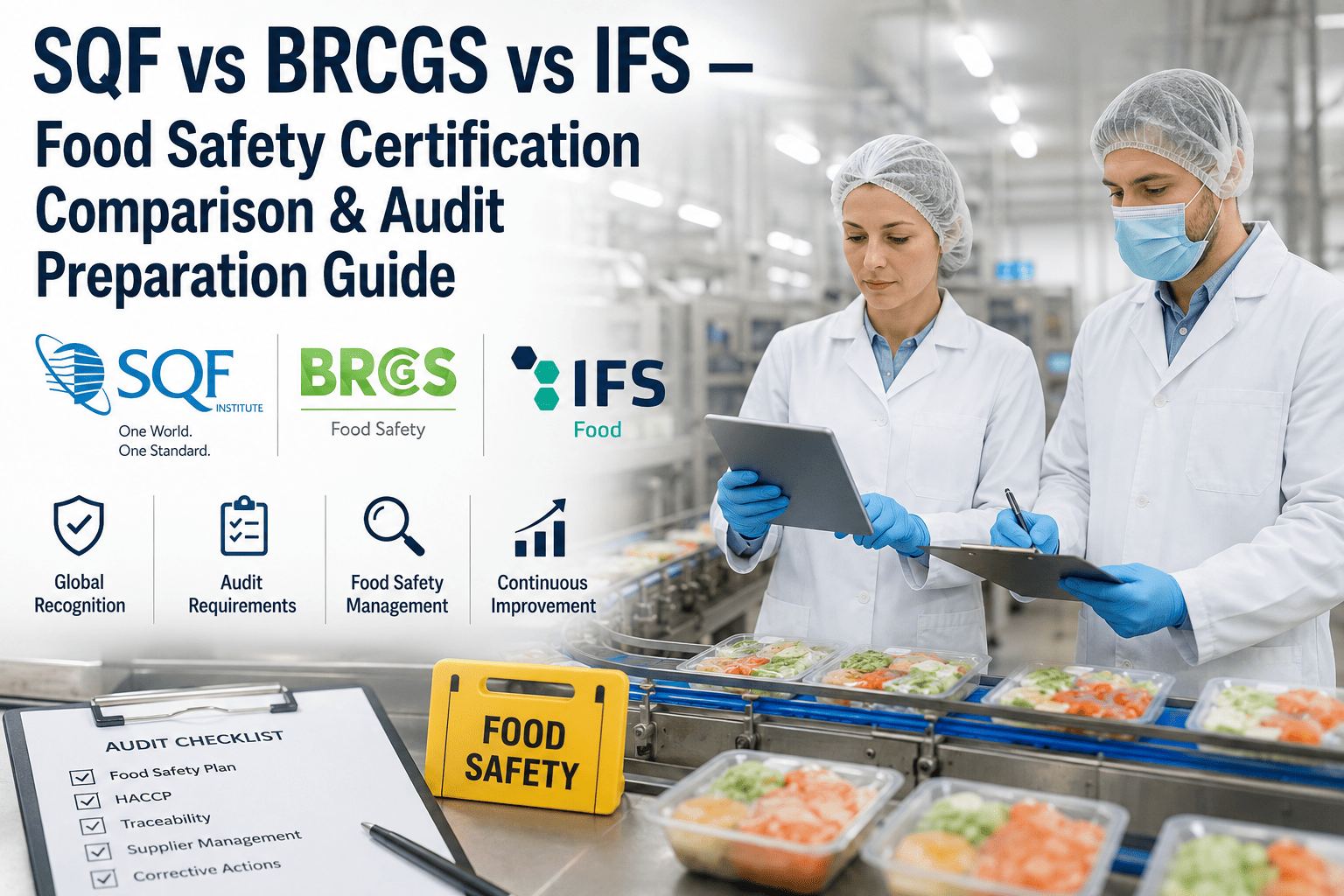
The Global Food Safety Initiative (GFSI) benchmarks third-party food safety schemes against a harmonized set of requirements — when a scheme achieves GFSI recognition, its scope, audit methodology, and technical requirements have been verified as equivalent to the GFSI baseline. SQF, BRCGS, FSSC 22000, and IFS Food are the four most widely deployed GFSI-benchmarked certification schemes globally — and while each achieves GFSI recognition, they differ substantially in structure, audit format, and the market channels where they carry the greatest commercial weight. Understanding those differences affects retailer acceptance, audit cost, certification timeline, and the operational investment required to sustain compliance year over year.
SQF Food Safety Standard: Structure, Scope, and Certification Requirements
Understanding SQF Edition 9 for Food Manufacturing Facilities
The Safe Quality Food (SQF) program, managed by the Food Marketing Institute (FMI), is the dominant food safety certification standard in North American retail supply chains — particularly for facilities supplying Walmart, Costco, and Kroger. SQF Edition 9 operates on three certification levels: Level 1 (Food Safety Fundamentals), Level 2 (HACCP-based food safety plans), and Level 3 (comprehensive food safety and quality management), allowing facilities to scale certification ambition to operational maturity. Audits are conducted annually by SQFI-licensed Certification Bodies, with unannounced audit options available at higher grading levels — and facilities using digital compliance platforms that can Book a Demo consistently report faster audit preparation cycles and fewer corrective action findings.
BRCGS Food Safety Standard: Technical Requirements and Global Market Reach
BRC Global Standard for Food Safety Issue 9 — What Changed and What It Demands
The BRCGS Global Standard for Food Safety Issue 9 is the preferred certification scheme for food manufacturers supplying UK and European grocery chains — including Tesco, Sainsbury's, Marks & Spencer, and Aldi. Its technical requirements are among the most rigorous of any GFSI scheme, with depth in site infrastructure, environmental hygiene zoning, and allergen management. Issue 9 strengthened the food safety culture clause, enhanced food fraud vulnerability assessment requirements, and mandated fully unannounced audits for AA+ grade holders — making continuous compliance monitoring essential for top-tier BRCGS performance rather than seasonal audit preparation alone.
FSSC 22000 Food Safety Certification: ISO Architecture and Scheme-Specific Requirements
How FSSC 22000 Version 6 Builds on ISO 22000 and HACCP Principles
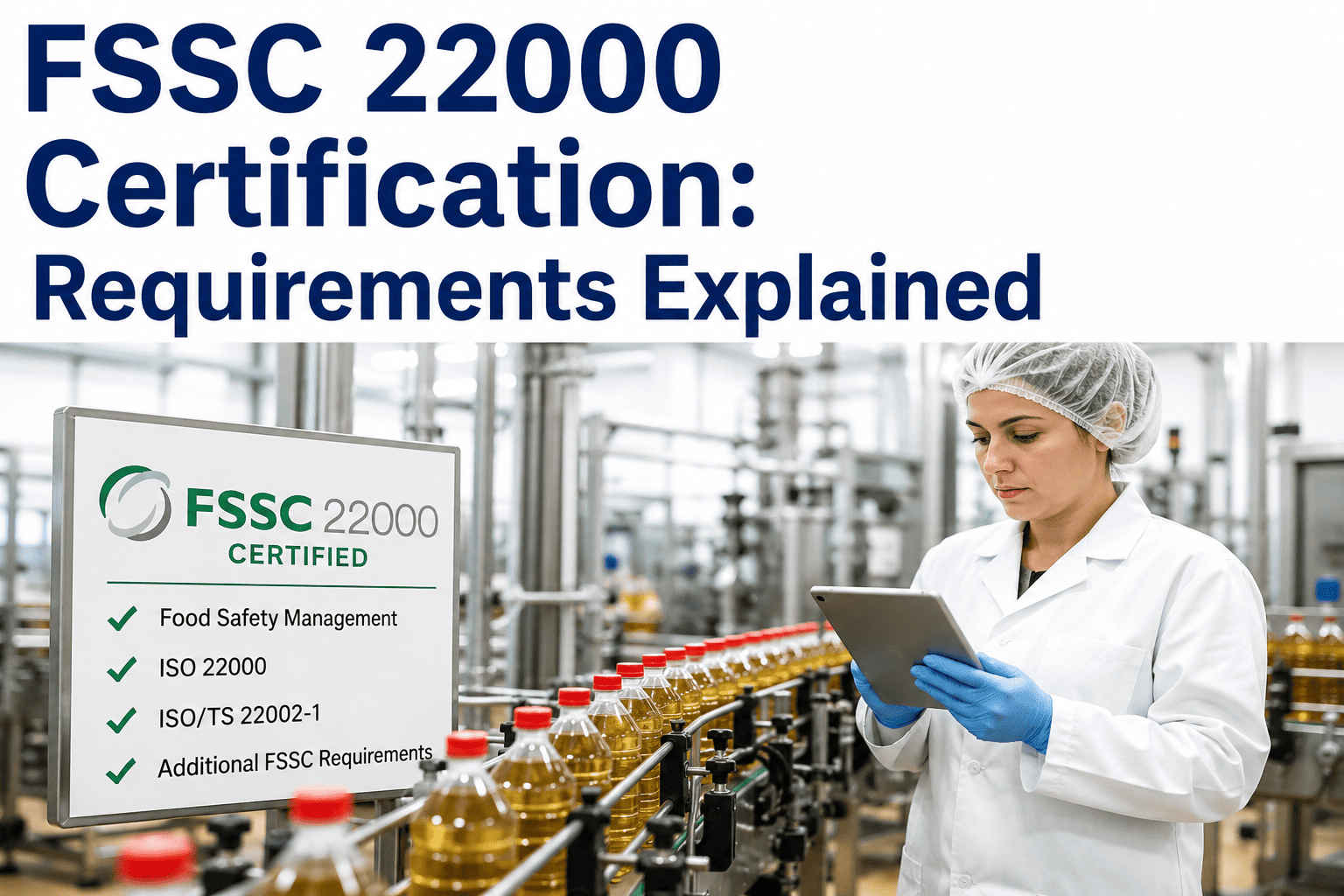
FSSC 22000 is built on ISO 22000 — the international standard for food safety management systems — supplemented by sector-specific Prerequisite Programs from the ISO/TS 22002 series and FSSC's own Additional Requirements. Its ISO foundation gives it particular strength for facilities already operating ISO 9001 systems and for manufacturers targeting international markets where ISO recognition carries commercial weight alongside GFSI certification. Version 6, mandatory from April 2024, introduced a strengthened food safety culture program, supply chain management requirements, environmental monitoring, food fraud mitigation, and a new Food Defense module — and Quality Directors can Book a Demo to see how integrated compliance platforms handle FSSC's multi-layer documentation requirements.
IFS Food Standard: Version 8 Requirements and European Retail Alignment
Understanding IFS Food v8 for Food Processing and Private Label Manufacturers
The IFS Food standard Version 8 is the dominant certification scheme for food processors supplying German, French, Italian, and broader continental European retailers — including REWE, Edeka, Carrefour, and Coop. IFS uses a scored audit approach where each requirement clause is evaluated on a weighted point scale: facilities scoring 75%+ receive IFS Food certification, while those scoring 95%+ earn Higher Level status — a distinction that carries significant commercial weight in European private label tenders. Version 8 increased the scoring weight on food safety culture, added sustainability and food loss requirements, and explicitly acknowledged cloud-based compliance management as valid documentation infrastructure.
SQF vs BRC vs FSSC 22000 vs IFS: Direct Capability Comparison
Choosing the Right GFSI-Benchmarked Standard for Your Food Manufacturing Facility
The table below maps critical structural and operational dimensions across all four major GFSI-benchmarked food safety standards — providing Quality Directors with a side-by-side reference for certification selection, audit preparation planning, and multi-standard compliance strategy.
| Comparison Dimension | SQF (Edition 9) | BRCGS (Issue 9) | FSSC 22000 (v6) | IFS Food (v8) |
|---|---|---|---|---|
| GFSI Recognition | Yes | Yes | Yes | Yes |
| Primary Market Focus | North America | UK / Global Retail | International / ISO | Continental Europe |
| Audit Frequency | Annual | Annual (Unannounced Options) | Annual Surveillance + 3yr Recert | Annual |
| Grading / Scoring System | Excellent / Good / Satisfactory / Fail | AA+ / AA / A / B / C / D | Conform / Not Conform | Higher Level (95%+) / Certified (75%+) |
| Food Safety Culture Requirement | Yes (Edition 9) | Yes (Issue 9 — Strengthened) | Yes (Version 6) | Yes (Version 8) |
| Food Fraud Requirements | VACCP Required | Yes — Enhanced | Yes (Additional Req.) | Yes (v8 Expanded) |
| Environmental Monitoring | Mandatory | Mandatory (Risk Zones) | Mandatory (v6) | Required |
| Unannounced Audit Option | Optional | Mandatory at AA+ | Optional | Optional |
| ISO 22000 Alignment | No | No | Core Foundation | Partial |
| Certification Body Accreditation | SQFI-Licensed CB | BRCGS-Approved CB | IAF-Accredited CB | IFS-Approved CB |
Six Critical Factors for Selecting the Right Food Safety Certification Standard
How Quality Directors Should Evaluate GFSI Scheme Fit for Their Facility
Selecting a food safety certification standard is a market access strategy, an operational investment decision, and a supplier relationship signal all at once. The six factors below represent the decision framework experienced Quality Directors use to match their facility profile to the right GFSI scheme — and avoid pursuing a certification that creates audit overhead without proportional commercial return. Facilities ready to assess their compliance posture against any of these four standards can Book a Demo for a structured gap analysis.
Food Safety Analytics Requirements Across SQF, BRC, FSSC 22000, and IFS
What Data Infrastructure Each GFSI Standard Actually Requires
The analytics and data management requirements embedded in each GFSI-benchmarked standard have expanded substantially with each recent revision — reflecting both GFSI's Benchmarking Requirements evolution and growing retailer expectation that food safety programs generate measurable, trend-auditable performance data rather than static procedure documents. Understanding what each standard requires from a data perspective is essential for Quality Directors building compliance infrastructure that sustains certification grade performance across multiple audit cycles.
Building a Compliance Intelligence Platform for GFSI Certification Success
How Analytics-Driven Food Safety Management Sustains Certification Performance
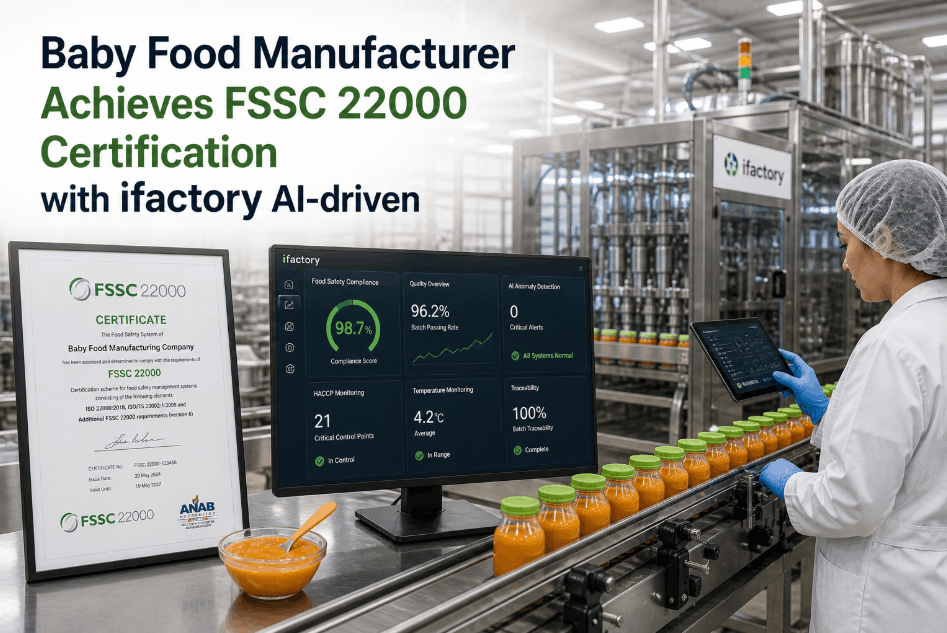
The most significant shift in food safety certification management is the transition from document-based compliance to performance-data-driven compliance — a transition all four major GFSI schemes are explicitly driving through their latest revisions. Facilities managing certification through static SOPs and spreadsheets consistently face two problems: excessive audit-season preparation time and corrective action findings discovered during the audit rather than through internal review. Purpose-built compliance analytics platforms resolve both by creating continuous performance data that mirrors what GFSI auditors expect — making audit readiness a perpetual operational state, not a seasonal exercise. Quality Directors ready to evaluate this capability can Book a Demo for a configuration walkthrough mapped to their current standard portfolio.
Frequently Asked Questions: GFSI Food Safety Standards Comparison
What is the difference between SQF and BRC food safety certifications?
SQF dominates North American retail supply chains with a three-level certification structure, while BRCGS is preferred for UK and European retailers using a graded system (AA through D). Both achieve equivalent GFSI recognition, but commercial acceptance varies significantly by geography and retail customer base.
Is FSSC 22000 harder to obtain than SQF or BRCGS?
FSSC 22000 is not harder — but its ISO 22000 foundation requires a management system approach rather than a prescriptive checklist. Facilities with existing ISO experience typically find Version 6 more familiar than BRCGS Issue 9's infrastructure-focused requirements.
Can a food facility hold multiple GFSI certifications simultaneously?
Yes — many co-manufacturing facilities hold two or more GFSI certifications at once. Common combinations include FSSC 22000 + IFS for European co-packers and BRCGS + SQF for North Atlantic export facilities. An integrated compliance platform significantly reduces shared documentation burden.
Which food safety standard does Walmart require?
Walmart accepts multiple GFSI-benchmarked certifications including SQF, BRCGS, and FSSC 22000. In practice, the vast majority of North American Walmart food suppliers hold SQF — reflecting its strong alignment with FMI retail member requirements.
What is IFS Higher Level certification?
IFS Higher Level is awarded to facilities scoring 95%+ in the scored IFS audit, compared to 75%+ for standard certification. It carries significant commercial weight in European private label tenders and signals elite compliance performance to procurement teams.
How often do GFSI food safety standards get updated?
Each scheme manages its own revision cycle. Recent major updates: BRCGS Issue 9 (February 2023), IFS Food v8 (2023), FSSC 22000 v6 (mandatory from April 2024), and SQF Edition 9 (2021). GFSI's evolving Benchmarking Requirements require all scheme owners to maintain ongoing alignment.
What analytics data do GFSI auditors look for?
Auditors across all four schemes prioritize performance trend data over static documents — including environmental monitoring trends, internal audit closure rates, supplier performance scores, and food safety culture KPIs. Continuous compliance analytics platforms consistently help facilities achieve higher certification grades.