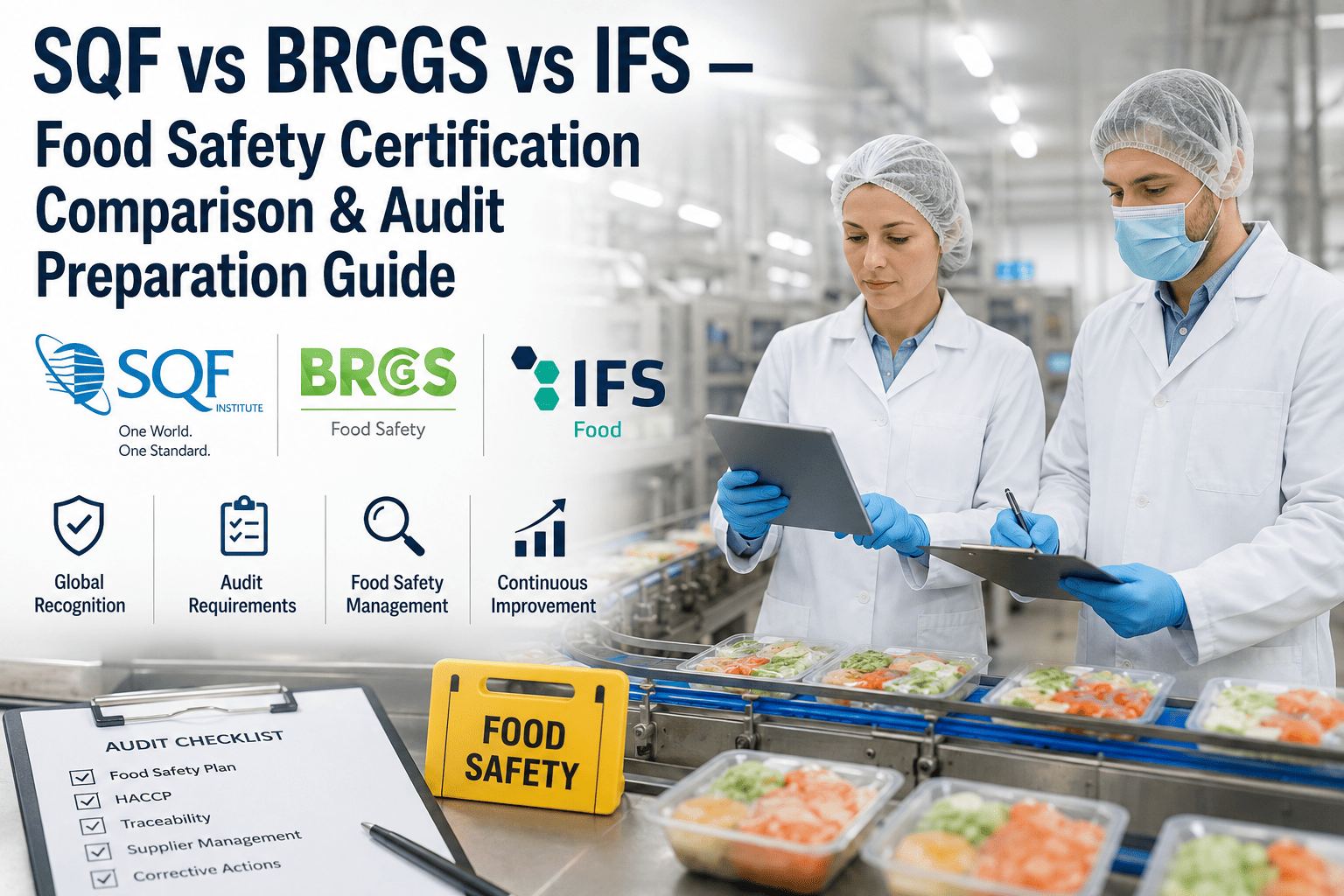
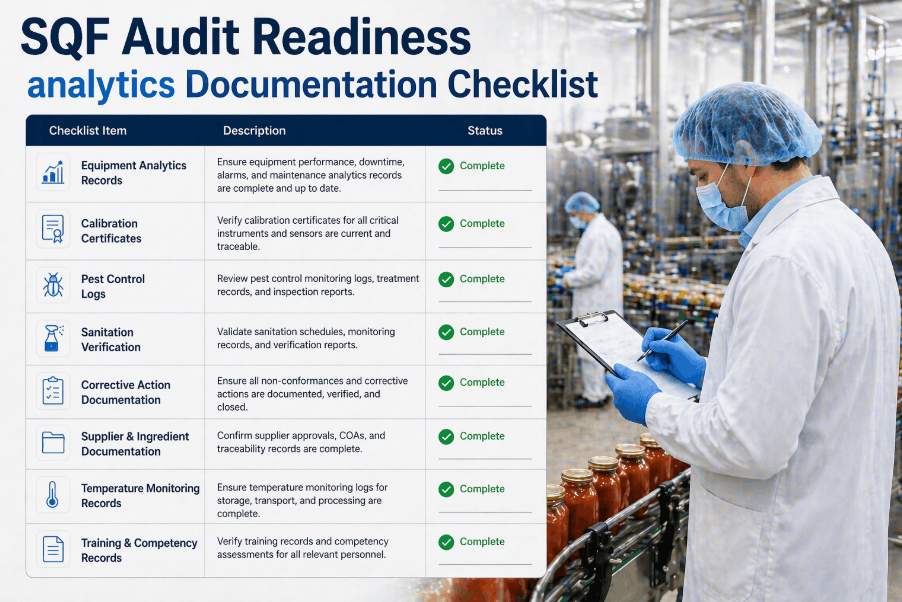
Food safety audits are no longer a once-a-year scramble — they are a continuous compliance requirement that demands real-time documentation, instant data retrieval, and airtight process records. For manufacturers pursuing SQF, BRC, and FSSC 22000 certification, the difference between a clean audit and a costly finding often comes down to one thing: whether your documentation system can keep up with your production floor. AI-driven compliance tracking changes that equation entirely — transforming audit preparation from a weeks-long ordeal into a process that takes hours.
AI-DRIVEN PLATFORM
·
SQF · BRC · FSSC 22000
·
GFSI COMPLIANCE
Automate Your Food Safety Audit Documentation Program
iFactory tracks every CCP monitoring event, calibration record, corrective action, and maintenance interval across your food plant — eliminating manual logs and delivering audit-ready documentation on demand.
Why SQF, BRC, and FSSC 22000 Audits Are Getting Harder to Pass
GFSI-benchmarked schemes like SQF, BRC Global Standards, and FSSC 22000 have raised the bar significantly over the past three audit cycles. Auditors now expect not just records — they expect traceable, timestamped, digitally verifiable evidence of process control. Manual binders, spreadsheet logs, and paper-based HACCP records are increasingly flagged as insufficient, particularly for high-care and high-risk zones. The regulatory pressure is real: a single major nonconformity can delay certification by months and cost a facility its largest retail account.
SQF Edition 9
Requires documented evidence of ongoing food safety system verification, corrective actions, and calibration histories across all critical equipment.
BRC Global Standard Issue 9
Demands real-time monitoring evidence at CCPs, documented maintenance programs, and full traceability from raw material to dispatch.
FSSC 22000 Version 6
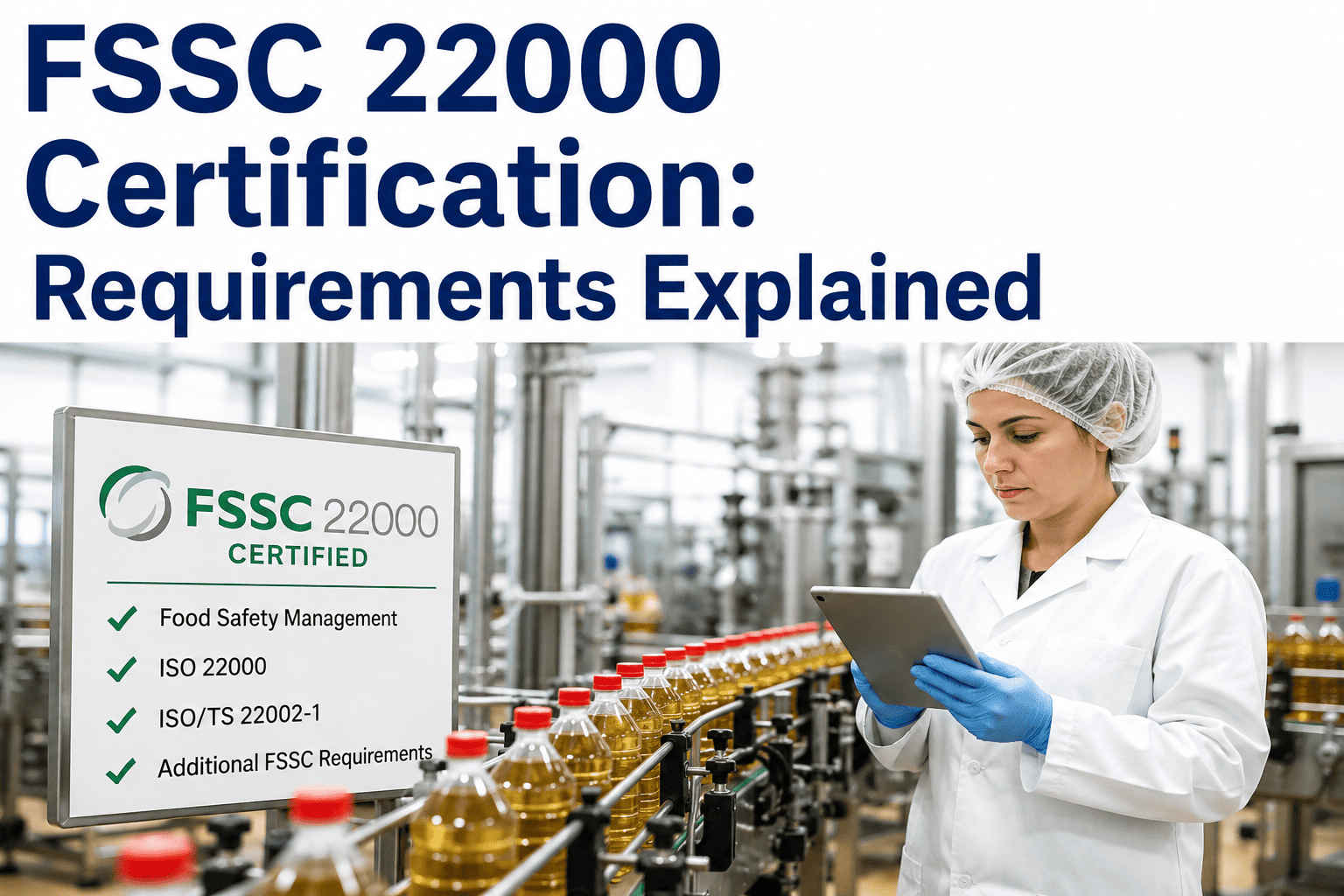
Adds food fraud vulnerability assessments, environmental monitoring programs, and documented food defense plans to the core ISO 22000 requirements.
GFSI Benchmarking
All three schemes now align with GFSI's enhanced focus on food safety culture — meaning auditors assess documentation practices, not just documented outcomes.
The Documentation Challenge
The Hidden Cost of Manual Audit Preparation
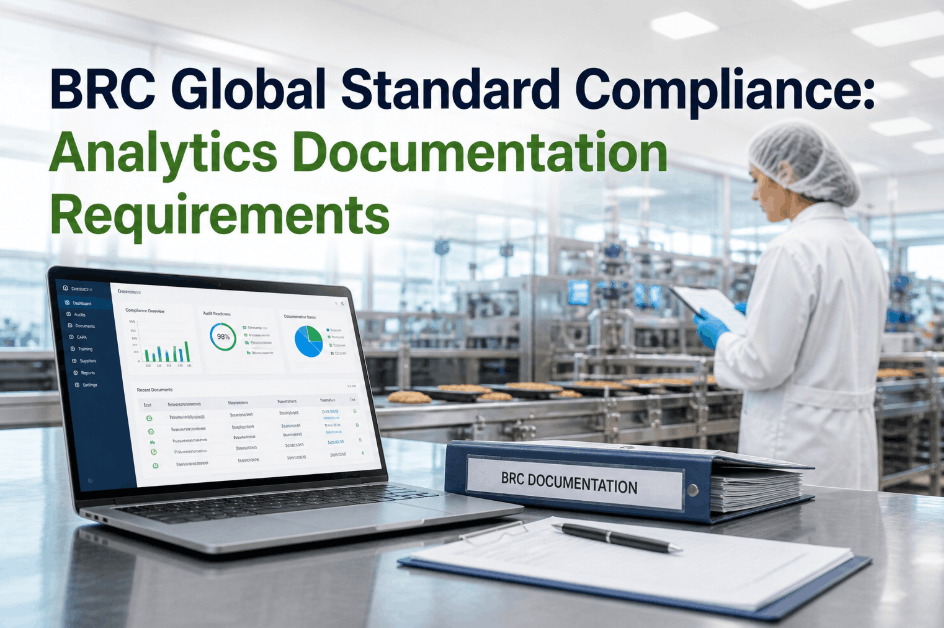
Most food facilities spend 40 to 80 hours preparing for a single SQF or BRC audit — pulling maintenance records, compiling calibration logs, assembling CCP monitoring sheets, and organizing corrective action reports. This labor is invisible on the P&L but carries massive opportunity cost: every hour spent on audit prep is an hour not spent on production optimization, training, or continuous improvement. Worse, manually assembled documentation is fragile. One missing temperature log or an undocumented corrective action can flip a minor nonconformity into a major finding.
AI-driven compliance tracking eliminates this fragility by capturing and storing every relevant data point automatically — from the moment a sensor reading is taken to the moment a corrective action is closed. Book a Demo to see how automated documentation reduces your audit prep time by up to 95%.
How AI-Driven Works
How AI-Driven Compliance Tracking Makes You GFSI Audit-Ready
iFactory's AI-driven compliance module is built around one principle: every action on the production floor should generate audit-ready documentation without requiring manual data entry. Here is how each component maps directly to GFSI audit requirements.
01
Automated CCP Monitoring Records
IoT sensors continuously monitor critical control points — pasteurizer temperatures, metal detector function checks, freezer zone integrity — and log every reading with a timestamp. When an auditor requests proof that your pasteurizer maintained the required temperature for a specific production run six months ago, the system generates the complete record in seconds.
02
Calibration History and Equipment Verification
SQF and BRC auditors consistently flag calibration record gaps as major nonconformities. iFactory tracks calibration schedules, sends automated reminders, logs completed calibrations with technician sign-off, and maintains the full calibration history for every instrument — all searchable and exportable in audit-ready format.
03
Corrective Action Tracking and Closure
Every deviation from a monitoring limit automatically triggers a corrective action workflow — assigning responsibility, setting deadlines, and capturing the root cause analysis and resolution. FSSC 22000 and BRC require documented evidence that corrective actions were completed and verified effective. iFactory provides that evidence automatically.
04
Preventive Maintenance Documentation
AI-generated work orders include full documentation: fault description, parts used, technician actions, and closure timestamp. This creates the preventive maintenance evidence trail that SQF Edition 9 and BRC Issue 9 auditors specifically examine when assessing equipment reliability and food safety risk control.
05
Environmental Monitoring Program Records
FSSC 22000 Version 6 and BRC Issue 9 place heavy emphasis on environmental monitoring — particularly for Listeria and allergen contamination risk. iFactory logs all environmental sampling events, results, and response actions, building the documented program evidence that auditors require for high-care and high-risk production environments.
Audit Preparation: Manual vs. AI-Driven Documentation
Documented outcomes from food facilities that transitioned from manual compliance records to iFactory's AI-driven compliance tracking platform.
GFSI Audit Readiness Comparison
Scheme-Specific Coverage
SQF, BRC, and FSSC 22000: What iFactory Documents for Each Scheme
Each GFSI scheme has distinct documentation requirements. iFactory's compliance tracking layer is mapped to the specific clauses that auditors examine most closely — so your facility is not just generally organized, but specifically prepared for the scheme you are being audited against. Book a Demo to see scheme-specific compliance coverage in action.
- SQF Element 2.4: Food Safety Plan (HACCP) — CCP monitoring records and verification activities
- SQF Element 11: Maintenance and Calibration — PM schedules, work order history, calibration logs
- SQF Element 2.5.2: Corrective and Preventive Action — documented CAR records with root cause and closure
- SQF Element 5.2: Environmental Monitoring — sampling events, results, trend analysis
Typical SQF audit prep time: reduced from 3 weeks to 4 hours
- BRC Clause 2: HACCP Food Safety Plan — CCP records, monitoring frequency, deviation responses
- BRC Clause 6.1: Equipment Maintenance — PM evidence, breakdown history, emergency repair records
- BRC Clause 6.2: Calibration — instrument registers, calibration certificates, out-of-tolerance events
- BRC Clause 3.9: Corrective Action — nonconformity records from detection through closure
BRC major nonconformities related to documentation: reduced to zero
- ISO 22000 Clause 8.5: HACCP Operational PRPs — documented monitoring and verification
- FSSC Additional Requirement 2.5.5: Environmental Monitoring Program — full documented program
- ISO 22000 Clause 8.9: Nonconformity — corrective action records with effectiveness verification
- FSSC Additional Requirement 2.5.3: Preventive Maintenance — scheduled and completed PM evidence
FSSC Version 6 additional requirements: fully covered by automated documentation
Real-World Outcome
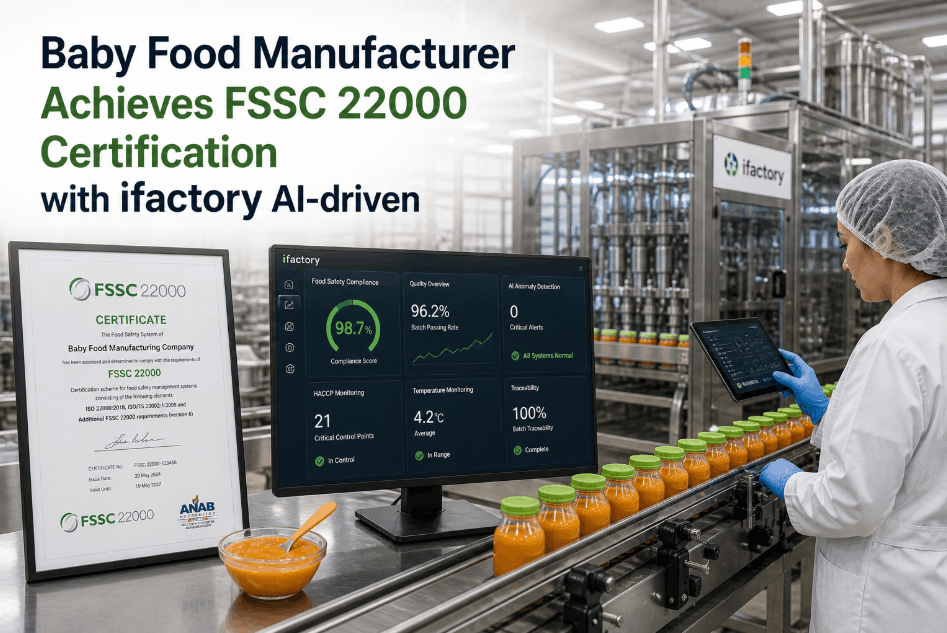
A frozen foods facility running SQF certification reduced their pre-audit documentation sprint from three weeks of intensive manual work to a four-hour automated report generation process. Their last SQF audit produced zero major nonconformities — down from three in the previous cycle. The auditor specifically noted the quality of their maintenance and calibration records as a program strength. Every record the auditor requested was retrieved and presented within minutes.
Continuous Compliance
From Annual Audit Prep to Continuous GFSI Compliance
The most significant shift that AI-driven compliance tracking enables is moving from an audit-reactive posture to a continuously audit-ready posture. Instead of scrambling to assemble documentation every time a certification audit approaches, your facility maintains a complete, up-to-date compliance record every single day.
This means internal audits become faster and more valuable. Supplier audits from retail customers produce less anxiety. And when your GFSI certification body announces an unannounced audit — which BRC, SQF, and FSSC 22000 all permit — your team responds with confidence rather than panic. Book a Demo to see how continuous compliance monitoring works across SQF, BRC, and FSSC 22000 requirements.
1
Connect Critical Monitoring Equipment
Deploy IoT sensors on CCPs, calibration-managed instruments, and maintenance-critical assets. Sensor installation requires no production interruption and takes hours, not weeks.
Outcome: Real-time HACCP monitoring from day one
2
Configure Scheme-Specific Documentation Rules
Map your HACCP plan, CCP limits, calibration schedules, and PM programs into iFactory. The system automatically captures evidence against each configured requirement.
Outcome: Automated compliance records aligned to your certification scheme
3
Activate Corrective Action Workflows
Configure deviation thresholds that automatically trigger corrective action workflows. Each event is documented from detection through root cause to closure — exactly what GFSI auditors examine.
Outcome: Complete corrective action audit trail, automatically maintained
4
Generate Audit Reports on Demand
When an audit is announced — scheduled or unannounced — generate comprehensive compliance reports covering any date range in minutes. Present auditors with structured, timestamped documentation that exceeds scheme requirements.
Outcome: Audit prep time reduced from weeks to hours
Frequently Asked Questions: AI-Driven GFSI Audit Preparation
Does iFactory cover all three GFSI schemes — SQF, BRC, and FSSC 22000?
Yes. iFactory's compliance tracking module is mapped to the documentation requirements of SQF Edition 9, BRC Global Standard Issue 9, and FSSC 22000 Version 6. The system captures the specific evidence — CCP records, calibration histories, corrective actions, environmental monitoring — that each scheme requires.
How quickly can we generate audit documentation when an audit is announced?
Most food facilities using iFactory generate complete audit documentation packages in 2–4 hours. The system stores all records continuously, so report generation is a retrieval and formatting exercise — not a data collection effort. Unannounced audits produce no additional stress because your documentation is always current.
Will our GFSI auditor accept digitally generated compliance records?
Yes. SQF, BRC, and FSSC 22000 all explicitly accept electronic records and digital documentation systems. Auditors increasingly prefer digital records because they are timestamped, searchable, and tamper-evident — qualities that paper-based systems cannot reliably provide.
How does iFactory handle corrective action documentation for GFSI audits?
Every corrective action event is automatically documented from initial detection through root cause analysis to verified closure. The system captures who identified the issue, what corrective action was taken, when it was completed, and what verification was performed — the complete evidence chain that SQF, BRC, and FSSC 22000 auditors examine.
Can iFactory support facilities pursuing multiple GFSI certifications simultaneously?
Yes. Many food manufacturers hold both SQF and BRC certifications, or are transitioning between schemes. iFactory's documentation layer captures evidence that satisfies multiple scheme requirements simultaneously, eliminating duplicate record-keeping and reducing compliance overhead across all certifications.
How long before we see measurable improvement in audit readiness?
Most facilities achieve a fully audit-ready documentation posture within 30–45 days of connecting their first monitoring assets. By the time the next audit cycle arrives, your compliance records are complete, organized, and retrievable in minutes — regardless of when the audit is announced.
Transform Your Audit Readiness This Quarter
iFactory — AI-Driven Compliance for SQF, BRC, and FSSC 22000 Certification
Stop spending weeks preparing for audits that should take hours. iFactory's AI-driven compliance tracking platform automatically generates the CCP monitoring records, calibration histories, corrective action trails, and environmental monitoring documentation that GFSI auditors require — continuously, without manual data entry.
Automated CCP monitoring records for SQF, BRC, and FSSC 22000
Complete calibration history tracking with auto-scheduled reminders
Corrective action workflows documented from detection to verified closure
Environmental monitoring program records for high-care environments
Preventive maintenance documentation mapped to GFSI audit clauses
Instant audit report generation covering any date range in minutes