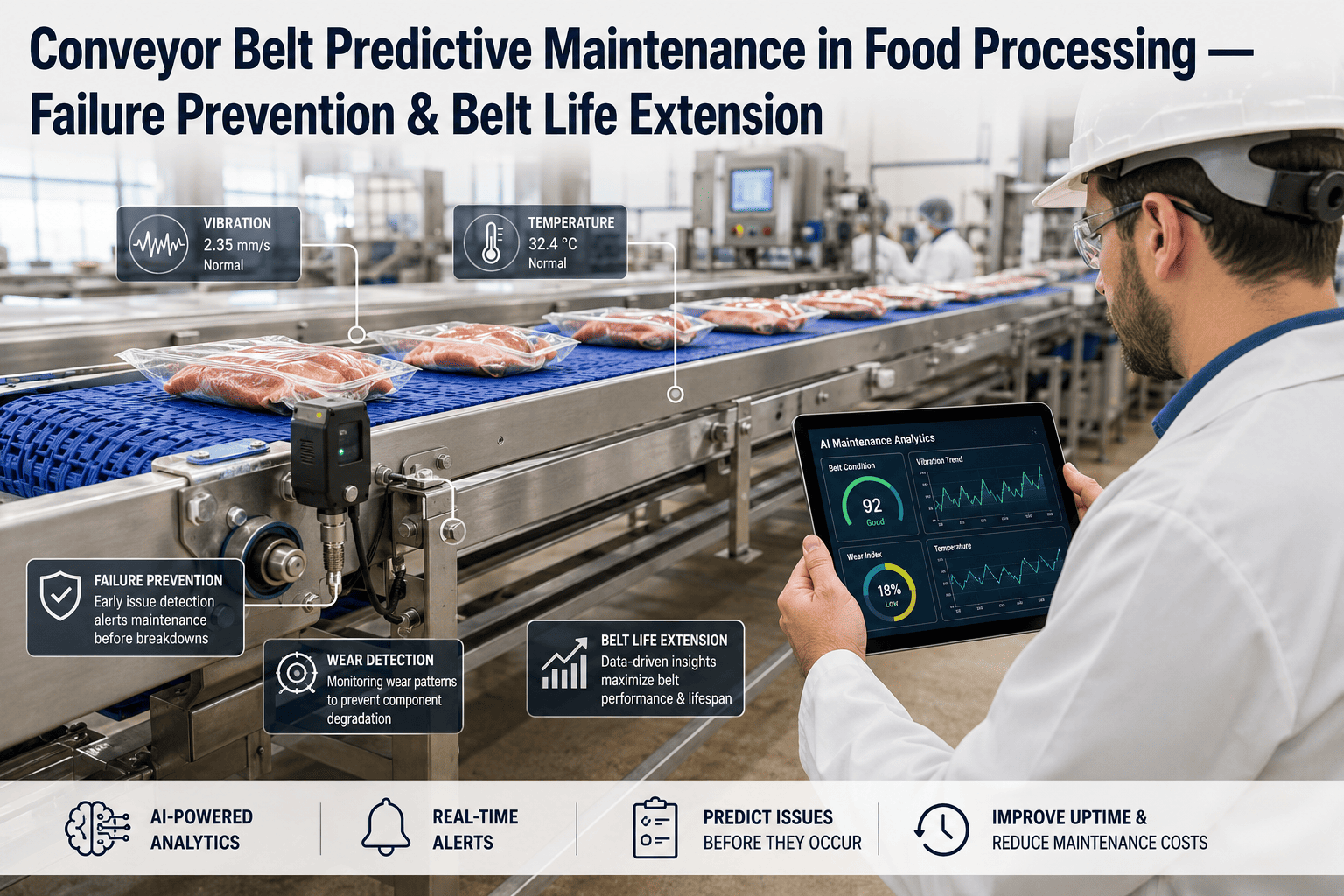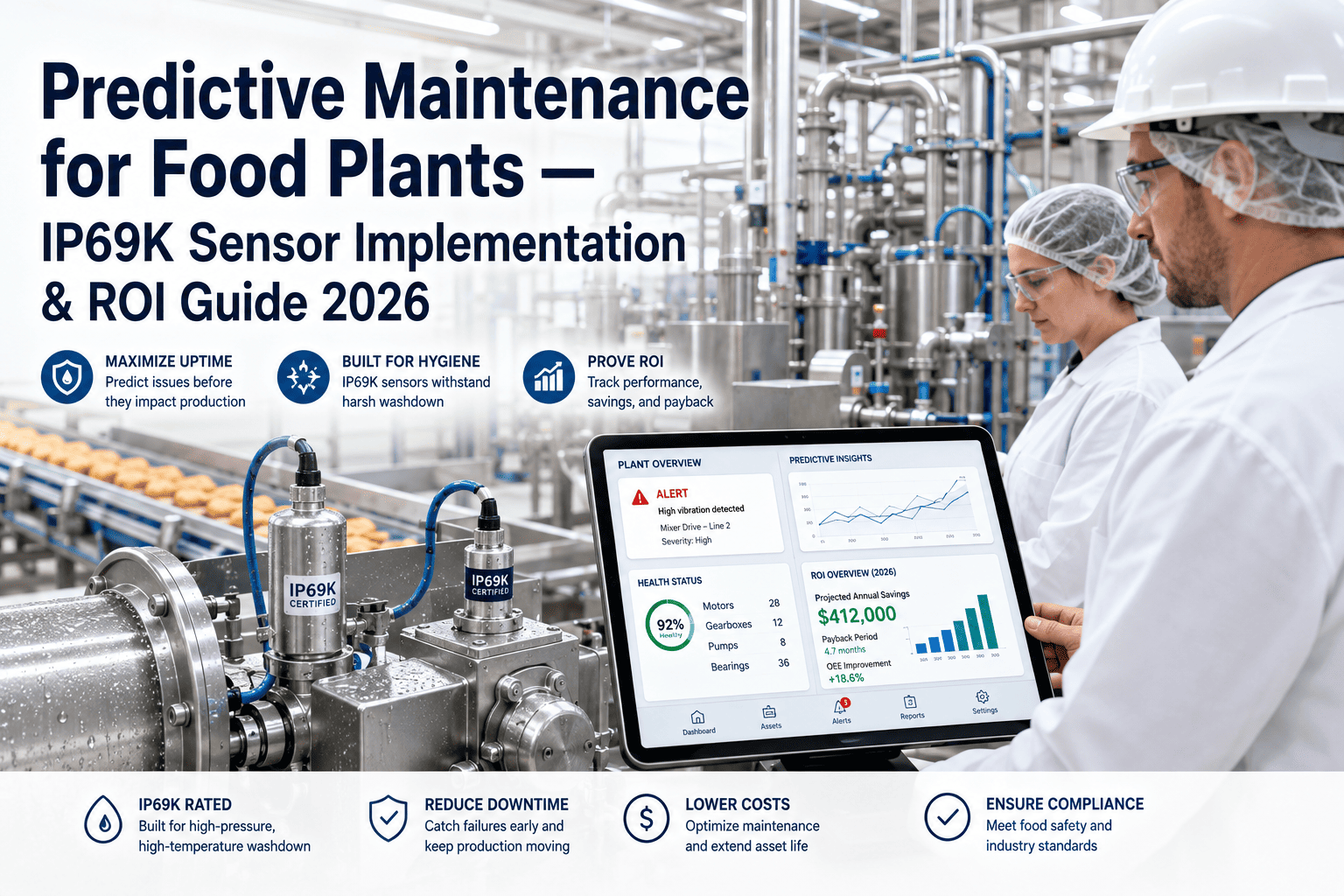
Motors, pumps, mixers, and conveyors don't fail without warning — bearings roughen, shafts drift out of alignment, and impellers start cavitating weeks before a breakdown actually happens. Vibration sensors catch that early signal, but food plants add a layer of difficulty that a typical factory doesn't face: every sensor on that equipment has to survive daily washdown and CIP cycles without corroding, harboring bacteria, or flooding the maintenance team with false alarms every time the cleaning shift starts. Done right, vibration monitoring becomes one of the highest-return additions to a food plant's maintenance program, and iFactory Support can help you scope it for your specific assets.
IoT Vibration Sensors for Food Equipment
Deploy vibration monitoring on motors, pumps, mixers, and conveyors with food-safe mounting, wireless data transmission, and alarm logic that survives daily CIP cycles.
What Vibration Data Actually Reveals
A single vibration sensor produces a signature that changes shape long before a failure is audible or visible. Reading that signature correctly means knowing what each pattern typically points to.
Bearing Wear
High-frequency spikes that grow in amplitude over days or weeks, usually the earliest and most common failure mode caught by vibration monitoring.
Misalignment
Elevated vibration at specific harmonics of running speed, often introduced after a maintenance repair or belt change that wasn't fully squared.
Imbalance
A dominant signal at exactly the rotational speed, common on mixers and fans where product buildup shifts the rotating mass over time.
Cavitation
Erratic, broadband noise on pumps that signals air entrainment or a suction-side restriction, often before any pressure drop is visible on a gauge.
Where Sensors Go on Common Equipment
| Asset | Primary Mount Point | What to Watch |
|---|---|---|
| Motors | Drive-end and non-drive-end bearing housing | Bearing wear, imbalance, overheating trends |
| Pumps | Bearing housing near the impeller shaft | Cavitation, seal wear, misalignment |
| Mixers | Gearbox housing and drive shaft bearing | Product-buildup imbalance, gear wear |
| Conveyors | Drive roller and idler bearing points | Belt tracking issues, bearing seizure risk |
The Hygienic Reliability Loop
Vibration monitoring in a washdown zone requires more than a rugged sensor — it requires a workflow that accounts for the chaos of a CIP cycle without losing real fault signals underneath it.
Turn vibration data into scheduled repairs, not surprise breakdowns
iFactory connects washdown-rated vibration sensors to AI models that separate a real bearing fault from CIP-cycle noise, so your team only gets alerted when it matters.
Frequently Asked Questions
Is an IP69K rating enough to trust a vibration sensor in a washdown zone?
IP69K is the baseline, not the full solution. It confirms the housing resists high-pressure, high-temperature water intrusion, but it says nothing about how the mounting hardware avoids bacterial harborage or how the accompanying software handles the noise generated during cleaning. A complete deployment needs hygienic design on the hardware side and CIP-aware alarm logic on the software side working together.
How do I stop CIP cycles from triggering false vibration alarms?
The most reliable approach ties the alarm software to the line's PLC state, so when the controller reports the machine is in CIP mode, vibration alarms are automatically suppressed or thresholds are adjusted for the duration of the cycle. Without this integration, sanitation shifts generate repeated critical alarms, and after a few nights of that maintenance teams predictably start ignoring the notifications entirely — right when a real fault could go unnoticed.
Which equipment should get vibration sensors first?
Start with assets that have the highest history of unplanned downtime or the highest cost of a failure — critical pumps on cold-chain lines, gearboxes on high-throughput mixers, and motors on single points of failure with no backup. Expanding sensor coverage gradually from there lets the maintenance team validate accuracy and build trust in the alerts before scaling plant-wide. iFactory Support can help prioritize this list against your maintenance records.
Do vibration sensors replace manual route-based inspections entirely?
In 2026, the industry is steadily moving away from manual, route-based data collection toward continuous wireless monitoring, since a technician walking the floor once a week can easily miss a fault developing between visits. Continuous monitoring doesn't eliminate the value of periodic hands-on inspection, but it does catch developing issues in the gaps between rounds, which is where most surprise failures originate.
What's the practical benefit over just waiting for a breakdown?
Early detection gives the maintenance team a repair window measured in weeks rather than minutes, meaning a bearing replacement can be scheduled for the next planned sanitation window instead of forcing an emergency shutdown mid-shift. This protects both Overall Equipment Effectiveness and food safety compliance, since unplanned stops mid-production carry their own contamination and rework risk. Book a demo to see a sized estimate for your specific lines.
Catch bearing failures weeks before they become downtime
iFactory deploys washdown-rated vibration sensors with CIP-aware software, so your maintenance team gets early warnings they can actually trust.