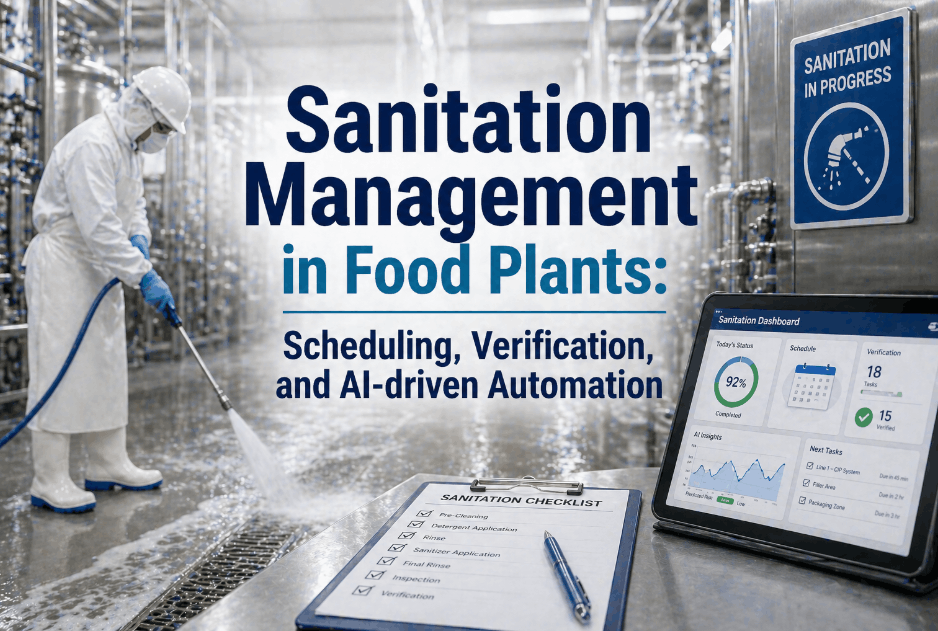
The master sanitation schedule is the document that SQF auditors reach for first, the document that FDA inspectors check against the production floor reality, and the document that most food plants quietly admit has not been updated since the last audit. It is supposed to be a living, facility-wide plan that lists every periodic cleaning task — equipment teardowns, overhead structure cleans, drain maintenance, wall and ceiling sanitation, ductwork service — with a defined frequency, a responsible person, a written procedure, and a verification method. In practice, it is often a spreadsheet taped to a supervisor's office wall with tasks checked off in batches the week before the auditor arrives. The gap between what the schedule says and what actually happens on the floor is where audit findings originate, where cross-contamination risk accumulates, and where the next recall begins. iFactory digitizes the master sanitation schedule so that every task is assigned, tracked, verified, and documented in real time — eliminating the paper-based compliance theater that auditors have learned to identify and that regulators increasingly refuse to accept. Build your digital MSS on production data that auditors can verify with a Book a Demo.
If the Schedule Is Not Running the Cleaning, the Cleaning Is Not Happening
iFactory replaces static spreadsheets and paper checklists with a digital master sanitation schedule that assigns tasks automatically, captures completion evidence in real time, flags overdue items before they become audit findings, and generates the verification records that FSMA, SQF, BRCGS, and FSSC 22000 all require.
The Master Sanitation Schedule Covers Everything the SSOPs Do Not
Food plants operate two parallel sanitation systems that work together but serve fundamentally different purposes, and confusing the two — or failing to maintain one because the other exists — is among the most common sanitation program deficiencies that auditors identify. Sanitation Standard Operating Procedures govern the routine, high-frequency cleaning that happens every shift — rinsing fillers, wiping sealing bars, sanitizing cutting surfaces, performing line clears between product changeovers. These tasks are triggered by production activity and documented in daily sanitation logs that the pre-operational inspection verifies before each production start. The master sanitation schedule covers everything else — the deeper, less frequent cleaning of equipment internals, non-contact surfaces, infrastructure, overhead structures, drains, walls, ductwork, and facility areas that would be forgotten entirely if a calendar did not tell someone to do them. The test is simple and auditors apply it routinely: if a task happens automatically because the line ran, it belongs in an SSOP. If it only happens because a schedule told someone to do it, it belongs in the MSS. Both must exist. Both must be documented. Both must be verified. And both must be current.
SSOPs (Daily Sanitation)
Every shift or per changeover
Product-contact surfaces, line clears, equipment rinse-downs, sanitizer application, pre-operational inspection. Triggered by production activity. Documented in shift sanitation logs.
MSS (Periodic Sanitation)
Weekly through annual
Equipment teardowns, non-contact surface deep cleans, overhead structures, walls, ceilings, drains, ductwork, exterior grounds, storage areas, utility systems. Triggered by calendar schedule. Documented in MSS completion records with verification.
Five Frequency Tiers — Assigned by Risk, Not by Habit
Cleaning frequency must be risk-based, not habit-based. A frequency listed as "as needed" is not acceptable under any major food safety standard — SQF, BRCGS, FSSC 22000, and FSMA all require that frequencies be documented, justified, and verifiable. The risk assessment that drives frequency assignment considers how directly the surface or area can contaminate product (Zone 1 through Zone 4 proximity classification), how quickly soil or microbial growth accumulates in that location under normal operating conditions, how difficult the surface is to access during routine daily cleaning operations, and the pathogen risk profile of the products manufactured in the facility. Areas that are closer to the product, accumulate soil faster, harbor higher-risk organisms, and are harder to reach during daily cleaning require more frequent MSS attention — not less. The frequency tiers below represent the standard framework used across food manufacturing facilities, with specific task assignments determined by each facility's unique risk assessment.
Daily / Per-Shift
Zone 1 — Product ContactConveyor belts, filler heads, slicers, mixers (product-contact parts), cutting boards, utensils, weighing equipment, packaging machine contact surfaces. Covered by SSOPs but included in the MSS overview for completeness and pre-operational verification scheduling.
Verification: Pre-operational inspection every shift. ATP swabs on product-contact surfaces per validated sampling plan. Visual inspection under adequate lighting before production start.
Weekly
Zone 2 — Adjacent SurfacesNon-contact equipment surfaces (machine frames, guards, housings), conveyor structure and supports, equipment legs and bases, shelving in production areas, Zone 2 environmental monitoring sites, floor drains in production areas, hand wash stations.
Verification: Visual inspection post-cleaning by supervisor. Environmental monitoring swabs per sampling plan. Documented sign-off on MSS completion log with date, person, and verification result.
Monthly
Zone 3 — Near EnvironmentWalls and wall-floor junctions in production areas, framework and structural members, equipment interiors accessible only through teardown, floor coving and sealant joints, lighting fixture exteriors, doorframes and door seals, forklift and pallet jack cleaning, maintenance tool storage areas.
Verification: Post-cleaning inspection with documented condition assessment. Photographic evidence for hard-to-inspect areas. Environmental swabs at validated sites to confirm cleaning effectiveness.
Quarterly
Zone 4 — Far EnvironmentOverhead structures, HVAC ductwork and diffusers, high-bay areas above production lines, ceiling panels, roof drains, exterior pest exclusion points, warehouse racking deep clean, cold storage evaporator coils and condensate pans, compressed air system filters.
Verification: Vendor service reports for contracted tasks (HVAC, compressed air). Internal inspection with photographic documentation for overhead areas. Pest control company reports for exclusion points.
Annual
Full FacilityComplete facility teardown cleaning of all equipment to bare metal where possible. Painting and surface restoration of walls, ceilings, and floors. Comprehensive infrastructure audit including roof condition, exterior drainage, loading dock seals, and perimeter fencing. Fire suppression system service. Exhaust hood and ductwork cleaning to bare metal per NFPA 96 requirements.
Verification: Management walk-through with documented deficiency list. Contractor service certificates for vendor-performed tasks. Before-and-after photographic records for infrastructure restoration items.
Every Missed Task Is an Audit Finding Waiting to Happen. iFactory Makes Sure Nothing Falls Through.
Automatic task assignment, real-time completion tracking, overdue alerts, and verification records that are generated as the work happens — not compiled the week before the auditor arrives.
Six Steps to Build a Master Sanitation Schedule That Survives an Audit
A master sanitation schedule that fails an audit almost always fails for the same reason: it was built as a compliance document designed to satisfy an auditor rather than as an operational tool designed to drive actual cleaning activity on the production floor. The schedule must be realistic about available labor hours and crew size, compatible with the production calendar and planned downtime windows, and structured so that the people performing the tasks can follow it without interpretation, improvisation, or reliance on tribal knowledge about how things are really done. Building the MSS as an operational tool rather than an audit artifact produces a system that survives between audits — because it is actually being used every week, not pulled out of a drawer and updated every twelve months.
Inventory Every Surface, Area, and Equipment Item
Walk the entire facility — production floor, warehouse, receiving, shipping, exterior grounds, locker rooms, maintenance shop — and list every surface, structure, and piece of equipment that requires periodic cleaning. Include overhead structures, drains, ductwork, and storage areas that daily SSOPs do not cover. Miss nothing. An item that is not on the schedule does not get cleaned, and an auditor who finds an uncleaned surface not listed on the MSS has a ready-made nonconformance.
Assign Risk-Based Frequency to Each Item
Classify each item into a frequency tier based on its risk profile: proximity to product, speed of soil accumulation, type of soil (allergen, pathogen, organic residue), and accessibility during routine cleaning. Zone 1 surfaces are daily. Zone 2 surfaces are weekly. Zone 3 and Zone 4 items are monthly through annual. Document the justification for each frequency assignment — auditors may ask why a particular item is cleaned quarterly rather than monthly, and the answer must be based on risk assessment, not convenience.
Write or Reference the Cleaning Procedure for Each Task
Every task on the MSS must have a corresponding written procedure that specifies the cleaning agent, concentration, contact time, rinse requirements, equipment or tools needed, and the sequence of steps. For equipment teardown tasks, the procedure must include disassembly instructions, parts that require soaking or special handling, and reassembly verification steps. The procedure can be a separate SSOP document referenced by number on the MSS, or embedded directly into the schedule for simple tasks.
Assign Responsible Person or Role to Each Task
Every task needs a named person or role responsible for performing it and a named person or role responsible for verifying completion. Avoid assigning tasks to departments — assign them to specific job titles or named individuals. If a task requires a contractor (HVAC ductwork cleaning, fire suppression service), the contractor is the responsible party and the verification responsibility stays internal. The schedule must account for shift coverage, weekends, holidays, and vacation periods.
Define Verification Method for Each Task
Completion without verification is not compliance. Each task must specify how cleaning effectiveness is confirmed: visual inspection, ATP swab testing, environmental monitoring swab, allergen swab, photographic documentation, or a combination. The verification method should be proportional to the risk — Zone 1 product-contact surfaces require ATP verification, while quarterly warehouse racking cleans may require only documented visual inspection with photographic evidence.
Calendar the Tasks Against Production and Available Labor
Spread the MSS tasks across the production calendar so that no single week is overloaded and no month has empty gaps. Weekly tasks should be assigned to specific days. Monthly tasks should be distributed across four weeks. Quarterly and annual tasks should be scheduled during planned downtime windows or low-production periods. The schedule must be realistic about available labor hours — a common MSS failure is scheduling more cleaning hours in a week than the sanitation crew can physically perform, which guarantees that tasks are skipped and records are either incomplete or fabricated.
What a Properly Structured MSS Entry Looks Like
The table below shows how individual MSS entries should be structured — each task identified by area, equipment, and surface, with frequency, procedure reference, responsible person, verification method, and completion documentation requirements specified in separate columns. This level of detail is what auditors expect to see when they review the MSS, and it is what distinguishes a functional operational schedule from a vague cleaning checklist. Every entry should be specific enough that a new employee or a temporary sanitation worker could read the entry and understand exactly what needs to be cleaned, how often, following which procedure, and how completion will be confirmed. iFactory generates this structure automatically from your facility configuration and populates it with task assignments, scheduling, and verification workflows that run continuously rather than being compiled retrospectively before an audit event.
| Area / Equipment | Task | Frequency | Procedure | Responsible | Verification |
|---|---|---|---|---|---|
| Production floor drains | Disassemble, scrub, sanitize, reassemble | Weekly | SSOP-012 | Sanitation Lead — Shift A | Visual + environmental swab |
| Mixer #3 interior (non-contact) | Full teardown, degrease, sanitize housing | Monthly | SSOP-027 | Sanitation Crew + Maintenance | Visual + ATP swab on reassembly |
| Overhead structure — Line 2 | Wipe/vacuum dust, inspect for condensation | Quarterly | SSOP-041 | Sanitation Supervisor | Photo documentation + sign-off |
| HVAC ductwork and diffusers | Professional duct cleaning service | Annual | Vendor SOW | HVAC Contractor | Service certificate + internal inspection |
| Warehouse racking — Zone B | Full wipe-down, debris removal, inspection | Quarterly | SSOP-038 | Warehouse Sanitation Lead | Visual inspection + condition report |
Our MSS was a 14-page spreadsheet that nobody updated between audits. Every recertification, the sanitation team spent three weeks backfilling records and deep-cleaning areas that should have been maintained all year. After switching to iFactory's digital MSS, tasks auto-assign on their scheduled date, completion requires a timestamped photo and the responsible person's verification, and overdue items trigger alerts to the sanitation supervisor and the SQF practitioner simultaneously. Our last SQF audit had zero sanitation-related findings for the first time in four years of certification — and the auditor specifically noted that the MSS records were the most complete and consistent she had reviewed at any facility that year.
Frequently Asked Questions
Q: What is the difference between a master sanitation schedule and daily sanitation standard operating procedures?
Daily SSOPs cover the high-frequency, product-contact cleaning that happens every shift or between product changeovers — rinsing fillers, sanitizing cutting surfaces, wiping conveyor belts, performing line clears. The master sanitation schedule covers everything that is not triggered by daily production activity: weekly equipment deep cleans, monthly wall and drain sanitation, quarterly overhead and ductwork cleaning, and annual facility teardowns. Both documents are required by FSMA, SQF, BRCGS, and FSSC 22000, and both must be maintained with completion records and verification evidence. iFactory manages both systems in a single platform — schedule a Book a Demo to see the unified sanitation management dashboard.
Q: How does iFactory handle task assignment and overdue tracking for the MSS?
Each MSS task is configured with its frequency, responsible person or role, and verification requirements. On the scheduled date, the task is automatically assigned to the designated person and appears in their task queue on the mobile interface. If the task is not completed and verified by the end of the scheduled window, the system generates an automatic overdue alert to the sanitation supervisor and the SQF practitioner or food safety manager. Overdue tasks remain visible on the dashboard with escalating priority indicators until completed, and the overdue duration is logged in the compliance record so that patterns of missed tasks can be identified and addressed through corrective action. Contact Support Contact to discuss configuration for your facility.
Q: How should we determine the right cleaning frequency for each area — is there a standard?
Cleaning frequency should be determined by a risk assessment that considers the proximity of the surface to the product (Zone 1 through Zone 4), the type and speed of soil accumulation, the pathogen risk profile of the product category and production environment, and the accessibility of the surface during routine daily cleaning. There is no universal standard that prescribes specific frequencies for specific surfaces — the standard requires that frequencies be justified by risk assessment and validated by cleaning effectiveness data. An MSS entry that lists "as needed" as the frequency is not acceptable under any major food safety standard, because it provides no basis for scheduling, tracking, or auditing. Use Book a Demo to see how iFactory structures risk-based frequency assignment.
Q: What verification evidence do auditors expect to see for MSS tasks?
Auditors expect three layers of evidence: task completion records showing the date, time, person who performed the cleaning, and the procedure followed; verification records showing that a second person (typically the supervisor) confirmed the cleaning was performed correctly through visual inspection, ATP testing, or environmental swabbing; and corrective action records for any task that was missed, overdue, or failed verification. The most common MSS audit finding is not that cleaning was not performed — it is that the documentation does not adequately prove it was performed, or that verification was not conducted independently of the person who performed the cleaning. Reach out through Support Contact for verification protocol guidance.
Q: Can iFactory manage both internal sanitation tasks and vendor-performed tasks like HVAC cleaning and pest control?
Yes. The MSS includes both internally performed tasks and vendor-contracted tasks on the same schedule. For vendor tasks, the responsible party is configured as the vendor company name, the scheduled date triggers a reminder to the internal coordinator to confirm the vendor appointment, and the verification step requires upload of the vendor's service certificate or report along with an internal post-service inspection record. This ensures that vendor-performed tasks receive the same scheduling, tracking, and documentation rigor as internally performed tasks — which is precisely what auditors verify when they review the MSS for areas like HVAC ductwork, compressed air system servicing, and pest exclusion maintenance. Schedule a Book a Demo to see vendor task management in the MSS module.
Your MSS Should Run Itself. Not Require a Three-Week Scramble Before Every Audit.
iFactory digitizes your entire master sanitation schedule — automatic assignment, real-time tracking, timestamped verification, and audit-ready records that prove your sanitation program runs 365 days a year, not just during audit week.