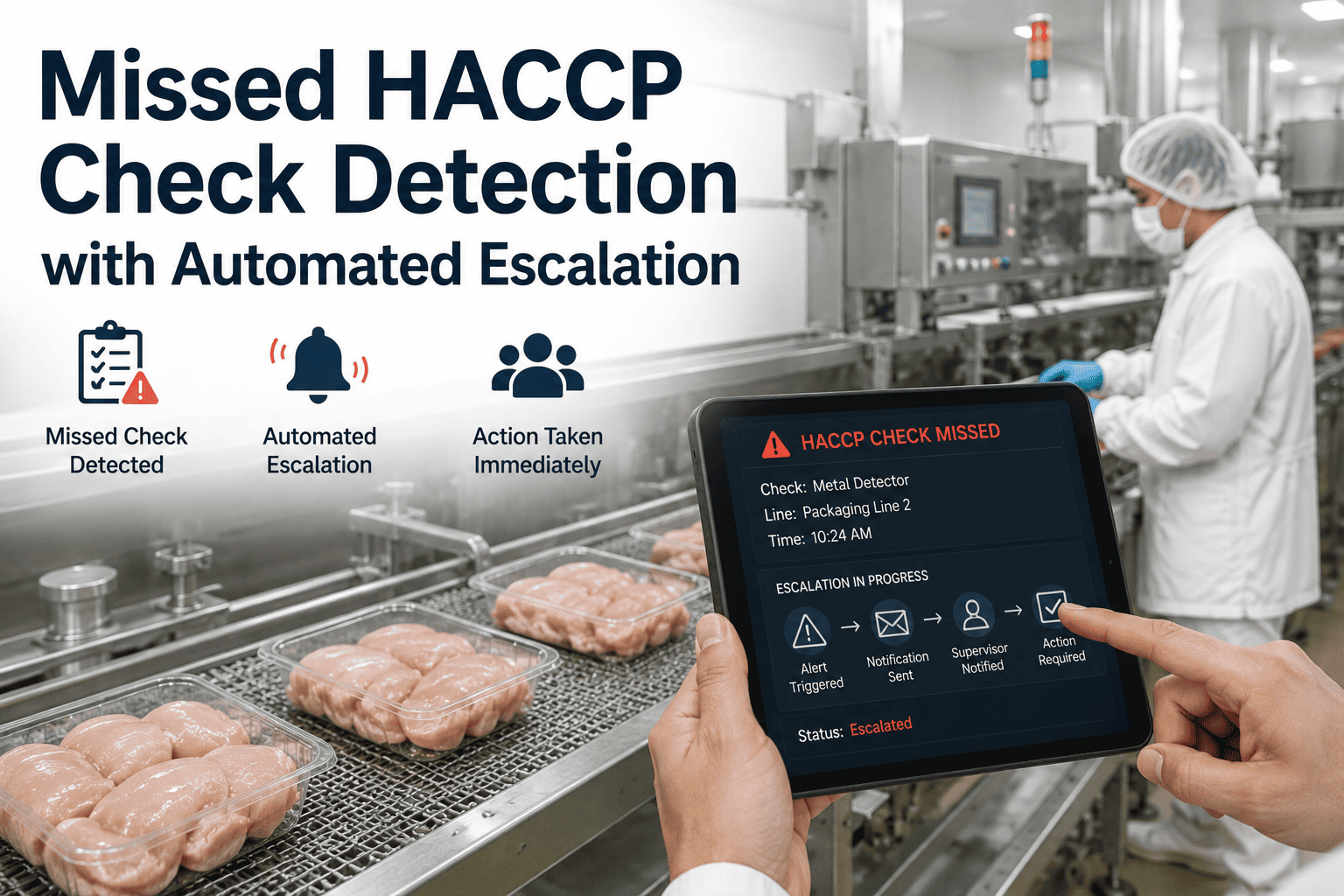
A missed CCP check is not the same failure as an out-of-range reading. An out-of-range reading tells you the process drifted; a missed check tells you nothing at all, because the monitoring window simply passed with no data captured — and on paper, that gap is easy to miss until the next scheduled review pulls the log and someone notices a blank line where an entry should be. By then, whatever happened during that window is unrecoverable. See how automated escalation flags a missed HACCP check the moment the monitoring window closes, instead of during the next audit walkthrough.
Food Safety · Missed Check Detection
A Blank Line in a HACCP Log Is Not a Small Problem
Automated escalation that flags a missed HACCP check the instant the monitoring window passes, routing it to the right person before it becomes a gap discovered weeks later during an audit.
Why a Missed Check Is Worse Than It Looks
The Difference Between a Bad Reading and No Reading
An out-of-range CCP reading is a known problem with a known response — the process deviated, a corrective action gets triggered, and the plan for handling exactly this situation is already written into the HACCP plan. A missed check is a different category of problem entirely, because there's no data to respond to. Nobody knows whether the process was in control during that window or not; the record simply doesn't exist. On paper, this gap often isn't discovered until a supervisor reviews the log at shift change, or worse, until an auditor flips through the binder and finds a blank cell where a signature should be.
Discovered Late
A missed check on paper is typically found during a routine review hours or shifts later, long after any corrective window for the affected product has closed.
No Data to Act On
Unlike an out-of-range reading, there's no measurement to evaluate — the product moved through the process with an unverified status that can't be reconstructed after the fact.
Easy to Miss in a Busy Log
A single blank row among dozens of completed entries on a shift's paper log is genuinely easy to overlook, especially during a fast-moving production day.
An Audit Finding, Not Just an Internal Gap
A pattern of missed checks discovered during a certification audit raises questions about program adequacy that a single out-of-range reading with documented corrective action typically does not.
How Automated Escalation Works
From a Missed Window to a Resolved Alert
1
Monitoring Window Tracked
Every CCP's defined monitoring frequency is tracked continuously against the current time, rather than relying on someone remembering when the last check was due.
2
Window Passes Without Entry
The moment a scheduled monitoring window closes with no corresponding entry logged, the system flags it immediately rather than waiting for a periodic review to notice.
3
Alert Routes to the Right Person
The assigned shift supervisor or QA contact for that specific CCP receives an immediate alert, rather than a generic notification that nobody feels directly responsible for acting on.
4
Escalation If Unacknowledged
If the initial alert isn't acknowledged within a defined window, it escalates automatically to the next level of responsibility, so a missed check can't quietly sit unaddressed.
Catch It the Moment It Happens
Stop Finding Missed Checks During the Next Audit
iFactory flags a missed HACCP check the instant the monitoring window closes and escalates automatically if it isn't acknowledged, closing a gap paper logs can't catch in real time.
Common Root Causes
Why Checks Actually Get Missed
| Root Cause | How It Typically Happens | What Escalation Catches |
|---|
| Shift Change Confusion | Outgoing operator assumes incoming operator will cover the check | Alert fires regardless of which shift is active |
| Production Rush | Operator prioritizes keeping the line running over a scheduled check | Real-time alert while there's still time to act |
| Assumed Coverage | Two operators each assume the other completed the check | System doesn't rely on assumed coverage at all |
| Equipment or Access Issue | Monitoring point temporarily inaccessible during the window | Escalation prompts a documented alternative action |
What Changes for QA and Supervisors
What Real-Time Escalation Actually Changes
01
Checks Get Completed Late, Not Skipped
An immediate alert often means the check still happens shortly after the window, closing the gap in minutes rather than leaving it as a permanent blank in the record.
02
Fewer Surprises During Audits
A pattern of near-misses caught and resolved in real time replaces a pattern of missed checks discovered cold during a certification audit walkthrough.
03
Visibility Into Systemic Gaps
If the same CCP or shift generates repeated missed-check alerts, that pattern becomes visible to QA as a scheduling or staffing issue worth addressing at the root.
04
Accountability Without Blame Culture
Real-time alerts catch the gap as a process event to fix in the moment, rather than surfacing weeks later as a finding that reads as a personnel failure after the fact.
Getting It Running
Setting Up Escalation Rules for Your CCPs
Automated escalation is configured against the monitoring frequencies already defined in a plant's HACCP plan, so setup starts with confirming each CCP's required interval and who the responsible party is for that specific monitoring point across each shift. This mapping typically already exists in the HACCP plan documentation, which means the configuration work is largely a matter of transferring that existing structure into the system rather than redesigning monitoring responsibilities from scratch.
Escalation thresholds — how long an alert waits before escalating to the next level — are set per CCP based on how quickly a missed check needs a response. A CCP with a short, frequent monitoring interval typically gets a tighter escalation window than one monitored less often, since the acceptable delay before escalation should reflect how much risk accumulates during the gap. Most plants start with a conservative escalation window and adjust based on real alert volume once the system has been running for a few weeks, since an escalation threshold set too tight can generate alert fatigue that undermines the whole point of real-time flagging.
Common Questions
Frequently Asked Questions
Does this replace the need for a supervisor to review logs at shift change?
No — shift-change review remains valuable for broader trend awareness and continuity, but automated escalation adds a real-time layer that doesn't wait for that review to happen, which matters because the corrective window for a missed check is often much shorter than the time until the next scheduled shift review.
Talk to support about how escalation fits alongside your existing shift handover process.
How is this different from just setting a calendar reminder?
A calendar reminder tells someone a check is due but has no way of knowing whether it was actually completed, and it doesn't escalate to anyone else if the reminder is dismissed or ignored. Automated escalation is tied directly to whether an entry was actually logged for that CCP, and it routes to a defined next-level contact automatically if the initial alert goes unacknowledged.
Won't frequent alerts just get ignored after a while?
Alert fatigue is a real risk if escalation thresholds are set too aggressively, which is why most plants start conservative and tune thresholds based on actual alert volume once the system has run for a few weeks. A high volume of alerts on a specific CCP is also useful information in itself, often pointing to a scheduling or staffing gap worth fixing at the root rather than just tightening the alert.
Can escalation rules differ by CCP or by shift?
Yes — escalation windows and routing are configured per CCP, and can also account for different staffing structures across shifts, so a CCP monitored by a single operator on a night shift can have different escalation logic than the same CCP during a fully staffed day shift.
Book a demo to see how escalation rules are configured for a multi-shift plant.
Does a missed-check alert count as a food safety incident on its own?
A missed check is typically treated as a process gap requiring investigation and, where relevant, a documented disposition of the affected product, following whatever protocol a plant's HACCP plan and quality system define for that scenario — the alert itself doesn't determine the outcome, but it ensures the gap is investigated promptly rather than discovered too late to act on.
Close the Gap in Real Time
Never Discover a Missed Check During an Audit Again
iFactory flags every missed HACCP monitoring window the instant it happens and escalates automatically until it's resolved.