Modernizing SAP QM and SAP xMII for Food & Beverage Operations
By Riley Quinn on June 1, 2026
SAP QM has been the quality system of record for F&B operations for two decades — inspection lots, quality notifications, batch certificates, stability studies, audit management. The modules work, the workflows are validated, the audit trail is defensible. What’s changed is the intelligence feeding them: AI-native SPC modernizes each of the five core SAP QM functions without replacing the underlying system. Same SAP QM. Same workflows. Dramatically better intelligence layer. Book an AI SPC migration workshop to map AI modernization against your specific SAP QM configuration.
SAP QM × AI Intelligence
Five SAP QM Functions, Each Modernized by AI Intelligence
SAP QM stays as system of record. AI-native SPC adds the predictive, autonomous, and self-learning intelligence each QM function lacks today.
SAP QM remains the system of record — AI-native intelligence layers above without replacing it
What SAP QM Does Well — And Where AI Intelligence Is Needed
SAP QM isn’t broken for F&B operations. The module handles inspection lots, batch certificates, stability studies, CAPA workflows, and audit management with proven workflows and a defensible audit trail. What’s structurally missing is the intelligence layer that decides what to inspect, predicts what will fail, and codifies what was learned. Three honest observations about the SAP QM operational reality.
KEEP
SAP QM workflow architecture
Inspection lots, quality notifications, batch certificates, stability studies, audit management — these are validated workflows F&B operations rely on. Replacing them adds 12–18 months and breaks integrations with procurement, finance, and compliance.
ADD
AI-native intelligence layer
Predictive SPC, multivariate RCA, vision inspection, self-learning failure pattern library, auto-generated CoA. These capabilities feed SAP QM via OData/REST APIs — they don’t replace it.
RETIRE
Manual data entry burden
Operators typing inspection results into SAP QM, QA staff assembling batch certificates by hand, audit teams scrambling to consolidate CAPA evidence — the manual burden retires when AI-native intelligence auto-populates SAP QM workflows.
The Five SAP QM Functions, Each Modernized by AI Intelligence
Modernization isn’t a single change — it’s five concrete additions to the five core SAP QM functions. Each function continues to operate exactly as today, with AI-native intelligence feeding it higher-quality input. The audit trail still flows through SAP QM. The CAPA workflow still uses SAP QM transactions. What changes is what arrives in SAP QM and how fast.
Inspection plans built manually per material. Sampling procedures applied uniformly regardless of supplier history or batch risk. Quality characteristics updated quarterly at best.
With AI Modernization
Risk-based dynamic sampling. Inspection plans auto-adjusted by supplier lot quality history. Characteristics continuously refined by failure pattern library. AI recommends plan updates with confidence scores.
02
Quality Inspection
Inspection lots (17 standard types), results recording, usage decisions
Today in SAP QM
Statistical sampling at 2–5% of units. Manual results recording at workstation terminals. Usage decisions taken hours after lab analysis. Type 16 stability studies tracked manually.
With AI Modernization
100% per-unit AI vision inspection. Continuous in-line monitoring with sub-second latency. Real-time usage decisions on Type 01 inspection lots. Stability study trending automated.
03
Quality Notifications
Deviation tracking, defect codes, CAPA workflows
Today in SAP QM
Notifications created reactively after deviation discovered. Defect codes selected from dropdown lists. Root cause investigated manually over 4–8 hours. CAPA effectiveness rarely verified.
With AI Modernization
Notifications auto-created on multivariate alert. Defect codes pre-selected with confidence scores. Root cause arrives pre-attached with ranked hypotheses (78–88% top-1 accuracy). CAPA effectiveness verified automatically against failure pattern library.
04
Quality Certificates
CoA generation, batch certificates, shelf-life documentation
Today in SAP QM
CoA assembled manually from inspection lot results. QA staff manually verify completeness. Stability projections calculated from historical averages. Customer CoAs delivered 24–72 hours after batch release.
With AI Modernization
CoA auto-generated at batch release with full traceability. Completeness verified by AI checks. Stability projections from per-batch AI models. Customer CoAs delivered at release with FSMA 204 KDE/CTE included.
Audit packs assembled retrospectively over 40–80 hours. Documentation gaps surface during audit week. Findings tracked but recurrence not verified. Unannounced audits expose unprepared evidence.
With AI Modernization
Per-batch audit packs auto-generated in 5–10 minutes. Gaps flagged in real-time as batches run. Findings linked to failure pattern library for recurrence prevention. Unannounced audits identical to announced.
Need each of these AI modernizations mapped against your specific SAP QM configuration? Book an AI SPC migration workshop — the per-function modernization plan is the most valuable single deliverable for SAP QM owners.
SAP xMII Modernization — The Companion Layer
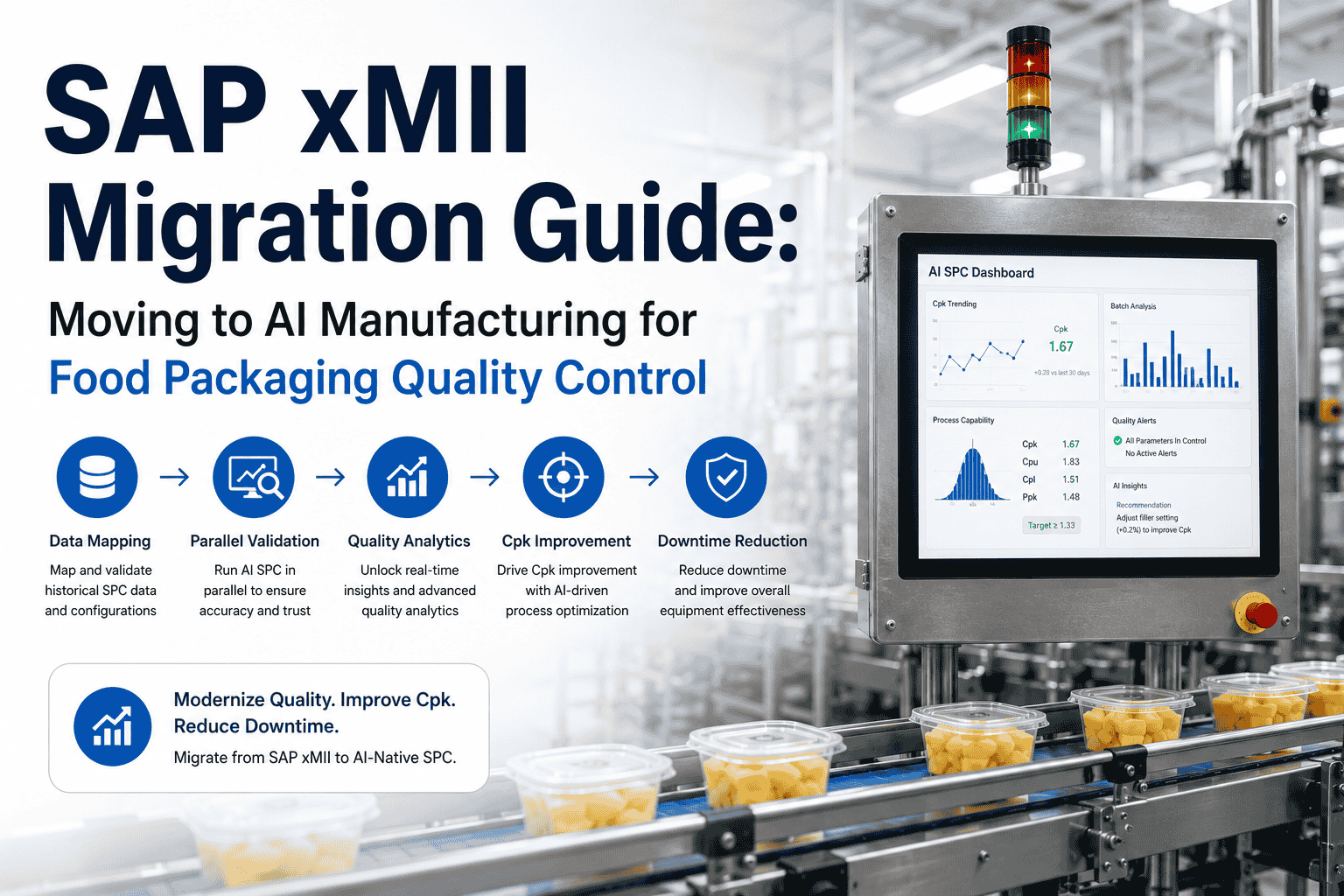
SAP xMII handles the MES execution layer that feeds SAP QM with production data. Modernizing SAP QM without modernizing xMII leaves the intelligence pipeline incomplete — SAP QM receives better workflows but the same upstream data quality. Three xMII capabilities migrate to the AI-native engine while xMII remains for orchestration and shop-floor execution.
BLS Transactions → AI Model Invocations
xMII Business Logic Services running rule-based univariate SPC migrate to AI-native model invocations running LSTM + Nelson + Autoencoder confidence fusion. Same trigger conditions, dramatically better intelligence output feeding SAP QM.
Display Templates → AI-Native Dashboards
xMII display templates retire to responsive AI-native dashboards. Same data, modern interface. Mobile copilot for off-floor access. Embedded prescriptive guidance replacing raw chart interpretation.
Query Templates → Federated Intelligence
xMII query templates pulling from siloed historians, PLC, and database tables migrate to federated intelligence that auto-correlates across PLC + historian + SAP QM + CMMS. Cross-system trace in seconds, not hours.
SAP QM and SAP xMII Modernized Together — No System Replacement
iFactory layers AI-native intelligence above SAP QM and SAP xMII via OData/REST APIs. Both SAP systems stay as systems of record. Predictive SPC + autonomous RCA + AI vision + auto-generated audit packs deliver measurable batch consistency improvement within 30 days. Full deployment runs 8–12 weeks with payback in 7–9 months.
The Modernization Outcome Math — Per SAP QM Function
SAP QM owners defend modernization investment to the CFO with concrete per-function metrics. Each modernized SAP QM function delivers measurable operational improvement — not vendor sales-deck percentages, but specific time and accuracy improvements that compound across the audit cycle, batch portfolio, and supplier relationships.
Swipe horizontally to compare per-function metrics
SAP QM Function
Today
Modernized
Improvement
Quality Planning: sampling cadence
Quarterly manual review
Continuous risk-based adjustment
~90% effort reduction
Quality Inspection: unit coverage
2–5% statistical sampling
100% per-unit AI vision
20–50× coverage
Quality Notifications: RCA time
4–8 hours per investigation
15–45 minutes verification
8–16× faster
Quality Certificates: CoA delivery
24–72 hours after release
Auto-generated at release
Days to minutes
Audit Management: audit pack time
40–80 hours annual prep
5–10 min per-batch generation
~95% time reduction
Cross-function: batch consistency CV
7–9% baseline
2–3% at maturity
50–75% CV reduction
Vendor Evaluation — The SAP QM Owner’s Lens
SAP QM owners evaluate vendors differently than xMII evaluators or quality engineers. The decisive criteria test whether the vendor preserves SAP QM as system of record, integrates via SAP-native APIs, and respects the validated workflows that took years to establish. Eight criteria separate SAP-respectful vendors from rip-and-replace pitches.
01
SAP QM preservation
Ask:
"Does the platform preserve SAP QM as system of record, or replace any of the five core QM functions?"
All five QM functions stay in SAP QM. The platform layers above and feeds them. Vendors who replace any QM function add 12–18 months and break the SAP ecosystem integration chain. Demand evidence that the vendor's reference customers still run SAP QM workflows after deployment.
02
OData / REST integration
Ask:
"Does the platform integrate with SAP QM via OData/REST APIs, or require ABAP customization?"
OData and REST APIs work for both ECC and S/4HANA. ABAP-dependent integrations rebuild during S/4HANA migration. Production-grade platforms use SAP-native APIs that survive the S/4HANA boundary without rework.
03
Inspection lot auto-population
Ask:
"Does the platform write back to SAP QM inspection lots with complete results, defect codes, and usage decisions?"
Production-grade platforms populate inspection lots automatically — not just trigger them. Vendors who only create lots and leave operators to fill in results haven’t solved the manual-entry problem. Demand a live demo showing inspection lot auto-population with AI-derived results.
04
Stability study automation
Ask:
"Does the platform automate Type 16 stability study tracking with predictive shelf-life projection?"
F&B stability studies are central to shelf-life claims and recall risk. AI-native platforms model stability per batch using LSTM forecasting on storage condition data. Generic vendors leave stability tracking manual — missing the operational benefit and exposing recall risk.
05
CAPA effectiveness verification
Ask:
"Does the platform verify CAPA effectiveness automatically against the failure pattern library?"
CAPAs closed on paper without recurrence verification are the most common audit finding. Production-grade platforms check whether the same drift signature recurs within 30–90 days and either confirms CAPA effectiveness or escalates. Vendors who only document CAPA creation leave the audit gap unresolved.
06
Batch certificate auto-generation
Ask:
"Does the platform auto-generate CoA and batch certificates at release with full traceability?"
CoA at release (not 24–72 hours later) is the production-grade benchmark. Auto-generation includes FSMA 204 KDE/CTE, supplier lot links, calibration certificates, and electronic signature compliance. Manual CoA assembly costs 2–4 hours per batch — multiplied across the SKU portfolio, that’s a quantifiable headcount opportunity.
07
Audit pack on demand
Ask:
"How long does the platform take to generate a complete audit pack for any historical batch?"
5–10 minutes is the production-grade benchmark. Vendors quoting hours haven’t solved evidence assembly — they’ve just digitized the storage layer. Pick a random batch ID from the previous quarter and ask the vendor to generate the pack live during the demo.
08
S/4HANA migration alignment
Ask:
"Does the platform’s SAP QM integration approach work identically on ECC and S/4HANA?"
Plants migrating to S/4HANA need quality intelligence layers that survive the migration boundary unchanged. Production-grade platforms use the same OData/REST integration on both ECC and S/4HANA. Vendors with ECC-specific integration architectures force rebuilding during S/4HANA migration.
Expert Perspective
"The most common mistake SAP QM owners make in evaluating modernization is framing it as a replacement decision. SAP QM’s five core functions — planning, inspection, notifications, certificates, audit management — aren’t broken. They’re validated workflows F&B operations have depended on for two decades. What’s structurally missing is the intelligence layer that decides what to inspect, predicts what will fail, and codifies what was learned. AI-native SPC adds that intelligence layer above SAP QM without touching any of the five core functions. Inspection lots still flow through SAP QM. Quality notifications still drive CAPA workflows. Batch certificates still print from SAP QM. Audit packs still defend regulatory inspections. What changes is what arrives in SAP QM and how fast: pre-populated inspection results, multivariate RCA hypotheses pre-attached to notifications, CoA auto-generated at release, audit packs ready in 5–10 minutes. The plants doing this well preserve their SAP investment while delivering 50–75% batch CV reduction within six months. The plants that try to rip-and-replace SAP QM end up 18 months later with worse compliance, broken integrations, and the same CV problem they started with."
— F&B SAP QM Modernization Practice, 2026 industry insight
5 functions
SAP QM core modules modernized by AI-native intelligence overlay
8–12 wk
deployment timeline preserving all SAP QM workflows
50–75%
batch consistency CV reduction within 6 months of cutover
Conclusion: SAP QM Modernization Is an Intelligence Decision, Not a Replacement Decision
F&B SAP QM owners evaluating modernization in 2026 face a clearer choice than the vendor pitches suggest. SAP QM’s five core functions aren’t broken — quality planning, quality inspection, quality notifications, quality certificates, and audit management work as designed and have been validated through years of audits. What’s missing is the AI-native intelligence layer that decides what to inspect, predicts what will fail, codifies what was learned, and auto-populates SAP QM workflows with higher-quality input. Each of the five functions modernizes independently: risk-based dynamic sampling for planning, 100% per-unit coverage for inspection, multivariate RCA pre-attached to notifications, CoA auto-generated at release, audit packs ready in 5–10 minutes. SAP xMII modernizes in parallel as the companion MES layer, with BLS transactions migrating to AI model invocations and display templates retiring to responsive dashboards. Both SAP systems stay as systems of record. The integration runs through SAP-native OData/REST APIs that survive the S/4HANA migration boundary unchanged. Deployment timeline: 8–12 weeks. First measurable improvement: 30 days. Batch consistency outcome: 50–75% CV reduction within six months. Book an AI SPC migration workshop to map AI modernization against your specific SAP QM configuration and SAP xMII landscape.
Map AI Modernization to Your SAP QM Configuration
iFactory’s F&B SAP modernization practice runs a 90-minute workshop applying the five-function modernization framework, the xMII companion-layer migration, and the per-function outcome math to your real SAP QM configuration. You leave with a phased deployment plan, per-function modernization projections, and a CFO-defensible business case.
No — SAP QM stays as system of record. All five core QM functions (quality planning, quality inspection, quality notifications, quality certificates, audit management) continue to operate exactly as today. What changes is the intelligence layer feeding them. AI-native SPC writes inspection results, defect codes, RCA hypotheses, CAPA evidence, and CoA data back to SAP QM via OData and REST APIs. The downstream SAP workflows (procurement integration, finance integration, sales integration, compliance integration) continue working exactly as today — they just receive higher-quality, earlier, more accurate input from the AI-native intelligence layer. Validated workflows stay validated. Audit trails stay defensible. The intelligence layer is the addition, not a replacement.
Which SAP QM functions deliver the largest modernization benefit first?
Quality Notifications (Function 03) typically delivers the largest visible benefit within the first 30 days because RCA time drops from 4–8 hours to 15–45 minutes per investigation — immediately freeing quality engineer time. Quality Inspection (Function 02) delivers the largest structural benefit within 90 days as 100% per-unit AI vision coverage replaces 2–5% statistical sampling, dramatically improving defect catch rate. Audit Management (Function 05) delivers the largest CFO-defensible benefit at the next audit cycle as audit pack assembly drops from 40–80 hours annual to 5–10 minutes per batch. Quality Certificates (Function 04) delivers immediate customer-facing benefit as CoA delivery moves from 24–72 hours to release-time. Quality Planning (Function 01) delivers the longest-running benefit as risk-based dynamic sampling compounds over months. Plants typically see all five benefits within the first six months with the full modernization deployment.
How does this work with our planned S/4HANA migration?
The AI-native intelligence layer uses OData and REST APIs that work identically on SAP ECC and SAP S/4HANA — the integration approach survives the migration boundary unchanged. This is critical for plants planning S/4HANA migration within the next 24 months: investing in AI modernization on ECC doesn’t create rework during the S/4HANA migration. The intelligence layer continues operating during the S/4HANA cutover, writing back to S/4HANA QM via the same API patterns it used with ECC QM. SAP QM’s core functions (planning, inspection, notifications, certificates, audit management) carry over to S/4HANA QM with the same structure, so the AI modernization patterns apply identically. Plants that prefer to sequence the work can modernize on ECC first (faster ROI, simpler deployment), then migrate the entire stack including the AI intelligence to S/4HANA — or migrate to S/4HANA first and then layer AI modernization above. Both sequences work because the AI architecture is SAP-version-agnostic.
What happens to SAP xMII during SAP QM modernization?
SAP xMII modernizes in parallel as the companion MES execution layer. Three xMII capabilities migrate to the AI-native engine: Business Logic Services (BLS) transactions running rule-based univariate SPC migrate to AI model invocations running LSTM + Nelson + Autoencoder confidence fusion across 80+ correlated tags. Display templates retire to responsive AI-native dashboards with embedded prescriptive guidance and mobile copilot access. Query templates pulling from siloed historians, PLC, and database tables migrate to federated intelligence auto-correlating across PLC + historian + SAP QM + CMMS. SAP xMII continues to handle MES orchestration, shop-floor execution, and integration with PLCs — the parts of xMII that work well stay. What retires is the intelligence layer that hit its architectural ceiling: rule-based univariate SPC, manual cross-system correlation, and desktop-only display templates.
How long does the SAP QM modernization deployment take?
Total deployment runs 8–12 weeks with first measurable improvement visible within 30 days. The deployment sequence runs across the five SAP QM functions in parallel rather than sequentially. Weeks 1–2: SAP QM configuration discovery, current-state assessment per function, integration architecture validation. Weeks 3–5: OData/REST integration setup, inspection lot auto-population templates, quality notification AI workflow, CoA auto-generation templates. Weeks 4–9: Self-learning model bootstrap using 6–12 months of historical SAP QM data, failure pattern library seeding, multivariate model training per SKU. Weeks 8–12: Parallel operation with legacy intelligence, validation of AI-derived inspection results against historical baselines, quality engineer sign-off per function. Cutover: AI-native intelligence layer becomes primary, legacy xMII display templates retire, operators trained on prescriptive copilot workflow. Months 4–6: Continuous learning maturity, full batch consistency CV reduction visible, audit pack workflow validated through actual audit. Payback period across F&B SAP QM modernization deployments averages 7–9 months.