Most food plants do not fail at real-time AI monitoring because the technology is hard, they fail because the rollout skips straight to dashboards before the data is even connected. A deployment playbook fixes the order of operations: connectivity first, then unified KPIs, then leadership adoption, each step built on the one before it. Plants that follow that sequence tend to reach a working system in weeks rather than restarting a stalled project every quarter. iFactory AI, an on-premise AI platform for manufacturing, runs this exact sequence on new deployments, and teams planning their own rollout can walk through a twelve-week deployment plan built around their own systems.
From Fragmented Systems to a Live Plant View in Twelve Weeks
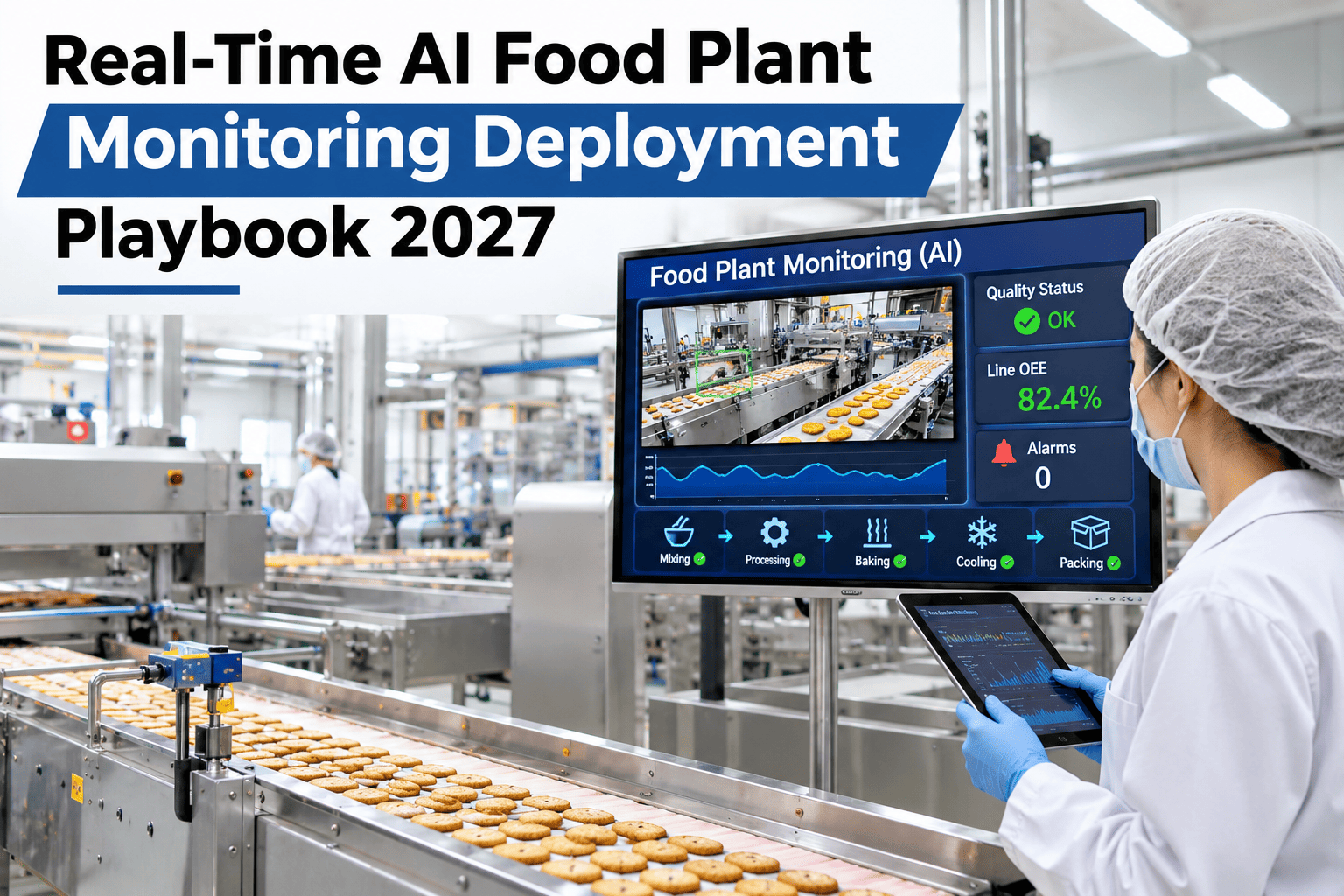
A real-time AI food plant monitoring deployment playbook — connect the data, unify the KPIs, and win leadership adoption in a defined sequence instead of a stalled, open-ended project.
Why So Many Monitoring Projects Stall Before Go-Live
A fragmented plant usually has an MES, a historian, a quality system and a spreadsheet or two, none of which were designed to talk to each other. A deployment that starts by building dashboards on top of that mess inherits every gap in the underlying data, which is why so many monitoring projects look good in a demo and then quietly stop being used.
The Three Phases of a Working Deployment
Get Your Own Twelve-Week Plan
Share which systems your plant already runs, and iFactory AI will map a deployment sequence specific to your current gaps.
What Makes a Good Pilot Line, Specifically
Not every line is equally suited to go first. The best pilot usually combines a known, visible pain point with data that is already reasonably accessible, because a line that is both hard to connect and politically sensitive tends to drag the entire schedule even before the KPI phase starts.
A good pilot also needs a sponsor willing to defend a rough first month. The first few weeks of real-time data on any line tend to surface uncomfortable truths about how much downtime was previously going unrecorded, and a plant that treats that discovery as a win rather than a failure is the one that keeps the project moving into the KPI and adoption phases instead of quietly shelving it.
Where Does Your Plant Sit Today?
Scaling Past the First Line Without Losing the Gains
The temptation after a successful pilot is to move fast and roll every remaining line out at once. That usually recreates the exact problem the pilot was meant to avoid, because a single rushed rollout across many lines at once means any connectivity gap or KPI disagreement surfaces everywhere simultaneously instead of once, in a controlled setting.
A steadier approach extends the same three-phase sequence to a small batch of additional lines at a time, reusing the tag naming and KPI definitions already agreed during the pilot so each new line adds less new negotiation than the first one required. By the time the whole plant is connected, the KPI definitions have been proven stable across enough lines that leadership trusts the numbers without needing to double-check them against the old spreadsheets.
A Checklist for Each Phase of the Playbook
Mistakes That Push a Timeline Past Twelve Weeks
Who Owns Each Phase of the Playbook
Splitting ownership this clearly matters because a deployment that leaves every phase to one team usually stalls at whichever phase that team is weakest in. Spreading ownership across the people who already know their own piece best keeps each phase moving at a realistic pace.
A Plant That Skipped Connectivity, and Restarted
A mid-size plant once bought a dashboard product and tried to go live in week two, before any tag mapping had been agreed. The dashboard looked impressive in the demo, but it was fed by inconsistent tag names across three lines, so the OEE numbers it showed never matched what supervisors already knew from the floor. Trust collapsed within a month, and the project restarted from the connectivity phase it had skipped, costing more time than following the sequence in order would have taken the first time.
What a Plant Manager Would Check Before Signing Off
What Plants Ask Before Starting This Playbook
Build Your Deployment on the Right Sequence
Book a session with iFactory AI to map a twelve-week real-time monitoring deployment for your own plant and systems.