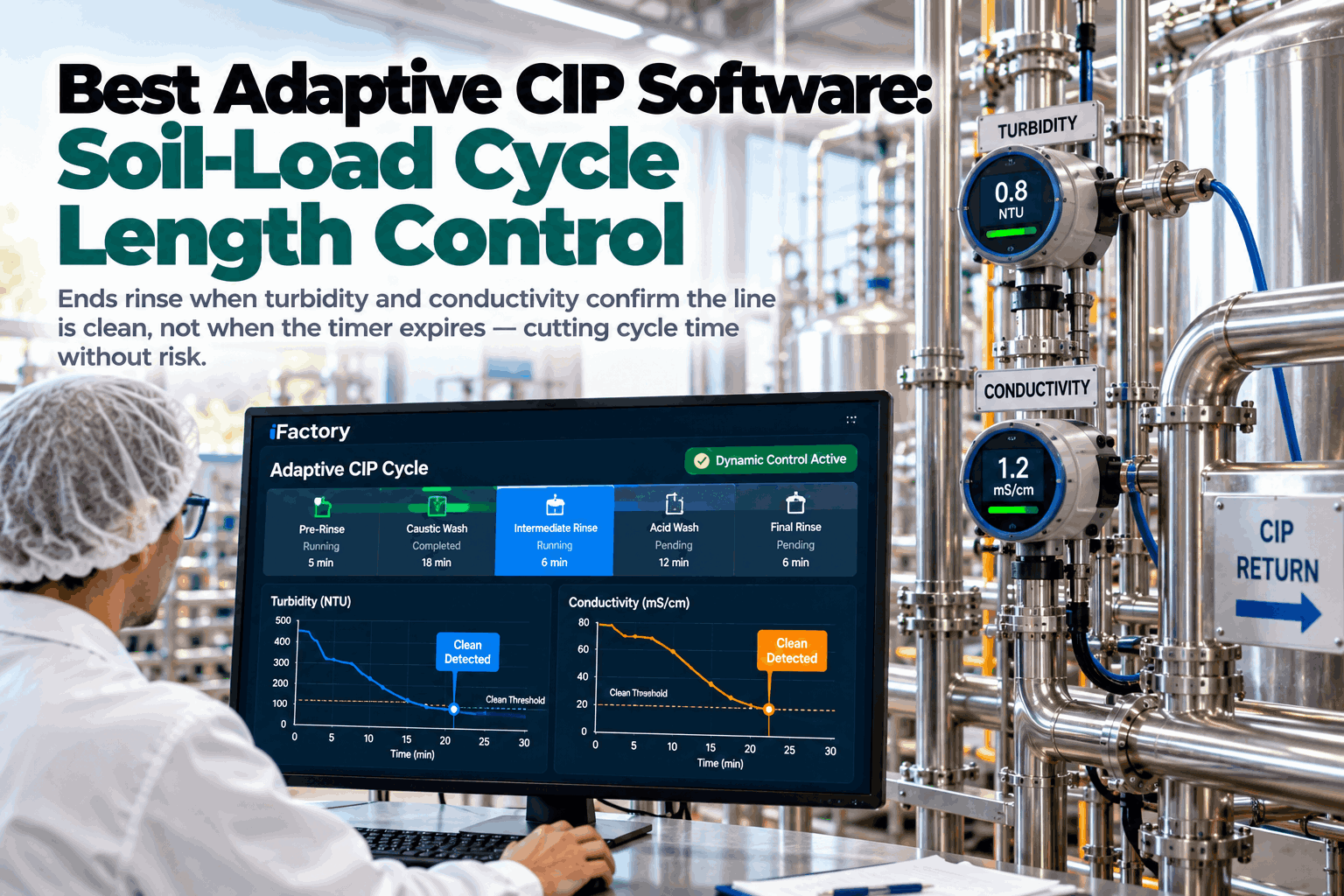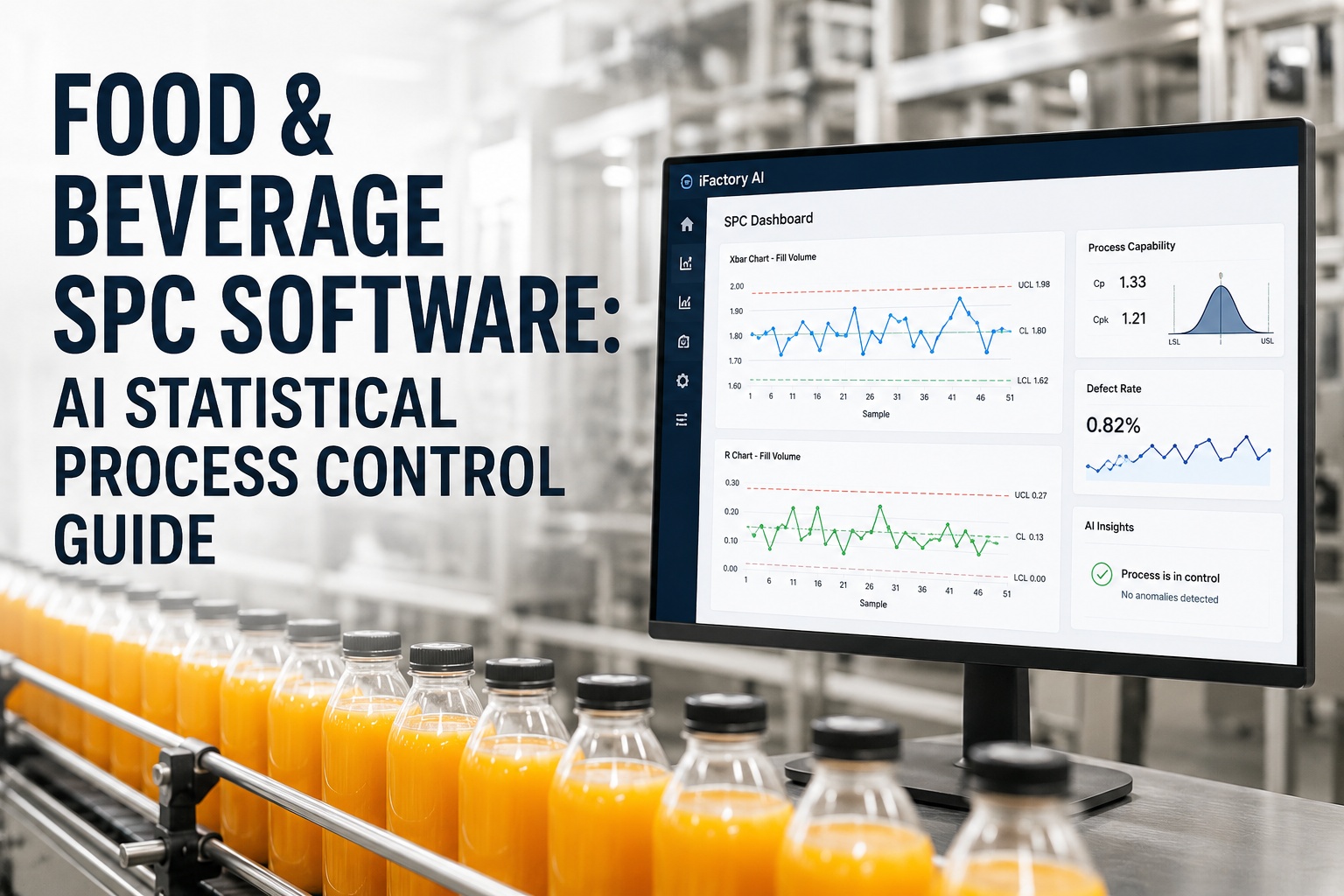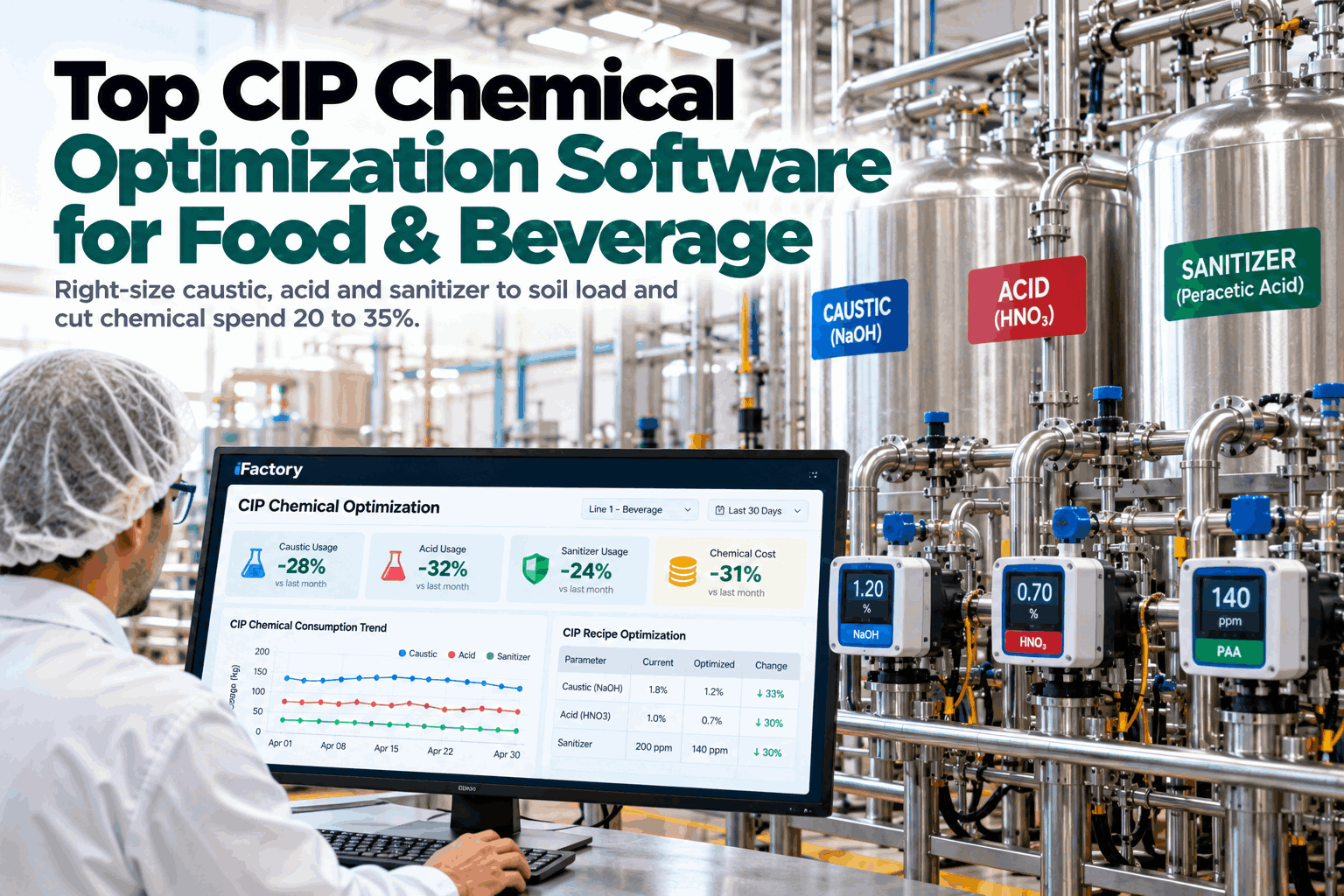
Most food plants pay for more CIP chemistry than their soil needs. Caustic gets topped up "to be safe", sanitizer runs at the top of its label range, and nobody checks the strength cycle by cycle. This guide shows how to right-size each chemical, and what good CIP chemical software should do. To check your own dosing, book a chemical spend review.
CIP Chemical Optimization Software for Food and Beverage
Match caustic, acid and sanitizer to the soil you actually clean, prove the clean still holds, and stop paying for strength that only goes down the drain.
- Why more caustic is not always a better clean
- Seven things good CIP chemical software does
- A simple chemical audit you can run this month
Caustic
Recipe band 0.8–1.2%. Cycles average 1.6%.
Acid
Recipe band 0.5–0.8%. Cycles average 0.7%.
Sanitizer
Label range shown as the band. Cycles sit near the top.
The band is the target window. The marker is the average of recent cycles. Every number here is an example. Your bands come from your validated recipes and your sanitizer's label.
Why Food Plants Overdose CIP Chemicals
Nobody overdoses on purpose. It happens one top-up at a time.
A failed swab, a busy shift, an operator who adds an extra measure "just in case". Each choice makes sense on the day, and none is logged anywhere useful. Together they push strength well above the recipe, and the extra chemistry rarely improves the clean. Our CIP support team can help you find where it starts on your site.
Manual top-ups
Strength is checked by hand, and the safe answer is always "add a bit more".
One recipe for every soil
The same strength for a light rinse-off product and the heaviest burnt-on deposit.
Sensors not trusted
Conductivity probes drift or read without temperature correction, so people stop believing them.
No one sees the cost
Chemical bills arrive monthly, for the whole site. No circuit owns its share.
Research on dairy cleaning found that stronger caustic can make protein deposits harder to remove, not easier. Past a point, extra strength adds cost, effluent load and rinse time, with no gain in clean.
Three common beliefs
- "Stronger is safer." Only up to the point the soil needs.
- "Probes cannot be trusted." Calibrated and temperature-corrected, they can.
- "Chemicals are a small cost." Add effluent, rinse water and heat, and they are not.
What the data usually shows
- A few circuits carry most of the overdosing
- Top-ups cluster on certain shifts or products
- Verification passes just as well at recipe strength
Right-Sizing Each Chemical to the Soil
Each chemical has one job. Dose it for that job, on that circuit.
Caustic removes fat and protein. Acid removes minerals such as milk stone and scale. Sanitizer reduces the microbes left behind. Additives help them wet, rinse and stay clear of foam. Each has a strength that does its job on your soil, and anything above it is waste. To work out those strengths for your circuits, book a dosing workshop.
Signs a circuit is overdosed
- Strength well above recipe on most cycles
- Frequent manual top-ups in the log
- Long rinses to bring conductivity back down
- Effluent pH swings after CIP
Signs a circuit is underdosed
- Verification failures after heavy runs
- Visible film or milk stone build-up
- Strength falling during the wash
- Return temperature below set point
Strength is only one of four levers
Strength
The lever most plants pull first, and the one most often overused.
Temperature
Warmer caustic works faster. A cool return weakens the wash more than a low dose.
Flow
Fast, turbulent flow scrubs the wall. Poor flow cannot be fixed with more chemical.
Contact time
Each wash needs its validated minutes. Shorter only after a proper trial.
Change one lever and the others may need to move. That is why every dosing change starts as a trial, not a new standard.
Sanitizer strength is set by its label, not by your preference. Too weak and it fails. Too strong and you are outside the label's directions. The goal is a steady dose in the middle of the range, not the top of it. Automatic dosing makes that far easier to hold.
One Circuit's Chemical Bill, Right-Sized
Here is a month of chemical spend on one busy circuit, before and after dosing to recipe. Wash times and temperatures stay exactly as validated.
What Good CIP Chemical Software Does
Not a ranking of vendors. A checklist to judge any of them.
The "best" tool is the one that fits your skids, your chemicals and your QA rules. A feature list matters less than whether it shows dose and result side by side. Use the seven points below to judge any option, including the one you may already own. If you want a second opinion on a shortlist, our team can help.
Reads strength every cycle
Temperature-corrected conductivity at supply and return, logged automatically.
Knows each circuit's recipe
Compares actual strength, time and temperature with the validated recipe for that circuit.
Counts top-ups
Shows manual additions and dosing pump runs, so overdosing has a cause, not just a number, and a shift or product it belongs to.
Links to verification
Puts ATP, swab or rinse results next to the dose that produced them, so every saving can be shown to be safe.
Turns strength into money
Converts litres of chemical into cost per circuit and per cycle.
Proposes, never forces
Suggests new set points for QA to trial. Changes go through your change control.
Keeps a record
Every dose, change and approval stored, ready for an audit.
Which skids and PLCs can you read today? How do you correct conductivity for temperature? Can you show dose and verification on one screen? Who approves a set-point change, and where is that recorded? What happens to our data if we stop using you?
Three kinds of tool, and where each fits
CIP controller recipes
The PLC and screens on your CIP set. Doses and times each cycle, but rarely compares cycles or shows cost.
Chemical supplier platforms
Dosing and monitoring from your chemical supplier. Strong on their own products, often blind to the rest of the plant.
Plant-wide analytics
Reads every skid, every chemical and your verification results together. This is where iFactory sits.
Running a CIP Chemical Audit
Four weeks of data will tell you more than a year of invoices.
A chemical audit compares what each circuit should use with what it really uses. It needs no new equipment on most skids, only a careful look at data you already record. Most audits find one or two circuits worth fixing first, and a clear reason why they drifted. To run one with us on a single circuit, book an audit kick-off.
The audit, step by step
- Check the probes. Calibrate conductivity and confirm temperature correction.
- Pull four weeks. Strength, time and temperature for every wash.
- Compare to recipe. Average strength against each circuit's validated band.
- Price the gap. Turn extra strength into litres and money.
- Pick one circuit. Trial the recipe dose with QA watching.
Strength against recipe
Average and spread of wash strength per circuit, against its validated band.
Chemical cost per cycle
Caustic, acid and sanitizer in money, per circuit and per cycle.
First-time pass rate
The guard rail. If it slips, the dose goes back up while you find out why.
How iFactory Helps Right-Size CIP Chemistry
Every dose, on every circuit, next to the result it produced.
iFactory reads conductivity, temperature, flow and dosing signals from the CIP skids you already have, and joins them with your verification results, product schedule and chemical prices. It shows strength against recipe for each cycle, flags overdosing and its likely cause, and turns it into cost. Proposed changes go to your QA team as trials, never straight to the skid. Questions on fit go to our support desk.
Connect
Read-only links to CIP skid PLCs, dosing pumps and SCADA. Nothing on the skid changes until your team decides it should.
Compare
Each wash against its recipe band, with cost per cycle.
Explain
Top-ups, cool returns and probe drift shown as likely causes.
Prove
Trials tracked against verification, so savings never cost you the clean.
iFactory's own CIP programme quotes chemical cuts of up to about 15 percent as typical. Larger cuts, such as 20 to 35 percent, are possible on circuits that are badly overdosed or that add solution recovery. Your audit tells you which you have.
Turnkey AI: Delivered, Connected and Live in 6–12 Weeks
You do not build this. It arrives ready.
iFactory ships as a pre-configured NVIDIA AI server, racked and ready, with the software pre-loaded. Rack it, plug in power and Ethernet, and the AI is live on your network.
Our team handles cabling, network setup, PLC and SCADA integration, operator training and 24×7 remote monitoring. The server sits inside your own network, so CIP and quality data stay on site. For a scope matched to your plant, request a turnkey quote.
Ship, network and data
Server installed. CIP skids, dosing pumps and verification records connected. Recipes loaded.
Model training and pilot
Chemical baseline built. First dosing trial on one circuit, checked by your QA team.
Go-live and training
Dosing tracked on every circuit. Sanitation and QA staff trained. 24×7 remote monitoring begins.
Frequently Asked Questions
What caustic strength should a food plant use for CIP?
Most CIP runs caustic somewhere between 0.5 and 2 percent, hot. The right figure for each circuit is the lowest strength that passes verification on your heaviest normal soil, set in your validated recipe. Higher is not automatically better, and in dairy work stronger caustic has been found to make protein deposits harder to shift.
How does conductivity control CIP chemical strength?
Caustic and acid conduct electricity in proportion to their strength. A conductivity probe, corrected for temperature, tells the skid how strong the solution is, so it can dose to a target instead of relying on manual top-ups. Calibrate probes on a schedule, or the readings will drift and people will stop trusting them.
Can we reuse caustic between CIP cycles?
Yes, on the right circuits. Many plants return caustic to its tank and top it up. Some go further with membrane filtration to clean it. Avoid reuse where allergens, aseptic lines or very heavy soils make carry-over a risk. Reused solutions also need regular strength checks, since soil builds up in them over time.
Will lower chemical strength make cleaning worse?
Not if you trial it properly. Change one circuit at a time, keep wash time and temperature as validated, and watch verification results closely. If results slip, go back to the previous strength straight away and look for the real cause, such as flow or temperature.
How should we choose CIP chemical software?
Start with your problem, not the product. Check that a tool reads strength every cycle, knows each circuit's recipe, links dose to verification, shows cost, and keeps an audit record. Then check it fits your skids, your chemical supplier and your change control process.
Does our chemical supplier need to be involved?
Yes, ideally. Suppliers know their products' limits and often run their own dosing tools. iFactory works alongside them, adding the plant-wide view and the link to your verification results. Sharing the data usually makes supplier reviews faster and more useful.
How quickly can we see savings?
Often within the first month on an overdosed circuit, because the fix is mainly a set-point change and a stop to habitual top-ups. Bigger savings from recovery take longer, since they may need tanks or piping. To check your starting point, contact our team.
See What Your CIP Chemistry Really Costs
In thirty minutes we go through your circuits, recipes and chemical spend, and point out where strength is most likely running above need. You keep the notes whether or not you go further with iFactory.
- 1CIP recipes with strengths and times
- 2Six months of chemical invoices
- 3Any skid trends for conductivity
- 4Sanitizer labels and contact times
- 5Recent verification failures and causes