Every food safety leader in North America now works against two dates, not one. The FDA's Food Traceability Final Rule under FSMA Section 204 has been pushed from January 20, 2026 to July 20, 2028, made binding by the Continuing Appropriations Act of 2026 in November 2025. But Walmart's supplier traceability requirement, which mirrors the FSMA 204 data model with SSCC-18 pallet labels, GS1-128 case labels, and KDE-rich ASNs, has been enforced since August 1, 2025, and chargebacks on non-compliant shipments are already landing in vendor scorecards. For processors on the Food Traceability List, the operational deadline is now, not 2028. Walk through a traceability data model against your production floor when you book a demo.
FDA FOOD TRACEABILITY RULE · FSMA SECTION 204 · JULY 2028 DEADLINE
The traceability system a food processor needs to build for FSMA 204, one-up one-back, and the retailer scorecards already pulling forward from the federal deadline.
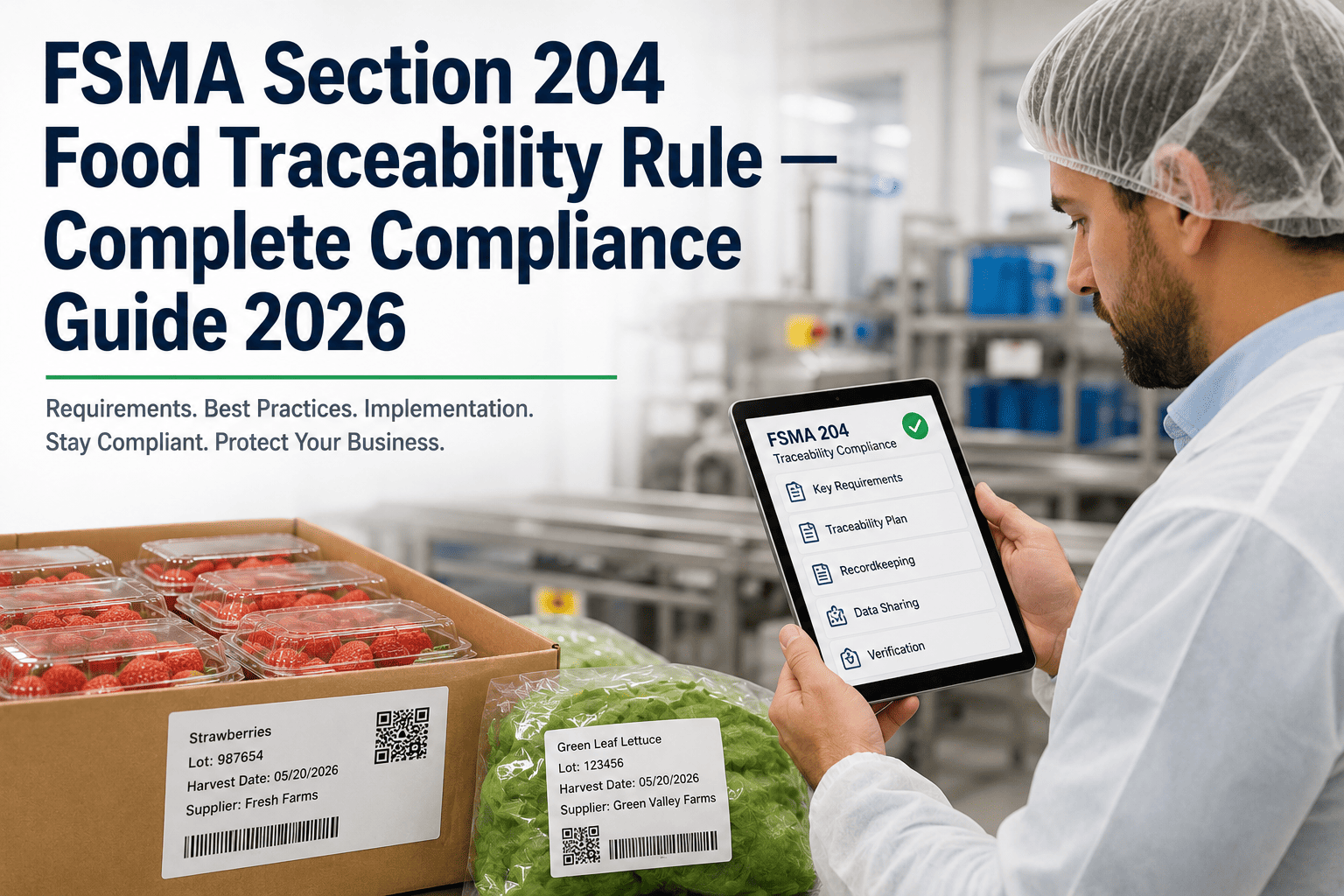
FSMA 204 is not a records project. It's an operational data problem that has to be solved on the receiving dock, on the production line, and in the shipping office simultaneously — because the FDA can ask for a sortable spreadsheet of Key Data Elements across all Critical Tracking Events, from any lot, within 24 hours.
Jul 20 2028
FDA compliance date, binding under the Continuing Appropriations Act of 2026.
Aug 1 2025
Walmart supplier requirement live, chargebacks assessed on non-compliant ASNs.
24 hours
FDA response window for a sortable electronic traceability spreadsheet.
7 CTEs
Critical Tracking Events, each with its own required Key Data Elements.
The deadline that already happened
Reading FSMA 204 as a 2028 project misses the pressure on food processors right now. Retailers built their supplier traceability requirements directly on the FSMA 204 data model, and enforce it through contracts, not federal timelines. If you ship to a mass retailer, your customer's date governs your project plan.
Nov 21 2022
FDA publishes the Food Traceability Final Rule in the Federal Register.
Aug 1 2025
Walmart's supplier traceability requirement takes effect with SSCC-18, GS1-128, and KDE-loaded ASNs.
Aug 7 2025
FDA publishes the proposed 30-month extension in the Federal Register.
Nov 2025
Continuing Appropriations Act of 2026 directs FDA not to enforce the rule prior to July 20, 2028.
Jul 20 2028
FDA enforcement begins for all persons subject to Food Traceability Rule recordkeeping.
The four building blocks of a FSMA 204 traceability system
Before wiring anything, operations, QA, and IT need a shared vocabulary. Every conversation about traceability data collapses into these four objects, and every requirement in the Food Traceability Rule maps to one of them.
FTL
Food Traceability List
The list of foods the rule applies to, published and maintained by FDA. Covers cheeses (excluding cottage cheese as of Feb 2026 guidance), shell eggs, fresh cut fruits and vegetables, several finfish and crustaceans, sprouts, herbs, ready-to-eat deli salads, and nut butters.
CTE
Critical Tracking Event
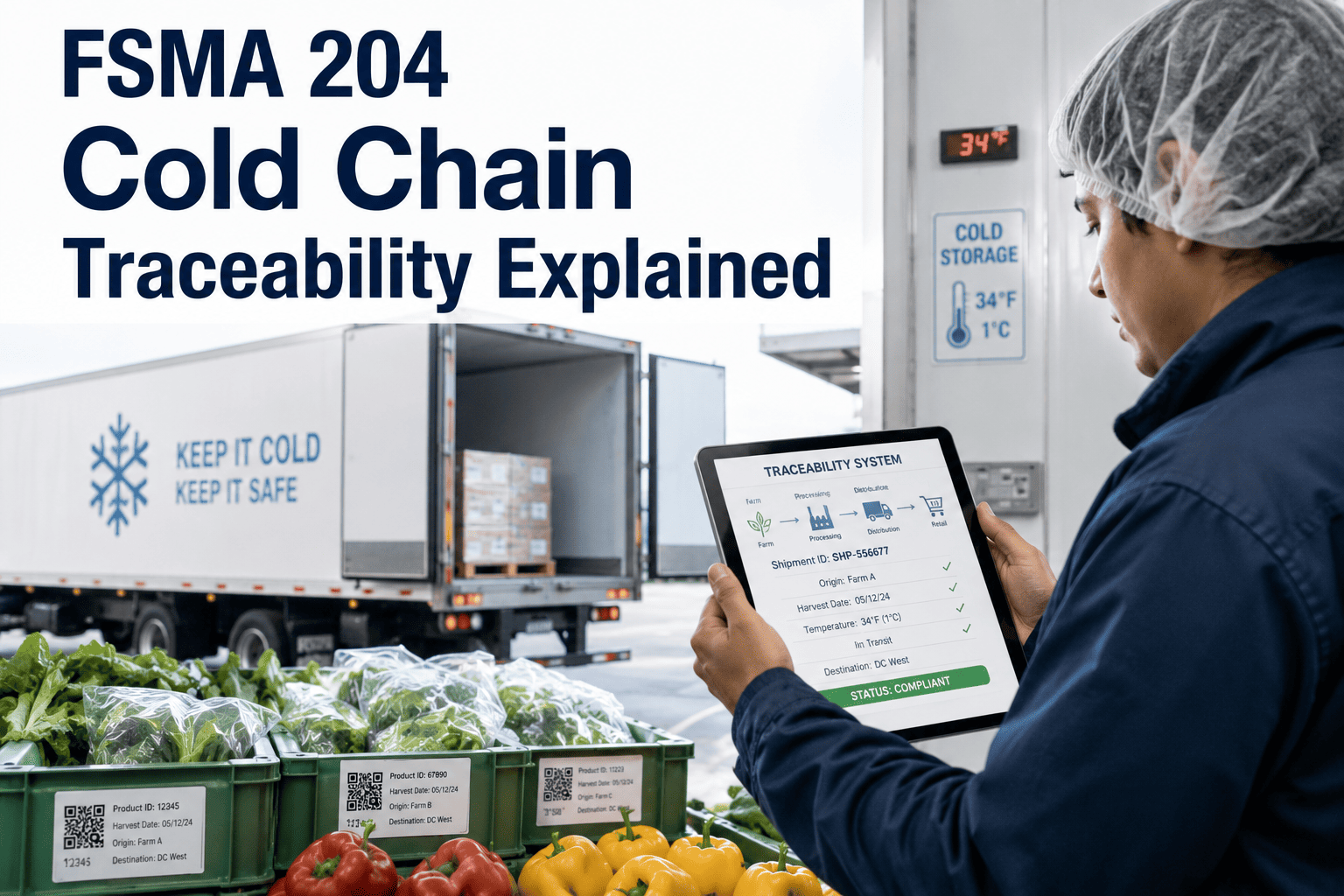
A defined event in the supply chain where records must be captured: harvesting, cooling, initial packing, first land-based receiving, shipping, receiving, and transformation. Each CTE has a specific set of required data elements.
KDE
Key Data Element
The individual data points recorded at each CTE. Lot code, quantity, unit of measure, product description, ship-from and ship-to identifiers, dates, and references to the previous CTE. The KDE list varies by CTE, and that variance is where most systems break.
TLC
Traceability Lot Code
The identifier linking every CTE record to a specific batch. Assigned at initial packing, first land-based receiving, or transformation, it stays with the lot across the supply chain and is the join key for any recall investigation.
The seven Critical Tracking Events
Each CTE has its own KDE list under the rule. Skipping one, or capturing partial data, breaks the chain and forces manual reconstruction during a recall. A working system captures every applicable CTE for every lot without operator memory or paper handoffs.
01
Harvesting
Location description, location identifier, harvest date, quantity, unit of measure, food description, and business name for raw agricultural commodities.
02
Cooling
Location, date of cooling, quantity, unit of measure, food description, and reference to the harvest CTE. Applies to raw agricultural commodities before first receipt.
03
Initial Packing
Traceability lot code assignment, quantity, unit of measure, packing date, location description, location identifier, and reference to the harvest CTE.
04
First Land-Based Receiving
First receipt of a food not from a land-based source, such as seafood coming off a vessel. TLC assignment, entry date, and location details are captured here.
05
Shipping
Ship date, quantity, unit of measure, TLC, ship-to and ship-from location identifiers, entry number of the previous source, and food description.
06
Receiving
Receipt date, quantity, unit of measure, TLC, source location, and reference to the previous shipping CTE from the supplier — the one-up-one-back pivot point.
07
Transformation
Any activity that changes the food, its package, or its TLC. Requires new TLC assignment, input and output lots linked, production date, and food description.
See a working FSMA 204 data model against your production line
iFactory captures every CTE with its full KDE set from receiving through transformation to shipping, so the 24-hour recall spreadsheet exists before the FDA asks.
Book a Demo
From receiving dock to shipping manifest
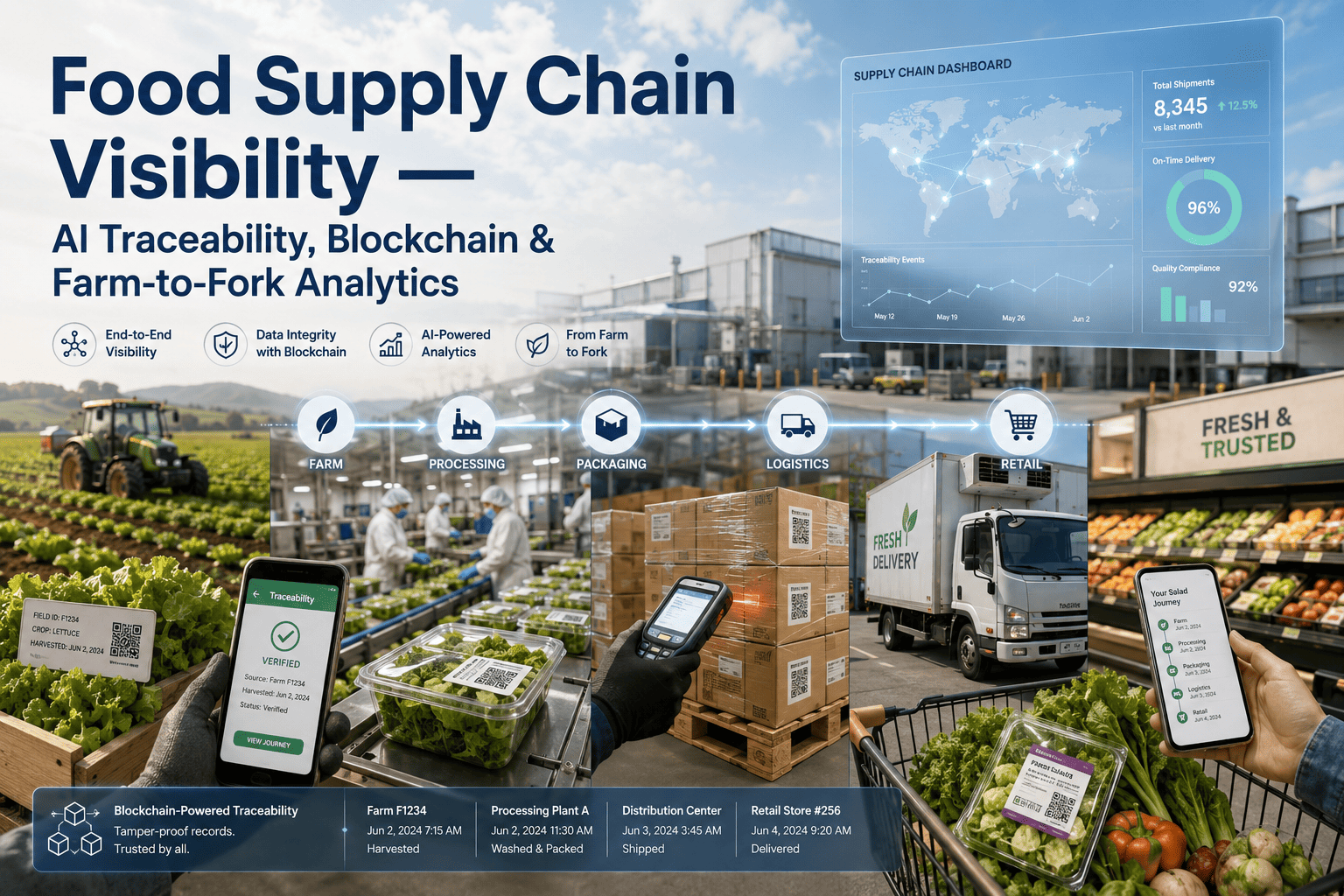
A recall investigation reads left to right and right to left through this table. The system has to keep every field aligned to the same TLC, from the receiving dock to the moment the case is loaded onto a customer truck.
| Stage | Trigger | KDEs captured | Source system |
| Receiving |
Inbound pallet scan |
Supplier TLC, receipt date, quantity, food description, source location, previous shipping reference |
WMS or receiving app |
| Storage |
Putaway confirmation |
Bin location, TLC, temperature at putaway, quantity on hand |
WMS |
| Production start |
Batch order release |
Input TLCs consumed, production order, start time, line identifier |
MES |
| Transformation |
Finished good declaration |
New TLC assigned, output quantity, input-to-output lot links, food description, production date |
MES writing to ERP |
| Case and pallet build |
Label print |
GS1-128 case label, SSCC-18 pallet label, TLC, quantity, best-by date |
Label print / MES |
| Shipping |
ASN generation |
Ship date, TLC, quantity, ship-to location identifier, transport reference, previous CTE link |
ERP / TMS |
One-up, one-back in daily operation
The rule's phrasing is deceptively simple. One-up one-back means every inbound shipment must arrive with usable KDEs and every outbound shipment must carry them forward — with data formats and lot code conventions your suppliers and customers haven't necessarily agreed on yet.
One back — what arrives from suppliers
Supplier TLC on the case and pallet label, ASN carrying the previous shipping CTE reference, product description matching the FTL entry, and unit of measure consistent with receiving. Missing KDEs from a supplier block every downstream CTE, and the plant becomes the failure point in an audit.
On the plant floor — what happens in between
Every input TLC consumed by a batch is recorded against the production order, a new TLC is assigned at transformation, and input-to-output lot linkage is written so a recall can walk backward from any finished case to every raw material lot that touched it.
One up — what ships to customers
Case label with GS1-128 encoding the finished TLC, pallet label with SSCC-18, ASN with the shipping CTE payload, and a data feed the customer can consume — retailer scorecards flag any missing field, and the deduction lands before the FDA ever asks.
On request — the 24-hour spreadsheet
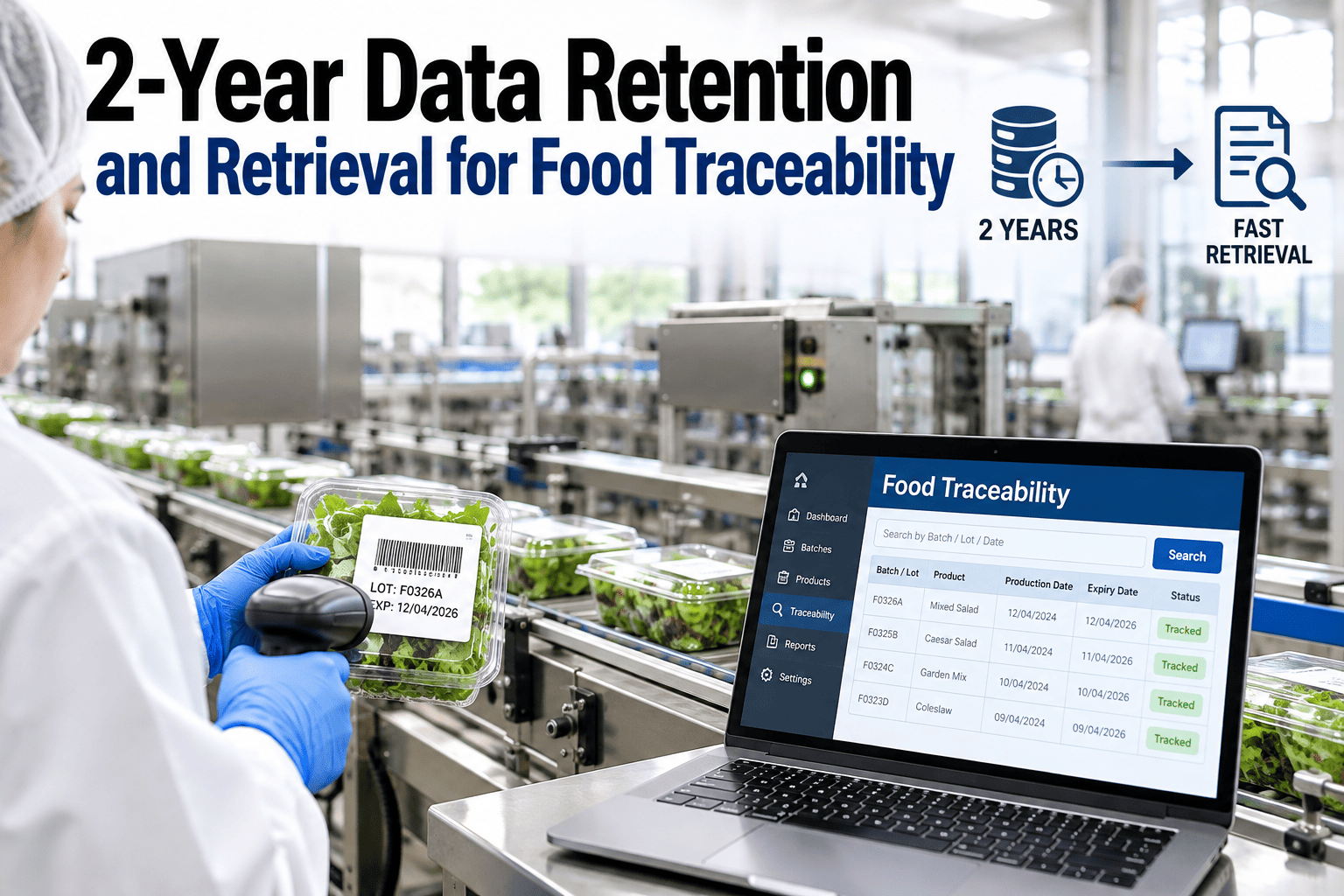
A sortable electronic spreadsheet in the FDA's specified format, filterable by TLC, food description, date range, and CTE, deliverable in under 24 hours. Manual reconstruction from paper receipts and disconnected systems will not meet this standard.
The six patterns that quietly break traceability
Most systems that fail an audit don't fail because they were never built. They fail because operational workarounds crept in and no one noticed until the recall started. These are the patterns we see repeatedly on the plant floor.
Handwritten lot codes on cases
Any lot code entered by hand loses to typos and rushed shifts. The TLC must come off a scan or a printed label.
Silent lot merging in the batch tank
When two inbound lots are combined mid-batch without a transformation record, the input-to-output linkage is destroyed and any recall becomes facility-wide.
Rework loops with no new TLC
Rework is transformation. Product returned to a mixer, remelted, or repacked needs a new TLC linked back to the original — or the chain of custody quietly breaks.
ERP receipt without a supplier TLC field
If the ERP receiving screen has nowhere to capture the supplier TLC, operators paste it into a notes field or drop it. Either way, the one-back link disappears.
Labels printed from an offline template
Case and pallet labels generated from a spreadsheet template can't guarantee unique SSCC-18 codes or live TLC lookup, so the shipping CTE writes bad data forward.
Product held for release with no CTE record
Hold-and-release status changes are not tracked as CTEs, so a lot released after a QA hold has a hole in its history that only surfaces during a full audit trace.
Frequently asked questions
Does the July 20, 2028 extension mean we can pause the FSMA 204 project?
No, and this is the trap most operations teams have to talk their leadership out of. The federal date moved, but retailer requirements did not. Walmart's supplier traceability program has been enforced since August 1, 2025 with active chargebacks, and other mass retailers are on similar timelines. The commercial deadline pulls forward from the federal deadline in almost every case, so a pause on the FSMA 204 project usually means direct margin loss through vendor scorecards.
Book a demo to see how one data model handles federal and retailer scorecards.
Which foods are actually on the Food Traceability List?
The FTL covers specific high-risk categories: several fresh cheeses (with a February 2026 exemption for certain cottage cheese products), shell eggs, fresh-cut fruits and vegetables, tropical tree fruits, cucumbers, herbs, leafy greens, melons, peppers, sprouts, tomatoes, several finfish and crustaceans, ready-to-eat deli salads, and nut butters. If your product includes an FTL ingredient, the ingredient is regulated even if the finished good is not on the list.
Contact our support team to walk your portfolio against the current FTL.
Can we meet FSMA 204 with our existing ERP alone?
Rarely. ERPs handle lot receipts and finished goods well, but they were not built to record shop-floor CTE data at the granularity FSMA 204 needs, especially transformation events with input-to-output lot linkage and real-time TLC assignment. Most plants need a plant-floor system feeding the ERP with CTE-level data, while the ERP holds the aggregated record.
Book a demo to see the plant-floor to ERP data flow.
What format does the FDA expect the 24-hour spreadsheet in?
The FDA specifies an electronic sortable spreadsheet, and has published a template on the Food Traceability Final Rule webpage. It must be filterable by TLC, food description, date range, and CTE, and deliverable within 24 hours of a request. That means the underlying system has to store CTE data in a normalized, queryable form — a PDF export of receipts will not meet the standard.
Contact our support team to review the template against your recordkeeping.
How long does a FSMA 204 implementation typically take on the plant floor?
For a single-plant food processor with existing ERP and label printing, a working CTE capture layer feeding the ERP typically takes ten to sixteen weeks, depending on how clean the receiving process already is. Multi-plant rollouts add coordination time, especially where suppliers and customers use different lot code conventions and label standards that need alignment.
Book a demo to scope a timeline against your plants and product mix.
Turn FSMA 204 from a compliance risk into a working data model
iFactory captures every CTE with full KDE fidelity, assigns TLCs at transformation, and generates the FDA-format spreadsheet on demand. Book a demo and walk it against your plant.
Book a Demo