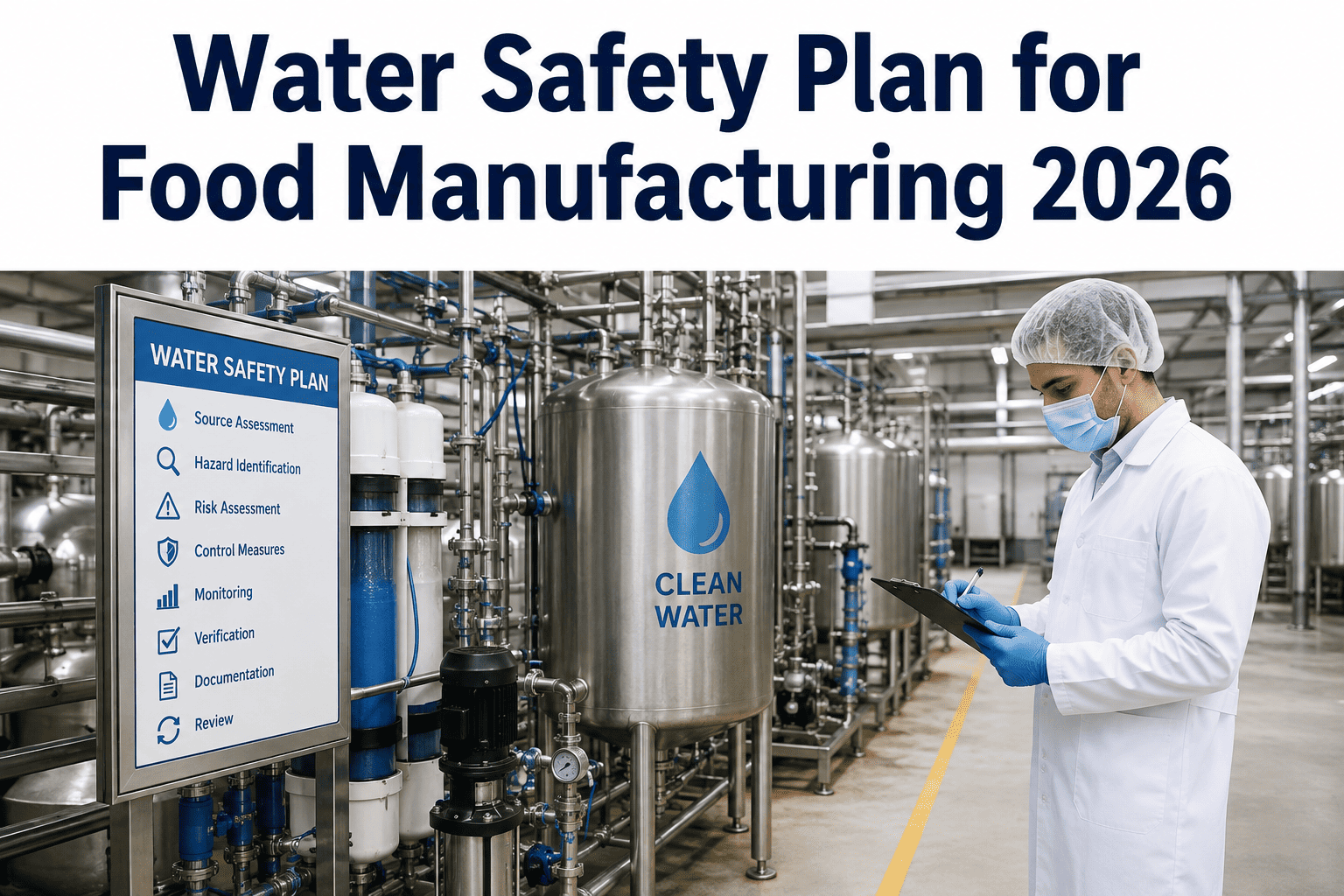
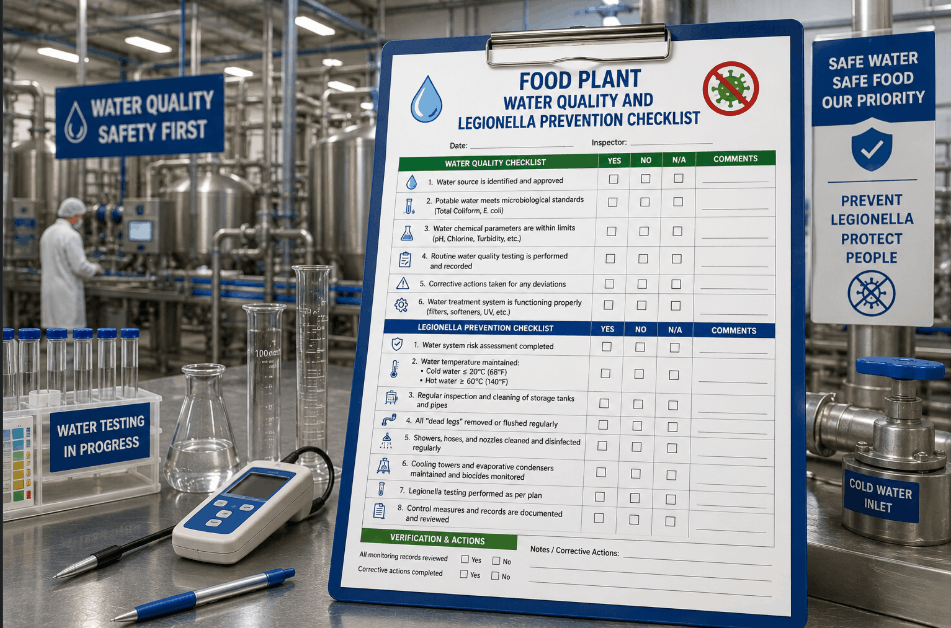
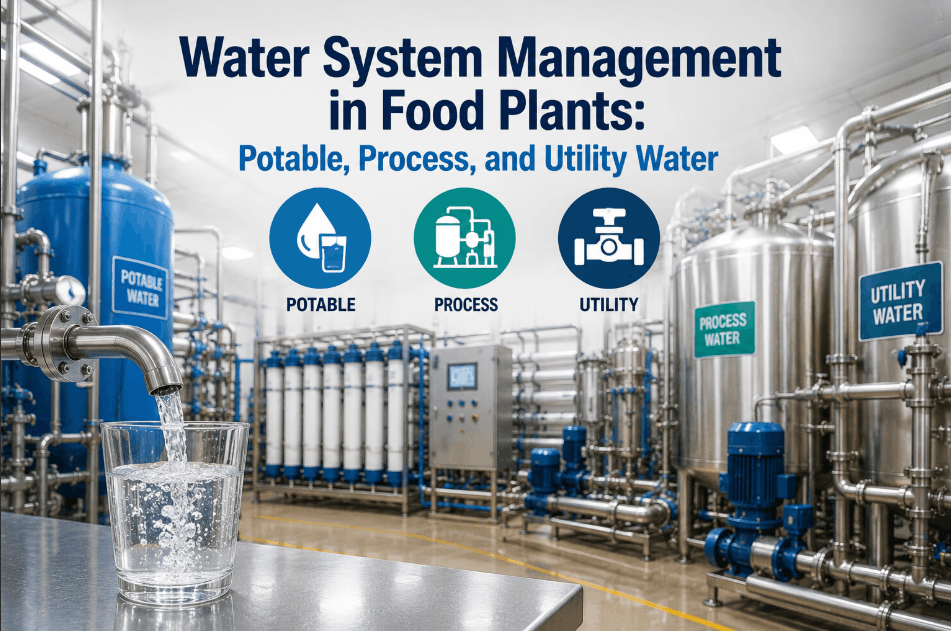
Water touches nearly every process in a food manufacturing plant, from washing raw produce to cooling pasteurized product to cleaning equipment between runs, and a plant's water safety plan is the document that determines whether that constant contact is a controlled input or an unmanaged hazard. A comprehensive water safety plan covers three distinct but connected obligations: potable water meeting drinking water standards at every point of use, process water quality appropriate to its specific application, and a documented Legionella and waterborne pathogen prevention program covering cooling towers, hot water systems, and aerosol-generating equipment. Auditors under SQF, BRCGS, and FSSC 22000 treat water as a prerequisite program in its own right, and FDA and state health inspectors increasingly ask for water management documentation as a standard line item. iFactory helps food and beverage plants build and continuously monitor every layer of their water safety plan, with the workflow explained at iFactory support.
Water Safety Plan · HACCP Compliance
Building a Water Safety Plan That Covers Potable Water, Process Water, and Legionella Risk
Testing schedules, chlorine residual monitoring, process water quality by application, and waterborne pathogen prevention — structured to satisfy FDA, GFSI, and occupational health expectations in one continuous program.
3 Domains
Potable, process, and pathogen control in one plan
Warm Water
Range where Legionella growth accelerates fastest
Annual
Minimum water safety plan review cycle
Biofilm
Primary hidden risk in stagnant or low-flow lines
Why Water Gets Its Own Prerequisite Program
The Three Ways Water Enters the Hazard Analysis
Water is unusual among prerequisite programs because it functions in three completely different roles inside the same facility, each with its own hazard profile, regulatory framework, and monitoring requirement. Treating all three as one undifferentiated "water testing" line item is the single most common structural gap in plant water programs, and it is the gap auditors are trained to probe for by asking which system a given test result actually corresponds to.
1
Potable Water
Water meeting drinking water standards used for handwashing, employee consumption, ice production, and any direct product contact application. Governed by municipal or well water supply standards and monitored for microbiological and chemical safety at the point of use, since quality at the meter does not guarantee quality at the tap furthest from the supply entry.
2
Process Water
Water used in washing, cooling, conveying, or as an ingredient, where quality requirements vary by application. Non-contact cooling water has different requirements than water used in a produce wash flume, and each application needs its own defined quality standard tied to the specific hazard it could introduce if it degraded unnoticed.
3
Building & Utility Water
Cooling towers, hot water systems, humidifiers, and other building water systems that do not contact product but present an occupational health hazard through Legionella and other waterborne pathogens carried in aerosols, a risk category that sits outside traditional food safety scope but squarely inside plant liability.
Potable Water Testing Program
What to Test, Where, and How Often
A potable water testing schedule needs to reflect the actual points of use in the plant, not just the incoming municipal supply. Internal plumbing, storage tanks, and dead-leg piping can all degrade water quality between the meter and the point where it touches product or an employee's hands, and a program built only around the incoming supply will miss every one of those internal degradation points until a routine outlet test happens to catch it.
Incoming Municipal Supply
Municipal report review: monthly
Coliform, chlorine residual, pH, municipal Consumer Confidence Report cross-check
Municipal suppliers test regularly, but the plant is still responsible for verifying the report is current and reviewing any exceedance notifications.
Well Water Supply
Full panel: quarterly minimum
Total coliform, E. coli, nitrates, pH, hardness, and any regionally relevant chemical contaminants
Private well supplies carry the full testing burden since there is no municipal treatment or reporting to rely on.
Storage Tanks & Cisterns
Testing: quarterly, inspection: annual
Coliform, chlorine residual, visual sediment inspection, tank interior condition
Storage introduces retention time and surface area for biofilm growth that the incoming supply test alone will not catch.
Point-of-Use Outlets
Rotating schedule: monthly across sites
Chlorine residual, coliform on a rotating basis covering every outlet annually at minimum
Handwash stations, ice machines, and direct-contact outlets furthest from the supply entry point are the most likely to show degradation.
Ice Production
Testing: monthly, plus visual daily
Coliform, total plate count, visual clarity and machine interior inspection
Ice machines are a recurring source of contamination findings due to infrequent cleaning schedules and condensation-driven biofilm.
Backflow Prevention
Certification: annual
RPZ device function test, cross-connection survey, certified technician sign-off
Prevents process water or non-potable sources from siphoning backward into the potable supply under pressure loss conditions.
Process Water Quality by Application
Matching Water Quality Standards to the Job Water Is Actually Doing
Not every gallon of water in a plant needs to meet the same standard, but every gallon needs a standard defined for its specific application, with a monitoring method matched to how quickly that application could turn a degraded input into a food safety event.
Application
Quality Standard
Monitoring Method
Frequency
Direct Product Contact
Potable, chlorine residual per local standard
Continuous residual monitoring or manual test strips
Continuous or per shift
Wash & Flume Water
Free chlorine or equivalent sanitizer within validated range
Automated dosing with residual sensor, logged
Continuous with hourly log check
Non-Contact Cooling
Biological and scale control per treatment program
Conductivity, biocide residual, microbiological culture
Weekly to monthly depending on system
Boiler & Steam Systems
Treated per boiler manufacturer and steam-contact requirement
Conductivity, pH, treatment chemical residual
Daily to weekly
CIP Rinse Water
Potable quality, verified free of cleaning chemical residue
Final rinse conductivity or pH check
Every CIP cycle
Ingredient Water
Potable, meeting product-specific specification
Full potable panel plus product-relevant parameters
Per potable testing schedule
A Missed Chlorine Residual Reading or a Skipped Cooling Tower Inspection Rarely Causes an Immediate Problem — Until the One Time It Does.
iFactory tracks every water testing point, every residual reading, and every Legionella control task against its schedule, flagging gaps before they become audit findings or occupational health incidents.
Legionella Risk Systems
Where Legionella Actually Grows in a Food Plant, and What Controls Each Location Needs
Legionella thrives in warm, stagnant water with biofilm present, conditions that exist in specific, identifiable systems across most food plants. A Legionella-focused Water Management Plan, aligned with ASHRAE 188 and CDC toolkit guidance, identifies each system, its risk level, and its control measures, so that monitoring effort is concentrated where the actual growth conditions exist rather than spread evenly across every water asset in the facility regardless of risk.
High Risk
Cooling Towers
Warm water, constant aerosolization, and large surface area make cooling towers the highest-risk system in most industrial water networks. Requires biocide treatment program, conductivity and biocide residual monitoring, and periodic Legionella culture testing.
High Risk
Hot Water Systems & Tanks
Water heaters, storage tanks, and distribution loops operating below the temperature threshold that suppresses Legionella growth. Requires temperature verification at the tank and at the furthest point of use, with corrective action for any reading in the growth-favorable range.
Moderate Risk
Ultrasonic Humidifiers
Reservoir design and fine aerosol generation make these units highly susceptible to biofilm formation. Requires daily cleaning documentation and periodic hydrogen peroxide or equivalent sanitization per manufacturer guidelines.
Moderate Risk
High-Pressure Wash Systems
Sanitation wash-down equipment generates fine aerosols during cleaning operations. Requires drainage design review, equipment maintenance schedules, and personnel respiratory protection where aerosol exposure risk is elevated.
Lower Risk
Sink Aerators & Showerheads
Scale buildup on fixtures provides a protective matrix for bacterial colonies even in lower-volume systems. Requires monthly removal, descaling, and disinfection soak per the facility fixture maintenance schedule.
Lower Risk
Dead Legs & Low-Flow Branches
Infrequently used piping branches allow water to stagnate even in an otherwise well-managed system. Requires identification during system mapping and either elimination or a documented flushing schedule.
Water Management Plan Structure
The Six Elements a Defensible Water Safety Plan Document Needs
A water safety plan document is judged less on length than on whether each of the following six elements is present, current, and traceable to actual records rather than aspirational language written once and never revisited.
01
Water System Description & Diagram
Full schematic of every water system in the facility — supply entry, storage, distribution, process applications, cooling towers, hot water systems — with flow direction and control points marked.
02
Hazard Analysis by System
Documented risk assessment identifying where Legionella growth, chemical contamination, or microbiological hazard could occur in each mapped system, and the severity and likelihood of each.
03
Control Limits & Monitoring
Defined control limits for temperature, disinfectant residual, and other relevant parameters at each control point, along with the monitoring method, frequency, and responsible role.
04
Corrective Action Procedures
Documented steps for responding to any control limit deviation, including remediation, retesting, and the threshold for escalating to shock disinfection or system shutdown.
05
Verification & Validation
Periodic Legionella culture testing and broader water quality data review to confirm the control measures are actually working, not just being performed on schedule.
06
Roles, Training & Documentation
Named responsible individuals for each system, their training records, and a secure, retrievable record-keeping system covering every test result and corrective action taken.
Deviation Response Protocol
What Happens When a Reading Falls Outside the Control Limit
A control limit deviation is not a failure of the water safety plan — it is the plan working as intended, provided the response that follows is fast, documented, and consistent. Plants that struggle with water safety audits are rarely the ones with occasional deviations; they are the ones without a clear, repeatable response sequence for when a deviation happens.
Immediate Isolation
The affected outlet, system, or water use point is taken out of service immediately, and any product or process step that used the water since the last acceptable reading is flagged for hold and evaluation.
Root Cause Identification
Investigation into whether the deviation stems from a supply-side issue, a treatment system failure, a dead leg or stagnation point, or a sampling or measurement error, since the corrective path differs for each.
Remediation
Flushing, shock disinfection, chemical dosing adjustment, or mechanical repair depending on root cause, performed by a qualified individual and documented with before-and-after readings.
Verification Retesting
Confirmatory testing after remediation before the system or outlet is returned to service, with results documented against the same control limit that triggered the original deviation.
Record & Plan Update
Full documentation of the deviation, investigation, and remediation filed in the water safety record, with the water management plan updated if the root cause reveals a structural gap in the original system design or monitoring frequency.
Field Example
A Beverage Bottling Plant Closing a Legionella Documentation Gap Before It Became an Occupational Health Finding
A beverage bottling plant with two cooling towers and an extensive hot water distribution network for CIP operations had a water safety plan on paper but no consistent system for tracking whether scheduled biocide dosing, conductivity checks, and quarterly Legionella culture testing were actually being completed on time. A routine occupational health and safety inspection flagged the gap between the documented monitoring schedule and the available completion records, and the plant faced a corrective action deadline to demonstrate a functioning water management program before the next scheduled inspection.
Over a ten-week rollout with iFactory, the plant digitized its full water system map covering both cooling towers, the hot water distribution network, all point-of-use potable outlets, and the ice production equipment, with automated task scheduling for every monitoring point and escalation alerts for any reading approaching the control limit or any task falling overdue. The next scheduled inspection closed with the water management program cited as a positive example, and the food safety and facilities teams reported that the automated scheduling caught three separate instances in the following year where biocide dosing had drifted below the effective range before any culture result would have flagged a problem, allowing correction well ahead of any measurable Legionella growth.
The plant has since extended the same monitoring structure to its ultrasonic humidifier units in the packaging area after a near-miss finding during an internal audit revealed that daily cleaning logs for two units had gone unrecorded for nearly three weeks during a period of staffing turnover. Facilities leadership credited the structured task assignment and completion tracking with closing what had previously been an informal, memory-dependent process spread across shift handoff notes and a wall-mounted paper log that was easy to overlook during busy production periods. The plant's corrective action closure time for water-related deviations dropped from an average of several days under the paper-based system to same-shift resolution in most cases, since the automated alert reached the responsible technician directly rather than waiting for the next scheduled review of the paper logs.
10 weeks
Full water safety program rollout
3 catches
Biocide drift corrected before culture testing would flag it
Positive citation
At following occupational health inspection
Frequently Asked Questions
What Food Safety and Facilities Teams Ask Before Building a Water Safety Plan
Is a formal Water Safety Plan or Water Management Plan legally required for a food manufacturing facility?
Requirements vary by jurisdiction and system type. In the United States, OSHA's General Duty Clause and ASHRAE Standard 188 create an expectation that facilities with cooling towers or other high-risk water systems maintain a documented Water Management Plan, and several state and local health departments now require registration or plan submission for cooling towers specifically. Under GFSI schemes such as SQF, BRCGS, and FSSC 22000, a documented water safety program covering potable and process water is an explicit certification requirement, and increasingly Legionella control documentation is requested as part of the broader facility environmental control review. Even where not strictly mandated by a single regulation, the absence of a documented plan is a defensibility gap if an incident occurs, since inspectors and legal counsel alike treat a written, actively maintained plan as evidence of due diligence and treat its absence as evidence of the opposite. Facilities operating across multiple states or countries often find it simpler to build a single program calibrated to the strictest applicable standard rather than maintaining separate documentation per jurisdiction. To assess what applies to your specific facility type and jurisdiction,
book a demo.
What chlorine residual level should potable water maintain at the point of use?
Target residual levels are set by local drinking water regulations and by the facility's own validated program, and they vary based on the water source, distribution length, and local health authority requirements. As a general operational principle, a detectable free chlorine residual at the furthest point of use from the supply entry confirms that the disinfection carried through the full distribution system rather than dissipating in transit. A residual reading of zero at a distant outlet, even when the incoming supply tests correctly, indicates a distribution issue — stagnation, biofilm consumption of the disinfectant, or a dead leg — that needs investigation rather than being dismissed as a testing anomaly. Facilities using well water without municipal chlorination need a validated in-house treatment and monitoring program calibrated to their specific system.
How often should cooling towers be tested for Legionella specifically?
Testing frequency depends on the facility's risk assessment, applicable local regulation, and the tower's operating history, but quarterly Legionella culture testing is a common baseline for industrial cooling towers under an ASHRAE 188-aligned program, with more frequent testing following any system disruption, extended shutdown and restart, or biocide treatment change. Culture testing has a turnaround time of several days to two weeks depending on the method, which is why it functions as a verification and validation activity rather than the primary control — the day-to-day control relies on maintaining biocide residual and conductivity within validated ranges, with culture testing confirming the control program is actually working. A positive result above the facility's action threshold triggers immediate remediation per the water management plan's documented response protocol.
Do ice machines really need the same scrutiny as cooling towers or hot water systems?
Ice machines carry a different risk profile than Legionella-focused systems since ice production temperature is generally too cold for Legionella growth, but they remain a recurring source of food safety findings for a different reason — condensation, infrequent internal cleaning, and biofilm buildup on interior surfaces that directly contact the ice going into product or beverages. Monthly microbiological testing combined with a documented interior cleaning and sanitization schedule, and a daily visual inspection for clarity and unusual odor, addresses the actual risk profile for ice equipment. Ice machines are frequently overlooked in water safety programs because they are categorized separately from "water testing" in many facility checklists, which is itself worth correcting during a program review. A practical way to catch this gap is to walk the facility's water asset list and confirm that every ice machine, every humidification unit, and every hose-fed portable equipment item has an assigned monitoring schedule rather than assuming coverage exists because "water testing" appears somewhere in the broader food safety plan.
How does iFactory support ongoing water safety plan management?
iFactory maintains a full water system map for the facility covering potable supply points, process water applications, cooling towers, hot water systems, and humidification equipment, with each monitoring point scheduled against its defined frequency and control limit. Chlorine residual readings, conductivity checks, biocide dosing confirmations, and Legionella culture results are logged against the schedule, with automated alerts when a reading approaches a control limit or a scheduled task falls overdue. Deviation events trigger a documented corrective action workflow with retesting requirements before a system is returned to service, and the full water safety record — testing history, corrective actions, certifications, and the water management plan document itself — stays queryable on demand for inspections and audits. To see the water safety module configured against your specific system map,
book a demo.
Turn Your Water Safety Plan From a Static Document Into a Continuously Monitored Program.
Potable water testing, process water quality, and Legionella prevention — scheduled, monitored, and documented across every system in the plant.