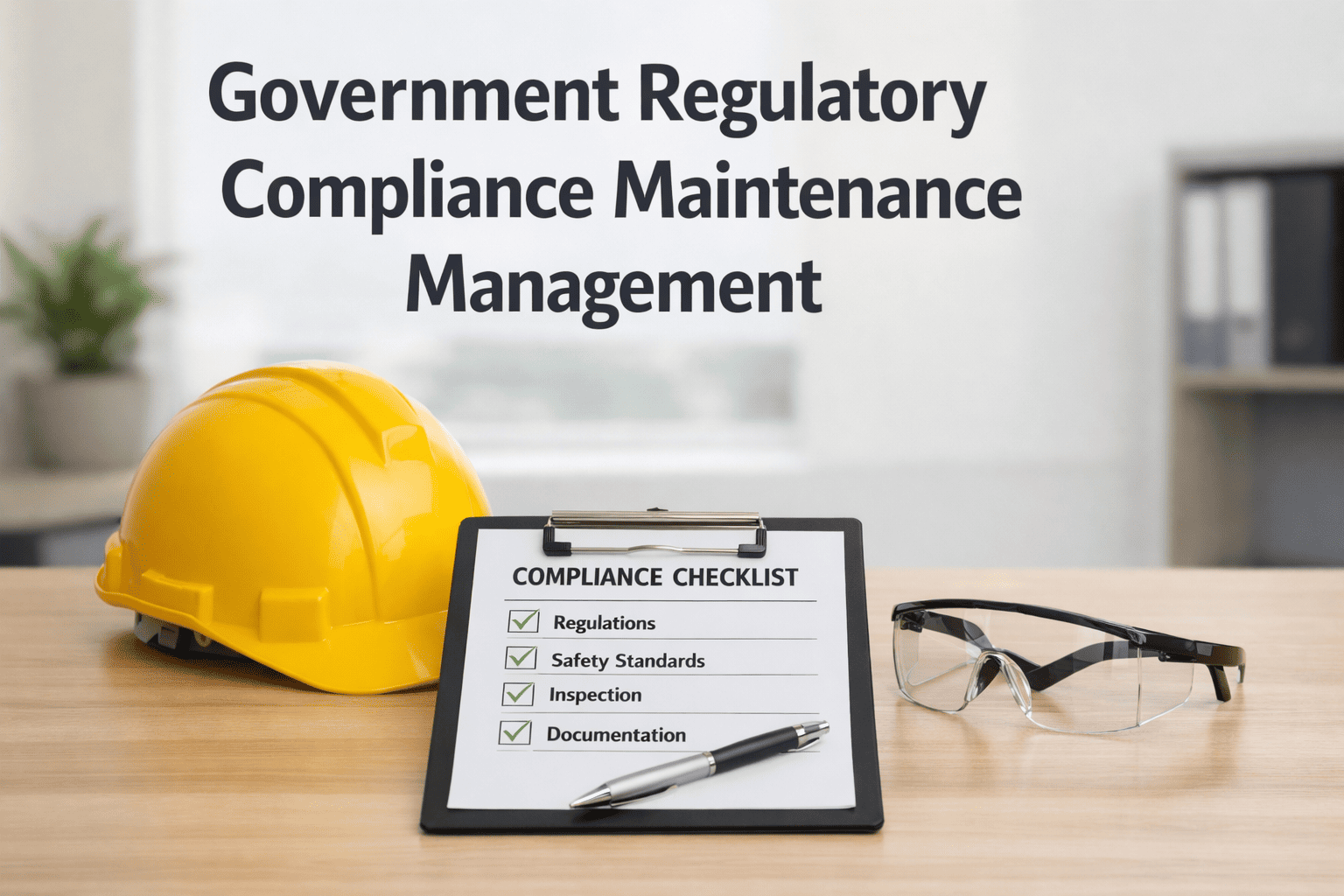
Government Regulatory Compliance Maintenance Management
By oxmaint on March 9, 2026
Every government building, water treatment plant, and public school in the United States operates under a complex web of federal, state, and local maintenance regulations. OSHA alone issued over 30,000 citations in the past year, with willful violation penalties now reaching $165,514 per incident. When you layer in EPA environmental mandates, ADA accessibility requirements, and NFPA fire safety codes, the compliance burden on public-sector maintenance teams becomes staggering. The reality is stark—manual compliance tracking using spreadsheets and paper logs leaves dangerous gaps that auditors find and regulators penalize. Modern compliance management software turns this challenge into a streamlined, automated workflow that keeps every inspection documented, every deadline met, and every facility audit-ready. Schedule a free compliance assessment to identify where your government facilities have regulatory gaps and how to close them.
Why Government Facilities Face Higher Compliance Risks Than Private Sector
Public-sector maintenance carries a unique burden. Government facilities serve vulnerable populations—children in schools, patients in public health centers, citizens in courthouses—making compliance failures a public safety crisis, not just a financial one. Unlike private businesses that answer primarily to shareholders, government agencies face public accountability, media scrutiny, and legislative oversight when maintenance-related compliance failures occur.
$165,514
Maximum OSHA penalty per willful violation in 2025
$67,544
Maximum daily EPA fine under the Clean Air Act
$150,000
ADA penalty for subsequent accessibility violations
The compounding problem is that government facilities often manage hundreds of assets across multiple locations—each with its own inspection schedule, regulatory body, and documentation requirements. A single missed fire alarm test or overdue elevator inspection creates a compliance gap that can remain hidden until an auditor or, worse, an incident exposes it.
Don't wait for a $165,000 citation to find your compliance gaps. Get Support now to get a centralized dashboard that tracks every OSHA, EPA, ADA, and NFPA deadline across all your government facilities—so nothing slips through the cracks.
OSHA, EPA, ADA, and NFPA: What Each Regulation Demands from Maintenance Teams
Understanding the specific maintenance obligations under each regulatory framework is the foundation of any compliance program. Each agency enforces different standards, inspection cycles, and documentation requirements—and the overlap between them creates blind spots that trip up even experienced teams.
OSHAWorkplace Safety
Occupational Safety & Health Administration
Requires documented lockout/tagout procedures for all energy-isolating equipment, regular fire extinguisher and exit route inspections, hazard communication programs with accessible Safety Data Sheets, and complete training records for every maintenance worker. Government facilities must maintain inspection logs that prove compliance with 29 CFR 1910 (General Industry) and 29 CFR 1926 (Construction) standards.
Lockout/TagoutPPE RecordsExit RoutesTraining Logs
EPAEnvironmental
Environmental Protection Agency
Mandates hazardous waste handling procedures, stormwater management plans, underground storage tank monitoring, and air quality compliance documentation. Government facilities generating hazardous waste must track manifests, maintain generator status records, and document proper disposal through licensed vendors with complete chain-of-custody records.
Requires all government buildings to maintain accessible pathways, operational elevators, compliant restroom facilities, and proper signage. Maintenance teams must track the condition of ramps, automatic doors, tactile surfaces, and accessible parking spaces—with documented remediation timelines when issues arise.
Sets enforceable standards for fire suppression system testing, alarm panel inspections, emergency lighting verification, and electrical preventive maintenance programs. NFPA 70B (now mandatory since 2023) requires documented electrical maintenance programs—and OSHA uses NFPA standards as evidence of national consensus during inspections.
How CMMS Software Automates Government Compliance Tracking
Manual compliance management fails government agencies because regulations change, staff turns over, and paper records disappear. A Computerized Maintenance Management System centralizes every regulatory requirement, automates inspection scheduling, and builds the audit trail regulators demand—removing human error from the most critical workflows.
Compliance Automation CapabilitiesHow CMMS replaces manual tracking at every step
Regulatory Calendar Engine
Maps every OSHA, EPA, ADA, and NFPA requirement to specific assets and auto-generates work orders on regulatory timelines. Fire extinguisher monthly checks, annual elevator certifications, quarterly EPA sampling—all scheduled without manual input.
Digital Inspection Checklists
Technicians follow regulation-specific checklists on mobile devices, capturing photo evidence, digital signatures, and GPS-tagged timestamps. Every inspection step maps directly to the regulatory standard it satisfies.
Escalation Alerts & Overdue Tracking
When a compliance task misses its deadline, the system escalates notifications from technician to supervisor to facility director. No overdue inspection sits unnoticed—every gap is flagged before it becomes a citation.
One-Click Audit Reports
Generate complete compliance documentation for any regulatory body in seconds. Every completed inspection, corrective action, training record, and sign-off is searchable and exportable—turning days of audit preparation into minutes. Get Support today and generate your first compliance audit report within minutes of setup.
Want to see how automated checklists, escalation alerts, and one-click audit reports work for your facilities? Book a 30-minute walkthrough and our team will demonstrate compliance automation configured for your specific regulatory requirements.
Government Compliance Inspection Schedules by Facility Type
Each type of government facility carries a different mix of regulatory obligations based on its function, occupancy classification, and the populations it serves. Knowing exactly which inspections apply—and how often—is the first step toward building a gap-free compliance program.
Inspection Frequency Matrix by Facility Type
Facility
OSHA Requirements
EPA Requirements
NFPA Requirements
ADA Requirements
City Halls & Courthouses
Annual safety audits, quarterly exit route checks
Hazmat storage logs, waste disposal records
Monthly fire alarm tests, annual sprinkler inspections
Inspection frequencies represent minimum regulatory requirements. Many jurisdictions impose additional state and local standards that increase these obligations.
Managing inspections across multiple facility types with different schedules? Get Support to auto-map every OSHA, EPA, ADA, and NFPA inspection frequency to the right assets—so your team never misses a deadline at any location.
The Real Cost of Non-Compliance: Penalties, Shutdowns, and Public Trust
Government compliance failures carry consequences far beyond financial penalties. A single OSHA violation can trigger a cascade of media coverage, legislative hearings, and public distrust that takes years to rebuild. Understanding the full cost of inaction puts the value of automated compliance management into perspective.
Direct Financial Impact
OSHA Willful Violation
$165,514
OSHA Repeat Violation
$165,514
OSHA Serious Violation
$16,550
EPA Daily Penalty (Clean Air)
$67,544/day
ADA First Violation
$75,000
Hidden Costs of Non-Compliance
Operational shutdowns — Facilities closed during investigations halt critical public services
Legal liability — Personal injury lawsuits from maintenance-related incidents
Leadership consequences — Agency directors removed over safety failures
Insurance increases — Premiums rise 20-40% following compliance citations
Public trust erosion — Media coverage of safety failures damages agency credibility
Stop Compliance Gaps Before They Become Headlines
One missed OSHA inspection can cost your agency more than an entire year of CMMS licensing. Automate every compliance requirement, build audit-ready documentation, and protect public trust with a platform designed for government maintenance operations.
Building Compliance-First Maintenance in Public-Private Partnerships
Public-Private Partnerships introduce dual accountability for regulatory compliance. When private operators manage government-owned assets, both parties need clear visibility into maintenance standards, inspection outcomes, and corrective action progress. Without a shared compliance platform, gaps form at the organizational boundary—exactly where auditors look hardest.
The Challenge
Private operators track maintenance in their own systems while government oversight teams use separate documentation
Compliance accountability becomes unclear—who is responsible for fire system inspections versus elevator certifications?
Audit preparation requires assembling records from multiple organizations with different formats and standards
The CMMS Solution
Unified compliance platform with role-based access gives both public and private teams visibility into shared obligations
Every compliance task is assigned to a specific responsible party with automated tracking and escalation workflows
One-click reporting satisfies both government auditors and private stakeholders with a single source of compliance truth
Running a Public-Private Partnership and need shared compliance visibility? Book a demo to see how role-based dashboards give both government oversight teams and private operators real-time access to inspection data, corrective actions, and audit-ready reports.
From Compliance Gaps to Audit-Ready Operations: Implementation Guide
Implementing compliance-focused CMMS across government facilities follows a structured approach that delivers immediate risk reduction while building toward comprehensive regulatory coverage. Most agencies reach audit-ready status within the first 90 days—with measurable compliance improvements visible from week one.
90-Day Compliance Transformation Roadmap
Days 1-14
Compliance Gap Analysis
Inventory all applicable regulations across facilities. Identify every compliance gap, overdue inspection, and documentation deficiency. Prioritize risks by penalty severity and public safety impact.
Days 15-35
System Configuration & Data Migration
Build compliance task templates for every regulation. Configure automated scheduling, alert escalation rules, and role-based access. Import historical maintenance records to establish audit continuity.
Days 36-60
Team Training & Pilot Launch
Train technicians on mobile inspection workflows and digital checklists. Educate facility managers on compliance dashboards. Run practice audit simulations to validate documentation completeness.
Days 61-90+
Full Compliance Activation
Activate automated compliance tracking across all facilities. Generate first comprehensive compliance reports. Begin continuous improvement cycle with performance benchmarking. Schedule a 30-minute demo and our team will build a 90-day compliance deployment plan tailored to your agency's regulatory obligations.
Compliance is not about passing inspections—it is about building systems that make compliance automatic. The government agencies that thrive are the ones that stop reacting to audits and start preventing the conditions that trigger citations. When every inspection is scheduled, every task is documented, and every corrective action is tracked to completion, compliance becomes a byproduct of good maintenance—not a separate burden.
— Public-Sector Facilities Management Director
Automate Government Regulatory Compliance Today
Your maintenance team protects public safety every day. Give them the tools to prove it. Centralize every OSHA, EPA, ADA, and NFPA requirement in one platform that schedules inspections automatically, captures evidence digitally, and generates audit-ready reports on demand—so your facilities stay compliant, your budgets stay protected, and your community stays safe.
What OSHA standards apply specifically to government building maintenance?
Government building maintenance falls primarily under OSHA's General Industry standards (29 CFR 1910), which cover lockout/tagout procedures for equipment servicing, hazard communication for chemical handling, personal protective equipment requirements, exit route maintenance, and electrical safety. The 2025 penalty for serious violations is $16,550, while willful violations can reach $165,514. Book a demo and we'll walk you through automated OSHA lockout/tagout scheduling, inspection logging, and citation-proof documentation.
How does CMMS help prepare for regulatory compliance audits?
CMMS generates instant audit trails containing completed inspection checklists with timestamps, photo documentation, corrective action records with resolution details, electronic technician sign-offs, and compliance trend reports. Instead of spending days gathering paper records before an audit, managers generate comprehensive compliance reports in minutes—searchable by regulation, facility, date range, or asset.
Can one CMMS platform track compliance across OSHA, EPA, ADA, and NFPA simultaneously?
Yes. Modern CMMS platforms map requirements from multiple regulatory bodies to specific assets and locations within one unified system. Each regulation has its own inspection schedule, compliance checklist, and documentation standard—but everything feeds into a centralized dashboard that shows real-time compliance status across all regulations and all facilities. Get Support for free and explore the multi-regulation compliance dashboard that shows every deadline, every facility, and every standard in one view.
What is the biggest compliance risk for government maintenance teams?
The biggest risk is not knowing what you are missing. Manual tracking systems create invisible gaps—an overdue fire alarm test, a lapsed elevator certificate, or an undocumented hazmat disposal. These gaps remain hidden until an auditor finds them or an incident exposes them. Automated compliance tracking eliminates this blind spot by surfacing every overdue task and escalating every missed deadline before it becomes a violation.
How quickly can government agencies implement compliance-focused CMMS?
Most government agencies achieve basic compliance automation within 4-6 weeks, with full deployment including mobile workflows, automated reporting, and multi-facility coverage by day 90. The phased approach delivers immediate risk reduction—starting with the highest-penalty regulations—while building toward comprehensive coverage. Schedule a free 30-minute consultation and our team will map your agency's regulations, identify priority gaps, and deliver a phased deployment timeline within one business day.