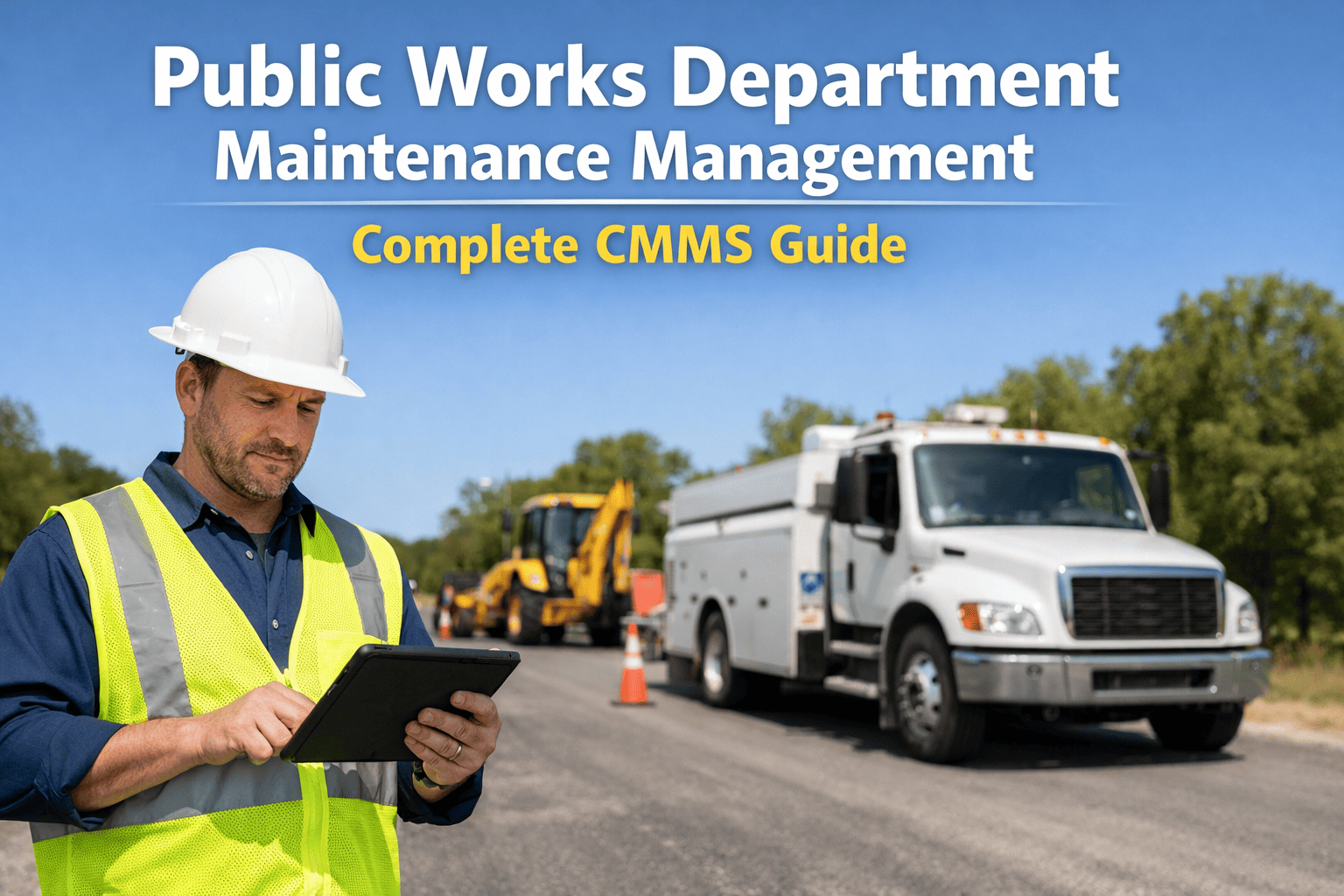
Public Works Department Maintenance Management: Complete CMMS Guide
By oxmaint on March 5, 2026
Every municipality relies on its public works department to keep roads safe, water flowing, parks maintained, and buildings operational. Yet most public works teams still manage thousands of assets across dozens of square miles using paper logs, phone calls, and spreadsheets that were never designed for infrastructure at scale. The result is predictable—missed inspections, emergency repair costs that devour budgets, and citizen complaints that erode public trust. A Computerized Maintenance Management System (CMMS) replaces this fragmented approach with a single platform that connects every crew, every asset, and every work order in real time. Schedule a consultation to explore how CMMS can streamline your municipal maintenance operations.
What Makes Municipal Maintenance Different from Private Sector Operations
Public works departments operate under constraints that most private organizations never face. Understanding these unique pressures reveals why a purpose-built CMMS is essential—not optional—for municipal infrastructure management.
Public Accountability
Every dollar comes from taxpayers. Council members demand documented proof that maintenance budgets are spent wisely, and any misstep becomes a public record. CMMS provides the audit trail that paper systems cannot.
Geographic Sprawl
Assets are scattered across an entire jurisdiction—underground pipes, remote pump stations, bridges over waterways, and traffic signals at hundreds of intersections. Coordinating crews without a centralized system means wasted windshield time and delayed responses.
Regulatory Burden
Federal EPA permits, state bridge inspection mandates, ADA accessibility requirements, and OSHA safety standards all demand documented compliance. A single missed inspection can trigger fines or legal liability.
Citizen Expectations
Residents expect potholes fixed quickly, streetlights repaired overnight, and parks kept safe year-round. When service fails, the complaints go straight to elected officials—and the maintenance team hears about it immediately.
$1 Trillion+
The estimated accumulated cost of deferred maintenance across U.S. public infrastructure. Municipalities that shift from reactive to preventive maintenance reduce total lifecycle costs by 25-35%.
How CMMS Solves the Five Biggest Public Works Pain Points
Municipal maintenance teams deal with the same recurring problems year after year. A properly configured CMMS addresses each one directly, turning operational chaos into structured, measurable workflows.
01
Lost & Delayed Work Orders
Digital work orders created, assigned, and tracked from any device. Automated routing sends requests to the nearest available crew with the right skill set—no more paper shuffling between offices.
02
Reactive-Only Maintenance Culture
Automated preventive maintenance schedules for every asset class. Calendar-based, meter-based, or condition-based triggers ensure critical equipment gets serviced before it fails—not after.
03
No Visibility into Asset Condition
Centralized asset registry with full maintenance history, condition scores, replacement cost data, and remaining useful life estimates. Every decision—repair or replace—is backed by data.
04
Slow Citizen Request Response
Self-service citizen request portal converts public reports into geo-tagged work orders automatically. Status updates flow back to residents, reducing repeat calls and building community trust.
05
Budget Justification Without Data
Real-time dashboards and automated reports show council members exactly where money is spent, which assets need capital investment, and how maintenance performance trends over time.
Dealing with lost work orders and reactive repair cycles? Book a 30-minute demo and we'll show you exactly how municipalities automate dispatching, preventive scheduling, and budget reporting—using workflows built for roads, water, parks, and facilities crews.
Infrastructure Assets Every Municipality Must Track
A CMMS only delivers value when it covers the full scope of municipal infrastructure. Public works teams typically manage six major asset categories—each with distinct maintenance cycles, inspection requirements, and failure consequences.
Municipal Asset Categories & CMMS Tracking Requirements
A CMMS consolidates all six categories into one searchable database—giving directors cross-departmental visibility that spreadsheets and siloed systems cannot provide.
From Citizen Report to Completed Repair: The Digital Workflow
The real power of CMMS becomes clear when you trace a single maintenance request through the entire lifecycle. What used to take days of phone calls and paperwork now happens in hours—with a complete audit trail at every step.
Citizen Reports
A resident submits a pothole report through the public request portal, uploading a photo with automatic GPS tagging of the exact location.
Auto-Created Work Order
CMMS converts the request into a prioritized work order, categorized by asset type, severity level, and geographic zone—no manual data entry required.
Smart Crew Assignment
The system assigns the task to the nearest available roads crew based on skill set, current workload, and proximity. The crew receives a mobile alert with driving directions and asset history.
Field Execution & Documentation
Technicians log materials used, labor hours, and completion photos directly from the mobile app. Parts are automatically deducted from inventory records.
Closure & Citizen Notification
Work order closes with a complete repair record. The citizen who reported the issue receives an automatic status update—building transparency and public confidence.
Your residents report issues daily—are you tracking every request from submission to resolution? Get Support to access the citizen request portal, mobile crew dispatching, and automated status notifications that cut response times from days to hours.
Measuring What Matters: KPIs That Drive Public Works Performance
Without measurable targets, maintenance teams operate on instinct rather than evidence. A CMMS captures the operational data that transforms vague goals into trackable performance indicators—giving directors the proof they need for budget hearings and strategic planning.
70-80%
Preventive Maintenance Ratio
Target percentage of all work orders that are planned preventive tasks versus reactive emergency repairs. Leading municipalities achieve 80%+ with CMMS automation.
<24 hrs
Citizen Request Response Time
Average time from citizen report to first crew response. CMMS auto-routing and mobile dispatch reduce this from days to hours.
95%+
Work Order Completion Rate
Percentage of work orders closed within their scheduled timeframe. CMMS tracking and automated escalation prevent tasks from falling through the cracks.
15-25 yrs
Asset Life Extension
Additional years of service life achieved through consistent preventive maintenance programs—delaying costly capital replacements by decades.
Ready to Measure and Improve Public Works Performance?
Stop guessing whether your maintenance program is working. CMMS gives you real-time dashboards, automated reports, and the data-driven evidence to optimize operations, justify budgets, and deliver better services to your community.
Connecting the Dots: CMMS Integration with Municipal Systems
Public works departments don't operate in a technology vacuum. A CMMS delivers maximum value when it connects with the GIS maps, financial software, SCADA systems, and citizen portals already in use across the municipality.
GIS & Mapping Platforms
Esri ArcGIS and similar platforms feed spatial data into CMMS, enabling map-based asset views, optimized crew routing, and location-aware work order creation. Maintenance teams see exactly where assets sit—and which ones need attention first.
Financial & ERP Systems
Bidirectional sync with accounting software ensures every work order cost flows to the correct budget line. Purchase orders, vendor invoices, and labor costs reconcile automatically—eliminating month-end surprises.
SCADA & IoT Sensors
Real-time feeds from water pressure sensors, pump station monitors, and building automation systems trigger work orders automatically when readings fall outside thresholds—catching failures before residents notice.
Citizen Engagement Portals
311 systems and municipal websites connect directly to CMMS so public reports convert to tracked work orders instantly. Status updates flow back to citizens without staff intervention.
Fleet Management Systems
GPS tracking and telematics data sync with CMMS to schedule vehicle maintenance by mileage or engine hours, track fuel consumption, and ensure DOT inspection compliance across the entire municipal fleet.
Already using GIS, SCADA, or ERP systems across your municipality? Schedule a demo and our engineers will map your current technology stack, identify integration points, and show you how CMMS connects every system into one unified maintenance platform—at no cost or commitment.
Getting Started: A Practical CMMS Rollout Plan for Municipalities
Deploying CMMS across multiple departments requires more than just installing software. A structured rollout that starts small, proves value quickly, and expands methodically ensures long-term adoption and measurable results.
Phase 1
Assess & Prioritize (Weeks 1-3)
Audit current maintenance processes, inventory critical assets, and identify the department with the highest pain—usually roads or water. This becomes your pilot department where CMMS proves its value fastest.
Phase 2
Configure & Migrate (Weeks 4-6)
Set up user roles, asset hierarchies, and work order templates. Import existing asset data from spreadsheets, GIS databases, and legacy systems. Configure the citizen request portal and notification rules.
Phase 3
Train & Launch Pilot (Weeks 7-9)
Train supervisors on dashboards and reporting, then onboard field crews with hands-on mobile app training. Launch the pilot department and measure results against baseline metrics.
Phase 4
Expand & Optimize (Week 10+)
Roll out to remaining departments using lessons learned from the pilot. Activate preventive maintenance schedules, configure advanced reporting for council presentations, and establish continuous improvement cycles.
Build a Smarter Public Works Department Starting Today
Your community deserves well-maintained roads, reliable water, safe parks, and responsive public services. CMMS gives your team the centralized platform to coordinate every department, track every asset, automate preventive maintenance, and prove your value with data—all while reducing costs and improving the quality of life for every resident you serve.
How long does it take to implement CMMS across a public works department?
Most municipalities have a pilot department running within 4-6 weeks, with full multi-department rollout completed in 10-14 weeks. Timeline depends on the number of departments, volume of assets to migrate, and complexity of integrations with existing GIS and financial systems. Book a demo to discuss a deployment timeline customized for your municipality.
Can CMMS handle citizen service requests directly from the public?
Yes. Modern CMMS platforms include citizen-facing portals where residents submit maintenance issues—potholes, broken streetlights, water leaks, park damage—with photos and GPS coordinates. Requests automatically convert into prioritized work orders, and status updates flow back to the reporting citizen without manual staff intervention.
Will our field crews actually adopt mobile work order tools?
Adoption rates are consistently high when the mobile interface is simple and clearly saves time. Technicians view assigned tasks, access asset history, attach completion photos, and log labor hours—all from a phone or tablet without driving back to the office. Most crews see the benefit within the first week. Get Support to try the mobile experience firsthand.
How does CMMS help with regulatory compliance for public infrastructure?
CMMS automatically schedules and documents required inspections for bridges, water systems, stormwater infrastructure, and public buildings. It generates audit-ready compliance reports that satisfy federal, state, and local requirements—from EPA stormwater permits to FHWA bridge inspection standards and ADA facility audits.
Can CMMS integrate with our existing GIS and financial systems?
Absolutely. CMMS platforms connect with Esri ArcGIS for spatial asset management, ERP and accounting systems for automated cost allocation, SCADA for real-time infrastructure monitoring, and 311 portals for citizen engagement. API-based integrations ensure data flows seamlessly between systems. Book a demo to review integration options for your current technology stack.