Multi-Campus Management: How Universities Centralize Operations with AI
By Mark Nessim on May 27, 2026
Multi-campus universities face a $112 billion national deferred maintenance backlog and an accelerating fiscal pressure that turns centralized operations from a strategic advantage into a survival capability. According to APPA, institutions operating 3+ campuses spend 18-25% more per square foot on maintenance than single-campus equivalents — not because their buildings are worse, but because each campus runs separate spreadsheets, separate work order tools, separate inspection logs, and ERP modules never designed for facility management. iFactory's centralized AI program packages a unified asset hierarchy, cross-campus failure pattern detection, FCI capital planning dashboards, and higher-education ERP integrations into a single phased deployment — pilot campus live in 4-6 weeks, full system rollout aligned to academic calendar, with 90-day hands-on implementation support included from kickoff. Book a demo to see the centralization roadmap and your university system's deployment timeline.
Higher Education — Multi-Campus AI 2026
Multi-Campus Management: AI-Centralized University Operations with Cross-Campus Intelligence
Unified asset hierarchy across every campus · Cross-campus failure pattern detection · FCI capital planning · APPA-aligned reporting · Banner / Workday / PeopleSoft integration · Phased academic-calendar rollout · 90-day implementation support included.
National higher-ed deferred maintenance backlog per APPA
18-25%
Extra cost per sq ft at 3+ campus institutions vs single-campus
6+ Lvl
Of nested hierarchy — system, district, building, asset, component
90 Day
Hands-on implementation support included from kickoff
Why Multi-Campus Universities Need AI Centralization — Not Another Standalone CMMS
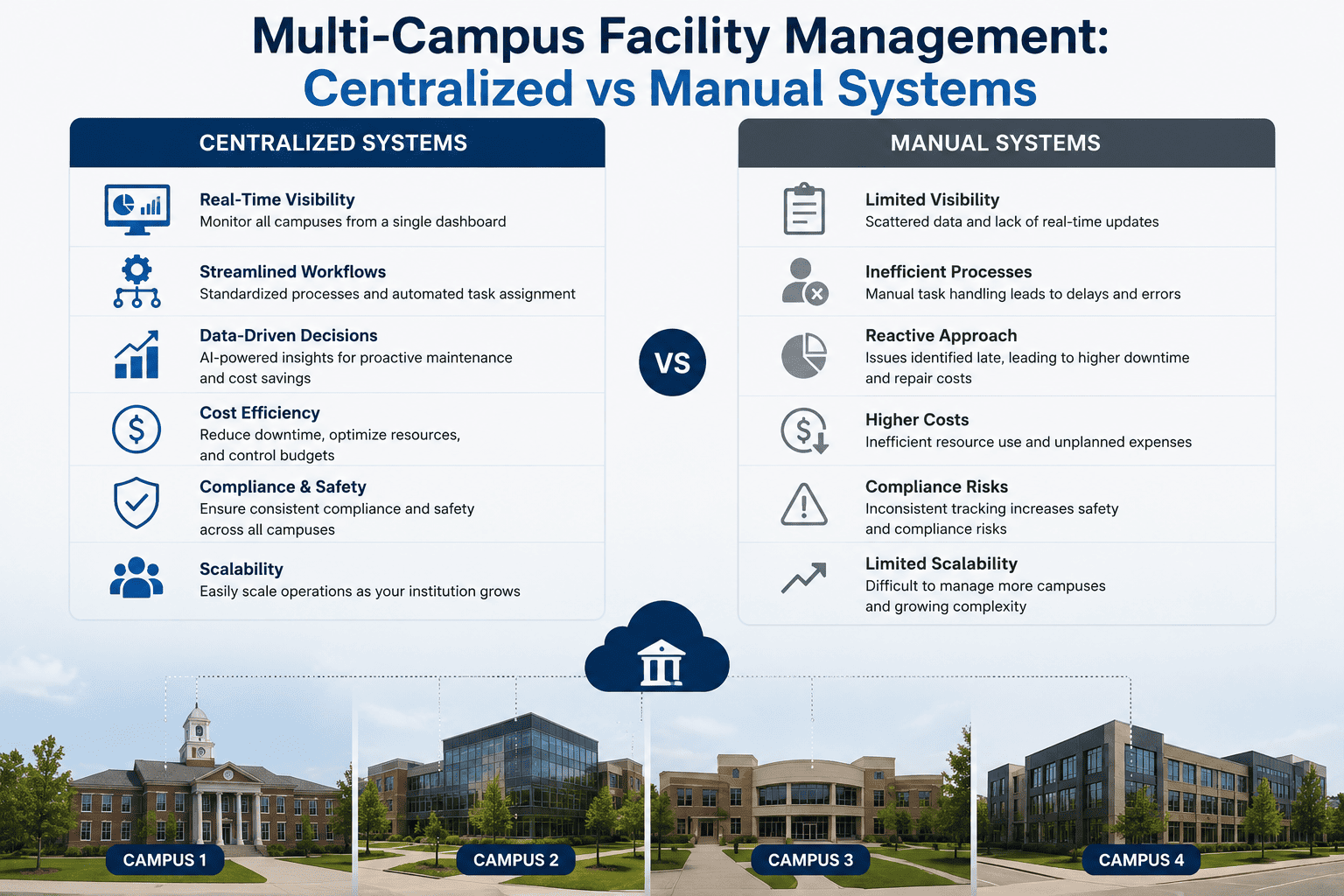
The standard path for multi-campus universities adopting facility management software involves selecting a CMMS vendor per campus, exporting data from departmental spreadsheets, hiring an integrator for ERP connections to Banner or Workday, validating role-based access for each campus team, and finally consolidating reports manually at the central office. Most of this work runs in parallel at each campus with no shared methodology — and the result is twelve disconnected systems that the CFO and provost cannot benchmark against each other. iFactory's centralization program collapses these silos by deploying one unified asset hierarchy across every campus, shipping pre-built PM templates for higher-education equipment categories, and assigning a dedicated higher-education implementation specialist for the full phased rollout aligned to your academic calendar.
5-Phase Multi-Campus Centralization Roadmap
Phase 1
Portfolio Audit
Every campus assessed · Asset inventory · Hierarchy design · ERP gap analysis
Discovery
▶
Phase 2
Pilot Campus
First site live · Pre-built templates loaded · Banner / Workday connected
Cross-campus pattern detection · FCI scoring live · Predictive workflows
Intelligence
▶
Phase 5
Capital Planning
Board-ready exports · 5-10 yr forecast · Bond-grade documentation
Live
The Three Problems iFactory's Multi-Campus Centralization Program Solves
01
Fragmented Operations Across Campuses With No Portfolio Visibility
Most multi-campus universities run independent work order systems, departmental inspection spreadsheets, and paper compliance logs at each site. The central office cannot benchmark spend-per-square-foot across campuses, identify which buildings carry the highest deferred maintenance liability, or document portfolio-level risk for the board of trustees. iFactory's centralization program deploys one unified asset hierarchy — system, district, building, floor, room, asset, component — with inherited PM templates at every level and role-based access so each campus team manages its own assets while leadership sees the complete portfolio. The CFO finally gets one consolidated report with consistent naming, condition scoring, and cost allocation across every site instead of reconciling twelve different spreadsheets at budget time.
Zero Cross-Campus Learning When Equipment Fails Anywhere in the System
When a chiller compressor fails at Campus A and the technician documents the bearing spalling failure mode at 8 years on a Carrier 23XRV model, that institutional knowledge stays trapped at Campus A. Identical units at Campuses B through K approach the same failure mode with no proactive inspection, no warning, and no benefit from what the maintenance team at Campus A just learned the hard way. iFactory's cross-campus AI analyzes maintenance patterns across every campus simultaneously — when a specific make, model, and failure mode is logged at any site, the platform scans every similar asset across the system and generates proactive inspection work orders with the exact failure mode to check for. Book a demo to see cross-campus failure pattern detection running on multi-site asset data.
Make + model matchingAuto WO with failure modeSystem-wide protection
03
Capital Requests Built on Anecdotes Instead of Documented Evidence
Boards approve what they can see documented — not what they hear described verbally during emergency budget requests. Without per-building Facility Condition Index data, cost-of-deferral projections, and reactive-to-planned ratio benchmarks, capital planning relies on the loudest emergencies rather than portfolio-grade evidence. iFactory's capital planning dashboards generate FCI per building, multi-year capital forecasts, and replace-vs-defer scenarios from live work order and inspection data — in board-ready and lender-ready formats. The same documentation supports credit rating agency reviews and bond issuance, the kind of fiscal management evidence that supports favorable credit assessments and lower interest rates on capital bonds.
FCI per building5-10 yr capital forecastBond-grade evidence
What's Included in the Multi-Campus Centralization Package
The implementation specialist runs a structured portfolio audit across every campus in the system — building inventory confirmed from existing records, asset inventory captured from spreadsheets and ERP exports, existing PM schedules reviewed per campus, compliance calendar consolidated across NFPA / ADA / OSHA / accreditation requirements, and ERP integration scope mapped against Banner, Workday, or PeopleSoft. The unified hierarchy is designed against your institutional structure — system office, districts or regions, individual campuses, building groupings, individual buildings, floors, rooms, and assets. By end of Phase 1, the project team has a documented hierarchy design, naming convention, condition-scoring methodology, and phased rollout plan aligned to your academic calendar.
DeliverableHierarchy design + phased rollout plan
InventoryEvery campus, every building, every asset
Pilot Campus · First Site Live, Templates Loaded & ERP Connected
Outcome: Pilot validated
One campus — typically the largest or most operationally complex — goes live as the reference deployment for the system. Pre-built higher-education PM templates load against the asset inventory: HVAC air handlers, central plant chillers, boilers, fume hoods, ULT freezers, elevators, fire suppression systems, and residence hall systems. ERP integration is configured against Banner, Workday, or PeopleSoft for cost center allocation and procurement workflows. The branded student request portal is rolled out to residence life. Maintenance crews receive mobile apps with offline capability for basements, tunnels, and remote zones. The pilot validates the hierarchy design and template library against a real campus operation — the configuration that succeeds at the pilot becomes the reference for plant-wide rollout. Contact iFactory about your existing ERP and Building Automation System inventory.
Live workflowsPM, inspections, work orders, student requests
IntegrationsBanner / Workday / PeopleSoft, Esri GIS, BAS
System Rollout · Campus-by-Campus Deployment with Inherited Configuration
Outcome: All campuses live
The pilot configuration cascades across remaining campuses one site at a time, with rollout activities scheduled into summer and winter academic breaks to avoid semester disruption. Inherited PM templates apply automatically to matching asset categories at each new campus — chiller templates configure against every chiller asset, residence hall templates configure against every residence hall, and so on. Role-based access provisions each campus team with its own assets while preserving system-wide visibility for central facilities leadership. Unified compliance calendars consolidate fire suppression, elevator, backflow, ADA, OSHA lab safety, and accreditation inspection schedules across every site. Branded student portals deploy to each campus with its own branding. By end of Phase 3, every campus operates on the same platform with consistent data, naming, and condition-scoring methodology.
AI Activation & Capital Planning · Cross-Campus Intelligence Live
Outcome: Portfolio intelligence active
With every campus contributing operational data to a single platform, cross-campus AI becomes meaningful. Failure pattern detection activates — when a Carrier 23XRV chiller fails at one campus and the technician documents the bearing failure mode at 8 years, the AI flags every identical unit across the system approaching similar wear with proactive inspection work orders. Facility Condition Index scoring goes live per building using the consolidated work order and inspection data. Multi-year capital forecasts and replace-vs-defer scenarios generate against live operational records. By end of Phase 5, the institution has board-ready and lender-ready capital planning evidence — per-building FCI trends, cost-of-deferral projections, reactive-to-planned ratio benchmarks, and capital replacement schedules in the formats rating agencies and bond reviewers recognize as creditworthy fiscal management.
AI liveCross-campus pattern detection active
Capital planFCI per building, 5-10 yr forecast, exports
What Centralization Delivers Across the University Portfolio
1 View
Every campus, every building, every asset — one unified platform
Replaces separate spreadsheets, ERP modules, and paper logs across all sites
Up to 40%
Reduction in emergency work orders per published CMMS deployment studies
Range based on industry benchmarks — actual results vary by institution
FCI
Live Facility Condition Index per building — APPA methodology
Board-ready and lender-ready capital planning exports
90 Day
Hands-on implementation support included from kickoff
Phased campus-by-campus rollout aligned to academic calendar breaks
FAQ: Multi-Campus AI Centralization for Higher Education
Yes — centralization is about shared data, methodology, and intelligence, not loss of campus control. Role-based access means each campus facilities team sees and manages its own assets, work orders, PM schedules, and inspection records. Central facilities leadership sees the complete portfolio for benchmarking, compliance oversight, and capital planning. The unified hierarchy, naming convention, and condition-scoring methodology apply consistently across sites so reports compare apples to apples — but day-to-day operational decisions stay with the campus teams who know their buildings best. Each campus also keeps its own branded student request portal, its own work order routing rules, and its own approval workflows. Book a scoping call to see role-based access configured for your institutional structure.
When equipment fails at any campus in the system, the technician documents the failure mode in the mobile app — what failed, the asset details, manufacturer and model, age in years, run hours, preceding conditions, and the specific component involved. The AI scans every similar asset across every other campus for matching patterns: same manufacturer and model, similar age, comparable operating environment, similar run-hour profile. Assets at other campuses approaching the same failure pattern get flagged with proactive inspection work orders that include the specific failure mode to check for. For example, a Carrier 23XRV chiller bearing failure at Main Campus at 8 years generates proactive inspection work orders for every Carrier 23XRV across the system approaching 7-8 years of operation. The entire system learns from every failure — an intelligence advantage that no individual campus running its own standalone tool can achieve.
Standard higher-education connectors are pre-built for Banner, Workday Student / Workday Finance, and PeopleSoft Campus Solutions — which collectively cover approximately 83% of US universities. The platform also integrates with Esri GIS for spatial asset mapping and campus location services, BACnet and major Building Automation Systems for sensor and BMS data, SAP for procurement and finance flows at larger systems, and standard PLC and SCADA protocols for central utility plants serving multiple campus buildings. Lease obligation tracking is supported for satellite campuses with leased facilities, including landlord vs. tenant maintenance responsibility flags and warranty contract coverage. Contact iFactory about your specific systems inventory before deployment scoping.
Boards of trustees approve what they can see documented — not what they hear described verbally during emergency capital requests. Board-ready exports include per-building Facility Condition Index trends, cost-of-deferral projections, replace-vs-defer scenarios, reactive-to-planned ratio benchmarks, emergency work order trends, and capital replacement schedules — all generated from live work order and inspection data across the portfolio. Lender-ready means the same documentation supports credit rating agency reviews and bond issuance — the kind of fiscal management evidence that supports favorable credit assessments. A university issuing capital bonds at a lower interest rate due to stronger credit assessment can save substantial amounts over the bond term, and rating agencies specifically recognize FCI trend data, systematic preventive maintenance programs, and data-driven capital plans as creditworthy fiscal stewardship.
Phased campus-by-campus deployment is standard — major rollout activities target summer break and winter break windows, with pilot validation and configuration work performed during the academic year when student impact is minimal. The pilot campus goes live first as the reference deployment, typically scheduled around the largest available break window. Subsequent campuses inherit templates, naming conventions, condition-scoring methodology, and ERP integration patterns automatically, which compresses each subsequent rollout. The dedicated implementation specialist coordinates campus-level activities with each site's facilities director and IT lead, and 90-day hands-on support is included to handle questions that emerge after each campus goes live. The result is a multi-campus deployment that respects how universities actually operate — academic calendars, semester transitions, residence hall move-in / move-out periods, and existing facility staff workloads.
Get Your Multi-Campus Centralization Roadmap
Unified asset hierarchy across every campus. Cross-campus AI that learns from every failure. FCI capital planning in board-ready and lender-ready formats. Pre-built integrations for Banner, Workday, PeopleSoft, Esri GIS, and major Building Automation Systems. Dedicated higher-education implementation specialist. 90-day hands-on support included from kickoff. One platform, one methodology, one source of truth — designed to replace the spreadsheet sprawl that costs multi-campus institutions 18-25% more per square foot than single-campus equivalents.