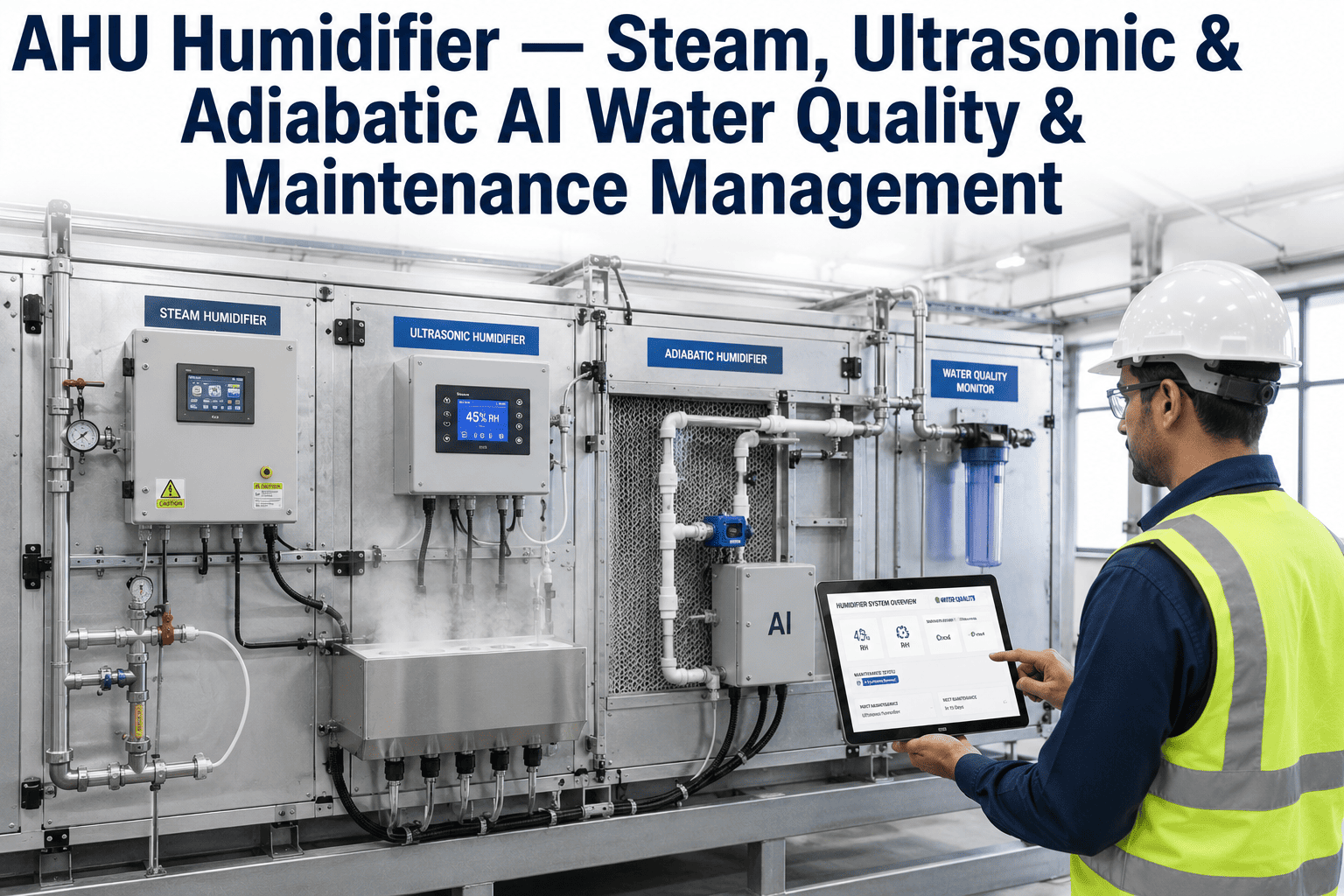
A steam humidifier cylinder scales up quietly. There's no alarm, no fault code on the BAS overview screen, just a slow rise in amperage draw and a slow fall in output capacity that nobody notices until a zone starts running dry in the middle of a February cold snap and the maintenance team is pulling the cylinder apart to find it packed solid with mineral deposit. Ultrasonic transducers foul the same way, adiabatic media clogs the same way, and every one of these failure modes shares a root cause that almost never gets tracked on its own: the quality of the water going into the system in the first place. AI-driven water quality monitoring tracks conductivity, hardness trend, and biofilm risk across every humidifier on a site continuously, catching the scaling curve weeks before it becomes a comfort complaint. Book a humidifier monitoring demo with iFactory to see how continuous water quality tracking turns a reactive cylinder-replacement budget into a scheduled, predictable maintenance line item.
AHU Humidification Systems
Steam, Ultrasonic & Adiabatic Humidifiers: AI Water Quality Monitoring That Catches Scaling Before It Costs You a Zone
Continuous conductivity and hardness tracking, mineral buildup trend detection, microbial risk scoring, and nozzle and cylinder health monitoring across every humidification technology in your AHU fleet.
63%
Of premature cylinder failures trace back to untracked water hardness above design spec
4-6 wks
Typical lead time between the start of a scaling trend and a noticeable capacity drop
$1,800+
Average emergency replacement cost per steam cylinder when failure happens mid-season
Three Technologies, Three Failure Patterns
Why One Water Quality Strategy Doesn't Fit Every Humidifier Type
Steam, ultrasonic, and adiabatic humidifiers all add moisture to an airstream, but they interact with source water in fundamentally different ways, which means the water-related failure each one experiences looks nothing like the others. A monitoring approach built for one technology and applied blindly to the rest will miss the exact signal that matters for each.
Steam Cylinder
Primary Risk: Scale Buildup on Electrodes
Water boils inside the cylinder and minerals concentrate around the electrodes as pure water leaves as vapor. Hardness above 200 ppm accelerates scale formation dramatically, raising amperage draw and eventually stalling steam output entirely well before the cylinder's rated service life.
Watch: conductivity trend, amp draw creep, fill cycle frequency
Primary Risk: Transducer Fouling and Microbial Growth
Ultrasonic
High-frequency vibration atomizes water directly into fine droplets, meaning any mineral content or biological contamination in the source water is aerosolized along with the moisture. Untreated water raises both scale fouling risk on the transducer and legionella-adjacent microbial risk in the reservoir.
Watch: reservoir turbidity, standing water time, biofilm risk score
Adiabatic Media
Primary Risk: Media Clogging and Nozzle Blockage
Water is evaporated across a wetted media pad or sprayed through fine nozzles, and mineral content left behind as the water evaporates gradually clogs media pores and nozzle orifices, reducing saturation efficiency and forcing higher pump pressure to maintain output.
Watch: pump pressure trend, saturation efficiency, nozzle differential
What Continuous Monitoring Actually Tracks
Four Signals That Predict a Failure Weeks Before It Happens
Conductivity Trend
Rising conductivity in makeup or reservoir water signals concentrating dissolved solids, the earliest available marker of an approaching scaling event across all three humidifier technologies.
Hardness Slope
Rather than a single hardness reading, the rate of change over rolling weeks distinguishes a stable water supply from one drifting toward a threshold that will accelerate scale formation.
Amperage or Pressure Drift
Steam cylinders draw more current as scale insulates the electrodes; adiabatic pumps need more pressure as media clogs. Both drift patterns are detectable well before an operator would notice reduced output.
Microbial Risk Score
A composite score built from standing water duration, reservoir temperature, and turbidity readings flags conditions favorable to biofilm and microbial growth before a culture test would ever be scheduled.
See Your Fleet's Water Quality Baseline
iFactory Connects to Your Existing Humidifier Controls and Water Treatment Skids
No cylinder replacement, no new water treatment equipment required to start. iFactory reads the signals your humidification controllers and BAS already generate and builds a water quality trend line within days.
Scaling Progression
The Six-Week Window Between First Signal and Comfort Complaint
Mineral scaling does not happen overnight. There is a predictable progression from clean baseline to failed output, and the entire value of continuous monitoring is compressing the time between the first detectable signal and the maintenance action that prevents the last stage from ever happening.
Week 0-1
Baseline Conductivity Rise
Source water conductivity begins trending upward, often correlated with seasonal water table changes or a treatment system drifting out of calibration.
Week 2-3
Early Deposit Formation
Amperage or pressure readings begin a slow, measurable drift as the first mineral layer forms on electrodes, transducer faces, or media surfaces.
Week 4-5
Accelerating Buildup
The deposit layer thickens faster as it provides more surface area for further mineral attachment, and drift rate steepens noticeably against the established baseline.
Week 6+
Output Capacity Loss
Without intervention, output capacity finally drops enough for a zone to register a humidity shortfall, arriving as a comfort complaint rather than a scheduled maintenance ticket.
Maintenance Response Matrix
Matching the Right Action to the Right Water Quality Signal
Not every water quality alert needs a technician dispatched immediately. A tiered response matrix keeps maintenance effort proportional to actual risk, reserving urgent action for signals that genuinely predict near-term failure.
| Signal Level | Trigger Condition | Recommended Action | Response Window |
|---|
| Baseline Watch | Conductivity within 10% of design spec | Log and continue routine schedule | No action needed |
| Elevated Trend | Hardness slope rising over 2+ weeks | Flag for next scheduled inspection | Within 2 weeks |
| Drift Warning | Amperage or pressure drift beyond threshold | Schedule descale or media replacement | Within 5 business days |
| Microbial Alert | Risk score crosses high threshold | Immediate reservoir flush and inspection | Within 24 hours |
This tiered structure is what turns humidifier maintenance from a fixed calendar interval, which either wastes labor on units that don't need it or misses units that are scaling faster than average, into a condition-based schedule matched to what each unit is actually doing.
Getting Started
From First Connection to Fleet-Wide Water Quality Visibility
Weeks 1-2
Fleet Inventory
Catalog every steam, ultrasonic, and adiabatic humidifier across the site along with existing water treatment equipment and available control signals.
Weeks 3-4
Signal Connection
Connect conductivity probes, amperage sensors, and existing BAS points into a unified monitoring feed without disrupting current humidification operation.
Weeks 5-6
Baseline Establishment
Collect several weeks of trend data per unit to establish a realistic normal range before alert thresholds are finalized against real behavior.
Week 7+
Live Response Matrix
Alerts route to the maintenance team through the response matrix, and every intervention gets logged against the original signal for future tuning.
Water quality is the most underrated variable in humidification maintenance because it doesn't show up on a work order until it has already caused damage. I've walked into buildings where the maintenance team could tell me the exact PM schedule for every AHU fan bearing but had no idea what the makeup water hardness was for their steam humidifiers, because nobody was tracking it continuously. Once you put a conductivity trend line in front of a maintenance manager, the scaling problem stops being a mystery and starts being a schedule they control.
Renata Ashworth-Okonkwo
Building Systems Engineer · 18 years in commercial HVAC water treatment and humidification design
Maintenance Manager Questions
AHU Humidifier Water Quality — Frequently Asked
Does this replace our existing water treatment system, like softeners or RO units?
No, continuous water quality monitoring works alongside whatever treatment equipment is already in place, whether that's a softener, reverse osmosis unit, or no treatment at all. What it adds is visibility into whether that treatment equipment is actually performing as designed over time, since softener resin exhausts and RO membranes foul gradually just like the humidifiers they're meant to protect. A conductivity reading downstream of a softener that starts climbing is often the earliest sign that the softener itself needs regeneration or resin replacement, well before the humidifier shows any symptom.
Reach out to our support team to discuss how monitoring integrates with your specific treatment setup.
Can this monitor humidifiers from different manufacturers on the same platform?
Yes, the monitoring approach is built around reading standard signals such as conductivity, amperage, and pressure rather than depending on a single manufacturer's proprietary controller, which means steam, ultrasonic, and adiabatic units from different vendors across the same site can be tracked on one unified dashboard. Most commercial humidification controllers already expose these values through BACnet, Modbus, or a similar protocol, so integration typically does not require replacing existing hardware.
How much does hard water actually shorten the life of a steam cylinder?
The relationship is steep rather than linear. A cylinder operating on water within its design hardness spec can regularly reach its full rated service life, while the same cylinder operating even moderately above spec, say 250 to 300 ppm against a 200 ppm design target, can see usable life cut by half or more, because scale accumulation compounds as thicker deposits create more surface area for further mineral attachment. Continuous conductivity tracking is specifically valuable because it catches that drift above spec early, while a single point-in-time water test taken during commissioning would miss it entirely.
What's the actual difference between a microbial risk score and just testing the water periodically?
Periodic water testing gives you an accurate reading for a single moment, but microbial risk in a humidifier reservoir is driven by conditions that change daily, including standing water duration, ambient temperature, and turbidity, all of which can create a risk window that opens and closes between scheduled test dates. A continuous risk score built from those same underlying conditions flags an elevated-risk period as it develops rather than waiting for the next quarterly test to happen to fall within that window.
Book a demo to see how the risk score is calculated for your specific reservoir configurations.
How long before we see a return on setting up this kind of monitoring?
Most sites see the first concrete return within the first descale or media replacement that gets scheduled proactively instead of happening as an emergency mid-season callout, since planned maintenance labor and parts typically cost a fraction of emergency service rates. Beyond the first avoided emergency, the larger and more durable return comes from extending average component life across the full humidifier fleet, which compounds over years rather than showing up as a single dramatic savings event.
Stop Finding Out About Scaling From a Comfort Complaint
Get Continuous Water Quality Visibility Across Every Humidifier on Site
iFactory connects to your steam, ultrasonic, and adiabatic humidification systems, tracks the conductivity and hardness trends that actually predict failure, and routes alerts through a response matrix your maintenance team can act on before a zone ever runs dry.