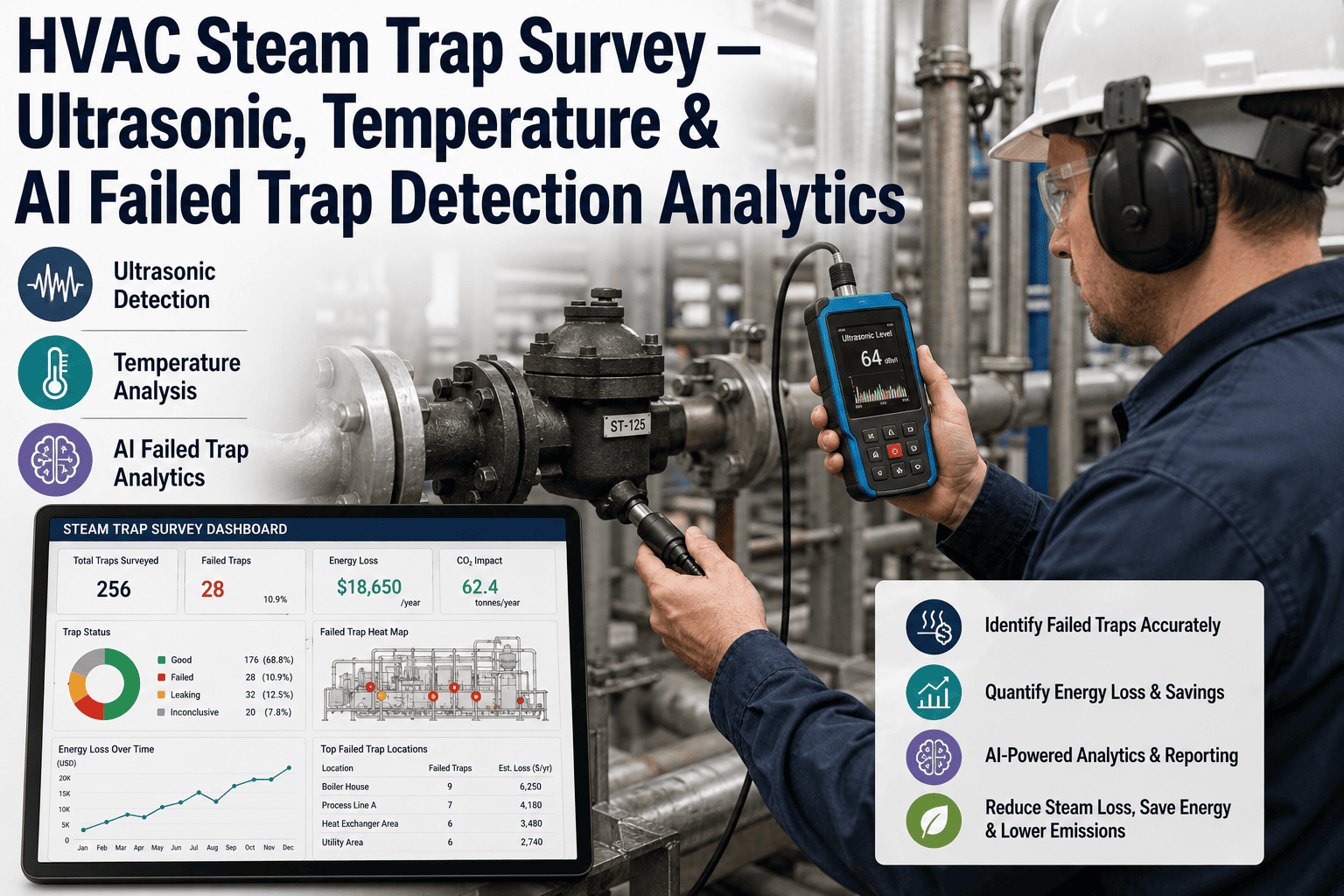
A failed steam trap doesn't shut anything down, which is exactly why so many of them stay failed for months. A trap stuck open just quietly blows live steam into the condensate return line, wasting the energy that went into making it and forcing the boiler to make up for lost condensate with cold makeup water. Multiply one failed trap across a plant with a few hundred of them, add a handful of PRVs drifting out of calibration and a flash tank recovering less steam than it should, and the cumulative energy loss becomes a real line item that nobody notices because no single failure ever trips an alarm. AI-based condensate system monitoring changes that by tracking trap performance, PRV condition, and flash tank recovery continuously, catching the slow leaks before they become a permanent tax on the boiler plant. See how much steam your condensate system is actually losing.
The Failures That Never Trip an Alarm Are the Ones Costing You Most
A stuck-open steam trap or a drifting PRV never stops production, which is exactly why they stay broken for months. Continuous monitoring turns silent energy loss into a visible, fixable work order.
of steam traps in a typical plant are failed at any given time, most of them stuck open and leaking live steam
the energy cost of makeup water compared to recovered condensate returned to the boiler feedwater system
steam traps in a mid-size process plant, most inspected on an annual walk-through schedule at best
Where Steam Energy Actually Gets Lost
A condensate system is a chain of components, and each one has its own failure mode with its own energy cost when it goes unnoticed.
Steam Traps
A trap stuck open passes live steam directly into the return line, the single largest source of preventable steam loss in most plants.
PRV Stations
A pressure-reducing valve drifting out of calibration either wastes energy oversupplying pressure or starves downstream equipment.
Condensate Return Piping
Undersized or leaking return lines lose condensate volume before it ever reaches the receiver, reducing recoverable feedwater.
Flash Tank Recovery
A poorly tuned flash tank vents recoverable flash steam to atmosphere instead of routing it to a low-pressure process load.
Boiler Feedwater
Every gallon of condensate not recovered gets replaced with cold makeup water, carrying its own treatment and heating energy cost.
How AI Monitoring Actually Catches These Failures
Trap and PRV failures leave detectable acoustic and thermal signatures long before anyone notices reduced condensate return or a rising fuel bill.
Acoustic Trap Monitoring
Ultrasonic sensors clamped to each trap detect the distinct sound signature of a stuck-open, stuck-closed, or leaking trap continuously rather than on an annual inspection cycle.
PRV Performance Tracking
Upstream and downstream pressure trending flags a PRV drifting out of its setpoint band before it causes downstream process disruption or wasted energy.
Flash Tank Efficiency Analysis
Continuous flow and pressure data across the flash tank quantifies how much flash steam is being recovered versus vented, flagging tuning drift over time.
Find Out How Much Steam Your Traps Are Wasting Today
iFactory reviews your trap population, PRV stations, and flash tank performance to show exactly where condensate energy recovery is falling short.
Trap Condition, Detection Method, and Typical Energy Loss
The cost of a failed trap depends heavily on failure mode and how quickly it gets caught, which is exactly what separates an annual inspection schedule from continuous monitoring.
What Changes When the Condensate System Is Monitored Continuously
Figures reflect typical outcomes within the first two quarters of deploying acoustic trap monitoring and PRV/flash tank tracking across a process plant's steam system.
Which Traps and Stations to Instrument First
Most plants can't instrument every trap in one project. Prioritizing by steam pressure and criticality delivers the fastest payback.
High-pressure process traps
Traps on high-pressure steam mains lose the most energy per failure, since the enthalpy content of high-pressure steam is significantly greater than low-pressure equivalents, making these the highest-value monitoring targets in almost every plant.
PRV stations feeding critical processes
A drifting PRV on a station feeding a critical process load risks both energy waste and product quality issues, making these stations a priority for continuous pressure trending regardless of overall steam volume involved.
Traps in hard-to-access locations
Traps in elevated, enclosed, or high-temperature areas are the ones most likely to get skipped during a manual walk-through inspection, which is exactly why they benefit most from continuous remote monitoring.
A Process Engineer's View on Condensate Recovery
Our annual trap survey always found the obvious failures, the ones that had probably been broken for six months already. What we were missing were the traps that failed the week after the survey and then ran blown-through until the next one came around a year later. Continuous acoustic monitoring closed that entire gap, and our condensate return rate went up more from catching those in-between failures than from anything in the annual survey itself.
The Bottom Line on Condensate System Monitoring
A failed steam trap or a drifting PRV never trips an alarm, which is exactly why these failures survive so long in most plants. The energy cost compounds quietly, one trap at a time, until it shows up as a fuel bill nobody can fully explain. Continuous acoustic and thermal monitoring across traps, PRVs, and flash tank performance turns that invisible loss into a specific, actionable work order, closing the gap an annual walk-through survey was never built to catch.
Frequently Asked Questions
How does acoustic monitoring tell a good trap from a failed one?
Steam traps produce a distinct ultrasonic signature depending on their operating state, since a healthy trap cycles open and closed in a recognizable pattern while a stuck-open trap produces continuous high-amplitude noise from live steam blowing through. A model trained on these signatures across trap types can distinguish normal cycling from blow-through, backed-up condensate, or intermittent leaks with far more confidence than a technician listening manually during a brief walk-through. Book a trap survey to see how this applies to your specific trap population.
Is continuous trap monitoring worth it for a smaller trap population?
Even a plant with a few dozen traps can lose a meaningful amount of steam energy to a handful of undetected failures, since each stuck-open high-pressure trap represents continuous loss until it's found and repaired. The payback calculation depends more on steam pressure and cost per unit than on the raw trap count, so a smaller high-pressure system can justify monitoring just as readily as a larger low-pressure one.
How does PRV drift actually get detected before it causes a problem?
Continuous upstream and downstream pressure trending against the PRV's designed setpoint band catches gradual drift long before it becomes severe enough to disrupt a downstream process, since the trend line typically shows a slow, steady deviation over weeks rather than a sudden jump. That lead time is what allows a planned recalibration instead of an emergency response after a process upset has already occurred.
What does flash tank tuning actually involve and why does it drift over time?
A flash tank separates lower-pressure flash steam from high-pressure condensate so the flash steam can be routed to a useful low-pressure load instead of being vented, and tuning drift typically happens gradually as process loads shift and the tank's original design assumptions no longer match actual operating conditions. Continuous flow and pressure monitoring flags when recovery efficiency has dropped enough to warrant a retuning.
Does improving condensate return actually reduce water treatment costs too?
Yes — every gallon of condensate recovered and returned to the boiler is a gallon of cold makeup water that doesn't need to be treated, softened, and de-aerated before it can be used as feedwater, so higher condensate return rates reduce both energy and water treatment chemical costs simultaneously. Talk to a specialist about quantifying that combined savings for your specific boiler plant.
Stop Paying for Steam That Never Does Any Work
Book a 30-minute assessment. iFactory maps your trap population, PRV stations, and flash tank performance and shows exactly where condensate energy is being lost today.