Screw chillers earn their reputation for reliability honestly, the twin-rotor design has fewer moving parts than a centrifugal machine and tolerates load swings better than most alternatives, but that reputation quietly encourages maintenance teams to under-watch them. Oil carryover, bearing wear, and rotor clearance all degrade slowly enough that a screw chiller can run for months past the point where cooling capacity has already started slipping below what the building actually needs. By the time someone notices the supply air is warmer than it should be, the rotor clearance has usually opened up far more than a simple oil top-off can fix. Read more about how continuous monitoring catches this earlier at ifactory support.
Catch Rotor Clearance Wear Before Capacity Actually Drops
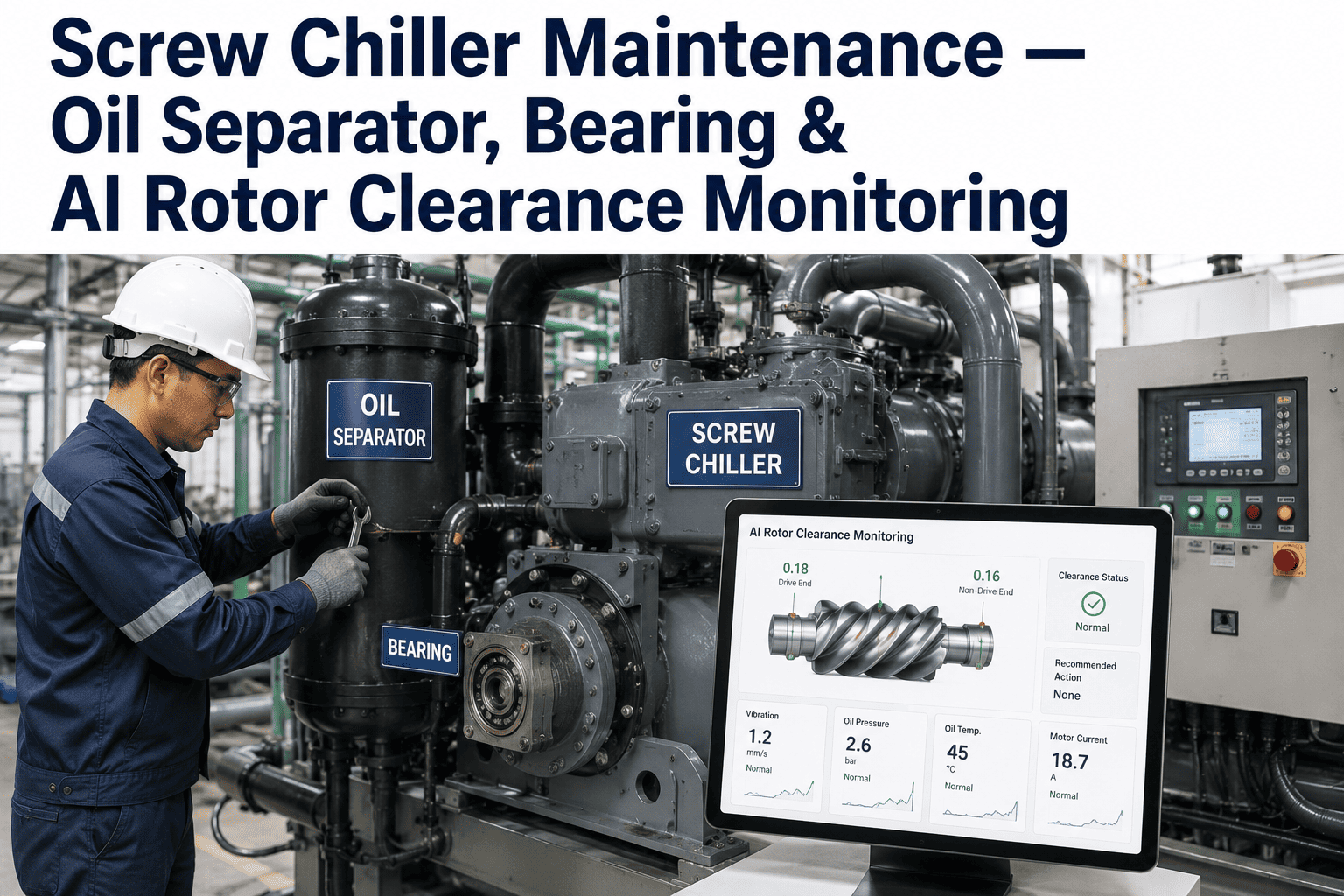
AI tracks oil separator performance, bearing condition, and rotor clearance trend together, so the slow wear that quietly erodes screw chiller capacity gets caught while a routine repair still fixes it.
Why Screw Chillers Fail Quietly Instead of Suddenly
A screw compressor's cooling capacity depends on maintaining a tight clearance between the twin rotors and the housing, and that clearance is what oil injection is there to protect. Oil serves three jobs at once inside a screw compressor: it lubricates the rotor contact points, it seals the clearance gaps against internal leakage, and it carries away compression heat. When oil separator performance degrades, whether from a saturated separator element, a clogged return line, or excessive oil carryover into the refrigerant circuit, all three of those jobs suffer simultaneously, and the compressor starts losing sealed volume long before anyone notices a hard failure.
This is what makes screw chiller degradation so easy to miss during a standard walk-through inspection. The compressor still runs, the discharge temperature still looks roughly normal, and the unit does not trip an alarm. What actually happens is a slow decline in volumetric efficiency, meaning the same compressor speed and same running hours deliver progressively less actual cooling capacity. A facility that has not been trending this data often does not discover the problem until building temperatures start drifting during a peak load day, at which point the rotor clearance has usually opened up enough that oil top-offs and filter changes no longer solve it, and the fix becomes a rotor or bearing rebuild instead of a routine service call.
See Whether Your Screw Chillers Are Quietly Losing Capacity
Bring recent run-hour and discharge temperature logs to a 30-minute call, and we will estimate where your volumetric efficiency actually stands today.
What Typically Happens Without Continuous Monitoring
Most maintenance managers running a fleet of screw chillers are working from a preventive schedule built around oil analysis every few months and a visual inspection during a seasonal shutdown. That schedule catches gross contamination and obvious leaks, but it is not frequent enough to catch a slow rotor clearance trend, which can develop over many months in a way that never shows up as an outright abnormal reading on any single inspection date. The gap between inspections is exactly where capacity quietly erodes.
The financial consequence tends to show up in two places at once. First, energy costs rise because a compressor losing volumetric efficiency has to run longer, or at higher speed, to deliver the same cooling load, and that inefficiency compounds every month it goes uncorrected. Second, when the capacity shortfall finally becomes visible, it is usually visible on the worst possible day, the hottest day of the year, when the building's cooling demand peaks at the exact moment the chiller has the least capacity margin left to give.
| Inspection Method | Detects Rotor Wear | Typical Lead Time | Repair Scope If Caught Late |
|---|---|---|---|
| Visual walk-through | No, wear is not visually apparent | None | Rotor or bearing rebuild |
| Quarterly oil analysis | Partial, contamination only | Weeks to months | Bearing replacement |
| Continuous AI monitoring | Yes, via volumetric efficiency trend | Months | Oil separator service or bearing top-off |
The Oil Separator Is Almost Always Where the Trail Starts
If there is one component worth watching more closely than any other on a screw chiller, it is the oil separator. Its job is to strip oil out of the compressed refrigerant vapor before that vapor moves on to the condenser, and when it starts failing, the consequences cascade through the rest of the system. Oil that carries over into the condenser and evaporator coats heat transfer surfaces, reducing heat exchange efficiency in exactly the same way condenser fouling does. At the same time, the compressor is losing the oil volume it needs for sealing and lubrication, which is the direct mechanical link between a struggling oil separator and accelerating rotor clearance loss.
Because oil carryover is measurable well before it becomes visually obvious, it is one of the highest-value single parameters to monitor continuously on a screw chiller fleet. A separator element approaching the end of its service life shows a steadily rising carryover trend for weeks before oil fouling becomes severe enough to measurably affect heat transfer, which gives a maintenance team a genuinely useful window to schedule the element replacement during a planned outage instead of reacting to a capacity complaint.
Bearings Fail on a Different Timeline Than Rotors, and That Matters
It is worth separating two failure paths that often get discussed together under the general heading of screw chiller wear. Rotor clearance loss, driven primarily by oil sealing performance, tends to progress slowly and fairly linearly over months, which is why volumetric efficiency trending works so well as an early indicator. Bearing wear follows a different pattern; it can remain nearly flat for a long period and then accelerate quickly once a particular wear threshold is crossed, because a bearing that has lost some of its clearance tolerance starts generating more heat and more vibration, which in turn accelerates further wear in a feedback loop. That difference in behavior is exactly why a single monitoring approach is not enough on its own, and why vibration and thrust bearing temperature need to be watched as their own distinct signal rather than folded entirely into the oil separator story.
In practice this means a maintenance manager reviewing a screw chiller's health dashboard should expect to see two different kinds of trend lines behaving two different ways. A slow, steady decline in volumetric efficiency over a period of months is consistent with normal wear that can usually be scheduled around a convenient outage window. A vibration or bearing temperature reading that starts moving even modestly after a long period of flat stability deserves faster attention, because that pattern is often the leading edge of the accelerating phase rather than the slow steady one, and the useful maintenance window between first detection and forced shutdown tends to be shorter for bearing-driven failures than for gradual clearance loss.
What a Maintenance Manager Actually Does With This Data
The value of any monitoring program ultimately comes down to whether it changes a real decision, and for a maintenance manager overseeing a fleet of screw chillers, continuous monitoring changes three decisions in particular. First, it changes when a unit gets scheduled for oil separator service, moving that decision from a fixed calendar interval to the point where actual carryover data shows the element is genuinely degrading. Second, it changes parts inventory planning, since a bearing kit or separator element flagged by a clear trend can be ordered with enough lead time to avoid rush shipping charges. Third, and often most valuable over a multi-year horizon, it changes capital planning, giving a documented efficiency history to point to when deciding whether an aging unit is a good candidate for continued investment or for replacement.
Frequently Asked Questions
Get Continuous Rotor and Oil Separator Visibility
Bring your screw chiller run data and last oil analysis report to the call, and we will show you where the volumetric efficiency trend actually stands.