A condenser water pump that fails on the hottest day of the year rarely fails without warning, it fails without anyone watching for the warning at the right frequency. Bearing wear, impeller damage, cavitation, and misalignment each leave a distinct signature in a pump's vibration spectrum weeks before the failure that finally takes the pump offline, but those signatures live at specific frequency bands that a simple "is it vibrating more than usual" check will never resolve. A reliability engineer who's spent any time with a spectrum analyzer already knows this. The harder problem is doing it continuously, across every chilled water, hot water, and condenser water pump in a building, rather than during an annual route survey that happens to catch a fraction of the failures actually developing at any given time. If your pump PdM program is still route-based rather than continuous, book a demo to see what continuous coverage actually catches.
PIPING & HYDRONIC · HVAC PUMP PREDICTIVE MAINTENANCE
Every Failure Mode Has Its Own Frequency Signature
iFactory's AI vibration analytics continuously monitor chilled water, hot water, and condenser water pumps, isolating bearing wear, impeller damage, cavitation, and misalignment weeks before any of them takes a pump offline.
Bearing Wear1x-3x RPM harmonics
CavitationBroadband high-frequency noise
Misalignment2x RPM axial & radial peaks
FIVE WAYS A PUMP ACTUALLY FAILS
The Failure Modes Behind Every Pump Replacement
"The pump failed" is rarely the full story. Almost every HVAC pump failure traces back to one of a handful of specific, well-documented mechanical failure modes, each with its own progression timeline and its own vibration signature.
Mechanical Seal Leaks
Seal face wear develops gradually as lubrication and alignment degrade, eventually producing a visible leak that often isn't caught until water damage or a low-pressure alarm forces attention.
Bearing Degradation
The most common root cause of unplanned pump failures, bearing wear produces a clear, progressive vibration signature at specific harmonics of running speed well before audible noise or heat becomes apparent.
Impeller Wear or Damage
Erosion, cavitation damage, or debris impact on the impeller reduces pump efficiency and capacity gradually, often mistaken for a system flow problem rather than a pump condition issue.
Cavitation
Insufficient suction pressure causes vapor bubbles to form and collapse violently against internal surfaces, producing a distinctive broadband noise signature and accelerating impeller and seal wear.
Shaft Misalignment
Coupling misalignment between motor and pump introduces vibration at specific harmonics and accelerates bearing and seal wear across the entire assembly, often traced back to an imperfect installation or a shifted baseplate.
READING THE SIGNATURE
What Vibration Data Actually Tells You
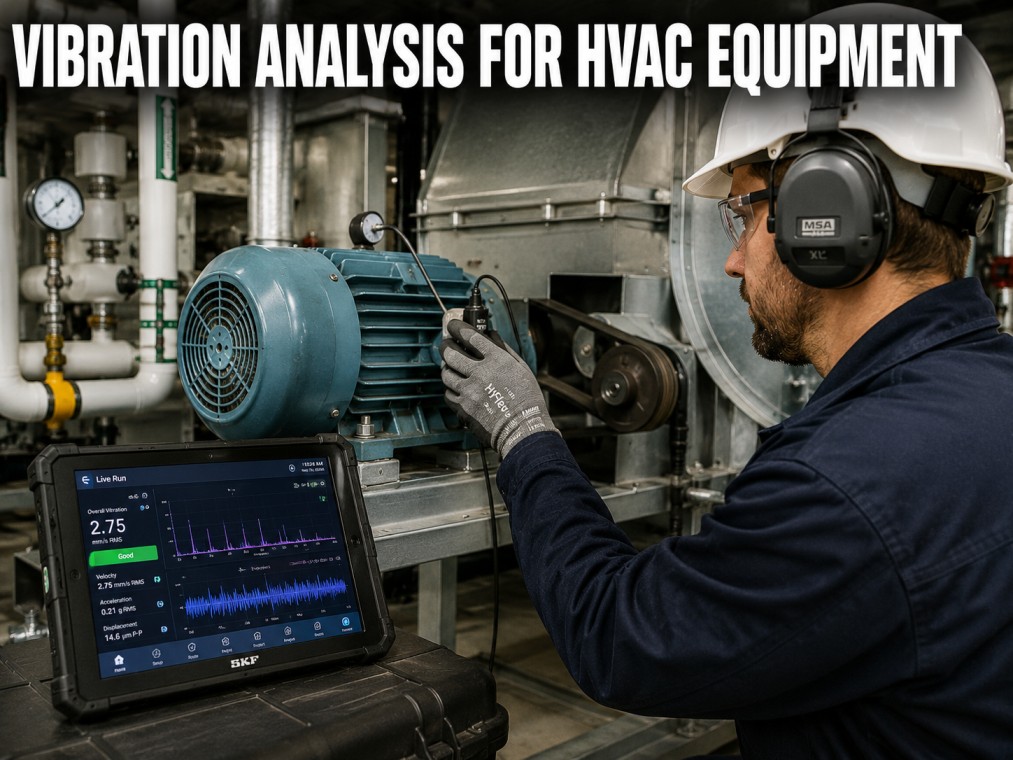
A single overall vibration number tells you something changed. A full spectrum analysis tells you what changed and how far along it is, which is the difference between a generic alarm and an actionable diagnosis.
EARLY
Subtle amplitude increase at bearing defect frequencies, often present for weeks before any audible or thermal indication appears, the earliest reliable warning of developing bearing wear.
DEVELOPING
Harmonic peaks growing at 1x, 2x, and 3x running speed, a pattern that typically indicates misalignment or looseness progressing rather than a single isolated event.
ADVANCED
Broadband high-frequency noise across the spectrum, the signature most associated with active cavitation damage already occurring inside the pump casing.
CRITICAL
Rapid amplitude escalation across multiple frequency bands simultaneously, indicating a bearing or seal failure has progressed to the point where near-term unplanned failure is likely.
See what's already developing in your pump fleet
iFactory can run a vibration baseline across your chilled water, hot water, and condenser water pumps and show you what's already trending.
ACROSS YOUR ENTIRE PUMP FLEET
Coverage That Doesn't Stop at One Loop
Chilled Water Pumps
Primary and secondary loop pumps under continuous variable speed operation, where bearing load cycles constantly with demand.
Hot Water Pumps
Heating loop pumps facing seasonal duty cycles, where extended idle periods can mask early-stage bearing wear until the next heating season.
Condenser Water Pumps
Cooling tower loop pumps exposed to the highest cavitation risk from suction-side fouling and variable tower water levels.
ROUTE-BASED VS CONTINUOUS
What Changes When Monitoring Never Stops
| Factor |
Route-Based PdM |
Continuous AI Monitoring |
| Data frequency |
Monthly or quarterly snapshot |
Ongoing, trend visible within days |
| Fast-developing faults |
Can progress to failure between routes |
Caught as soon as the signature appears |
| Seasonal or idle equipment |
Often skipped when off duty cycle |
Monitored whenever running, no gap |
| Root cause classification |
Depends on analyst experience and time |
Consistent, automated classification per fault type |
| Fleet-wide coverage |
Limited by technician hours available |
Scales across the entire pump fleet equally |
TURNKEY DEPLOYMENT
How iFactory Gets Your Pump Fleet Monitored
What Gets Built
Vibration sensors installed across priority chilled, hot, and condenser water pumps
Baseline spectrum established for each pump's normal operating signature
Automated fault classification per bearing, seal, impeller, and alignment signature
Real-time alerts routed to your reliability team as trends develop
Historical trend dashboard for every monitored asset
Rollout Timeline
Weeks 1-2: Pump fleet audit and sensor placement prioritization
Weeks 3-4: Sensor installation and baseline signature capture
Weeks 5-6: Alert threshold tuning and reliability team training
FREQUENTLY ASKED QUESTIONS
What Reliability Engineers Ask About Pump PdM
How early can this actually catch a developing bearing failure?
Bearing defect frequencies typically show a measurable amplitude increase weeks before the failure produces any audible noise, heat, or noticeable performance change, which is exactly the window continuous monitoring is built to catch that a monthly or quarterly route survey frequently misses entirely. The exact lead time varies by bearing type, load, and how the fault initiated, but the general pattern holds consistently enough that catching a bearing fault at this early stage typically means a planned replacement during a scheduled window instead of an emergency callout during peak cooling season.
Book a demo to see real early-stage bearing signatures from a live deployment.
Do we need to instrument every single pump, or just the critical ones?
Most reliability teams start with their highest-consequence pumps, those serving critical cooling loads or with a documented history of repeat failures, and expand coverage from there as the value of continuous monitoring becomes clear on the initial deployment. This staged approach lets you prioritize sensor investment where failure consequence is highest first, rather than treating full-fleet instrumentation as an all-or-nothing decision on day one.
Contact our support team to prioritize your specific pump fleet by criticality.
Can this distinguish cavitation from a bearing problem, since both can sound similar?
Yes, and this is precisely the kind of distinction that a simple "is it louder than usual" check cannot make reliably but a full spectrum analysis can. Cavitation produces a distinctive broadband high-frequency noise signature across a wide range of frequencies simultaneously, while bearing degradation produces amplitude increases concentrated at specific harmonic frequencies tied to the bearing's own defect geometry and the shaft's running speed. Because the model analyzes the full frequency spectrum rather than a single aggregate vibration number, these two failure modes are classified separately with a clear diagnostic basis rather than left for a technician to guess between based on sound alone.
Book a demo to see how the two signatures are distinguished on real pump data.
How does this handle seasonal pumps that sit idle for months at a time?
Continuous monitoring simply picks up data whenever the pump is actually running, which means a hot water pump idle through the cooling season still gets a fresh vibration reading the moment it starts up again at the beginning of the next heating season, rather than waiting for an annual route survey that might land weeks or months after startup. This closes a specific gap that route-based programs consistently struggle with, since technician routes are typically scheduled on a fixed calendar that doesn't always align with a seasonal asset's actual duty cycle.
Contact our support team to discuss coverage for your specific seasonal equipment.
What happens once a fault is detected, does it automatically generate a work order?
Detected faults route to your reliability team with the specific classification, severity, and trend history attached, and from there the decision to generate a work order, schedule further inspection, or continue monitoring the trend sits with your team rather than being triggered automatically without review. This keeps a human in the loop for the judgment call on urgency and scheduling, while removing the much harder problem of noticing the developing fault in the first place, which is where continuous monitoring adds the most value over a periodic manual check.
Book a demo to see the exact alert and review workflow your team would use.
SEE THE FAULT WEEKS BEFORE THE FAILURE
Give Every Pump the Continuous Attention a Route Survey Can't
iFactory's AI vibration analytics continuously monitor your entire pump fleet, isolating bearing, seal, impeller, cavitation, and misalignment faults weeks before they take a pump offline.