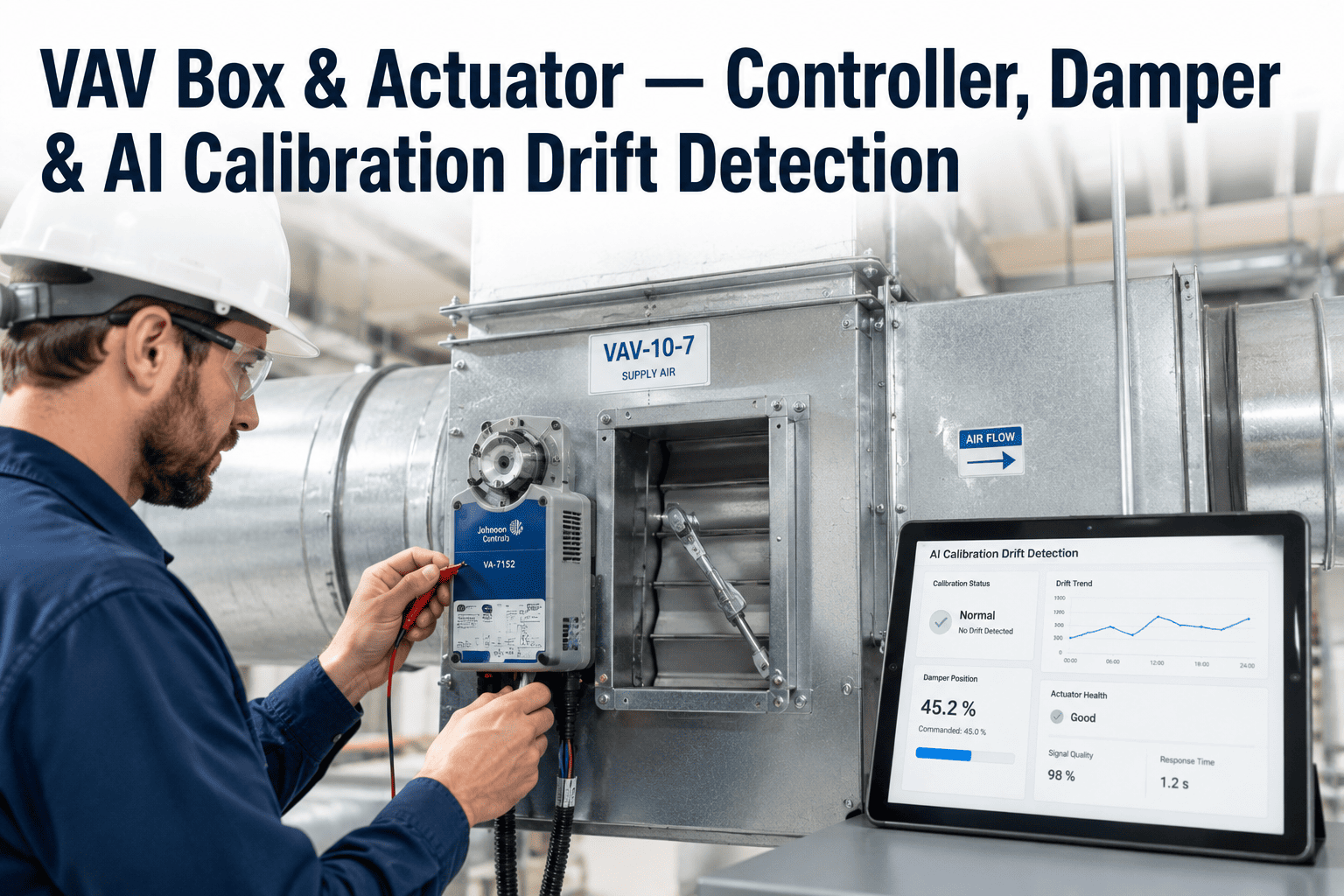
A VAV box actuator that's five degrees out of calibration doesn't trip an alarm. It just quietly delivers a little less air than the controller thinks it's delivering, day after day, until a tenant on the fourth floor starts submitting the same temperature complaint every Tuesday afternoon and nobody can figure out why. Multiply that five-degree drift across three hundred boxes on a large commercial floor plate and you get a building that's simultaneously overcooling some zones, undercooling others, and burning reheat energy to correct for both, while every individual box still reports itself as functioning normally. AI-based calibration drift detection compares commanded position against actual delivered airflow across every VAV box continuously, catching the gap between what a controller thinks is happening and what's actually happening in the duct. Book a VAV calibration demo with iFactory to see how drift detection turns hundreds of individually invisible small errors into a ranked list your team can actually work through.
VAV Box & Terminal Unit Calibration
VAV Box, Actuator & Damper Calibration Drift Detection — Find the Zones Quietly Costing You Comfort and Energy
AI-driven comparison of commanded actuator position against actual delivered airflow catches calibration drift across your entire terminal unit fleet before it becomes a repeat comfort complaint or a wasted reheat cycle.
VAV boxes in a typical commercial building are running with meaningful calibration drift at any given time
15-20%
Typical reheat energy waste attributable to poorly calibrated terminal units
3-6 mo
Average time a drifted actuator runs undetected under a fixed annual PM schedule
Understanding the Gap
Commanded Position vs. Actual Delivered Airflow — Where Drift Hides
Every VAV box controller believes its damper is at whatever position it last commanded. What it usually cannot see is whether the actuator actually reached that position, whether the damper blade is binding partway through its travel, or whether the airflow sensor feeding the loop has drifted from its own calibration. Any one of these three failure points produces the same downstream symptom — a zone that isn't getting the air it should — but each needs a different fix.
Boxes 112, 126, and 140 show meaningful gaps between commanded and actual delivery — the pattern that a fixed inspection schedule would only catch by chance, not by design.
Three Distinct Root Causes
Drift, Binding, and Sensor Error Look the Same From the BAS but Need Different Fixes
01
Actuator Calibration Drift
The actuator's internal reference point for zero and full-open positions gradually shifts from its original commissioning value, most commonly on spring-return actuators after repeated power cycles, causing every commanded position to land slightly off target.
02
Damper Blade Binding
Linkage wear, debris in the duct, or a bent blade can cause the damper to physically bind before reaching its commanded position, so the actuator reports success while the actual airflow path remains partially restricted.
03
Airflow Sensor Drift
The velocity pressure sensor feeding the control loop can drift from its own calibration over time, meaning the box confidently maintains what it believes is correct airflow while actually running consistently high or low.
See Drift Detection on Your Own Terminal Units
iFactory Reads Your Existing BAS Trend Data — No New Sensors Required in Most Cases
Calibration drift detection runs against the commanded position and airflow trend data your VAV controllers are already logging, surfacing the boxes worth a technician visit within the first data collection cycle.
Comfort Complaints Are the Visible Symptom — Energy Waste Is the Bigger Number
A tenant complaint is the loudest signal a drifted VAV box produces, but it's rarely the most expensive one. A box under-delivering cooling air triggers a zone temperature call for more cooling, which the AHU answers by lowering supply air temperature or increasing fan speed across the entire system, not just the one affected zone. A box over-delivering does the opposite, forcing reheat coils to work harder to avoid overcooling a space that never needed that much air in the first place.
Across a building with several hundred terminal units, even a modest percentage running with meaningful drift compounds into a measurable share of total HVAC energy spend, invisible on any single utility bill line item but fully recoverable once the specific boxes driving it are identified and corrected.
Drift Severity
Typical Cause
Energy Impact
Minor (under 10%)
Early actuator drift
Low, monitor trend
Moderate (10-25%)
Actuator drift or sensor error
Noticeable reheat waste
Severe (25%+)
Binding or failed actuator
Significant, plus comfort risk
Implementation Path
From Fleet Connection to a Ranked Calibration Punch List
Weeks 1-2
BAS Data Mapping
Identify which VAV controllers already trend commanded position, actual airflow, and damper feedback, and where gaps exist.
Weeks 3-4
Baseline Collection
Gather several weeks of operating data per box to distinguish genuine drift from normal short-term variation in demand.
Weeks 5-6
Drift Scoring
Rank every terminal unit by drift severity and likely root cause, prioritized by comfort risk and estimated energy impact.
Week 7+
Ongoing Monitoring
New drift is caught continuously going forward, replacing the annual blanket inspection with a live, prioritized punch list.
The thing that surprises reliability engineers most when they first see a drift-ranked list isn't that problems exist, it's how unevenly they're distributed. On every fleet I've looked at, a small handful of boxes account for the majority of both the comfort complaints and the wasted reheat energy, while a much larger set is running fine and doesn't need a technician anywhere near it. A calendar-based inspection schedule treats every box the same. A drift-ranked list tells you exactly which twenty boxes out of three hundred are worth a visit this month.
Damian Fitzgerald-Okafor
Controls Reliability Engineer · 16 years commissioning and troubleshooting large commercial VAV systems
Do we need new airflow sensors on every VAV box for this to work?
In most modern installations, no. The majority of commercial VAV controllers already include an integral velocity pressure sensor and report both commanded position and measured airflow to the BAS, which is sufficient data to detect drift without any new hardware. Older or simpler pneumatic boxes without electronic feedback are the main exception, and those typically need a retrofit controller before drift detection becomes possible. Contact support to review your specific controller inventory.
How do you tell the difference between actuator drift and a sensor calibration problem?
The distinguishing pattern is in how the discrepancy behaves across the actuator's full range of travel. Actuator drift typically shows a consistent offset across the entire stroke, since the reference point itself has shifted, while a sensor calibration issue tends to show an error that scales with airflow rate, larger at high flow than at low flow. The classification model looks at this pattern across historical stop data to assign a probable root cause rather than just flagging that something is wrong.
Will this catch a damper that's stuck fully open or fully closed?
Yes, and these tend to be the easiest cases to detect because the gap between commanded and actual position is typically largest and most consistent for a fully stuck damper, compared to the more subtle percentage-level drift that partial binding or gradual actuator drift produces. A stuck damper usually surfaces at the top of the severity ranking within the first data collection cycle rather than requiring extended baseline monitoring.
How often should we expect new boxes to show up on the drift list once we're past the initial rollout?
This varies by building age and actuator type, but a reasonable expectation for a well-maintained fleet is that a small percentage of boxes will develop new detectable drift each month, driven by normal mechanical wear, seasonal demand swings that stress actuators differently, and the occasional installation or commissioning issue that only becomes visible under real operating conditions. The value of continuous monitoring is catching that ongoing trickle immediately rather than accumulating it silently until the next annual inspection cycle. Book a demo to see typical drift rates for buildings similar to yours.
Does correcting VAV calibration drift actually move the energy bill, or is the impact mostly comfort-related?
Both effects are real, but the energy impact is often the larger dollar figure even though comfort complaints get more attention. A single under-delivering box mostly causes a local complaint, but dozens of boxes running even moderate drift simultaneously force AHU-level compensation, lower supply air temperatures, higher fan speeds, more reheat, that shows up across the entire system's energy consumption rather than just the affected zones.
Stop Chasing Comfort Complaints One at a Time
Get a Ranked List of Exactly Which VAV Boxes Need Attention
iFactory compares commanded position against actual delivered airflow across your entire terminal unit fleet, classifies the likely root cause, and hands your team a prioritized punch list instead of a blanket annual inspection.