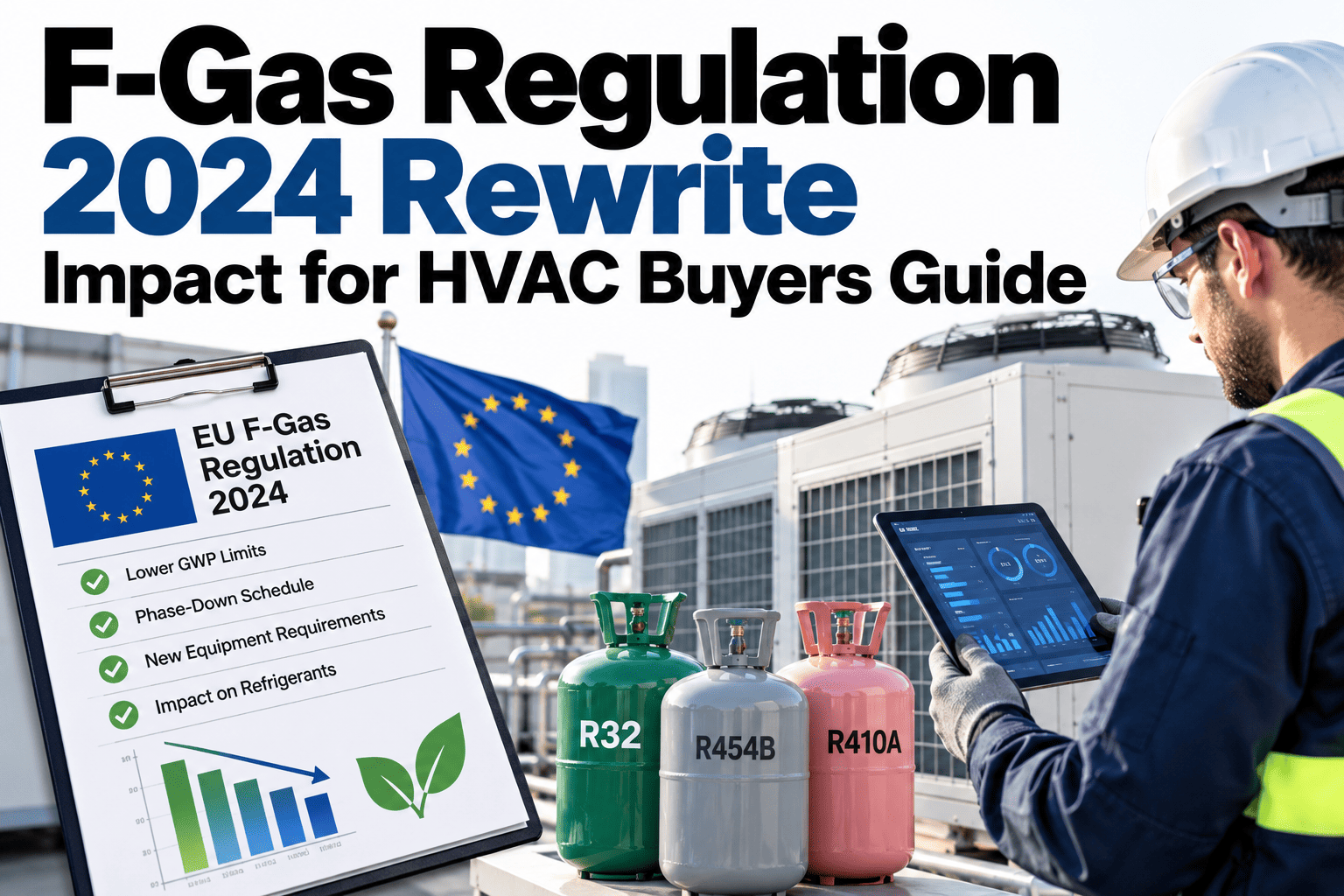
The EU F-Gas Regulation was rewritten in 2024, and the new rules change what HVAC buyers can purchase, install and service. Regulation (EU) 2024/573 tightens the supply of HFCs, sets a path to a full phase-out by 2050 and adds staged restrictions on equipment and servicing. Buyers who plan now can avoid stranded equipment and costly refrigerant surprises. For help mapping the rules to your own assets, you can review your refrigerant exposure with our team. Always confirm exact dates in the regulation text.
HVAC refrigerant transition
Buy HVAC Equipment That Still Makes Sense Under the Rewritten F-Gas Rules
iFactory AI helps European buyers track refrigerants, leak records and equipment exposure so purchase decisions match where the rules are heading.
Illustrative: HFC supply stepping down over time
What changedThe 2024 Rewrite at a Glance
The new regulation replaced the earlier framework and raised the pace of change.
2024/573
Number of the new regulation
2024
Year it entered into force
2050
Target for full HFC phase-out
Staged
Restrictions by equipment and refrigerant
Exact bans differ by equipment type, size and refrigerant global warming potential, so buyers should check the rules against each product.
How it reaches a buyerFrom Regulation to Purchase Order in Five Steps
1
Supply is limited
The HFC quota shrinks over time toward zero.
2
Prices and availability shift
Scarcer refrigerants cost more and can be harder to source.
3
Equipment restrictions apply
Some products face staged limits on being placed on the market.
4
Servicing rules tighten
Rules on what refrigerant can be used for repairs change.
5
Records and leak checks matter
Owners must show control of leaks and refrigerant use.
Quota effectWhy a Shrinking Supply Changes Your Long-Term Cost
Think of the quota as a staircase that steps down. This chart is illustrative and not a forecast.
Equipment bought today may need servicing for many years. Refrigerant choice affects the cost of that whole period.
Know Which Assets Are Exposed Before You Buy
Share your equipment list and refrigerant types and see how iFactory AI can flag exposure and plan replacements.
Servicing rulesSix Servicing Topics Every Owner Should Understand
Virgin versus reclaimed
Rules can limit new refrigerant for repairs and favour reclaimed supply.
Global warming potential
Higher-GWP refrigerants face tighter limits.
Equipment size
Charge size changes which rules and checks apply.
Leak checks
Regular checks and prompt repairs reduce loss and penalties.
Records
Keep logs of charges, leaks and recovery.
Certified technicians
Only qualified staff may handle refrigerants.
Details vary, so keep records that are easy to produce on request. To organise yours, ask our team about refrigerant record keeping.
Buyer viewWhat to Check for Each Equipment Type Before You Purchase
| Equipment type | What to check | Buyer action |
|---|
| Split and small systems | Refrigerant GWP and any placing-on-market limits | Ask suppliers for compliant options |
| Chillers | Refrigerant type, charge size and future service rules | Compare lower-GWP models and lifetime cost |
| Heat pumps | Refrigerant and flammability class | Confirm installer training and safety needs |
| Refrigeration plant | Servicing restrictions for existing refrigerants | Plan retrofit or replacement timing |
| Existing assets | Refrigerant, leak history and age | Rank by exposure and criticality |
Decision choiceBuy for Today or Buy for the Next Twenty Years
Choosing on price alone
Higher-GWP refrigerant stays in use
Service cost can rise as supply tightens
Risk of early replacement
Weaker records add audit risk
Choosing with the rules in mind
Lower-GWP options considered
Service cost planned over the asset life
Replacement timing planned
Records ready for inspection
Lower-GWP refrigerants such as A2L types bring flammability and safety requirements. Plan training, design and codes before choosing them.
Action planA Practical Checklist for HVAC Buyers
Step 1
List every asset with its refrigerant, charge and age.
Step 2
Rank exposure by rules, cost and how critical each asset is.
Step 3
Update purchase specs and plan replacements and retrofits.
Asset list with refrigerant type
Charge size per asset
Leak check history
Planned replacement dates
Supplier compliance statements
Record system owner named
Refrigerant familiesA Plain-Language Guide to the Refrigerants Buyers Meet
Refrigerant names can be confusing. Understanding the families helps buyers compare options calmly.
1
HFCs
Widely used for years and now the main target of the phase-down. Many have high global warming potential.
2
HFOs and blends
Lower-GWP alternatives. Some are mildly flammable and carry safety requirements.
3
A2L refrigerants
A safety class describing low toxicity and mild flammability. Design and codes must account for it.
4
Natural refrigerants
Options such as propane, carbon dioxide and ammonia. Each suits particular applications and has its own safety needs.
5
Reclaimed refrigerant
Recovered and reprocessed refrigerant that can help service existing equipment where rules allow.
Suitability depends on application, equipment size, safety codes and local rules. Always involve your engineer and supplier.
Cost planningFour Cost Lines Buyers Often Miss
Purchase price is only one part of the picture. Whole-life cost is where refrigerant choice shows its effect.
Refrigerant
Price and availability over the equipment life
Servicing
Technician training and safety requirements
Leak management
Checks, repairs and refrigerant loss
Replacement
Timing and cost of early retirement
A cheaper unit with a high-GWP refrigerant can become costly if supply tightens or rules change during its life.
Retrofit or replaceUse Age and Leak Risk to Choose a Path
Not every asset needs the same answer. This simple grid shows one way to sort decisions.
Leak history
Older asset
Newer asset
Frequent leaks
Replace soon
Plan replacement with a lower-GWP option
Investigate
Find the cause and repair before it spreads
Few leaks
Plan ahead
Budget replacement and watch records
Keep and monitor
Maintain records and review yearly
Treat the grid as a starting point. Engineers should confirm each decision with real asset and refrigerant data.
Documentation pathBuild an Audit-Ready Refrigerant Record Step by Step
Good records make inspections routine and protect the organisation from penalties.
1
Create a register
List every asset with refrigerant type and charge.
2
Log every event
Record additions, recoveries and repairs with dates.
3
Schedule leak checks
Match check frequency to charge size and rules.
4
Store certificates
Keep technician and company certification records.
5
Review yearly
Check completeness and update the register.
Digital records beat paper because they can be searched and reported on request. To set up yours, ask our team about refrigerant record keeping tools.
Who does whatSpread Responsibility Across the Organisation
Refrigerant planning touches several teams. Clear roles prevent gaps.
Procurement
We add refrigerant and compliance questions to every specification.
Facility manager
We keep records, schedule checks and manage contractors.
Finance lead
We budget for service costs and replacement timing.
Compliance lead
We track rule changes and prepare for inspections.
Review the plan twice a year, since rules and supplier offerings continue to change.
The rule stackFour Layers of Rules Sit Behind Every Purchase
The EU regulation is only one layer. Buyers need to see how the layers fit together.
EU regulation
Sets the quota, bans and general duties.
National rules
Add local enforcement, certification and reporting.
Standards and codes
Set safety needs for design, installation and flammable refrigerants.
Your own policy
Sets your risk appetite, specifications and timing.
Local requirements vary between countries. Always confirm with your national authority and your engineer.
Know your mixSee How Your Portfolio Splits by Refrigerant Type
A simple refrigerant mix shows where exposure sits. This portfolio split is an illustrative example.
45 percent: Higher GWP
Older HFC systems facing the most pressure.
30 percent: Medium GWP
Common blends that need a plan over time.
15 percent: Lower GWP
Newer systems better placed for the transition.
10 percent: Natural
Propane, carbon dioxide or ammonia systems.
The size of the first block shows how much planning effort your portfolio needs in the coming years.
Planning horizonA Calendar That Spreads the Work Over Time
Spreading action over several years avoids rushed decisions and budget spikes.
This year
Build the register and rank exposure
Next year
Update specifications and start retrofits
Three years
Replace the highest-risk assets
Five years
Review progress against rule milestones
Review the calendar every year, since rule details and market options evolve.
Your dataBring Refrigerant Records Into One Register
Data from suppliers, service teams and leak detection often lives in different places. One register ties it together.
Supplier documentsService reportsLeak detection data
Refrigerant register
Compliance reportsBudget planningReplacement roadmap
A single register makes inspections simple and planning easier. To explore options, ask our team about refrigerant register tools.
Purchase decision flowFour Questions to Ask Before Signing a Purchase Order
A short checklist at purchase time prevents expensive surprises later.
1
Check the refrigerant
What type is used and what is its GWP?
2
Check the rules
Do any placing-on-market limits apply?
3
Check the life cost
What will servicing and refrigerant cost over the asset life?
4
Check safety needs
Does the design meet codes for any flammability class?
Ask the supplier to confirm each point in writing and keep the answers with the purchase file.
Expert reviewWhat a Refrigerant Compliance Specialist Would Check First
Expert review
The F-Gas rewrite rewards owners who plan early and keep clean records. Always rely on the regulation text and local authority guidance for exact dates and obligations.
VerdictPlanning ahead cuts the risk of stranded equipment and cost surprises.
Watch forAssuming one date applies to every equipment type and size.
Do nextBuild a refrigerant register and check each purchase against current rules.
Frequently asked questionsWhat Buyers Ask About the 2024 F-Gas Rewrite
Does the rewrite affect equipment I already own?
Existing equipment can usually keep running, but servicing and leak rules may apply. Costs can change as supply tightens.
Review your existing assets.
Should I wait to buy until the rules settle?
Are A2L refrigerants the only option?
No, options vary by application, and each has trade-offs in efficiency, safety and cost. Compare them for your use case.
Discuss refrigerant options.
What records do I need to keep?
Keep logs of refrigerant charge, additions, recovery, leak checks and repairs by asset. Check local requirements.
Ask about record templates.
Where do I confirm exact dates and limits?
Use the regulation text and guidance from your national authority, since details differ by equipment and refrigerant.
Plan a compliance review.
Plan the transition early
Stay Ahead of the F-Gas Rules With a Clear Plan
Book a session with iFactory AI to map your assets, track refrigerants and prepare purchase and service decisions for the years ahead.