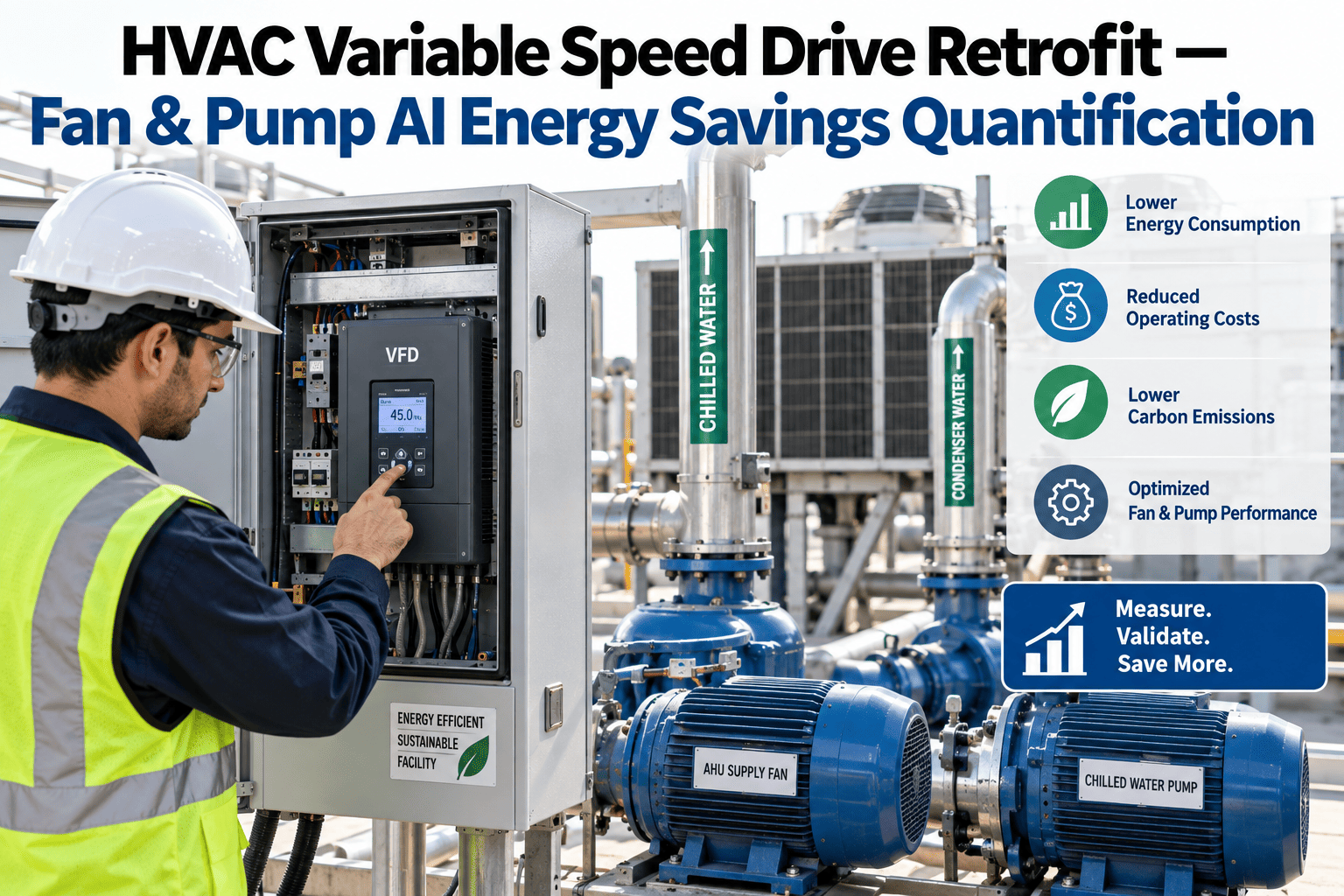
Most fans and pumps in a commercial building run at full speed regardless of actual load, throttled by a damper or valve instead of a motor that simply spins slower when less airflow or flow rate is needed. That's an expensive way to run a motor, because fan and pump power follows a cubic relationship with speed — cutting speed by twenty percent doesn't cut power by twenty percent, it cuts it by roughly half. A variable speed drive retrofit lets the motor actually slow down instead of fighting a throttled damper, and the energy savings from that single change are usually large enough to justify the retrofit on their own. The harder part is proving it after installation, since a capital budget justification or a sustainability report needs actual measured savings, not a theoretical estimate from a vendor brochure. AI-based savings quantification tracks exactly what a VSD retrofit delivers against its own pre-retrofit baseline. See what a VSD retrofit would actually save on your specific fans and pumps.
A Motor That Slows Down Uses Far Less Power Than One That's Throttled
Fan and pump power follows a cubic relationship with speed. A VSD retrofit captures that relationship directly, and AI tracking proves exactly how much it saved.
typical fan and pump energy reduction achievable from a variable speed drive retrofit on previously throttled equipment
common payback period for a VSD retrofit on equipment that runs long hours against a throttled damper or valve
the mathematical relationship between motor speed and power draw that makes VSD retrofits so effective
Why a Small Speed Reduction Delivers a Large Power Reduction
The affinity laws governing centrifugal fans and pumps state that flow scales linearly with speed, but power scales with the cube of speed. That means a motor running at 80 percent speed uses roughly half the power of one running at full speed, and a motor at 60 percent speed uses barely a fifth. A damper or valve throttling airflow or flow rate at the outlet doesn't capture any of this relationship — the motor still spins at full speed and draws full power regardless of how much the damper restricts the output. A variable speed drive lets the motor speed itself track actual demand, which is exactly where the affinity law's cubic relationship turns a modest reduction in output into a dramatic reduction in energy consumption.
Speed Reduction vs. Power Reduction
The gap between the two bars at each speed level is the affinity law in action — a small cut in speed produces a disproportionately large cut in power draw.
100% Speed
80% Speed
60% Speed
40% Speed
Find Out Which Fans and Pumps Are the Best VSD Candidates
iFactory analyzes your throttled fans and pumps against real load profiles to show exactly which units would deliver the fastest VSD payback.
Control Method Compared Against Typical Energy Savings
Not every flow control method captures the same energy savings, and the gap between the least and most efficient approach is larger than most facility budgets assume.
Proving VSD Savings for a Capital Budget or Sustainability Report
A retrofit's projected savings and its actual measured savings are two different numbers, and only the second one holds up in a capital review or an ESG report.
Pre-retrofit baseline measurement
Actual energy consumption and runtime hours are logged before the retrofit, establishing the true baseline a post-retrofit comparison needs rather than relying on a nameplate rating assumption.
Post-retrofit continuous monitoring
Power draw is tracked continuously after installation, normalized against actual load conditions so seasonal variation doesn't get mistaken for a change in retrofit performance.
Documented savings reporting
Verified savings figures feed directly into capital project close-out documentation and sustainability reporting, giving finance and ESG teams a number backed by measured data rather than a vendor estimate.
What Changes When Savings Are Actually Measured
Figures reflect typical outcomes when a facility moves from throttled damper control to a monitored VSD retrofit on its largest fan and pump loads.
A Facility Manager's View on VSD Retrofit Justification
Getting capital approval for our first VSD retrofit was harder than the installation itself, because finance wanted proof, not a vendor's projected savings sheet. Once we had actual pre- and post-retrofit consumption data on that first project, approving the next four retrofits took a fraction of the time, because we could show real measured numbers instead of asking anyone to trust an estimate.
The Bottom Line on VSD Retrofits
The affinity laws make VSD retrofits one of the most reliably high-return energy projects available for throttled fans and pumps, since a modest speed reduction produces a disproportionately large power reduction. The remaining obstacle is usually proof, not physics — capital budgets and sustainability reports need measured savings, not projections. Continuous pre- and post-retrofit monitoring turns a vendor estimate into a documented, defensible number.
Frequently Asked Questions
Which fans and pumps make the best VSD retrofit candidates?
Equipment that runs long hours at partial load against a throttled damper or valve delivers the fastest payback, since the energy waste from throttling compounds continuously over thousands of annual runtime hours. Equipment that runs at or near full speed most of the time offers little for a VSD to optimize, since there's minimal speed reduction available to capture. Book a review to see which units in your building are the strongest candidates.
How is post-retrofit savings actually verified against the baseline?
Verification compares actual measured power draw after the retrofit against the documented pre-retrofit baseline, normalized for load conditions like outdoor air temperature and occupancy so a mild winter or lighter production schedule doesn't get mistaken for retrofit performance. This normalization is what separates a defensible savings number from a simple before-and-after utility bill comparison.
Does a VSD retrofit affect equipment lifespan?
Running a motor at reduced speed for most of its operating hours generally reduces mechanical wear compared to running at full speed against a throttled restriction, since the motor and bearings experience less continuous full-load stress. Harmonics and electrical considerations from the drive itself are typically managed through proper VSD sizing and installation practice.
What's a realistic payback period for a typical VSD retrofit project?
Payback depends heavily on runtime hours, local electricity rates, and how aggressively the equipment was previously throttled, but equipment running long hours at significant partial load commonly pays back within one to three years, making it one of the faster-payback energy projects available for most facilities.
Can VSD savings data be used for utility rebate applications?
Many utility efficiency incentive programs require documented pre- and post-installation measurement to qualify for a rebate, and continuous monitoring data is typically formatted to satisfy that specific verification requirement rather than requiring a separate measurement and verification study. Talk to a specialist about aligning this documentation with your utility's specific rebate program.
Turn a Vendor Estimate Into a Measured Number
Book a 30-minute assessment. iFactory reviews your throttled fans and pumps and shows exactly what a VSD retrofit would deliver and how it would be verified.