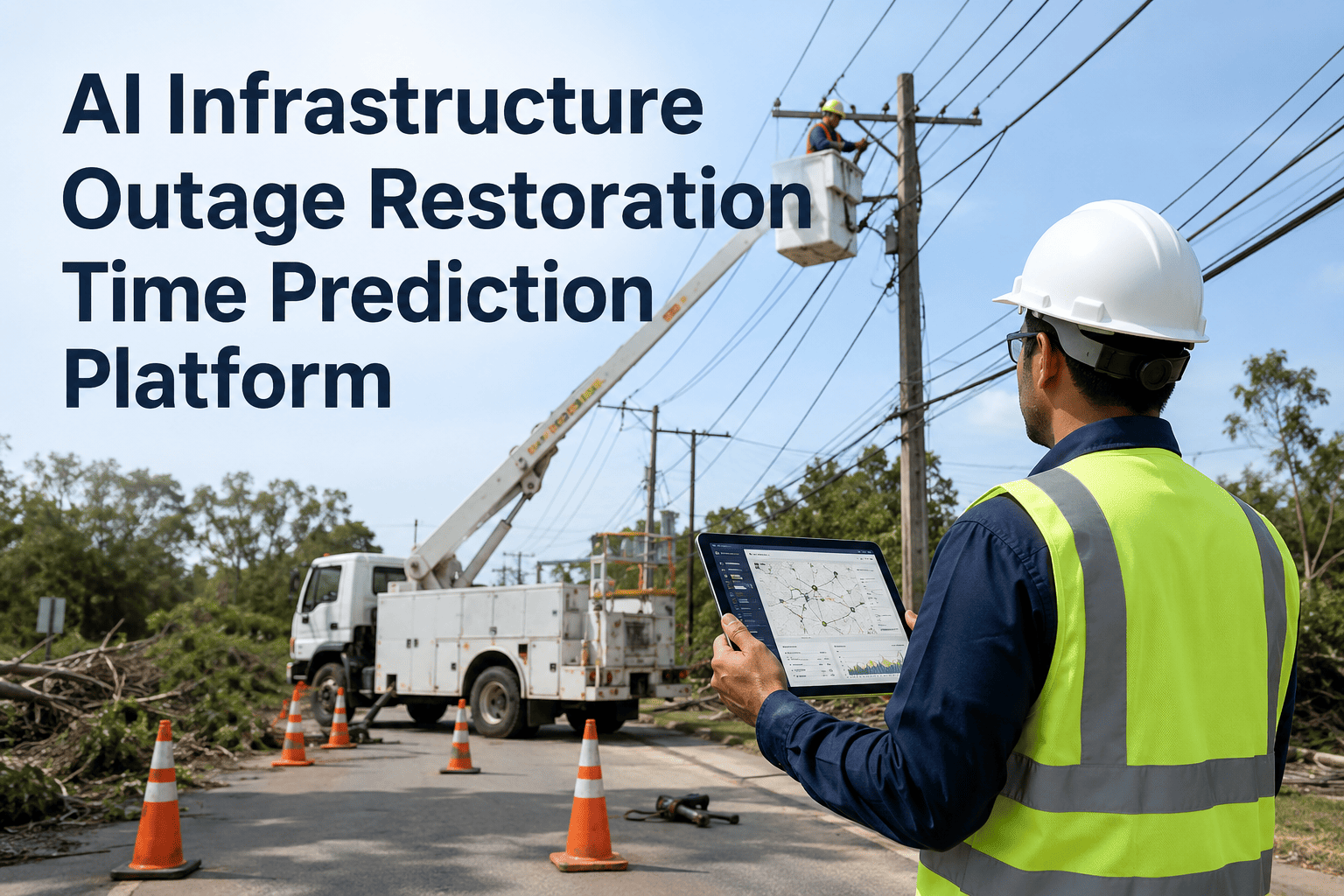
When the power goes out, the water stops flowing, or a transit line goes dark, the first question every affected customer, dispatcher, and regulator asks is the same one: how long until this is fixed. Most infrastructure operators still answer that question with a rough estimate pulled from a crew supervisor's gut feel, and when that estimate turns out wrong, customer trust erodes faster than the actual repair takes. Large-scale storm restoration research covering tens of thousands of outage events has consistently found that an estimate falling short of the real repair time damages customer confidence far more than a cautious one ever does, which means most operators are optimizing for the wrong kind of wrong. iFactory AI replaces that guesswork with a restoration time prediction platform that combines incident severity, asset location, crew availability, historical repair patterns, and live network conditions into a single, defensible estimate your dispatch team can stand behind, updated continuously rather than issued once and left to go stale. If your outage communications are still built on instinct instead of data, you can book a demo and see what a defensible restoration estimate actually looks like.
Know How Long Restoration Will Actually Take — Before You Tell a Single Customer
iFactory AI turns incident severity, asset location, crew availability, historical repair data, and real-time network conditions into a restoration time estimate your operations team can trust and your customers can plan around.
A wrong restoration estimate costs you more than a slow one
Restoration research built on tens of thousands of real storm and outage events has settled a question infrastructure operators used to answer by instinct: which mistake hurts more, telling a customer it will take longer than it actually does, or telling them it will be fixed sooner than it is. The data is consistent across utilities and event types, and it should change how every operator builds its restoration estimates.
What goes into an iFactory restoration prediction
A restoration estimate is only as trustworthy as the data behind it. iFactory pulls live and historical signals directly from the systems you already run — outage management, SCADA, CMMS, weather feeds, and crew scheduling — and turns them into a single number your dispatch team can put in front of a customer with confidence.
The factors that move a restoration estimate the most
Not every signal carries equal weight. Crew availability and incident severity tend to move an estimate far more than secondary factors, and understanding that hierarchy is what separates a model that adjusts intelligently from one that just averages every input equally. A model that treats spare parts availability with the same weight as crew dispatch distance will produce a confident-looking number that is wrong in exactly the situations where accuracy matters most, which is why iFactory continuously re-weights these factors against your own historical repair outcomes rather than applying a fixed industry formula.
Restoration accuracy is becoming a regulatory and contractual issue
Infrastructure operators used to treat restoration estimates as a customer service courtesy, something dispatch mentioned if a caller pressed hard enough for a number. That has changed. Regulated utilities now face reporting obligations around outage duration and customer communication, municipal water and transit agencies answer to service-level agreements that specify maximum response and restoration windows, and public agencies increasingly face public scorecards and after-action reviews comparing how accurately they communicated restoration timelines against how long repairs actually took. A restoration estimate that cannot be traced back to the data that produced it is a liability in front of a regulator or an oversight board, not just an inconvenience for the customer who planned their evening around it.
This is also where the cost of a rough estimate compounds beyond a single incident. Every restoration estimate your team issues, right or wrong, becomes a data point regulators and customers use to judge whether your organization understands its own infrastructure. An operator that consistently issues estimates it can explain and defend builds a credibility asset that pays off during the next major storm or system-wide event, when public patience is thinnest and the stakes of a missed estimate are highest. iFactory AI is built with that scrutiny in mind: every restoration prediction carries the specific signals that produced it, so your team can show its work instead of defending a number nobody can trace back to a source.
The same incident, handled two different ways
The clearest way to see the value of a data-driven restoration estimate is to watch the same outage unfold twice — once with a rough estimate issued at the start and never updated, and once with an estimate that adjusts as real conditions change. The incident itself does not have to be severe for the gap between these two approaches to show up; even a routine single-asset failure exposes how much confidence a dispatcher loses the moment a static estimate is proven wrong in front of an anxious customer.
Without a predictive estimate
Outage reported, crew dispatched based on a supervisor's rough estimate with no data behind it
Customers told "a few hours," an estimate nobody can defend if it turns out wrong
Original estimate blown past, call center volume spikes, dispatch has no update to offer
Power restored, but the estimate error was never measured, so nothing improves for next time
With iFactory restoration prediction
Outage reported, AI generates a restoration window from incident severity, crew data, and repair history
Customers receive a defensible estimate with a confidence range, not a single guessed number
Estimate automatically refreshes as crew status, site access, and repair progress change
Power restored inside the predicted window, and the accuracy is logged to sharpen the next estimate
An estimate built on instinct is a guess wearing a timestamp. Book a demo and see a live restoration prediction built from your own outage and crew data.
Six capabilities behind every restoration estimate
iFactory AI is not a single formula that spits out a static number. It is a live prediction system that keeps working for the entire duration of an incident, from the first alarm to the moment service is fully restored, and it keeps a record of every input that shaped each estimate so your team can explain a prediction to a regulator, a manager, or a frustrated customer without guessing at what drove it.
Incident severity classification
Outage reports, sensor alarms, and asset criticality data are classified automatically to establish a realistic starting point for the restoration estimate, instead of treating every incident as equally urgent.
Crew and resource availability modeling
Current crew location, skill match, equipment on hand, and existing workload are factored into every estimate, so the prediction reflects who is actually available to respond, not an assumed full crew.
Historical repair pattern matching
New incidents are matched against similar past repairs by asset type, failure mode, and location, giving the model a grounded baseline instead of a generic industry average.
Weather and network condition integration
Live weather severity, site accessibility, and downstream network dependencies are layered into the estimate, capturing the conditions that most often turn a routine repair into an extended one.
Dynamic estimate updates
Restoration estimates refresh automatically as new field data arrives — a crew delay, a part shortage, a site access issue — instead of standing as a static number issued once and forgotten.
Dispatch and customer communication feed
The current estimate is pushed directly into outage maps, IVR systems, and dispatch boards, keeping every channel your customers and crews see aligned to the same live number.
What operations leaders say about restoration estimate accuracy
Restoration accuracy rarely comes up in vendor conversations until an operator has already lived through a storm where the outage map estimate and the field reality drifted apart in front of thousands of customers at once. Operations leaders who have been through that experience tend to describe the same turning point in almost identical language.
Every operator learns the hard way that an estimate you cannot defend is worse than no estimate at all. Crews get pulled in every direction during a major event, and if the number on the outage map does not move as conditions change on the ground, customers stop trusting it within the first hour. The operators who handle this well are not the ones with the fastest crews, they are the ones whose restoration estimate updates itself in real time instead of sitting frozen from the moment it was first issued.
FAQ: AI restoration time prediction with iFactory
Stop guessing how long restoration will take
See how iFactory AI turns incident severity, crew availability, and historical repair data into a restoration estimate your dispatch team and your customers can actually trust.