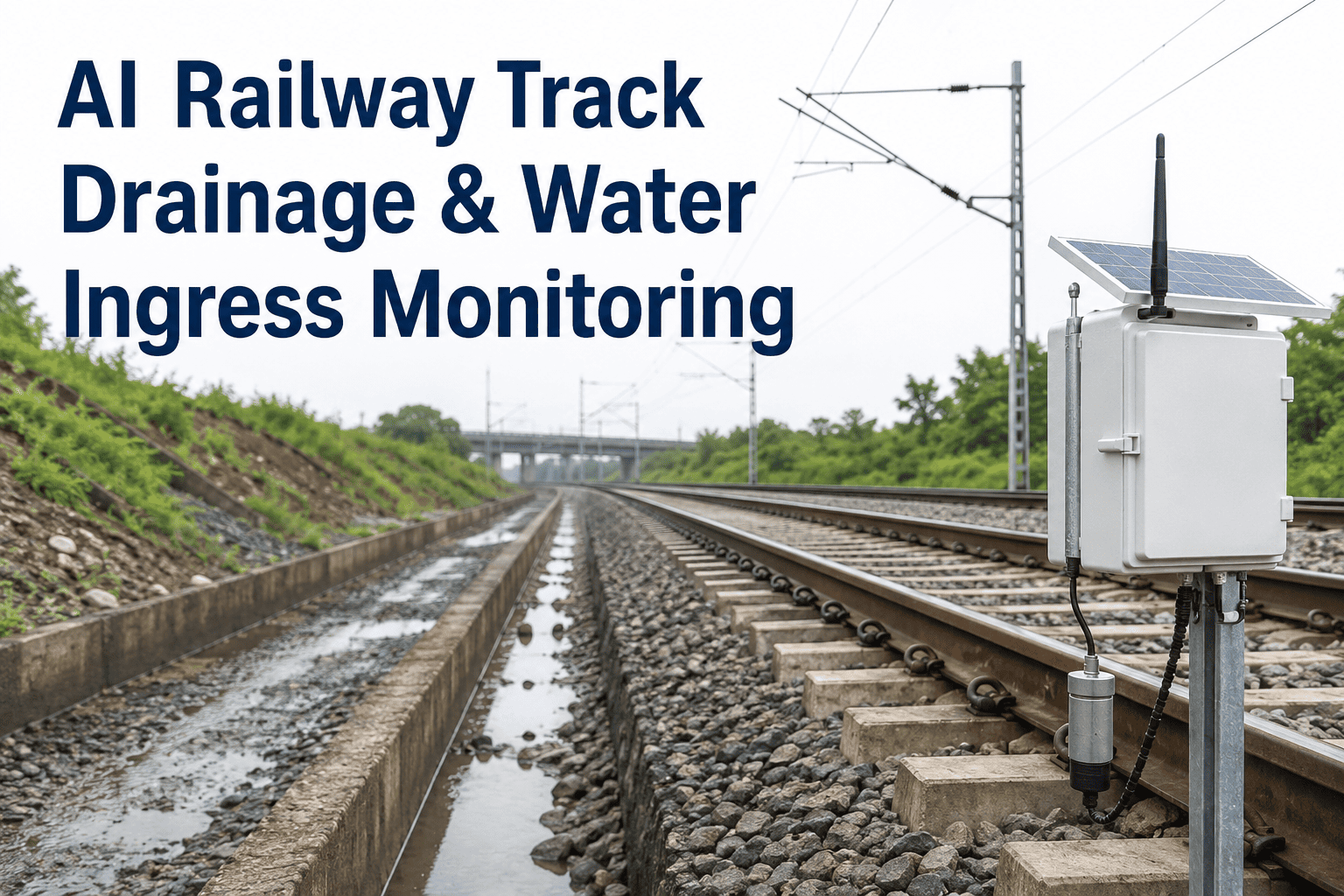
Water is the single most common cause of railway track failure, and it rarely announces itself until ballast pockets have already formed, a cess drain has silently overflowed, or subgrade has softened past the point of easy repair. A blocked culvert or a cracked drainage channel during a heavy monsoon week can turn a stable embankment into a slow-motion slope problem, and the first sign most infrastructure teams get is a speed restriction notice or a track geometry alarm that arrives long after the moisture damage has already spread through the formation layer. Traditional inspection walks catch surface symptoms like mud pumping or wet ballast between sleepers, but by the time water is visible at the ballast shoulder, it has usually been moving through the subgrade for weeks already. AI-based drainage and water ingress monitoring software closes that gap by tracking moisture, flow, and structural response data continuously across the corridor, flagging drainage degradation while a scheduled clearance or repair can still prevent a formation failure. Rail infrastructure teams evaluating what continuous drainage monitoring looks like for their own corridor can start by reaching out to the iFactory support team.
Track Formation Doesn't Fail Overnight. Water Spends Weeks Getting There First.
iFactory's drainage and water ingress monitoring software tracks moisture, flow, and formation response across your corridor continuously, comparing live sensor readings against how each section actually behaves, so a rising water table gets flagged while a scheduled clearance can still stop it from becoming a speed restriction.
Why Water Ingress Is the Hardest Failure Mode to Catch Early
A cracked rail or a worn switch component gives a visible, measurable signal well before it fails outright. Water ingress does not behave the same way. It moves underground, through ballast voids and subgrade layers that nobody can see from the cess path, and it often only becomes visible once the damage has already reached the point of affecting track geometry, ballast bearing capacity, or embankment stability.
Damage Happens Below the Surface
Moisture moves through ballast voids and subgrade layers long before it shows up as a wet patch, mud pumping, or a visible sag that a walking inspection could actually catch.
Drainage Assets Are Easy to Overlook
Cess drains, culverts, and catch pits sit outside the main track envelope and often only get attention during scheduled clearance cycles, not when they actually start losing capacity.
Weather Concentrates the Risk
A single heavy rainfall event can overwhelm a drainage system that handled years of normal weather without issue, turning a slow-building problem into an emergency within hours.
Track Geometry Alarms Come Too Late
By the time a geometry car or an axle-box sensor flags a defect linked to formation softening, the underlying moisture problem has usually been developing for weeks already.
Water-Related Track Defects and How Much Warning Each One Gives
Not every drainage-related failure develops on the same timeline, and knowing the difference changes how a maintenance team plans a response. Some patterns build gradually over weeks; others can turn critical within days once a blockage or a saturation threshold is crossed.
| Defect or Failure Mode | Typical Warning Window | What the Model Tracks | Impact if Missed |
|---|---|---|---|
| Ballast Fouling and Mud Pumping | 3-6 weeks | Moisture content trend and fines migration signature | Reduced ballast bearing capacity, track geometry drift |
| Cess Drain or Culvert Blockage | 2-4 weeks | Flow rate and water level trend at inlet and outlet points | Localized flooding, accelerated formation saturation |
| Subgrade Softening | 1-3 weeks | Subsurface moisture and load-response stiffness change | Speed restriction, potential track settlement |
| Embankment Slope Movement | 5-10 days | Pore pressure trend and slope displacement sensors | Emergency possession, derailment risk |
| Formation Washout | 1-4 days | Rapid water level rise and flow surge detection | Sudden track support loss, full line closure |
Which Track Sections This Applies To
Drainage risk looks different depending on where a section sits on the corridor, and a monitoring program has to account for that instead of treating every kilometer of track the same way.
Ballasted Mainline in Cuttings
Cuttings concentrate surface runoff from the surrounding land into a confined channel, making cess drain capacity and side-drain condition the primary risk factor.
Embankments and Fill Sections
Elevated sections depend on internal drainage and slope stability together, so pore pressure and moisture data need to be read alongside displacement trends.
Culverts and Cross-Drainage Points
Undersized or silted culverts are a recurring root cause of localized flooding, and flow-based monitoring catches capacity loss well before a monsoon peak tests it.
Tunnel Portals and Retaining Structures
Water pressure behind a retaining wall or at a portal face degrades slowly and quietly, which makes continuous moisture and displacement tracking especially valuable here.
Stop Waiting for a Geometry Alarm to Confirm What Water Already Started
iFactory connects live moisture, flow, and structural response data to a prediction model built for track formation behavior, then turns that prediction directly into a scheduled work order.
What a Missed Drainage Failure Actually Costs a Railway
An unplanned drainage failure rarely shows up as a single clean line item on a maintenance budget. The cost spreads across operations, safety, and asset condition at once, and almost all of it traces back to a problem that was building underground long before anyone noticed it.
Speed Restrictions and Delays
A suspected formation problem typically forces an immediate speed restriction while the section is investigated, which cascades into delays across the wider timetable.
Emergency Possession Costs
An unplanned possession to repair a washout or a slope failure carries premium labor, plant hire, and traffic disruption costs well above a planned clearance window.
Derailment and Safety Risk
Severe formation softening or embankment movement under a moving load is one of the more serious safety exposures a track authority manages, and it escalates quickly once started.
Accelerated Asset Deterioration
Repeated saturation cycles shorten the working life of ballast, sleepers, and formation layers, pulling forward capital renewal work that could otherwise have been deferred.
How a Moisture Trend Becomes a Scheduled Work Order
A drainage risk score sitting in a dashboard nobody checks does not protect a corridor from a washout. The value only shows up once the trend turns into a planned clearance or repair that a maintenance team actually acts on.
Continuous Sensor Ingestion
Moisture probes, flow sensors at culverts and cess drains, and displacement sensors on embankments stream condition data continuously along the corridor.
Section-Specific Baseline Modeling
The system builds a behavior baseline for each track section based on its own soil, gradient, and historical rainfall response, rather than one generic threshold.
Drift and Blockage Detection
Live readings are compared against the baseline continuously, surfacing a slow-forming blockage or a rising water table long before a fixed alarm threshold would trip.
Failure Window Prediction
The model converts a detected drift into a specific, dated risk window for the affected section rather than a vague health score.
Automatic Work Order Creation
The prediction is pushed directly into your maintenance system as a scheduled work order for clearance or repair, so it becomes planned work rather than a report someone has to remember.
A Composite Scenario: The Cutting That Didn't Slip
A regional rail network had a recurring pattern of side-drain silting in a long cutting section, typically forcing a temporary speed restriction once or twice a monsoon season after localized flooding softened the cess area. After the network connected flow sensors at the drain outlets and moisture probes along the formation to a prediction model trained on that section's own rainfall history, the system flagged a capacity drop in the side drain nineteen days ahead of what would have been the next forced restriction.
The maintenance team scheduled a mechanical desilting during a planned possession window with low traffic density, confirmed the drain capacity had returned to baseline afterward, and completed the work without a single unplanned speed restriction that season. When the drain was inspected, the silt buildup matched the severity the model had predicted almost exactly, confirming the team had intervened at the right point rather than too early or too late.
The network extended the same monitoring approach to two additional cuttings and one embankment section identified as similarly at-risk the following season, using the first section's model as a starting template. Within two monsoon seasons, the corridor had moved from reactive emergency clearances to a maintenance calendar built around predicted drainage risk windows instead of guesswork.
Common Mistakes Rail Infrastructure Teams Make With Drainage
Treating Drainage Clearance as a Calendar Task Only
A fixed annual clearance schedule ignores the fact that some sections silt up far faster than others based on local soil, gradient, and rainfall exposure.
Monitoring Track Geometry Without Monitoring Drainage
A geometry car catches the symptom after formation softening has already begun, but it says nothing about the drainage capacity that caused the softening in the first place.
Underestimating Culvert and Cross-Drainage Risk
Culverts are easy to deprioritize because they sit out of sight, yet undersized or blocked culverts are a recurring root cause behind embankment and formation failures.
Reacting Only After a Monsoon Event
Waiting until heavy rainfall exposes a weakness means the response is always emergency repair rather than a planned intervention timed around traffic and possession windows.
Is Your Corridor Ready for Drainage Monitoring
You can name the sections most exposed to water risk
If your permanent way and civil engineering teams already agree on which cuttings, embankments, or culverts are the usual trouble spots, that list is the right starting scope.
You have some baseline moisture or flow data
Existing rainfall records, past speed restriction history, or any prior instrumentation accelerates model deployment, though a program can also start from new sensors.
Your maintenance system can accept automated work triggers
A prediction only turns into protection if it can create or flag a work order directly instead of requiring someone to manually translate a report into action.
Leadership is willing to act on an early warning
A predictive drainage program only pays off if the team schedules a planned clearance off the forecast instead of waiting to see whether the section actually floods first.
Frequently Asked Questions
How is this different from a standard track geometry inspection?
A geometry inspection measures the symptom, such as a change in track alignment or level, after formation softening has already begun to affect the physical position of the track. Drainage and water ingress monitoring looks further upstream, tracking moisture, flow, and pore pressure trends that typically precede a geometry defect by weeks. Combining both gives a track authority both the early warning and the confirmation signal, rather than relying on the geometry alarm alone as the first indication something is wrong. Teams can see how this layered approach applies to their own network by contacting iFactory support.
What kind of sensors does a drainage monitoring program actually need?
Most deployments combine subsurface moisture probes near known problem sections, flow or water level sensors at culvert and cess drain outlets, and displacement or pore pressure sensors on embankments and cuttings identified as higher risk. The exact mix depends on the failure modes a given corridor is most exposed to, and a program typically starts with the highest-risk sections rather than instrumenting an entire network at once. Existing rainfall and inspection history can also feed the model alongside new sensor data.
How much advance warning can we realistically expect?
Warning windows vary significantly by failure mode, ranging from roughly three to six weeks for gradual issues like ballast fouling down to just a few days for a fast-developing formation washout during an extreme rainfall event. The model provides a specific predicted window rather than a single fixed number, so the exact lead time depends on which failure pattern is developing on a given section and how quickly local conditions are changing.
Can this scale across a large network with many cuttings and embankments?
Yes, the model tracks every monitored section individually even across a large multi-division network, and deployments typically begin with the sections that have the highest history of speed restrictions or known drainage weaknesses before expanding further. This phased approach lets a track authority prove the model's accuracy on a manageable scope before committing to network-wide instrumentation. Book a demo to see how a phased network rollout is typically scoped.
How does a predicted drainage risk actually turn into completed maintenance?
Once the model predicts a risk window for a specific section, that prediction is pushed directly into your maintenance system as a work order with the affected asset, recommended action, and suggested timing already attached, rather than sitting in a dashboard someone has to remember to check. Closing that loop between detection and scheduled action is usually the single biggest reason an accurate early warning still fails to prevent a speed restriction or worse in practice, since a forecast that nobody acts on protects nothing.
Give Your Track Formation the Early Warning System Water Ingress Deserves
iFactory builds drainage and water ingress monitoring models around your corridor's specific sections, turning live moisture and flow data into early warnings and scheduled maintenance work before a speed restriction ever reaches the timetable.