How AI Vision Reduces Safety Incidents on Major Bridge Projects
By Grace on May 23, 2026
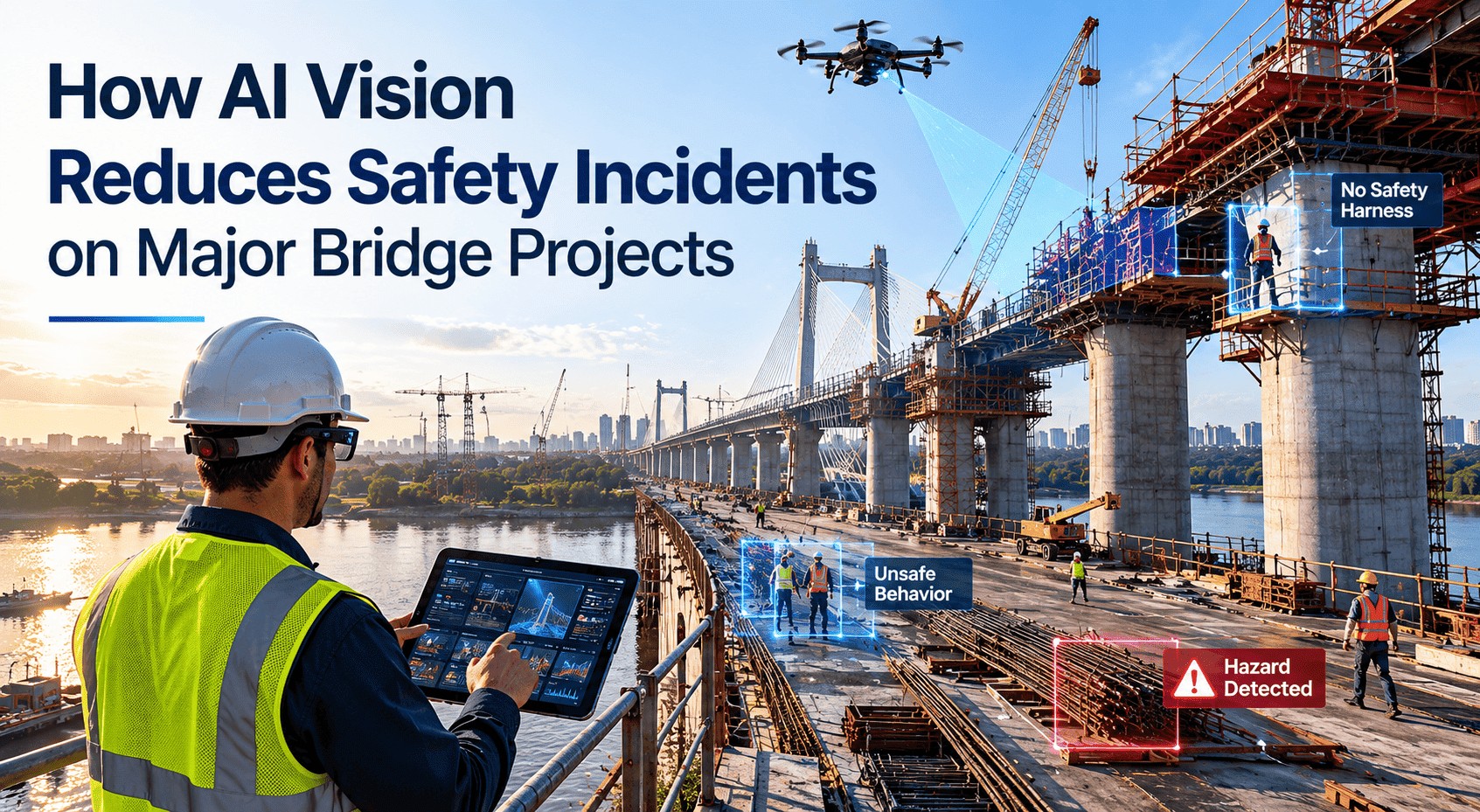
The crane load swings across the deck as the morning shift moves rebar into position on the north span. Below, three workers are standing inside the active swing radius -- one adjusting a formwork tie, one reviewing a layout drawing, one simply waiting. On the edge of the deck, a harness is hanging loose on a worker leaning over the guardrail to signal the crane operator. Nobody has noticed. The safety supervisor is at the far end of the bridge checking confined space permits. The next walk-through is scheduled in forty minutes. By then, the crane load will have completed twelve cycles, and the harness will still be hanging loose. The statistical reality of bridge construction safety is that between manual inspections, dozens of PPE violations, proximity hazards, and unauthorized zone entries occur without detection. These unreported events are the root cause of the 40,000+ construction injuries that occur annually in the United States alone. AI vision for bridge construction safety exists to close the gap between what manual inspection catches and what actually happens on the deck between inspections.
AI Vision Safety · Bridge Construction · PPE Detection · Hazard Alerting · Infrastructure
AI Vision Reduces Safety Incidents on Major Bridge Projects
iFactory's AI vision safety platform monitors every zone of your bridge construction site continuously -- detecting PPE violations, crane proximity hazards, deck edge risks, and confined space breaches in real time, and alerting supervisors before an incident occurs.
Fewer safety incidents reported by construction firms using AI vision monitoring platforms in 2024-2025 deployments
25%
Faster hazard response with AI-based detection systems vs manual inspection alone (BCG research)
95%+
mAP detection accuracy achieved by YOLOv8 models trained on bridge-specific PPE and hazard imagery
4-6x
Documented ROI when measured against avoided incident costs alone -- not including delay or insurance savings
The Four Risk Zones That Define Bridge Construction Safety
Bridge construction sites are not uniform environments. They are layered risk zones where the hazard profile changes every few meters -- from the open deck edge at height to the confined interior of a pier column, from the crane swing path to the temporary works access where delivery vehicles and workers intersect. Each zone has a different risk signature, and each requires a different AI vision detection configuration. A single camera model covering all zones with the same detection logic will miss the zone-specific hazards that cause the majority of bridge construction incidents.
Zone 1
Deck Edge and Height
Harness attachment, guardrail proximity, edge-of-deck approach. Falls from height account for 36% of construction fatalities. AI detects missing harness attachment and edge proximity before a fall event.
Zone 2
Crane Swing and Lift Path
Worker in active swing radius, suspended load proximity, crane hook alignment. Struck-by incidents involving heavy equipment cause 75% of construction fatalities. AI detects zone intrusion instantly.
Zone 3
Confined Space and Structure Interior
Pier column interiors, abutment cavities, coffer dam access. Entry without permit, missing atmospheric monitoring, unsecured access. AI detects entry events and verifies permit compliance documentation.
Zone 4
Material and Equipment Interface
Delivery vehicle paths, material staging areas, worker-vehicle intersections. Mobile equipment proximity to workers, housekeeping slip hazards, crowd density near formwork zones during concrete pours.
What AI Vision Detects on Bridge Construction Sites
AI vision on a bridge construction site operates at the intersection of object detection, behavior recognition, and environmental monitoring. YOLO-based deep learning models running at 30+ frames per second classify every worker, every piece of equipment, and every zone boundary in the camera feed simultaneously. The detection categories fall into three tiers based on risk severity and required response time.
Risk Tier
Critical
Harness not attached at height
Worker on deck edge or scaffold without fall arrest system attached. Alert fires within 0.5 seconds with worker location and photo. Supervisor notified via SMS and app.
Critical
Worker in active crane swing zone
Person detected inside the crane swing radius during load movement. Geofenced zone boundary enforced by AI. Alert includes crane operator notification and immediate supervisor escalation.
High
Hard hat or helmet missing
Worker detected without head protection. Most common PPE violation on bridge sites, especially during material handling and formwork operations. Automated compliance log generated.
High
Unauthorized deck edge approach
Worker within 1 meter of unprotected edge without fall protection. AI detects proximity to edge perimeter via depth-aware segmentation. Timestamped photo and location added to safety log.
Medium
Confined space entry without permit
Entry event detected at pier column or abutment access point. AI cross-references entry with active permit database. Unpermitted entry triggers immediate supervisor alert and documentation hold.
Medium
Equipment proximity to workers
Dump truck, excavator, or concrete pump within unsafe distance of workers. Distance thresholds configurable per equipment type and site phase. Alert includes equipment ID and operator name.
Low
Housekeeping and slip hazards
Unsecured materials on deck, standing water, debris in walkways. Low-criticality but high-frequency alerts that support proactive housekeeping management and reduce trip-and-fall incidents that account for 15% of site injuries.
The AI Vision Alert Pipeline
From Camera Capture to Supervisor Action
1
Camera captures
Fixed 4K or existing CCTV feeds every zone at 30+ fps
→
2
AI detects hazard
YOLOv8 model classifies violation, severity tier, and zone
→
3
Alert dispatched
SMS + app notification with photo, zone, and worker location
→
4
Supervisor intervenes
Corrective action taken before incident occurs. Event logged with timestamped evidence.
Before AI Vision
Safety supervisor walks the deck every 40 minutes. Between walk-throughs, PPE violations, zone breaches, and proximity hazards go undetected. Incident reports are written after the event. Investigation relies on witness statements and incomplete recollections.
The Difference AI Vision Makes
Every zone watched 24/7. Every PPE violation detected within 0.5 seconds. Every zone intrusion logged with photo and timestamp. Incident rate drops 40-60%. Supervisor time shifts from reactive investigation to proactive prevention.
With AI Vision
Harness violation alert arrives before the worker leans over the edge. Crane zone intrusion stops the lift before the load swings near personnel. Weekly safety reports show trending data per subcontractor, per zone, per shift. Incidents are prevented, not investigated.
During construction of a coastal bridge project in South America, AI-triggered weather safety protocols detected sudden high-wind conditions on three separate occasions and immediately paused crane operations -- preventing an estimated $480,000 in potential equipment losses and material damage. More importantly, the system safeguarded lives by ensuring no personnel were in or near the crane swing path when wind speeds exceeded the safe operating threshold. The project safety supervisor noted that the AI detected the wind condition and initiated the crane shutdown protocol 8 to 12 minutes faster than the manual weather monitoring procedure that had been in place on prior projects.
-- Project Case Study: South American Coastal Bridge, AI + Smart Weather Sensor Integration, 2024
The Financial Case: What a 40-60% Incident Reduction Means for a Major Bridge Project
The average cost of a workplace injury in construction is $42,000 per incident. A fatality averages $1.46 million in total financial impact when you include direct costs, insurance premium increases, OSHA fines, legal fees, and project delay penalties. For a major bridge project running 24 to 36 months with 200 to 400 workers on site at peak, the baseline incident cost projection using industry average injury rates is significant. A 40-60% reduction in incidents -- the range reported by construction firms using AI vision safety platforms in 2024-2025 -- translates directly to millions in avoided costs over the life of the project.
Beyond the direct incident cost savings, AI vision safety programs deliver additional financial returns that compound the ROI. Insurance carriers increasingly offer premium reductions for sites with continuous AI monitoring. Project delay risk from safety shutdowns is reduced when near-misses are prevented rather than investigated. OSHA audit standing improves when every safety event is documented with timestamped photo evidence. The documented 4-6x ROI for AI safety programs is a conservative estimate that accounts only for direct incident cost avoidance -- not the secondary benefits that typically match or exceed the primary savings.
Get a Free AI Safety Assessment for Your Bridge Project
iFactory's safety engineers review your current site layout, camera infrastructure, and incident history -- and identify exactly where AI vision monitoring would deliver the highest risk reduction and financial return for your specific project phase and bridge type.
How iFactory AI Vision Integrates With Your Existing Site Operations
AI vision safety for bridge construction does not require dedicated hardware or a separate camera network. The iFactory platform is designed to overlay on existing site camera infrastructure -- the same CCTV system already installed for security and project monitoring. Edge AI processing nodes connect to the camera feed through standard RTSP and ONVIF protocols, running YOLO-based detection models locally on GPU-accelerated edge hardware. No video data leaves the site network. Alerts are the only traffic that reaches the supervisor's mobile device.
Hardware
Works with existing fixed CCTV, 360 cameras, and mobile site cameras. Edge AI nodes process video locally. No cloud dependency. No camera replacement required.
Detection
YOLOv8 models trained on bridge-specific imagery for PPE, zone intrusion, proximity, and environmental hazards. 95%+ mAP accuracy. Configurable per project phase and zone.
Bridge construction safety has reached a point where the manual inspection model -- periodic walk-throughs, clipboard checklists, and reactive incident investigation -- is no longer sufficient for the scale and complexity of modern infrastructure projects. The risk zones are too numerous, the subcontractor workforce too mobile, and the hazard windows between inspections too wide for a human-centered monitoring system to catch every violation before it becomes an incident. AI vision closes those windows. It watches every zone, every second, every shift -- detecting PPE violations, crane zone intrusions, deck edge hazards, and confined space breaches within milliseconds of occurrence, not minutes after the fact.
The results from 2024-2025 deployments are not projections. They are measured outcomes: 40-60% fewer safety incidents, 25% faster hazard response, 95%+ detection accuracy, and a documented 4-6x return on investment measured against incident cost avoidance alone. The South American coastal bridge case study -- where AI detection of high-wind conditions prevented an estimated $480,000 in losses across three automated crane shutdown events -- demonstrates the real-world impact that the technology delivers when integrated with site operations.
iFactory's AI vision platform is built for bridge and infrastructure project teams who need to reduce safety incidents, not just report them. Book a Demo to see a live PPE detection and zone-alert demonstration configured for your site conditions and project phase, or talk to an expert about deploying AI vision safety monitoring on your next bridge project.
Frequently Asked Questions
iFactory works with existing site cameras through standard RTSP and ONVIF protocols. Most bridge construction sites already have CCTV infrastructure for security and project documentation purposes. The edge AI node connects to the existing camera feed, processes video locally, and sends alerts only when a hazard is detected. No video data is transmitted off-site, no camera replacement is required, and the system can be operational within 48 hours of edge hardware installation. For sites without existing camera coverage, iFactory can supply ruggedized 4K cameras designed for construction environments with integrated illumination and dust-resistant housings.
The AI models are trained on bridge-site imagery that includes rain, fog, low-light, dust, and night-time conditions. YOLOv8's architecture handles variable image quality better than threshold-based detection systems because it learns froth morphology directly from labeled data, not from brightness or contrast heuristics. For low-light periods, cameras with integrated IR illumination maintain detection accuracy. The edge AI node processes at 30+ fps regardless of lighting conditions. If visibility drops below the confidence threshold for reliable detection, the system sends a "camera obscured" status alert rather than generating false positives -- ensuring the supervisor knows when coverage is degraded and can take corrective action.
Yes. The system can be configured to track violations by zone, shift, and subcontractor crew when worker identification is linked to hard hat color, vest labeling, or equipment assignment. Over time, the AI dashboard surfaces which crews, shifts, or task types drive repeat violations -- enabling targeted toolbox talks before incidents occur. This data is also valuable for subcontractor safety reviews: objective violation frequency and severity data replaces subjective performance assessments. The automated behavioral profile gives prime contractors and project owners documented evidence of safety performance across all subcontractors on the project.
Deployment is structured to avoid production disruption. The edge AI node connects to the existing camera network during a scheduled maintenance window and begins processing video immediately. The system runs in passive observation mode for the first 7 days, generating alerts internally so the safety team can validate detection accuracy against their own observations. After validation, the alert routing is activated. No site operations are impacted at any stage because the AI is monitoring the existing camera feed, not controlling any equipment. Zone definition and hazard configuration changes can be made through the dashboard without hardware modification.
Initial deployment on a single bridge project -- connecting to existing cameras, configuring zones, training models on site-specific imagery, and activating alert routing -- typically takes 2 to 3 weeks from hardware installation to live alerting. The passive validation period adds 7 days before alerts are routed to supervisors. For multi-project programs across a portfolio, deployment scales faster because the model training and zone configuration are transferable between similar bridge types and site layouts. Cost varies with the number of zones and cameras, but the documented 4-6x ROI based on incident cost avoidance alone means most deployments pay for themselves within the first 6 to 9 months of operation.
Every Hazard That Escapes Between Walk-Throughs Is an Incident Waiting to Happen. iFactory Closes That Gap on Every Zone, Every Shift.
iFactory's AI vision platform turns your existing site cameras into a continuous, high-accuracy safety monitoring system -- detecting PPE violations, crane zone intrusions, deck edge hazards, and confined space breaches in real time, with instant alerts to supervisors and a complete evidential record for every event.