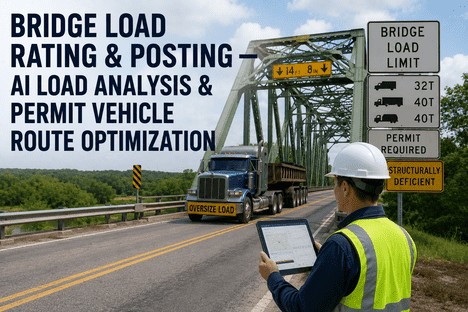
Bridge Load Rating Bridge Formula B and Permit Vehicle Analysis
By Grace on June 18, 2026
Every bridge has a finite capacity, and every overweight vehicle permit application asks the same question: can this structure carry this load safely? Bridge load rating is the engineering answer to that question. Using the AASHTO Manual for Bridge Evaluation (MBE), structural engineers calculate rating factors (RF) for each bridge component under HL-93 design loads, state legal loads, and permit vehicle configurations. An RF below 1.0 means the bridge is overstressed. An RF above 1.0 means it has reserve capacity. The difference between these two numbers determines whether a truck crosses, takes a detour, or triggers a bridge posting that redirects thousands of vehicles per day to alternate routes.
For fleet operators, infrastructure managers, and permitting engineers, the load rating is the single document that controls access to the road network. A bridge rated for HS-20 may accommodate routine permit loads but fail under a superload configuration that requires route-specific finite element analysis. A bridge with an LRFR inventory rating factor of 0.85 triggers mandatory posting, reducing the legal vehicle weight from 80,000 lbs to whatever the calculated posting level dictates. And when Federal Bridge Formula B interacts with a bridge that has marginal rating factors, the permitting pathway becomes a multi-agency coordination problem that can delay a critical shipment by weeks.
Bridge Load Rating · LRFR Analysis · Formula B Compliance · Permit Vehicle Routing
Your Bridge Rating Factor Determines Every Permit Decision. If It Is Wrong, the Truck Stops or the Bridge Pays the Price.
iFactory helps infrastructure operators manage bridge load ratings, automate Formula B compliance checks, and streamline permit vehicle analysis with digital tools built for the MBE workflow.
Bridges in the US National Bridge Inventory — each requiring a current load rating per NBIS standards
42%
Of US bridges are over 50 years old — age-related rating factor degradation is the primary driver of new bridge postings each year
3–6 Weeks
Average turnaround time for a single superload permit engineering review when bridge load ratings must be checked route by route
$4.5B
Estimated annual cost of overweight truck permitting delays across US freight networks when bridge capacity is uncertain
What a Bridge Load Rating Actually Tells You — and What It Does Not
A bridge load rating is not a single number. It is a set of rating factors calculated for each critical component of the structure under multiple loading conditions at multiple limit states. The AASHTO MBE defines the methodology for calculating these factors using three distinct rating approaches: Load and Resistance Factor Rating (LRFR), Load Factor Rating (LFR), and Allowable Stress Rating (ASR). Each methodology produces inventory-level and operating-level ratings, and the controlling rating factor — the lowest RF across all components, all load cases, and all limit states — determines the bridge's legal load capacity.
The rating factor equation itself is structurally simple: RF equals capacity minus dead load effects, divided by live load effects, all adjusted through resistance and load factors that reflect the target reliability level. But the simplicity ends there. The capacity term depends on material properties that may have degraded since construction, section losses from corrosion or collision damage, and fatigue effects in steel members that are invisible to visual inspection. The live load term incorporates dynamic load allowance, distribution factors, multiple presence adjustments, and the specific vehicle configuration being evaluated — which may be HL-93 design load, an AASHTO legal load, a routine permit vehicle, or a superload with specialized axle geometry.
For the fleet manager or permitting engineer, the practical output of a load rating is a posting level. When the inventory rating factor under legal loads falls below 1.0, the bridge must be posted — meaning a weight limit sign goes up, and vehicles exceeding that limit must either detour or apply for a permit that triggers a more detailed operating-level analysis. When the operating-level rating factor also falls below 1.0 under the permit vehicle, the permit is denied or the vehicle must be rerouted. In every case, the rating factor is the gatekeeper, and getting it right is the difference between a bridge that is safely managed and a structure that is unknowingly overstressed.
The Three Load Rating Methodologies Defined by the AASHTO MBE — and When Each Applies
LRFR — Load and Resistance Factor Rating
The primary methodology for bridges designed to LRFD specifications. Uses statistically calibrated load and resistance factors to achieve uniform reliability across all limit states. Inventory and operating ratings are calculated separately using different live load factors that reflect the lower probability of extreme loads during the operating-level check.
Required for all new NBI ratings after FHWA October 2010 transition deadline.
LFR — Load Factor Rating
The legacy methodology for bridges designed to LFD or ASD standards. Uses factored loads with a single resistance factor and separate load factors for dead and live load. LFR operating-level ratings are generally reported as the legal load posting level, and this methodology remains acceptable for existing bridges that were originally rated using LFR.
Still widely used for rating older bridges not designed to LRFD specifications.
ASR — Allowable Stress Rating
The simplest methodology, based on working stress design principles. Stresses under service loads are compared against allowable stress limits with a single factor of safety. Limited applicability for modern rating work but still accepted by some owners for specific structure types and material systems where LRFR or LFR calibration data is not available.
Limited to specific structure types where LRFR calibration data is unavailable.
How Federal Bridge Formula B Controls Permit Vehicle Weight — and Why Axle Geometry Matters More Than Gross Weight
Bridge Formula B, codified in 23 USC Section 127, exists because gross vehicle weight alone is a poor predictor of bridge stress. A 90,000-lb load spread across seven axles over 50 feet of wheelbase produces less structural demand on a sixty-foot span than an 80,000-lb load concentrated on three axles over 14 feet. The formula W = 500 [LN/(N-1) + 12N + 36] captures this relationship by computing the maximum allowable weight as a function of axle count and axle spacing — more axles and longer spacing yield higher allowable weight, while short, concentrated configurations are penalized to protect bridges from disproportionate stress.
For permit vehicles, Formula B compliance is checked at every axle group along the vehicle combination. A five-axle tractor-semitrailer with 20-foot outer axle spacing may comply with Formula B at 80,000 lbs, while a three-axle single-unit truck with the same gross weight on 12-foot axle spacing violates it. The practical consequence is that permit applications must include detailed axle configuration data — not just gross weight — and the permitting agency must verify Formula B compliance for every bridge on the intended route using the actual axle geometry of the permitted vehicle.
How Bridge Formula B Works in Permit Vehicle Analysis — The 4-Step Compliance Check
1
Define Axle Groups
Every possible combination of 2 or more consecutive axles is treated as a group for Formula B checking. A 5-axle tractor-semitrailer produces approximately 10 distinct axle groups — from the steering axle group to the full vehicle. Each group must independently comply with its calculated weight limit.
2
Calculate Allowable Weight Per Group
For each group, plug L (axle span in feet) and N (number of axles) into W = 500[LN/(N-1) + 12N + 36]. Round the result to the nearest 500 lbs. Compare the calculated allowable weight against the actual load on that group. Any group exceeding its limit triggers a Formula B violation.
3
Apply Axle and Gross Weight Caps
Single axles are capped at 20,000 lbs and tandem axles at 34,000 lbs regardless of what Formula B calculates. Gross weight is capped at 80,000 lbs on interstate highways. The Formula B result is further capped by these statutory limits, and the most restrictive limit at every group level becomes the enforceable weight.
4
Route-Specific Bridge Rating Verification
Even when Formula B compliance is confirmed, each bridge on the intended route must have a current load rating that can accommodate the permit vehicle at operating level. This step — route-specific verification against LRFR operating rating factors — is where most permit applications are delayed or denied.
Permit Vehicle Analysis: From Superloads to Routine Overweight Permits
Permit vehicle analysis exists on a spectrum. At one end, routine overweight permits for divisible loads on standard routes are processed against pre-calculated bridge ratings using established legal load models. At the other end, superload permits for nondivisible loads exceeding 200,000 lbs or 16 feet in width require route-specific structural analysis, often including refined finite element modeling of individual bridge components, live load distribution verification at the project level, and posting bypass evaluations for every bridge with marginal rating factors.
The AASHTO MBE Part A, Chapter 6 defines the framework for both routine and special permit load ratings. Routine permits are evaluated against legal load ratings with an operating-level RF threshold of 1.0. Special permits exceeding legal load thresholds trigger a three-tier evaluation: first, a route review against existing load ratings; second, a refined analysis for bridges where ratings are marginal; and third, a posting bypass determination for bridges that cannot accommodate the load even with refined methods. Every step requires documented engineering judgment, and the entire process must be reproducible for audit and liability purposes.
Routine Overweight Permits
Vehicles exceeding legal weight limits on interstate or state highways by less than 25%. Evaluated against existing legal load ratings using an operating-level check with a 1.0 RF threshold. Standard processing in 1–3 business days when bridge ratings are current. Does not typically require route-specific refined analysis unless the vehicle configuration falls outside AASHTO legal load models.
Superload Permits
Vehicles exceeding 200,000 lbs gross weight or dimensional limits that trigger route-specific structural analysis. Requires finite element modeling of critical bridge components, live load distribution verification, and posting bypass evaluation for every bridge on route. Processing times of 3–6 weeks are typical. Each superload permit generates a complete engineering report that becomes part of the bridge owner's permanent record.
Formula B Exceptions and Grandfather Rights
Some states operate under grandfather provisions enacted when the Interstate System weight limits were adopted in 1956 and amended in 1975. These provisions allow higher gross weights on specific routes for specific vehicle configurations — typically up to 105,500 lbs on designated state highways. Permit applications on grandfathered routes must verify not only Formula B compliance but also whether the specific route and vehicle combination qualifies under the state's grandfather clause. Permitting engineers must maintain current documentation of each state's grandfather provisions because the route-specific applicability changes as state legislation evolves.
Dynamic Load Allowance and Impact Factors
Dynamic load allowance (IM) amplifies the static weight of a permit vehicle to account for impact effects from moving loads. The MBE specifies a 33% impact factor for all permit vehicles on smooth pavement, with provisions to reduce IM based on measured pavement roughness or increase it for routes with known surface irregularities. The interaction between IM and permit vehicle speed restrictions — many superload permits require speed reductions to 10–15 mph on specific bridges — can reduce the effective live load demand by 15–20%, which is sometimes the margin that makes a marginal permit feasible.
Every Permit Vehicle, Every Bridge, Every Route. The Rating Factor Is the Single Point of Truth — and It Must Be Current.
iFactory provides digital infrastructure for managing bridge load ratings, automating Formula B checks, and streamlining permit vehicle analysis workflows — from routine permits to superload engineering reviews.
The Permit Engineering Workflow: From Load Rating to Route Clearance in Six Stages
Every permit vehicle analysis follows the same structural logic, whether the vehicle is an 85,000-lb routine permit or a 400,000-lb superload. The six-stage workflow defined by the MBE and implemented by state DOT permitting offices is designed to ensure that no bridge is subjected to a load beyond its proven capacity at operating level. Understanding this workflow — and the bottlenecks that occur at each stage — is the first step toward reducing permit processing times and avoiding costly route denials after weeks of engineering review.
Stage 1
Vehicle Configuration and Route Definition
Permit applicant submits axle configuration, axle weights, gross weight, overall dimensions, and intended route. Route typically covers 50–200 miles of interstate and state highway. Every bridge along each route segment must be identified by NBI structure number, posted weight limit, current load rating, and posting status. A single superload route may cross 30–80 bridges, each requiring individual evaluation.
Vehicle axle group weight is checked against Formula B for every axle group combination. Single and tandem axle statutory caps are verified. Gross weight is checked against the interstate 80,000-lb limit and any applicable state-specific limits. If Formula B compliance fails, the permit is returned for reconfiguration — additional axles or longer axle spacing may resolve the violation. Approximately 15% of initial permit applications fail Formula B compliance on the first submission.
Formula B calculationAxle cap verificationState weight table checkGrandfather route check
Stage 3
Load Rating Factor Comparison
For each bridge on route, the permit vehicle's live load effect at operating level is compared against the bridge's current operating-level rating factor. Bridges with RF above 1.0 for the permit load pass. Bridges with RF below 1.0 require either refined analysis, posting bypass evaluation, or route modification. This stage accounts for approximately 60% of total permit engineering hours, particularly when bridge load ratings are outdated or missing.
RF comparison per bridgeOperating level checkMarginal bridge identificationRating currency audit
Stage 4
Refined Analysis for Marginal Bridges
Bridges with operating RF between 0.8 and 1.0 undergo refined analysis. This may include two-dimensional or three-dimensional finite element modeling, site-specific live load distribution factor calculation, measured material property verification, and dynamic load allowance adjustment for the permit vehicle's speed restriction. Refined analysis typically recovers 5–15% additional capacity compared to the standard rating, which is often sufficient to bring the RF above 1.0.
FEM modelingDistribution factor refinementMaterial testingSpeed restriction IM adjustment
Stage 5
Posting Bypass and Route Modification
Bridges that cannot accommodate the permit vehicle even after refined analysis require either posting bypass — routing the permit vehicle off the posted bridge and onto an alternate crossing — or a full route modification that may add 20–100 miles to the permitted journey. Posting bypass verification requires confirming that the alternate crossing has a current load rating sufficient for the permit vehicle, creating a secondary engineering review loop.
Final permit includes approved route, speed restrictions on specific bridges, time-of-day travel restrictions, escort vehicle requirements, and any seasonal load restrictions that apply. The complete engineering review becomes part of the bridge owner's permanent record. Permits for superloads may include instrumented bridge monitoring requirements, posting bypass verification documentation, and insurance certification requirements.
Approved route issueSpeed restriction conditionsEscort requirementsPermanent audit record
We evaluated a superload permit for a 320,000-lb transformer movement across 14 bridges on two state highway routes. Stage 3 analysis showed three bridges with operating RF between 0.82 and 0.91. Refined analysis using three-dimensional finite element modeling recovered 8–12% additional capacity on two of the three, bringing them above 1.0. The third bridge required a posting bypass adding 14 miles to the route. The total engineering review took four weeks. Without the refined analysis capability, all three bridges would have been denied at Stage 3, and the entire permit would have required route redesign that would have added 90 miles and three additional bridge evaluations.
— Bridge Engineering Manager, State Department of Transportation, Superload Permit Program
Conclusion
Bridge load rating, Formula B compliance, and permit vehicle analysis form a single integrated decision framework that controls access to the surface transportation network for every overweight vehicle movement in the United States. The load rating provides the structural capacity baseline. Formula B ensures that axle configuration distributes weight in a way that bridges are designed to accommodate. Permit vehicle analysis translates these two inputs into a route-specific, vehicle-specific authorization that protects both the infrastructure and the public.
The practical challenges that fleet operators and infrastructure managers face are not in the engineering methodology itself—the AASHTO MBE provides a clear, auditable framework. The challenges are in the data: load ratings that have not been updated since the last inspection cycle, Formula B checks that must be manually calculated for every axle group combination, permit routes that cross multiple jurisdictions with different grandfather provisions and posting policies, and superload applications that generate weeks of engineering review because bridge rating information is not accessible in a standardized digital format.
iFactory provides digital tools for managing bridge load ratings, automating Formula B calculations, and streamlining the permit vehicle analysis workflow across the full spectrum from routine permits to superload engineering reviews. Book a Demo to see how our platform centralizes bridge load rating data and permit vehicle analysis in a single digital workspace, or talk to an expert about a free assessment of your current permit processing workflow.
Frequently Asked Questions
The inventory rating represents the load level that can safely use the bridge for an indefinite period of time under normal traffic conditions. It uses higher live load factors reflecting everyday traffic exposure and produces a lower RF. The operating rating represents the maximum permissible live load that can be applied to the bridge — it uses reduced live load factors reflecting the lower probability of extreme loads occurring simultaneously during any single crossing. Operating rating RF values are typically 1.3 times higher than inventory RF values under LRFR methodology. The inventory rating is used for bridge management decisions including posting evaluation, while the operating rating is the threshold for permit vehicle evaluations. Talk to an expert about how inventory and operating ratings interact with your permit processing workflow.
HL-93 was introduced in the AASHTO LRFD Bridge Design Specifications in 1993 as a replacement for the HS-20 loading used in the older Standard Specifications. HL-93 combines three components — a design truck (identical to HS-20 with a 72,000-lb three-axle configuration), a design tandem (two 25,000-lb axles spaced 4 feet apart), and a design lane load (0.64 kips per linear foot) — and the controlling force effect is the envelope of the worst combination of these components. HL-93 produces approximately 25% higher live load effects on short to medium spans compared to HS-20. For modern bridge load ratings under LRFR, HL-93 is the required design load for computing rating factors under the MBE. Book a Demo to see how our platform handles HL-93 load rating calculations for your bridge inventory.
The superload threshold varies by state, but the most common definition is any vehicle exceeding 200,000 lbs gross weight, 16 feet in width, 150 feet in length, or any vehicle whose weight or configuration falls outside the AASHTO legal load models used in standard bridge ratings. Superload permits require: (1) route-specific refined analysis including finite element modeling of critical bridge components, (2) live load distribution verification at the bridge level rather than using standard AASHTO distribution factors, (3) posting bypass evaluation for every structure where the operating-level rating factor falls below 1.0 for the permit vehicle, (4) bridge-specific speed restrictions that reduce dynamic load allowance, and (5) complete engineering documentation that becomes part of the bridge owner's permanent record. Processing times of 3–6 weeks are typical, compared to 1–3 days for routine permits. Talk to an expert about structuring your superload permit workflow for faster processing.
Yes, with conditions. The posted weight limit is based on the bridge's inventory-level rating and applies to vehicles operating under legal weight limits without a permit. When a permit is issued, the vehicle's operating weight is evaluated against the bridge's operating-level rating, which is approximately 1.3 times the inventory rating. A bridge posted at 60,000 lbs (inventory rating) may have an operating rating of 78,000 lbs or higher, and a properly permitted vehicle weighing 75,000 lbs could legally cross if the permit is issued with the appropriate conditions. However, analysis must be route-specific and bridge-specific — the operating rating varies by bridge, by vehicle configuration, and by load effect being evaluated. Posting bypass is required for any bridge where the operating-level RF for the specific permit vehicle falls below 1.0, regardless of the posted limit. Book a Demo to see route-specific permit analysis with automated operating rating verification.
The NBIS requires that when inspection reveals deterioration, damage, or condition changes that could reduce the load rating, the bridge owner must recalculate the rating within 30 calendar days for critical findings. A rating factor decrease of 25% or more from the previous rating must be reported to FHWA through the National Bridge Inventory within 30 days. The practical implication for permit applicants is that bridge load ratings are dynamic — a bridge that had a satisfactory RF for a permit vehicle at the time of the last inspection may have a reduced RF after the next inspection cycle, invalidating previously approved permit routes. Fleet operators maintaining pre-approved permit routes should verify that bridge ratings on their regular routes have not been reduced since the last permit application. Talk to an expert about automated bridge rating monitoring for your fleet's permit routes.
The Rating Factor Does Not Lie. If Your Bridge Data Is Outdated, Your Permit Decisions Are Built on an Assumption — Not a Fact.
iFactory helps infrastructure operators and fleet managers centralize bridge load ratings, automate Formula B compliance, and accelerate permit vehicle analysis with digital tools purpose-built for the MBE workflow.