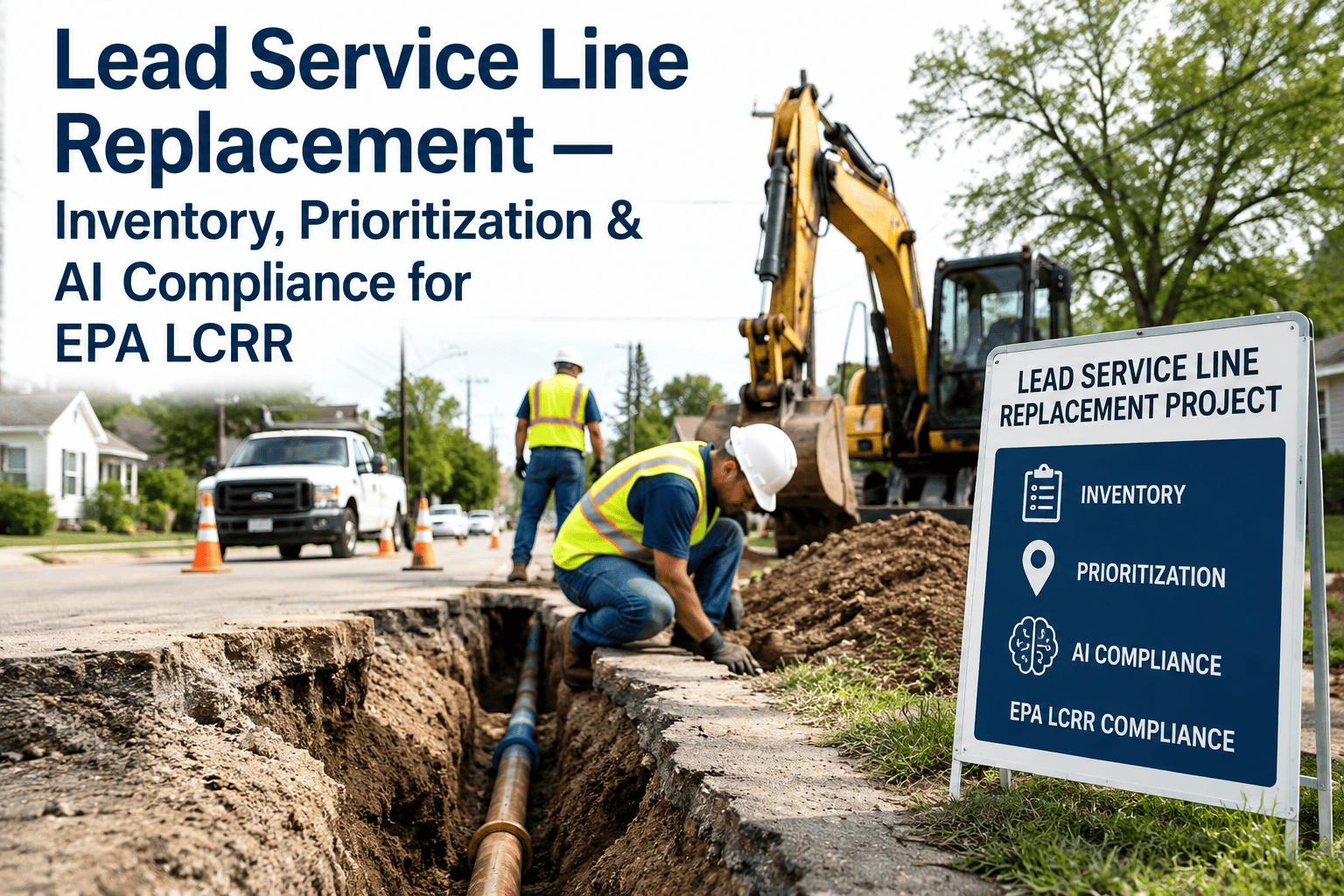
Every water system in the country is now working against a federal clock it didn't set. The EPA's Lead and Copper Rule Improvements require a validated baseline inventory and an approved replacement plan by November 1, 2027, unknown service line materials resolved by 2034, and full replacement of lead and galvanized-requiring-replacement lines by 2037. Most utilities are still working from a patchwork of paper tap cards, incomplete GIS layers, and service line records where "unknown" is the most common material listed. Missing that inventory deadline isn't a paperwork problem — it's a federal enforcement exposure that follows the EHS and compliance team long after the original engineer who built the records has retired. iFactory's AI inventory and prioritization system pulls together historical records, permit data, and field verification into one compliance-ready record — see how the inventory build maps against your current LCRI deadline.
Environmental & Resilience — LCRI Compliance
Build a Defensible Lead Service Line Inventory Before the Federal Deadline Does It For You
iFactory's AI system reconciles permit records, tap cards, GIS layers, and field verification into a single lead service line inventory, then ranks replacement priority by risk so your program stays ahead of every LCRI milestone through 2037.
Inventory Status Snapshot
Unknown Materials Remaining
4,380
Confirmed Lead / GRR
9,715
Replacement Plan Status
On Track for 2027
The LCRI Compliance Clock: What's Due, and When
2024
Initial Inventory Deadline
The Lead and Copper Rule Revisions' initial service line inventory requirement remained in force, requiring systems to classify every service line as lead, galvanized requiring replacement, non-lead, or unknown.
2027
Baseline Inventory & Replacement Plan
By November 1, 2027, community and non-transient non-community systems must submit a baseline inventory identifying lead lines, lead connectors, and galvanized-requiring-replacement lines, along with an approved replacement plan and updated sampling plan.
2034
Unknown Materials Validated
Systems must validate remaining unknown service line materials, closing the gap that lets utilities defer replacement decisions on lines that could still be lead.
2037
Full Replacement Deadline
Most water systems must have replaced all lead and galvanized-requiring-replacement service lines, with the lead action level already lowered from 15 ppb to 10 ppb driving earlier intervention along the way.
Why "Unknown" Is the Most Dangerous Line in the Inventory
Most utilities didn't lose track of their lead service lines through negligence. Records from decades ago simply weren't built for this level of scrutiny — permit cards list a plumber's initials and a date, not a material code; GIS layers were digitized from paper maps that never distinguished lead from galvanized; and service connections installed before 1986 often have no material record at all beyond the construction era itself. The result is an inventory where "unknown" can represent tens of thousands of connections, each one a potential compliance gap and a potential health exposure sitting unresolved.
Resolving unknowns manually means dispatching crews for physical verification, line by line, at a pace that can't keep up with a 2034 validation deadline across a large system. iFactory's AI inventory layer instead cross-references every unknown line against permit history, construction-era records, neighborhood-level installation patterns, and prior field verifications to statistically classify likely material before a single truck rolls, prioritizing physical verification only where the AI confidence score needs a field check to confirm.
Inventory Building
Permit records, tap cards, GIS layers, and prior inspection data are reconciled automatically into one system-wide inventory, resolving conflicting records instead of leaving each data source to disagree silently.
Risk-Based Prioritization
Replacement sequencing is ranked by construction era, known lead prevalence, proximity to schools and childcare facilities, and sampling history, so limited capital replaces the highest-risk lines first.
Compliance Tracking
Progress against every LCRI milestone — baseline inventory, unknown validation, full replacement — is tracked continuously, with reporting built to match what regulators and state primacy agencies expect to see.
10 ppb
lowered lead action level under the LCRI, down from 15 ppb
10 Years
the mandated window most systems have to complete full replacement
3 Sources
minimum record types typically needed to resolve one unknown line
The Baseline Inventory Deadline Doesn't Move for Anyone
iFactory builds a defensible, AI-reconciled inventory and a risk-ranked replacement plan so your team walks into the 2027 milestone with a record that holds up to review, not one built the month before it's due.
Manual Inventory Management vs. AI-Reconciled Compliance
| Capability |
Manual, Paper-Based Inventory |
iFactory AI-Reconciled Inventory |
| Record Reconciliation |
Permit cards, GIS layers, and inspection notes checked separately, with conflicts often going unnoticed. |
All sources reconciled automatically into one record, with conflicts flagged for verification. |
| Unknown Classification |
Resolved through physical field verification alone, at a pace limited by crew availability. |
Statistically classified from historical patterns first, with field checks focused on low-confidence lines. |
| Replacement Prioritization |
Often sequenced by geography or project convenience rather than measured risk. |
Ranked by construction era, lead prevalence, and proximity to vulnerable populations. |
| Compliance Reporting |
Assembled manually ahead of each regulatory deadline, under time pressure. |
Maintained continuously, exportable in the format regulators expect on demand. |
| Deadline Readiness |
Risk of scrambling to complete records in the weeks before a milestone. |
Progress tracked against every LCRI milestone well ahead of each deadline. |
Four Factors That Drive Replacement Priority
1
Construction Era
Service lines installed before the 1986 lead ban carry a materially higher probability of being lead, and construction-era data is one of the strongest predictors available for unresolved unknowns.
2
Sampling History
Tap sampling results at or near a service line, including any history of exceeding the lowered 10 ppb action level, weight that line and its surrounding neighborhood toward earlier replacement.
3
Vulnerable Population Proximity
Lines serving schools, childcare facilities, and disproportionately affected communities are weighted higher in the replacement sequence, consistent with the LCRI's equity-focused prioritization requirement.
4
Neighborhood Installation Patterns
Streets and subdivisions built by the same contractor in the same era frequently share material patterns, letting confirmed lines on a block raise or lower confidence on unresolved neighbors nearby.
Rolling Out an AI-Reconciled Inventory Program
Phase 1
Record Consolidation
Permit records, tap cards, GIS layers, and prior inspection data are ingested and reconciled into a single service line record, surfacing conflicts between sources for review.
Phase 2
Unknown Classification
Remaining unknown lines are statistically classified using construction-era and neighborhood pattern data, with confidence scores directing field verification crews to the lines that actually need a truck roll.
Phase 3
Risk-Ranked Replacement Plan
Confirmed and high-probability lead lines are sequenced into a replacement plan weighted by sampling history and vulnerable population proximity, ready for submission ahead of the 2027 milestone.
Phase 4
Continuous Compliance Tracking
Inventory and replacement progress update continuously as crews complete work, keeping the record audit-ready for every remaining LCRI deadline through 2037.
Common Mistakes in Lead Service Line Programs
Treating "Unknown" as a Permanent Category
Every unknown line is a compliance gap waiting to become a 2034 problem. Systems that resolve unknowns steadily now avoid a last-minute scramble against the validation deadline.
Sequencing Replacement by Convenience
Replacing lines in whatever order matches an unrelated road project ignores the risk differences between a confirmed lead line near a school and a low-probability line in a newer subdivision.
Letting Data Sources Stay Siloed
A GIS layer that disagrees with a permit record and neither gets reconciled means the inventory submitted to regulators may not reflect the same picture the field crew is working from.
Starting Compliance Reporting Too Late
Assembling a baseline inventory and replacement plan in the final months before a deadline leaves no time to catch and correct the discrepancies a careful review would find.
Frequently Asked Questions
What exactly is due by the November 1, 2027 LCRI deadline?
Community and non-transient non-community water systems must submit a baseline inventory identifying all lead service lines, lead connectors such as goosenecks and pigtails, and galvanized-requiring-replacement lines. Systems also need an approved lead service line replacement plan and an updated sampling plan in place by that date.
Book a demo to see how the inventory build maps to your baseline submission.
How does AI classify a service line without physically digging it up?
Classification starts with historical evidence — permit records, construction-era data, prior verifications on the same street, and neighborhood installation patterns from the same contractor or subdivision era. Lines with strong historical evidence get classified with high confidence; lines where the evidence is genuinely ambiguous are flagged for physical field verification rather than guessed at.
What happens to lines still marked unknown by the 2034 validation deadline?
The LCRI requires systems to validate remaining unknown service line materials by 2034, closing the gap that has historically let utilities defer decisions on lines that could still be lead. A prioritized, ongoing classification and field verification program is the practical way to close that gap steadily instead of facing a backlog as the deadline approaches.
How is replacement priority determined across a large service area?
Priority weighs construction era, confirmed or high-probability lead classification, tap sampling history including any lead action level exceedances, and proximity to schools, childcare facilities, and disproportionately affected communities, consistent with the LCRI's equity-focused prioritization expectations.
Talk to support about configuring prioritization weights for your service area.
Can this integrate with our existing GIS and asset management systems?
Yes. The inventory reconciliation process is built to ingest existing GIS layers, permit databases, and CMMS or asset management records rather than requiring a separate system of record. The goal is one consolidated, defensible inventory that stays synchronized with the systems your engineering and field teams already use daily.
Walk Into the Next LCRI Deadline With a Record That Holds Up
iFactory reconciles your permit records, GIS layers, and field data into one defensible lead service line inventory, then ranks replacement priority by real risk so your team stays ahead of every milestone through 2037.
Permit, tap card, and GIS records reconciled into one inventory
Unknown lines classified by evidence before a truck ever rolls
Replacement sequenced by risk, not by road project convenience
Compliance progress tracked continuously against every LCRI milestone