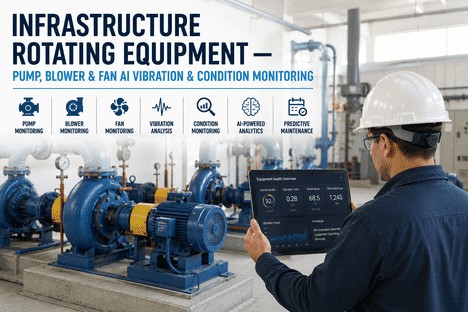
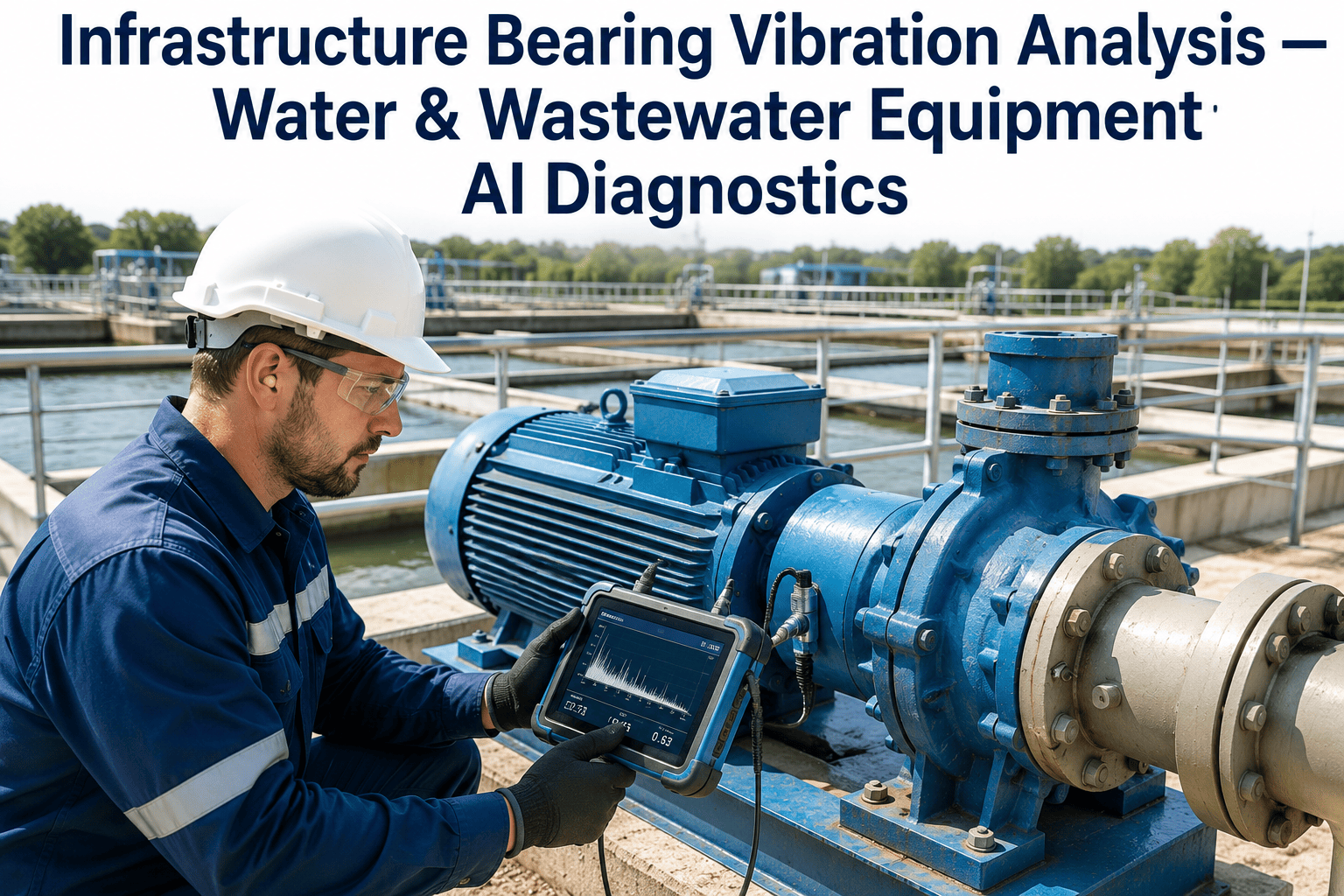
Infrastructure Rotating Equipment — Pump, Blower & Fan AI Vibration & Condition Monitoring
By Grace on June 23, 2026
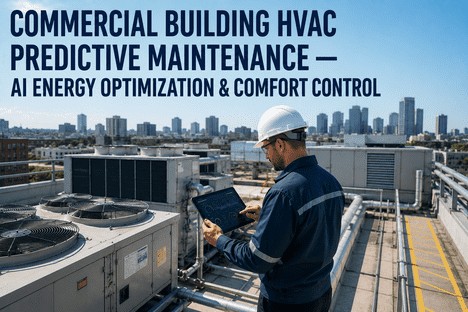
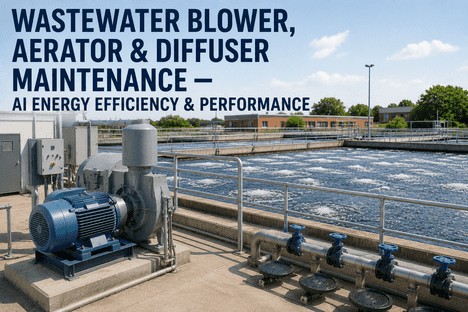
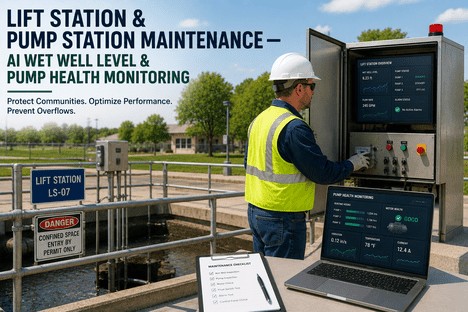
A 500 kW pump moves 3,000 litres of water per minute through a municipal main. A 200 kW blower keeps aeration alive across a wastewater treatment basin. A 75 kW fan delivers 85,000 CFM through a hospital's HVAC trunk. Each asset spins between 1,200 and 3,600 RPM, every hour of every day, on bearings that degrade without warning, on shafts that misalign under load, on impellers that erode one particle at a time. When one of them stops without notice — and 42% of unplanned downtime traces directly to equipment failure — the cost is not just the repair. It is the production line that halts, the treatment permit that is at risk, the surgical suite that loses ventilation, and the emergency contractor premium that turns a routine bearing swap into an eight-hour crisis at four times the planned cost. The reliability engineer's job is to see these failures before they happen. The question is whether the data infrastructure exists to make that foresight possible.
Rotating Equipment Reliability · AI Vibration Monitoring · Condition Analytics · Pump Blower Fan
Your Rotating Equipment Is Telling You When It Will Fail. iFactory Translates the Signal.
iFactory's AI-driven vibration and condition monitoring platform gives reliability engineers continuous visibility across pump, blower, and fan fleets — with real-time anomaly detection, spectral analysis, and automated work order triggers that turn raw vibration data into scheduled interventions before failure occurs.
Of rotating equipment failures are preceded by measurable vibration changes detectable weeks before breakdown — yet most facilities lack the continuous monitoring infrastructure to catch them
70%
Of pump downtime is caused by mechanical seal and bearing failures — both detectable through AI-driven vibration pattern analysis weeks before catastrophic loss
$260K
Average cost per hour of unplanned manufacturing downtime — the gap between detecting a bearing fault and scheduling its replacement is measured in money, not time
4-8x
Cost multiplier for emergency repair vs. planned intervention — predictive maintenance on rotating equipment is not a technology upgrade, it is a financial hedge
The Failure Modes That Cost You Most — and the Analytics Signatures That Predict Them
Every rotating asset generates a unique vibration signature at every stage of its life. When a bearing begins to pit, the signature shifts. When an impeller erodes, the frequency changes. When a shaft misaligns under thermal load, the amplitude tells the story before the coupling fails. The reliability engineer who reads these signatures does not wait for breakdowns — they schedule interventions at the precise point between potential failure and functional failure. iFactory's AI vibration analytics platform is built to detect these shifts and convert them into actionable work orders before unplanned downtime occurs.
The P-F Interval Is Your Window of Control. iFactory Turns It Into a Scheduled Intervention.
iFactory's AI continuously monitors vibration spectra, temperature, and operational parameters across your rotating equipment fleet — detecting the earliest deviation from baseline and generating a work order at the optimal intervention point, not after the failure has occurred.
The Reliability Engineer's KPI Framework — What to Measure Across Your Rotating Equipment Fleet
The difference between a dashboard that changes behaviour and a dashboard that gets ignored is whether every metric connects to a decision the reliability engineer can act on. The following KPI framework maps each measurement to a specific decision, threshold, and response — turning condition monitoring data into a closed-loop reliability workflow that iFactory's analytics platform executes automatically.
Vibration Severity
Overall velocity trend (mm/s RMS) per ISO 10816 — green/yellow/red threshold bands for each asset class
Spectral peak tracking at 1x, 2x, 3x RPM and bearing defect frequencies — deviation from baseline triggers investigation
Asset Health
MTBF trend by asset type — is mean time between failures improving, flat, or regressing across your pump, blower, and fan fleets?
Repeat fault rate — assets with more than two corrective work orders of the same failure code in 90 days flagged for root cause analysis
Maintenance Efficiency
Reactive-to-planned ratio — percentage of total work orders that are emergency vs. scheduled. Target: below 15% for mature programmes
Mean time to repair trend — is the team resolving issues faster as data quality improves and root cause identification accelerates?
Programme ROI
Maintenance cost per asset per year — tracked against replacement value to determine whether proactive investment is extending lifecycle as expected
Emergency spend reduction — year-over-year decrease in premium labour, expedited parts, and production loss from unplanned rotating equipment failures
The Rotating Equipment Reliability Maturity Model — Where Your Fleet Stands Today
Most municipal water, wastewater, and facility operations manage their rotating equipment fleets at Stage 1 or Stage 2 — running pumps, blowers, and fans until they fail or servicing them on fixed calendar intervals that bear no relationship to actual asset condition. The organisations that consistently outperform on uptime, maintenance cost, and asset lifecycle are operating at Stage 3 or Stage 4. The difference is not the brand of pump they buy — it is the reliability infrastructure they have built around it.
Rotating Equipment Reliability Maturity Model — Assess Your Fleet's Current Stage
Stage
Equipment Strategy
Data Capability
Reliability Engineer Impact
Stage 1
Run-to-Failure
Pumps, blowers, and fans operated until breakdown. Spare assets kept on hand. Repairs are emergency events. No condition data collected.
No monitoring. Paper logs. Work orders closed without fault codes or root cause. Technician knowledge is the only maintenance record.
Reactive. Cannot plan, only respond. Every failure is a crisis. Asset data cannot support trend analysis or lifecycle planning.
Stage 2
Calendar-Based
PM performed on fixed intervals — quarterly bearing greasing, annual belt replacement, calendar-driven overhauls regardless of actual condition.
CMMS in place with PM schedules. Work orders are generated by calendar. Asset records exist but condition data is absent or manually collected quarterly.
Preventive but blind. The engineer knows when maintenance was done, but not whether the asset needed it or whether the condition is deteriorating between intervals.
Stage 3
Condition-Based
Maintenance triggered by actual asset condition. Vibration, temperature, and operational data determine when intervention occurs. PM intervals are dynamic.
Continuous vibration monitoring. AI-driven anomaly detection. Real-time dashboards with spectral analysis. Data quality metrics actively managed.
Predictive. The engineer sees developing faults weeks before failure. Interventions are scheduled, not emergency. Root cause patterns emerge from fleet-wide data.
Stage 4
Prescriptive
AI prescribes optimal intervention timing, parts requirements, and labour allocation. Spares inventory is modelled on predicted failure timing. Replacement decisions are data-driven.
Fully integrated IoT sensor network, AI analytics with automated work order generation, integrated supply chain and workforce scheduling data.
Strategic. The reliability engineer manages by exception — the system handles detection, diagnosis, and work order generation. The engineer focuses on asset strategy and continuous improvement.
How iFactory's AI Condition Monitoring Platform Works Across Your Rotating Equipment Fleet
The architecture is designed for the reliability engineer who manages multiple asset classes across distributed sites and needs a single pane of visibility into the health of every rotating machine.
01
Sensor Integration
Wireless vibration and temperature sensors deploy on pump motors, blower gearboxes, and fan bearing housings in under 10 minutes per asset. No control system integration required.
02
Baseline Learning
AI establishes a unique vibration and temperature baseline for each asset during the first 14-21 days of operation. Normal operating bands are defined across speed, load, and process conditions.
03
Anomaly Detection
Continuous spectral analysis identifies deviations from baseline across velocity, acceleration, and envelope bands. Bearing defect frequencies, gear mesh patterns, and cavitation signatures are isolated automatically.
04
Work Order Trigger
When a parameter crosses the defined threshold, iFactory generates a work order in the CMMS with the asset ID, fault type, severity level, and recommended intervention timeline.
I came into a plant with 47 critical pumps, 12 aeration blowers, and 22 HVAC fans. We had a CMMS with perfect PM schedules and zero visibility into actual asset condition. The first six months of continuous vibration monitoring revealed that three of our 'critical' pumps had been operating with advanced bearing defects for an estimated four to six months. One blower gearbox was weeks from a tooth fracture that would have taken the entire aeration basin offline. The platform did not create the reliability programme. It gave me the data I needed to make decisions that the calendar-based system could not see.
— Reliability Engineer, Municipal Water Utility — 14 Years Rotating Equipment Experience
Conclusion
The statistics are not ambiguous: 42% of unplanned downtime traces to equipment failure. Eighty per cent of those failures are preceded by measurable vibration changes. The cost gap between a scheduled bearing replacement and an emergency pump failure is a factor of four to eight. The only variable that separates a reliability engineer who prevents failures from one who responds to them is whether the data infrastructure exists to detect the signal before the failure occurs.
iFactory's AI-driven vibration and condition monitoring platform is built for the reliability engineer who manages pumps, blowers, fans, and rotating equipment across municipal, industrial, and commercial infrastructure. It delivers continuous spectral analysis, automated anomaly detection, threshold-based alerting, and direct CMMS integration — turning raw vibration data into scheduled work orders before failure occurs. The platform does not replace the reliability engineer. It makes every decision the engineer makes more informed, every intervention earlier, and every maintenance budget allocation more defensible.
Book a Demo to see how iFactory's condition monitoring platform maps to your rotating equipment fleet's decision architecture, or talk to an expert to discuss a pilot deployment across your most critical assets.
Frequently Asked Questions
iFactory's AI analytics platform supports centrifugal and positive displacement pumps, wastewater aeration blowers, HVAC and industrial fans, compressors, motors, gearboxes, and other rotating equipment common to municipal, commercial, and industrial infrastructure. The sensor-agnostic architecture integrates with wireless vibration and temperature sensors deployed directly on bearing housings, motor frames, and gearbox casings. Talk to an expert to confirm compatibility with your specific asset types and operating conditions.
Physical sensor installation takes under 10 minutes per asset. A 50-pump fleet can be fully instrumented in a single day. The AI baseline learning period runs for 14-21 days, during which the platform establishes normal vibration and temperature operating bands for each asset. The first anomaly alerts typically begin firing in week three, and the first auto-generated work orders can be expected within 30-45 days of deployment. Book a demo to discuss a deployment timeline specific to your facility.
Yes. iFactory's condition monitoring platform integrates directly with major CMMS and EAM platforms including Maintenance Connection, Maximo, Fiix, UpKeep, and others. When a vibration anomaly crosses the defined severity threshold, the platform generates a work order in your CMMS with the asset ID, detected fault type, severity classification, and recommended intervention window — eliminating the gap between detection and action. Talk to an expert to confirm your specific CMMS integration requirements.
Organisations with 30 or more critical rotating assets typically achieve full payback within 8-14 months. The ROI is driven by three primary factors: prevention of emergency failures (one prevented catastrophic pump failure often covers the full platform cost), reduction in reactive-to-planned maintenance ratio (moving from 40% reactive to under 15%), and extended asset life through early detection of developing faults. Most customers report the first prevented failure within the first 90 days of continuous monitoring. Book a demo to receive a site-specific ROI estimate based on your fleet composition and failure history.
Eighty Per Cent of Rotating Equipment Failures Are Preceded by Measurable Vibration Changes. iFactory Catches the Signal Before the Failure Occurs.
iFactory gives every reliability engineer continuous visibility into the health of every pump, blower, and fan across their fleet — with AI-driven spectral analysis, automated anomaly detection, and direct CMMS integration that turns raw data into scheduled interventions before unplanned downtime.