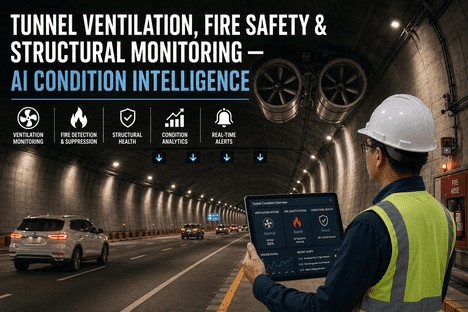
Every tunnel is a sealed environment where three failure modes can each become catastrophic on their own — and where all three can compound each other in minutes. A ventilation system that slows down under peak load raises CO concentration. Rising CO masks the early smoke signals from a smouldering vehicle fire. A fire that goes undetected long enough generates heat that causes the lining to spall. Three systems. Three failure modes. One shared consequence. And in most tunnel operations today, those three systems are monitored independently, with condition data that never meets in a single analytical view until something has already gone wrong. The global tunnel monitoring market was valued at over $6 billion in 2024 and is forecast to reach nearly $11 billion by 2033 — driven precisely by this recognition that reactive monitoring is not enough. iFactory's Tunnel Infrastructure module was built to give reliability engineers the integrated condition intelligence layer that disconnected sensor dashboards have never provided.
Tunnel Ventilation · Fire Safety · Structural Lining · Condition Intelligence · Predictive Maintenance
Three Systems. One Failure Mode. iFactory Monitors All of Them Together.
Continuous AI condition intelligence for tunnel ventilation performance, fire detection and suppression readiness, and structural lining integrity — unified in a single platform for reliability engineers who cannot afford to wait for incidents to reveal system gaps.
$11B
Forecast tunnel monitoring market by 2033 at 6.9% CAGR — operators investing in integrated AI condition intelligence now will hold the cost and safety advantage
1 in 3
Tunnels develops structural lining issues — cracks, water leakage, or deformation — during their operational life, many of which go undetected until maintenance becomes emergency repair
30 days
AI deformation prediction models can detect micro-cracks and abnormal displacement patterns up to 30 days before they become critical — if the monitoring infrastructure is in place
52%
Of new tunnel projects now integrate intelligent monitoring — while the majority of existing operational tunnels still run disconnected, system-siloed condition data
Why Tunnel Systems Fail in Ways Reliability Engineers Do Not See Coming
The engineering failure modes of tunnel infrastructure are well-documented. What is less understood — and more operationally dangerous — is the management failure mode that enables them: the structural separation of ventilation monitoring, fire safety monitoring, and structural health monitoring into independent data environments that never produce a shared condition picture.
A reliability engineer responsible for a highway or rail tunnel is typically working with airflow sensor dashboards from one system, fire panel status reports from a second, and inspection records for lining condition from a third — with no automated correlation between them, and no alert logic that fires when a pattern across all three indicates elevated risk. This is not a sensor problem. It is an integration problem. And it is exactly the gap that AI condition intelligence is designed to close.
The Three Failure Modes That Share One Consequence — and Why They Must Be Monitored Together
Ventilation Degradation
Airflow performance drops silently — CO builds, air quality thresholds are breached before any alert fires
Ventilation systems that operate below rated airflow capacity are among the most underdetected conditions in tunnel operations. A fan running at 70% capacity after bearing wear still passes binary on/off status checks. Only continuous performance analytics — tracking actual airflow against rated capacity, pressure differential trends, and energy draw — reveals the degradation before it crosses the air quality threshold that triggers regulatory consequence or, in a fire event, fails to extract smoke at the volume the evacuation plan requires.
Fire System Readiness Gap
Detection and suppression components test as operational on scheduled inspection — and fail in the first minutes of an actual fire event
Tunnel fire incidents with high temperature exposure cause ceiling and wall spalling, structural strength reduction, and — when suppression systems activate too slowly or at insufficient pressure — uncontrolled thermal spread. The gap is not in the hardware itself but in the readiness monitoring between scheduled test intervals. Detector sensitivity drift, sprinkler line pressure decay, and suppression activation latency all worsen between tests. AI condition intelligence tracks these parameters continuously and flags deterioration trends before the next scheduled inspection — not after an event reveals the gap.
Structural Lining Condition
Micro-cracks and deformation patterns develop over months — visible only when displacement data is read as a trend, not a snapshot
Approximately one-third of operational tunnels develop structural lining issues — cracks, water ingress, deformation — during their service life. Long-term groundwater exposure erodes lining material from the inside; traffic and train vibration creates cyclic loading stress that widens micro-cracks over time. Manual inspection on six or twelve-month cycles cannot detect displacement trends that develop across weeks. Continuous sensor data correlated with historical deformation patterns and external load events — weather, seismic activity, traffic volume spikes — produces the early-warning picture that inspection alone cannot.
The compounding risk that siloed monitoring misses entirely:
A ventilation system running at degraded capacity reduces fire smoke extraction volume. Reduced smoke extraction slows fire detection by obscuring sensor lines of sight. Delayed detection extends the thermal exposure window for lining material. Extended thermal exposure accelerates spalling and structural load reduction. Each failure mode independently raises risk — together, in sequence, they produce the incident that post-event investigation traces back to a condition that was measurable weeks or months before it became dangerous.
What AI Condition Intelligence Actually Does for Tunnel Infrastructure
The phrase "AI monitoring" has become generic enough to mean almost nothing in infrastructure conversations. What matters for tunnel reliability engineers is precisely what the AI does — what data it reads, what patterns it identifies, and what outputs it produces for the people responsible for maintaining system safety between inspection intervals. iFactory's approach to tunnel condition intelligence is built on four specific analytical capabilities.
Capability A
Ventilation Performance Analytics — Continuous Airflow Efficiency Against Rated Capacity
Real-Time Airflow Intelligence
iFactory reads continuous data from airflow velocity sensors, pressure differential transducers, CO and NOx detectors, and fan energy consumption meters — and analyses performance against each system's rated specifications at that point in its maintenance lifecycle. A fan operating at 78% of rated airflow is not a failure condition. It is a trend data point — and when combined with bearing temperature data showing gradual rise over thirty days and energy draw increasing for the same output, it is a predictive maintenance trigger that the platform surfaces to the reliability engineer before airflow drops to the threshold where regulatory compliance becomes an issue. Multipoint monitoring across the tunnel length also identifies ventilation asymmetries — zones where airflow is adequate at the measurement point but insufficient in the section between sensors — a condition that fixed single-point monitoring consistently misses.
Fan efficiency degradation trending
Zone-level airflow asymmetry detection
Pre-compliance threshold alerts
Capability B
Fire Detection and Suppression Readiness Monitoring — Between Inspections, Not Just At Them
Continuous Safety Readiness
iFactory monitors fire detection and suppression system readiness through continuous data feeds from detector sensitivity readings, line pressure gauges, activation circuit integrity tests, and thermal sensor baseline drift tracking. The platform identifies detector sensitivity degradation — where a unit's response threshold has drifted above specification — between test intervals, flagging it for recalibration before the next scheduled inspection rather than during the post-incident review. Suppression line pressure trends are tracked over rolling thirty and ninety day windows, with statistical anomaly detection identifying slow pressure decay that indicates valve seating issues or line micro-leakage. For electric vehicle fire risk specifically — a growing challenge as EV adoption increases in highway tunnels — the platform can be configured for temperature anomaly sensitivity profiles tuned to battery thermal runaway signatures, which present differently from fuel fire signatures that standard legacy detectors are calibrated for.
Detector sensitivity drift tracking
Suppression line pressure analytics
EV thermal signature profiling
Capability C
Structural Lining Condition Intelligence — Deformation Pattern Analysis Across the Full Tunnel Length
Predictive Structural Health
iFactory aggregates continuous data from convergence meters, strain gauges, displacement sensors, piezometers, and acoustic emission sensors — and applies pattern recognition to identify deformation trends that are invisible in point-in-time inspection snapshots. The platform's structural lining analytics correlate displacement data with external load events — traffic volume peaks, temperature cycling, groundwater pressure changes, and local seismic activity — to distinguish normal elastic response from progressive structural change that indicates developing lining failure. When micro-crack propagation rates exceed baseline and correlate with a specific loading pattern, the platform generates a condition intelligence report with the trend data, the correlated load events, and the projected timeline to inspection threshold — giving the reliability engineer the information needed to plan targeted inspection and intervention before the condition reaches a maintenance emergency. This is the approach that AI-powered deformation prediction models have shown can surface structural risk up to thirty days before it becomes critical.
Multi-sensor deformation trending
Load-correlated crack propagation alerts
Predictive intervention scheduling
Capability D
Cross-System Condition Correlation — The Intelligence That Siloed Monitoring Cannot Produce
Integrated Risk Intelligence
The single most valuable output of integrated tunnel condition monitoring is the cross-system correlation that no individual sensor dashboard can produce. iFactory's analytics engine identifies condition patterns across ventilation, fire safety, and structural data simultaneously — flagging the scenarios where degradation in one system materially elevates risk in another. A section of lining showing increasing deformation combined with a ventilation zone showing reduced airflow efficiency in the same tunnel segment is not two separate maintenance items. It is a compound risk profile that affects the structural consequence of a fire event in that location. The platform surfaces this correlation as a unified condition intelligence report — with the supporting data from all three systems, the risk logic that connects them, and the maintenance prioritisation the engineer needs to address the compound condition before it becomes a safety event.
Multi-system risk correlation engine
Compound condition reporting
Unified maintenance priority output
Monitoring Ventilation, Fire Safety, and Structural Integrity Separately Means You Only See Each Risk Alone. iFactory Shows You How They Interact.
Integrated AI condition intelligence across all three tunnel system domains — continuous, correlated, and actionable for the reliability engineers who cannot wait for the next scheduled inspection to discover what is already developing.
Tunnel Type Differences — Why Highway, Rail, Metro, and Utility Tunnels Require Different Monitoring Configurations
Not all tunnels have the same risk profile, and not all reliability engineers face the same condition monitoring challenge. The ventilation parameters that matter in a high-traffic road tunnel operating twenty hours a day are fundamentally different from the structural deformation priorities of a high-speed rail tunnel experiencing dynamic load cycles from passing trains. iFactory's platform supports configuration by tunnel type — with sensor weighting, alert thresholds, and analytical priority profiles that match the actual risk profile of each tunnel class.
Tunnel Type Monitoring Priorities — How iFactory Configures Each
Tunnel Type
Primary Monitoring Priority
iFactory Configuration Approach
Highway Road Tunnel
CO and NOx air quality, high-volume ventilation efficiency, vehicle fire rapid detection, lining integrity under traffic vibration load, EV battery thermal risk
Air quality threshold alerting, fan efficiency degradation trending, EV-profile fire detection sensitivity, vibration-correlated lining deformation monitoring
Railway Tunnel
Dynamic load structural response, track-induced lining vibration, pressure wave ventilation disruption, drainage system status, emergency ventilation reversal readiness
Cyclic load structural analytics, piston effect ventilation compensation, settlement and track alignment correlation, emergency system readiness scoring
Metro / Urban Subway
High passenger density fire evacuation readiness, platform ventilation at peak load, lining condition in aging urban tunnels, platform screen door integration
Peak-load ventilation capacity modelling, smoke extraction system readiness monitoring, age-adjusted lining deformation baselines, passenger safety risk weighting
Utility / Service Tunnel
Gas detection and ventilation adequacy, cable and pipe fire risk, groundwater ingress and lining water pressure, access and egress safety for maintenance personnel
Gas species monitoring integration, cable thermal anomaly detection, groundwater pressure trending, personnel safety incident correlation
"
We had ventilation performance data, fire system test records, and structural inspection reports — all in separate systems, reviewed on different cycles by different teams. After a routine inspection flagged minor lining cracking in one section, we looked back at the ventilation data for that zone and found airflow had been running at about 65% of rated capacity for the prior six weeks. Neither piece of information by itself would have changed our response timeline. Together, they told us we had a compound condition that needed immediate prioritisation. That correlation only became visible when the data lived in the same platform.
— Principal Reliability Engineer, Highway Tunnel Authority — 19 Years Infrastructure Asset Management
Conclusion
Tunnel infrastructure reliability engineering is, at its core, a pattern recognition problem operating under time pressure. Ventilation degradation, fire system readiness gaps, and structural lining deterioration each develop across weeks or months — giving reliability engineers a meaningful intervention window if the data is visible, correlated, and analytically interpreted in real time. The challenge is not sensor availability. Modern tunnels are well-instrumented. The challenge is integration: sensor data that stays siloed within individual system dashboards produces individual system alerts, not the compound condition intelligence that reveals when two degrading systems together create a risk profile that neither would indicate alone.
The global tunnel monitoring market is growing at pace precisely because infrastructure operators are recognising that point-in-time inspection supplemented by basic status dashboards is not adequate management for assets where the consequence of an undetected failure is closure, structural damage, or a life-safety event. AI condition intelligence — continuous, correlated across all three system domains, and producing actionable output rather than raw sensor feeds — is what reliability engineers need to move from reactive maintenance to genuine predictive control of tunnel infrastructure condition.
iFactory's Tunnel Infrastructure module gives reliability engineers the integrated platform that connects ventilation performance analytics, fire safety readiness monitoring, and structural lining condition intelligence in a single real-time environment — with the cross-system correlation capability that turns individual sensor readings into the compound condition picture that changes maintenance decisions before events make them for you.
Frequently Asked Questions
Your Sensors Already Have the Data. iFactory Connects It Into Condition Intelligence You Can Act On.
Integrated AI condition monitoring for tunnel ventilation performance, fire detection and suppression readiness, and structural lining integrity — continuous, correlated, and built for the reliability engineer who cannot afford to wait for an incident to reveal what was already developing.