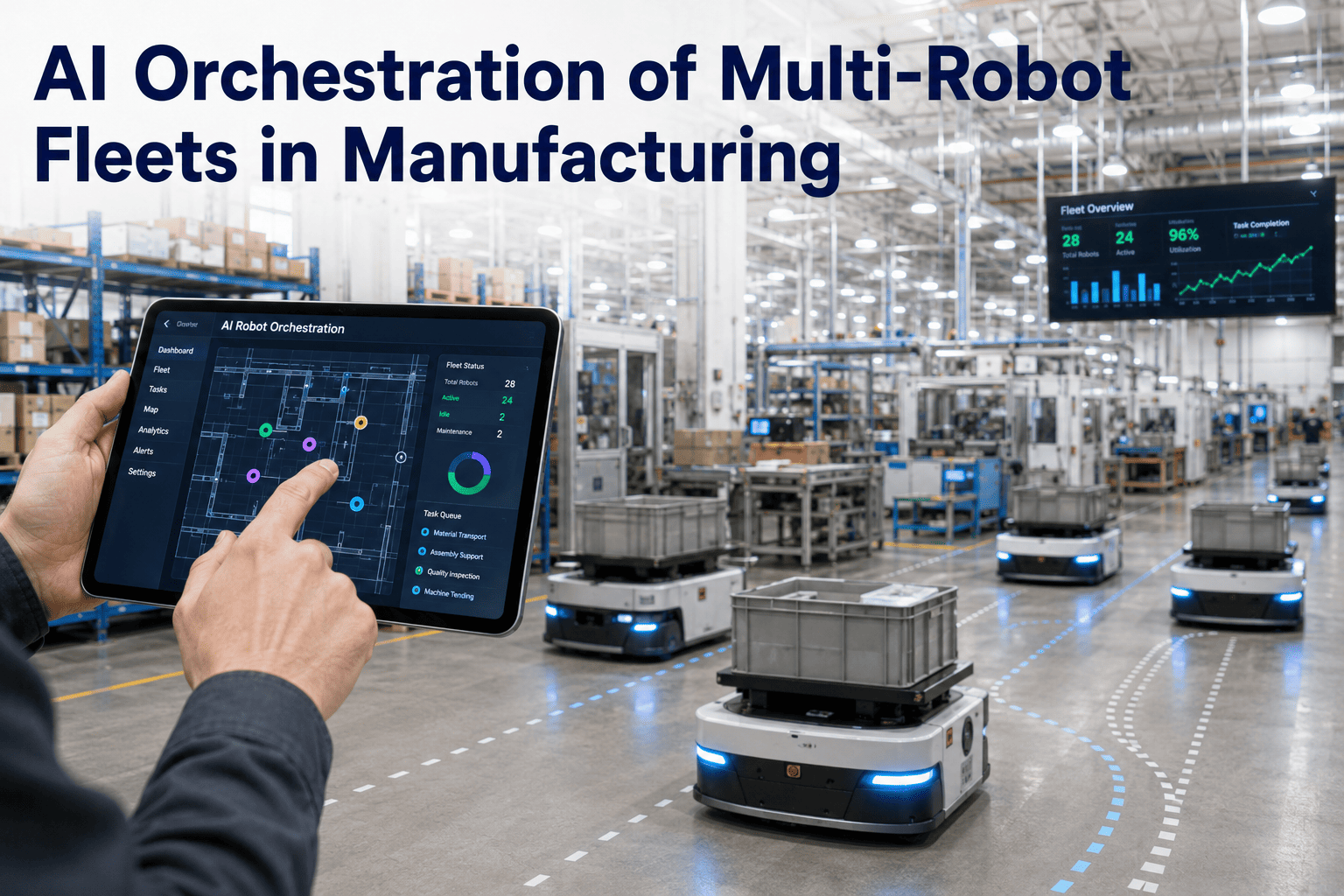
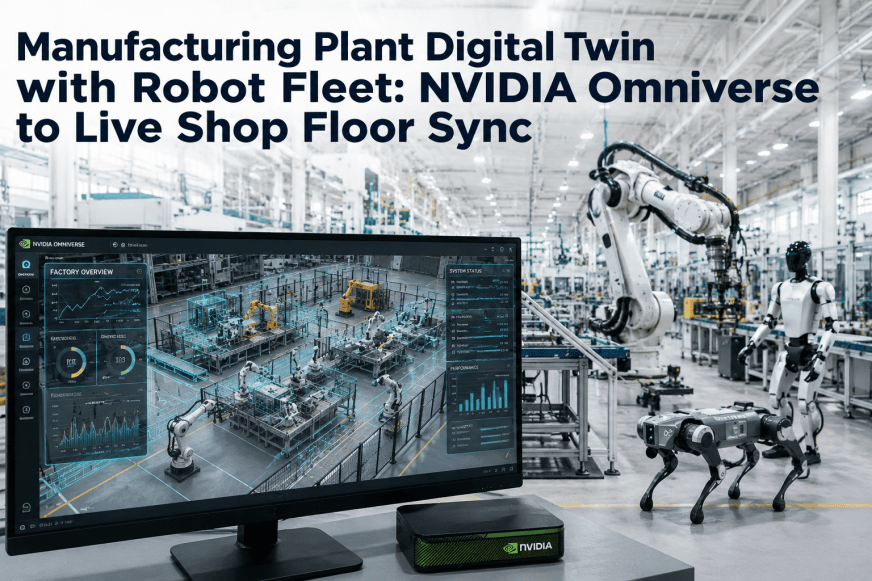
A cobot arm managed by its own controller, an AMR fleet managed by its vendor's app, and a quadruped inspector managed by a third dashboard can all be running perfectly well individually while the plant as a whole underperforms, because none of those three systems knows what the other two are doing. That is the fragmentation problem most Plant Managers run into the moment they move past a single robot type. AI orchestration exists to solve exactly this: one coordination layer that sees the full fleet, the production schedule, and the physical floor at once, instead of three well-optimized silos working past each other. Details on how a unified layer connects to systems you already run are available at ifactory support.
A mixed robot fleet without unified orchestration is a collection of individually optimized components that collectively underperform, because no single system is optimizing the interaction between them. The AMRs are well-managed by their vendor's scheduler, the cobots run their programmed sequences correctly, and the inspection robots complete their routes on time. But the system that has visibility into the production schedule, staffing, and material flow has no authority over any of the physical robots executing that plan, so material flow optimization across the whole floor stays out of reach no matter how good each individual component is.
A working orchestration layer does not replace each robot's native controller, it sits above them. Vendor-specific schedulers still handle low-level motion planning and safety-rated behavior for their own hardware, while the orchestration platform coordinates task assignment, traffic priority, and scheduling across every robot type at once, using the production plan as its source of truth rather than each vendor's isolated queue.
Work gets assigned to whichever available robot can complete it fastest, regardless of manufacturer, instead of being locked to a single vendor's queue while another robot type sits idle nearby.
AMRs, cobots, and human-driven forklifts share the same aisles under one set of priority rules, cutting the near-misses and blocked paths that come from each system managing its own routing in isolation.
Robot task queues update automatically as the production schedule shifts, so a delayed changeover or an expedited order flows through to every robot type without a planner manually re-tasking each system.
One dashboard shows battery levels, maintenance flags, and utilization across every robot type on the floor, replacing the practice of checking three or four separate vendor apps to get the same picture.
| Operating Dimension | Fragmented (Vendor Silos) | Orchestrated (Unified Layer) |
|---|---|---|
| Task assignment | Locked to each vendor's own queue | Assigned to fastest available robot |
| Traffic coordination | Each system manages its own routing | Shared priority rules across all robots |
| Schedule changes | Manually re-tasked per system | Propagates automatically to every fleet |
| Fleet visibility | Separate dashboard per vendor | One unified health and status view |
| Adding a new robot type | New standalone dashboard and process | Plugs into the existing coordination layer |
The plants that get this right do not rip out their existing vendor controllers to install orchestration software. They connect the orchestration layer as a coordination system that reads status from each robot's native controller and issues task-level instructions, while low-level motion planning and safety behavior stay exactly where they already are. This means a Plant Manager can add the orchestration layer incrementally, starting with the two robot types that interact most often, such as AMRs feeding a cobot cell, before expanding coverage to the rest of the fleet once the coordination logic has proven out on real production volume.
The technical work of connecting multiple vendors to a single orchestration layer is rarely the hardest part of the project. Every robot vendor exposes a different API, some more open than others, and older equipment may only offer limited integration hooks that require a middleware adapter rather than a direct connection. A Plant Manager should ask each vendor directly, before purchase, what level of API access they provide to third-party orchestration platforms, since some manufacturers intentionally restrict this to protect their own fleet management software's market position.
The harder part is usually organizational: deciding which team owns the orchestration layer once it spans multiple vendor relationships, and agreeing on a single source of truth for the production schedule that all robot types will be tasked against. Plants that treat this as purely a software integration project, without assigning clear ownership on the operations side, tend to see the technical rollout succeed while adoption stalls because nobody has the authority to resolve conflicts between what the schedule says and what a vendor's own system wants to do.
A drop in idle time across the fleet, not just within one vendor's robots, is the clearest early signal that cross-vendor task assignment is working as intended.
Fewer blocked paths and near-misses in shared aisles indicates the unified traffic rules are resolving conflicts that used to require manual intervention.
Track how quickly a production schedule change propagates to every robot's task queue, since this is where manual re-tasking used to introduce the most delay.
A meaningful drop in hours spent checking multiple vendor apps to answer one status question is a concrete, easy-to-measure productivity gain for planners and supervisors.

.png)