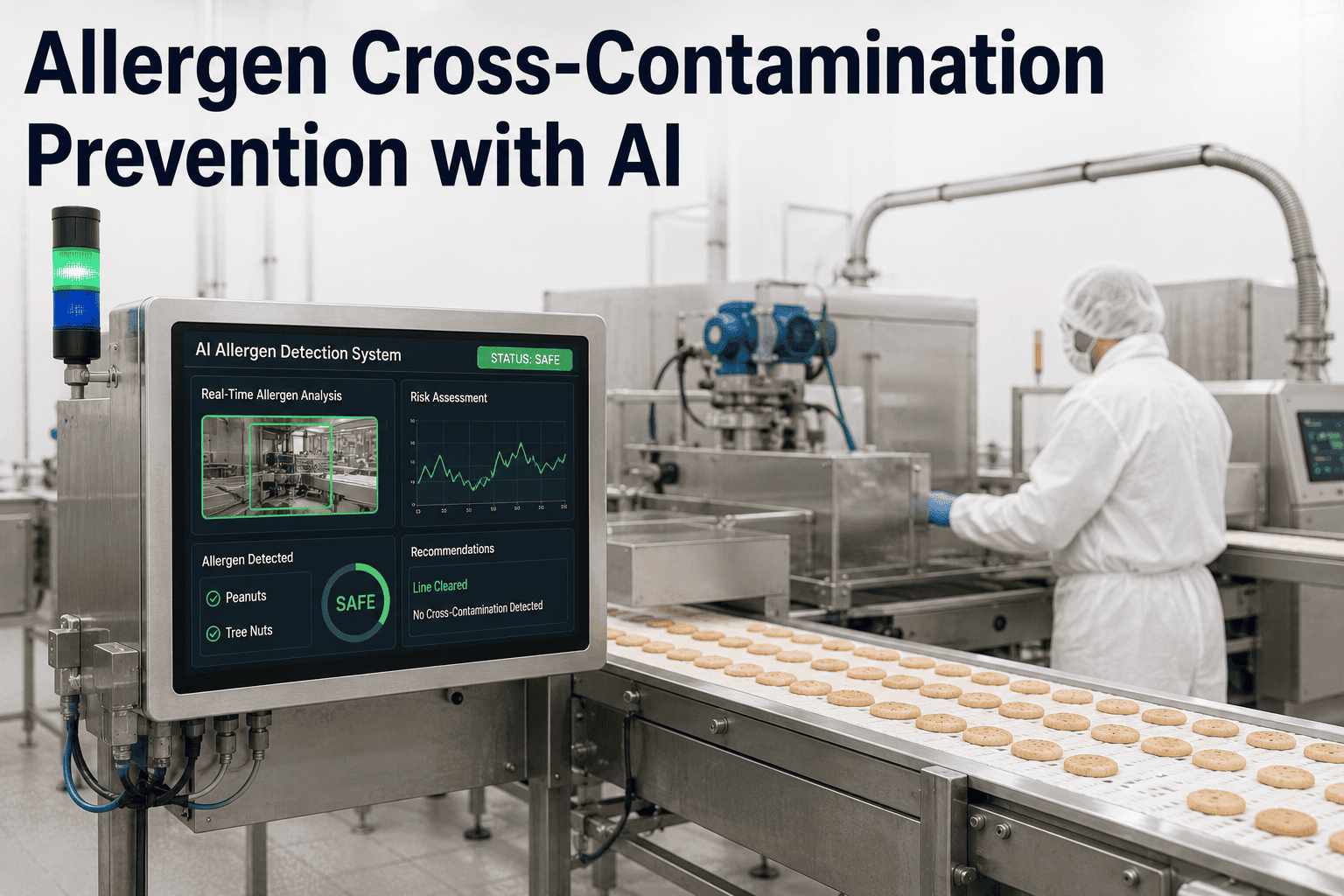
Allergen cross-contamination is the single largest driver of food recalls globally, accounting for a growing share of regulatory enforcement actions, class-action lawsuits, and brand trust erosion that takes years to recover from. In 2025 and into 2026, undeclared allergen recalls have continued to accelerate across every major food manufacturing market, driven by complex product portfolios, faster changeover schedules, and expanding allergen labeling regulations covering more than 14 recognized allergens across US, EU, UK, and APAC jurisdictions. The majority of these recalls are not caused by labeling mistakes but by physical cross-contamination during production, cleaning, and changeover that traditional food safety systems cannot detect in real time. To see how AI prevents these events in your plant, book a demo with our food safety engineering team.
The Allergen Recall Crisis in Numbers
The scale of the allergen recall problem has reached a level that demands attention from every level of food manufacturing leadership. These are not theoretical risks — they are measured, documented outcomes from regulatory enforcement data across the FDA, FSA, EFSA, and FSANZ jurisdictions in 2025 and 2026. The four data points below represent the most critical dimensions of the crisis: how often allergens drive recalls, where the root cause originates, which process stage fails most frequently, and what proportion of these events are preventable with currently available AI technology. Each of these metrics represents a direct financial and reputational risk that food safety managers are now expected to have a documented strategy for addressing.
of all FDA food recalls in 2025 involved undeclared allergens as the primary cause
of allergen recalls traced to physical cross-contamination rather than labeling or packaging errors
of cross-contamination events occurred during changeover or CIP process failures
of changeover-related allergen events were identifiable in advance with AI process monitoring
Six Critical Pathways Where Allergen Cross-Contamination Occurs
Understanding where allergen cross-contamination actually originates in a food manufacturing environment is the prerequisite for any effective prevention strategy. The following six pathways represent the most frequently identified root causes in allergen recall investigations. Each pathway operates through a distinct physical mechanism, requires a different detection approach, and demands a specific preventive intervention. Food safety managers who can map these pathways to their specific facility layout, equipment configuration, and production scheduling practices are significantly better positioned to deploy targeted prevention measures that address actual risk rather than theoretical vulnerability.
Shared Equipment Without Verified Cleaning Between Allergen Changeovers
The most common contamination pathway in multi-product food plants. When a production line transitions from a product containing a declared allergen to one that does not, the cleaning process between runs must completely remove all allergen protein residue from every product-contact surface. The failure mode is almost never a complete cleaning absence — it is an incomplete clean caused by incorrect CIP program selection, insufficient chemical concentration, inadequate temperature, reduced cycle time, or dead-leg areas in the piping that the CIP circuit does not effectively reach. Traditional verification relies on post-clean visual inspection and periodic swab testing, both of which are subjective, intermittent, and incapable of detecting residue in inaccessible locations that AI sensor monitoring can continuously assess.
Critical Risk PathwayCIP System Design Failures and Dead-Leg Residual Accumulation
CIP systems that were designed or modified without rigorous hygienic engineering review frequently contain dead legs — pipe sections, valve bodies, or sensor housings where cleaning solution does not achieve sufficient turbulence or contact time to remove allergen protein films. Over successive production cycles, these dead legs accumulate allergen residue that eventually reaches concentrations capable of contaminating subsequent product runs. The insidious nature of this pathway is that standard CIP verification methods — checking supply and return temperatures, chemical concentrations, and flow rates — can all pass while dead-leg areas remain inadequately cleaned. AI systems that monitor flow velocity profiles, pressure differentials across pipe sections, and temperature distribution across the CIP circuit can identify dead-leg risk zones that standard CIP monitoring cannot detect.
Critical Risk PathwayAirborne Dust Transfer Between Adjacent Production Lines
In facilities where allergen-containing and allergen-free products are manufactured in parallel or in adjacent production areas, airborne particulate transfer represents a difficult-to-detect contamination pathway. Powder handling operations — including dry mixing, flour dusting, seasoning application, and powdered ingredient dosing — generate airborne particles that can travel significant distances through HVAC systems, open doorways, and shared ceiling spaces. Standard environmental monitoring programs that rely on settled surface swabs at fixed locations consistently under-sample the actual airborne exposure risk because they measure deposition rather than airborne concentration and do not account for production-specific dust generation events. AI-integrated environmental monitoring that correlates dust concentration sensor data with production activity on adjacent lines can identify real-time cross-contamination risk that periodic swab programs miss entirely.
High Risk PathwayPersonnel Movement Between Allergen-Controlled Zones Without Adequate Barriers
Plant personnel moving between areas where different allergens are present or between allergen-containing and allergen-free zones represent a contamination vector that is especially difficult to control through procedural measures alone. Footwear, clothing, gloves, and handheld tools can all carry allergen residue across zone boundaries. The failure mode is most frequently a procedural compliance breakdown — a maintenance technician responding to an urgent breakdown call who moves from a peanut processing area to a dairy line without completing the full gowning change procedure, or an operator who removes gloves in one zone and inadvertently contacts a surface in another. AI-powered access control systems that integrate with production scheduling data can enforce zone-specific access restrictions based on the allergen profile of active production runs, automatically flagging or preventing unauthorized zone transitions that create cross-contamination risk.
High Risk PathwayIngredient Handling and Storage Cross-Contact
Allergen cross-contact during raw material receiving, storage, and staging is a pathway that originates before production begins but manifests as a finished product contamination event. Shared silos, incorrect ingredient staging, spilled allergen-containing ingredients in shared storage areas, and reusable containers that are not adequately cleaned between allergen and non-allergen ingredients all contribute to this pathway. The detection challenge is that ingredient-level cross-contact often occurs at concentrations below the threshold of finished product testing but above the threshold that triggers allergic reactions in sensitive individuals. AI systems that integrate ingredient receiving data, storage location assignments, and production scheduling can automatically verify that allergen-containing and allergen-free ingredients are physically separated throughout the pre-production workflow and flag any staging or storage assignment that creates a cross-contact risk before production begins.
High Risk PathwayRe-Work and Returned Product Reintroduction Without Allergen Verification
Re-work — the practice of reintroducing rejected or returned product back into the production process — is a well-documented but poorly controlled allergen contamination pathway. When product from a run containing a specific allergen is held for re-work and later reintroduced into a production run for a different product with a different allergen profile, the re-work material can introduce undeclared allergens into the receiving batch. The root cause is typically a breakdown in re-work labeling, storage segregation, or production scheduling controls that allow re-work material to be added to a batch without allergen profile compatibility verification. AI systems that track re-work inventory by allergen profile, enforce compatibility checks between re-work material and the receiving batch, and automatically block incompatible re-work additions eliminate this pathway entirely by making the verification systematic rather than procedural.
Medium Risk PathwayAllergen Risk Severity Matrix — Map Your Highest-Risk Scenarios
The following risk severity matrix maps common food plant scenarios against two dimensions: the likelihood of the scenario occurring under current operating conditions, and the severity of the consequence if it does occur. This matrix is the foundational tool that food safety managers use to prioritize allergen prevention investments. Scenarios falling in the Critical zone demand immediate AI-assisted prevention measures. High zone scenarios require targeted intervention within the current planning cycle. Medium zone scenarios should be addressed through systematic improvement programs. Low zone scenarios represent the target state that comprehensive AI allergen prevention achieves across all operations.
| Low Severity | Medium Severity | High Severity | Critical Severity | |
|---|---|---|---|---|
| High Likelihood | Shared tools between zones with moderate allergen levels | Manual CIP verification with paper checklists only | Shared line running dairy then non-dairy without verified CIP | Peanut line adjacent to tree-nut-free production, shared air handling |
| Medium Likelihood | Ingredient staging in separate designated areas | Automated CIP with periodic manual swab verification | Re-work reintroduction without automated allergen compatibility check | Multi-allergen facility with shared packaging lines and manual changeover |
| Low Likelihood | Dedicated allergen-free line with full automated CIP and AI verification | Single-product facility with no allergens present on site | Shared HVAC with allergen-specific filtration but no real-time monitoring | Contract manufacturing with frequent allergen profile changes and limited validation data |
How AI Verifies Allergen-Free Status During CIP and Changeover
AI-driven allergen verification during CIP and changeover operates as a continuous five-stage process that replaces the traditional approach of visual inspection plus periodic swab testing with a comprehensive, sensor-driven, and analytically validated verification chain. Each stage addresses a specific failure mode in the traditional process, and the five stages together create a verification integrity level that is fundamentally impossible to achieve through manual methods. The following details what AI monitors, analyzes, and verifies at each stage of the CIP and changeover process — and why each verification point matters for allergen prevention specifically rather than general cleaning validation.
Pre-CIP Allergen Risk Classification
Before any CIP cycle begins, the AI system automatically classifies the allergen risk level of the upcoming cleaning event by analyzing the allergen profile of the product that just completed its run, the allergen profile of the next scheduled product, and the shared equipment surfaces that require cleaning. This classification determines the CIP program intensity, chemical selection, temperature requirements, and post-clean verification rigor that the changeover demands.
- Verifies allergen profile of the completed product run against the master allergen register
- Cross-references next product allergen specifications to identify specific allergens requiring removal
- Selects and validates the CIP program matches the calculated allergen risk classification level
- Confirms chemical agent selection is appropriate for the specific allergen protein types present
CIP Cycle Parameter Monitoring and Deviation Detection
During the CIP cycle execution, the AI system monitors every critical parameter in real time — chemical concentration, temperature, flow velocity, pressure differential, and cycle duration — against the allergen-specific acceptance criteria established in the pre-CIP classification. Any parameter deviation that could compromise allergen residue removal triggers an immediate alert and automatic cycle extension or restart recommendation.
- Monitors chemical concentration at supply and return points to verify effective cleaning strength throughout
- Tracks temperature profiles to ensure allergen protein denaturation thresholds are achieved and maintained
- Detects flow velocity deviations that indicate partial blockages or dead-leg areas not receiving adequate cleaning
- Validates total cycle duration meets or exceeds the minimum required for the classified allergen risk level
Post-CIP Rinse Water Analysis and Trend Monitoring
Following the CIP cycle, the AI system analyzes rinse water parameters — turbidity, conductivity, pH, and organic load — to detect residual product or chemical contamination that would indicate incomplete allergen removal. Critically, the AI system does not evaluate these parameters against a single pass-fail threshold but against historical rinse water profiles from validated allergen-clean cycles, enabling detection of subtle anomalies that flat threshold testing cannot identify.
- Compares final rinse water turbidity against the statistical distribution of validated clean-cycle results
- Analyzes conductivity decline curves to detect abnormal residual chemical retention patterns
- Monitors pH stabilization time to identify delayed chemical drainage from dead-leg areas
- Trends rinse water parameters across successive cycles to detect gradual CIP performance degradation
Targeted Swab Verification Optimization
The AI system optimizes the manual swab verification process by using CIP monitoring data to identify the specific locations where allergen residue is most likely to persist — dead-leg endpoints, valve bodies, heat exchanger plates, and pump seals — rather than relying on fixed swab point schedules that may consistently sample low-risk locations while missing high-risk ones. This targeted approach dramatically increases the detection probability of any residual allergen contamination while reducing the total number of swabs required.
- Identifies high-risk swab locations based on real-time CIP performance data rather than fixed schedules
- Adjusts swab point selection dynamically based on equipment condition and cleaning performance trends
- Correlates swab results with CIP parameters to build a predictive model of cleaning effectiveness
- Reduces unnecessary swab testing at consistently validated clean points to focus resources on actual risk areas
Production Release Authorization with Full Audit Trail
The final stage is an automated production release decision that synthesizes all preceding verification data into a single allergen-clear status determination. The AI system evaluates pre-CIP classification, CIP parameter compliance, rinse water analysis results, and swab verification outcomes against the allergen-specific release criteria. Only when all verification stages pass does the system authorize production to proceed — and every data point contributing to the release decision is automatically recorded in a tamper-evident audit trail that satisfies regulatory inspection requirements without manual documentation assembly.
- Synthesizes all five verification stages into a single allergen-clear or allergen-hold release decision
- Generates a complete digital audit trail documenting every parameter, deviation, and corrective action
- Automatically notifies quality and production teams of release status through integrated alert channels
- Locks production start authorization until all allergen verification criteria are formally satisfied
Traditional Allergen Management vs AI-Powered Prevention — Feature Comparison
The operational difference between traditional allergen management approaches and AI-powered prevention is not a matter of incremental improvement — it is a fundamental shift in the detection timeline, verification reliability, and prevention capability that determines whether a food plant is reacting to allergen events after they occur or preventing them before they happen. The following comparison maps the critical capability differences across every dimension that affects allergen cross-contamination risk in a food manufacturing environment.
| Capability Dimension | Traditional Approach | AI-Powered Prevention | Prevention Impact |
|---|---|---|---|
| Contamination Detection Timeline | End-of-production or post-release testing, hours to days after occurrence | Real-time detection during CIP and changeover, minutes after initiation | Hours to minutes detection improvement |
| CIP Verification Method | Visual inspection plus periodic manual swab at fixed locations | Continuous sensor monitoring plus AI-targeted swab at dynamic high-risk locations | Up to 85% higher detection probability |
| Allergen Risk Assessment | Static risk assessment updated annually during HACCP review | Dynamic risk assessment updated for every changeover based on real-time conditions | Continuous risk recalculation per event |
| Changeover Validation | Operator completes paper checklist, supervisor signs off | AI validates every changeover parameter automatically against allergen-specific criteria | Eliminates procedural compliance gaps |
| Environmental Monitoring | Periodic settled surface swabs at fixed sampling points | Continuous airborne particulate monitoring correlated with production activity | Real-time cross-line transfer detection |
| Re-Work Control | Manual re-work log with allergen profile notation, operator-dependent verification | Automated allergen compatibility check blocking incompatible re-work additions | Systematic prevention vs procedural reliance |
| Zone Access Control | Signage, procedural barriers, and supervisory oversight | AI-integrated access control enforcing zone restrictions based on active allergen profiles | Automated enforcement vs manual compliance |
| Audit Trail Generation | Manual compilation from paper records, 20-50 hours per audit cycle | Automated digital audit trail generated continuously, retrieval in under 30 minutes | 90%+ reduction in audit preparation time |
| Regulatory Compliance | Retroactive documentation assembly for each regulatory inquiry | Continuous compliance documentation generated as operational byproduct | Compliance as byproduct, not separate effort |
Global Allergen Regulatory Requirements — What AI Automates for Compliance
Food manufacturers operating across multiple jurisdictions face an increasingly complex and divergent set of allergen labeling and control regulations. The regulatory landscape has expanded significantly in 2025-2026, with new requirements in the US, UK, EU, Canada, and Australia that create overlapping but distinct compliance obligations. AI-powered allergen prevention platforms address these requirements not as separate compliance projects but as an integrated operational capability that satisfies multiple regulatory frameworks simultaneously through a single data collection and verification infrastructure. The following summaries cover the five most consequential regulatory frameworks for food manufacturers and identify the specific compliance requirements that AI automation addresses directly.
FSMA Section 204 — Food Safety Modernization Act Traceability Rule
Requires electronic traceability records for foods on the Food Traceability List, including many allergen-containing products. AI platforms generate the required Key Data Elements and Critical Tracking Events automatically as production occurs, satisfying FSMA 204 documentation requirements as a direct byproduct of normal allergen prevention operations without separate compliance data collection processes.
Auto-generated CTE documentation, electronic lot traceabilityNatasha's Law and UK Allergen Labeling Regulations 2024
Requires full ingredient allergen labeling on all prepackaged for direct sale foods, with enhanced allergen management controls for PPDS products. AI allergen verification systems provide the production-level evidence that allergen controls were effective for every PPDS batch, creating the documented verification chain that enforcement authorities require during inspections and incident investigations.
Batch-level allergen verification evidence, PPDS compliance documentationEU Regulation 1169/2011 — Food Information to Consumers (FIC)
Mandates clear allergen labeling for 14 recognized allergens with specific emphasis on cross-contamination prevention controls and may-contain labeling substantiation. AI systems provide the quantitative cross-contamination risk data that enables informed decisions about precautionary allergen labeling, replacing subjective risk assessments with measured process data that satisfies FIC substantiation requirements.
Cross-contamination risk quantification, PAL substantiation dataCanadian Food and Drug Regulations — Enhanced Allergen Labeling (2025 Amendments)
Expanded allergen labeling requirements covering additional priority allergens with enhanced manufacturing control documentation requirements. AI allergen prevention platforms generate the process control evidence and cleaning verification records that Canadian regulators expect to see during facility inspections, particularly for shared-equipment manufacturing environments producing both allergen-containing and allergen-free products.
Manufacturing control evidence, shared equipment cleaning recordsFSANZ Standard 1.2.3 — Information Requirements for Listed Allergens
Requires declaration of specified allergens in food products with enforcement focus on cross-contamination prevention controls in manufacturing. AI systems provide the continuous monitoring and verification data that demonstrates effective cross-contamination controls to FSANZ enforcement authorities, including CIP verification records, environmental monitoring results, and changeover validation documentation in formats compatible with Australian regulatory expectations.
Cross-contamination control evidence, CIP verification recordsDeployment Roadmap for AI Allergen Prevention in Food Plants
Deploying AI-powered allergen prevention in a food manufacturing facility follows a structured four-phase approach that delivers measurable risk reduction at each stage while building the data foundation and organizational confidence required for full-scale deployment. Food plants that attempt to deploy all capabilities simultaneously consistently experience longer time-to-value and lower organizational adoption compared to those that follow a sequenced capability-building approach. The following roadmap reflects deployment patterns validated across food manufacturing operations ranging from single-line facilities to multi-plant global networks producing products across all major allergen categories.
Allergen Mapping and Risk Classification Foundation
Complete a comprehensive allergen mapping exercise across all products, ingredients, equipment, and production flows. Classify every piece of shared equipment by allergen risk tier based on the products it processes and the cleaning methods available. Map all six contamination pathways to your specific facility layout, equipment configuration, and operational procedures. Establish the digital allergen register that will serve as the reference data layer for all subsequent AI verification activities. Identify the two to three highest-risk changeover scenarios that will serve as pilot deployment targets in Phase 2.
Digital allergen register, risk-classified equipment map, pilot changeover selectionSensor Deployment and Real-Time CIP Monitoring Activation
Deploy IoT sensors on all CIP supply and return lines, including chemical concentration monitors, temperature sensors, flow meters, and pressure differential transducers. Integrate sensor data streams with the existing CIP control system to enable real-time parameter monitoring against allergen-specific acceptance criteria. Activate automated pre-CIP allergen risk classification for pilot changeover scenarios. Establish the CIP performance baseline data that will enable AI model training in Phase 3. Begin generating automated CIP verification reports for pilot changeovers to replace manual checklist-based verification.
Live CIP monitoring dashboard, automated pre-CIP classification, baseline performance dataAI Model Training, Swab Optimization, and Production Release Automation
With 8-10 weeks of validated CIP monitoring data accumulated, train AI models to predict CIP effectiveness based on real-time parameter patterns and historical swab results. Deploy AI-targeted swab verification that dynamically selects swab points based on CIP performance data rather than fixed schedules. Activate automated production release authorization for pilot changeovers that synthesizes all verification stages into a single allergen-clear decision. Validate AI prediction accuracy against manual swab results and refine models based on performance data. Extend deployment to all changeover scenarios identified in the Phase 1 risk classification.
AI-driven CIP verification active, targeted swab program, automated release authorizationEnterprise Deployment, Environmental Monitoring Integration, and Continuous Compliance
Extend the validated AI allergen prevention platform to all production lines and facilities in the network. Integrate airborne particulate monitoring for cross-line contamination detection. Deploy AI-powered zone access control that enforces allergen-specific movement restrictions based on active production schedules. Activate automated re-work allergen compatibility verification. Establish continuous compliance documentation generation that satisfies FSMA 204, Natasha's Law, EU FIC, and other applicable regulatory requirements as an operational byproduct. Implement monthly allergen prevention performance reviews with enterprise-wide benchmarking across all facilities.
Enterprise-wide AI allergen prevention, continuous compliance, compounding risk reductionAllergen Cross-Contamination Prevention with AI — Common Questions
How does AI detect allergen cross-contamination that visual inspection and swab testing miss?
AI detects allergen cross-contamination through continuous real-time monitoring of CIP parameters — chemical concentration, temperature, flow velocity, and pressure differentials — that reveal cleaning process failures as they occur, rather than after the fact. Visual inspection can only assess surface-level cleanliness on accessible areas, and swab testing samples only specific points at specific times, leaving large gaps in coverage. AI monitoring fills these gaps by analyzing the complete CIP process in real time and identifying parameter deviations that indicate allergen residue may remain in dead-leg areas, valve bodies, or heat exchanger plates that neither visual inspection nor periodic swabbing can reliably assess. To see exactly how AI monitoring covers the gaps in your current verification process, book a demo and our team will map the coverage comparison for your specific equipment configuration.
Can AI allergen prevention systems integrate with our existing CIP control systems and lab information management systems?
Yes, purpose-built AI allergen prevention platforms include pre-built integration connectors for all major CIP control systems including GEA, Tetra Pak, Alfa Laval, and SPX, as well as LIMS platforms such as SampleManager, LabVantage, and STARLIMS. The AI layer sits above your existing infrastructure, ingesting sensor data from CIP systems and swab results from LIMS without requiring any changes to your installed control systems or laboratory workflows. This integration approach means your existing CIP programs, chemical suppliers, and lab testing procedures continue operating normally while the AI layer adds a continuous verification and decision-support capability that your current systems cannot provide. For a detailed integration architecture assessment specific to your installed systems, book a demo with our integration engineering team.
What is the typical return on investment for AI allergen prevention in food manufacturing?
The ROI for AI allergen prevention is driven by three value streams: avoided recall costs, reduced verification labor, and improved production throughput from faster validated changeovers. A single allergen recall costs an average of $10-25 million in direct costs including product retrieval, regulatory investigation, legal exposure, and customer notification, with additional brand damage that can reduce revenue by 5-15% for 12-24 months following the event. AI allergen prevention typically delivers full ROI within 6-12 months through a combination of reduced swab testing labor, faster changeover validation that recovers 15-25 minutes per changeover, and most significantly, the avoided cost of even a single prevented recall event. To calculate the specific ROI for your operation based on your product portfolio and changeover frequency, contact our support team for a customized ROI analysis.
How does AI handle multi-allergen facilities where products contain different allergen combinations on the same line?
Multi-allergen facilities represent the highest-value deployment scenario for AI allergen prevention precisely because the complexity of managing multiple allergen transitions on shared equipment exceeds what manual verification can reliably handle. The AI system maintains a complete allergen profile matrix for every product and every piece of shared equipment, and for each changeover it calculates the specific allergens that must be removed based on the transition from Product A to Product B. This means the CIP program selection, chemical requirements, temperature thresholds, and post-clean verification criteria are all dynamically adjusted for each specific allergen transition rather than relying on a one-size-fits-all cleaning approach. The AI also tracks cumulative allergen residue risk across successive changeovers, identifying situations where repeated partial cleaning cycles could allow allergen buildup to reach actionable levels. To see how multi-allergen transition management works in practice, book a demo and we will demonstrate a live multi-allergen changeover scenario.
Does AI allergen prevention replace our existing HACCP plan and allergen control program?
AI allergen prevention does not replace your HACCP plan — it strengthens the verification and monitoring components of your existing allergen control program by adding capabilities that are impossible to achieve through manual methods. Your HACCP plan defines the critical control points, critical limits, and corrective actions for allergen management. The AI system provides the continuous monitoring, automated verification, and data-driven decision support that makes those controls significantly more reliable and auditable. In regulatory terms, the AI system serves as an enhanced monitoring and verification tool within your existing HACCP framework, not a replacement for it. Most food manufacturers find that AI deployment actually improves their HACCP program by providing the quantitative data needed to validate that critical limits are being consistently met, which strengthens the program during regulatory audits. For guidance on integrating AI verification into your existing HACCP structure, book a demo and our food safety specialists will walk through the integration approach.