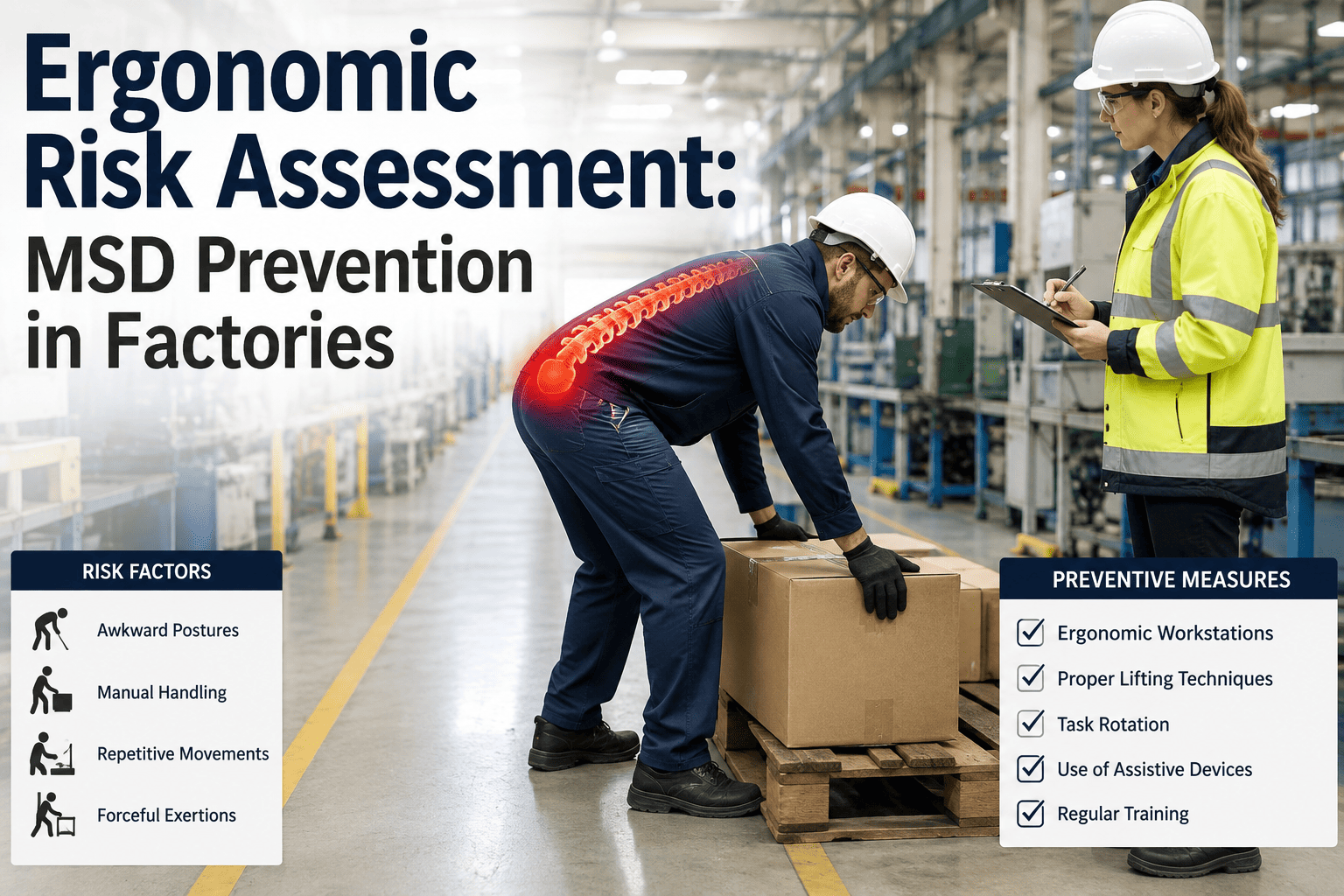
Musculoskeletal disorders account for roughly a third of all lost-time injury cases recorded by occupational safety agencies worldwide, and unlike a slip or a struck-by incident, an MSD rarely traces back to a single dramatic moment. It builds slowly, from thousands of repetitions of a shoulder held too high, a wrist bent too far, or a back that twists the same way every ninety seconds for an entire shift — and by the time a worker reports pain, the awkward posture that caused it has usually been in place for months. Structured ergonomic risk assessment using tools like REBA, RULA, and the NIOSH lifting equation catches that risk before it becomes an injury, scoring the actual postures workers hold rather than waiting for a claim to reveal the problem. Book a demo with iFactory's workforce safety team to see structured ergonomic assessment applied to your own workstations.
Safety & EHS · Ergonomic Risk Assessment
Ergonomic Risk Assessment: Catching Musculoskeletal Disorder Risk Before the Injury Claim
REBA, RULA, and NIOSH lifting equation assessments that score real postures at real workstations — turning a vague sense that "that job looks hard on the back" into a specific, prioritized list of workstations that need engineering intervention first.
The Scale of the Problem
Musculoskeletal Disorders Are the Largest Category of Work-Related Injury
~33%
Of all recorded lost-time work injury cases are musculoskeletal disorders
$3–$6
Returned for every dollar invested in ergonomic engineering controls
Months
MSDs typically develop gradually through repeated exposure, not a single incident
Choosing the Right Tool
REBA, RULA, and NIOSH — Matching the Assessment to the Task
The most common mistake in ergonomic assessment is applying a single familiar tool to every task regardless of fit. Each of the three tools below was built for a specific type of physical exposure, and using the wrong one produces a score that looks precise but doesn't actually describe the risk.
RULA
Rapid Upper Limb Assessment
Best for seated or standing tasks dominated by upper body posture — assembly, inspection, packing stations.
Scores arm, wrist, neck, and trunk posture, combined through reference tables and adjusted for muscle use and applied force.
REBA
Rapid Entire Body Assessment
Best for tasks involving the whole body and unpredictable postures — material handling, lifting, awkward reaches.
Scores trunk, neck, legs, and upper limbs together, capturing whole-body load in a way RULA's upper-body focus misses.
NIOSH Lifting Equation
Revised NIOSH Lifting Equation
Best for tasks that are specifically a lift — calculates a recommended weight limit based on distance, frequency, and posture.
Produces a Lifting Index comparing actual load to the recommended limit, rather than a posture score.
A common scoring error is applying the NIOSH equation to a task that isn't a discrete lift — it produces an invalid result outside its intended scope. REBA or RULA, chosen by whether the task is whole-body or upper-body dominant, is the correct tool for anything that isn't a clean lift-carry-place motion.
Reading the Score
Action Levels — What a REBA or RULA Score Actually Means
Score 1
Negligible risk — no action required
2–3
Low risk — change may be needed
4–7
Medium risk — investigate and change soon
8–10
High risk — investigate and change soon
11+
Very high risk — implement change now
Scores should be based on the worst posture sustained during a work cycle, not an average or a best-case snapshot — sampling video at short intervals through a full cycle catches the peak-risk moment that a single observation would miss entirely.
Score Your Real Workstations, Not a Sample
iFactory Runs Structured REBA and RULA Assessment Across Every Line
Instead of a one-time consultant walkthrough covering a handful of stations, iFactory helps safety teams run consistent, repeatable posture assessment across the full plant and prioritize the highest-scoring workstations first.
What Drives the Score
The Postural Risk Factors Behind a High Score
Upper Arm Flexion Above 60°
Reaching or working with the arm raised well above shoulder-neutral position for extended periods.
Sustained Trunk Bending
Forward or lateral bending of the back, especially combined with twisting, sharply increases spinal load.
Non-Neutral Wrist Position
Wrist flexion, extension, or deviation from straight alignment during repetitive or forceful tasks.
Manual Material Handling
Lifting, carrying, or lowering loads, particularly at awkward distances or heights from the body.
Intervention Effectiveness
What a Workstation Redesign Actually Achieves
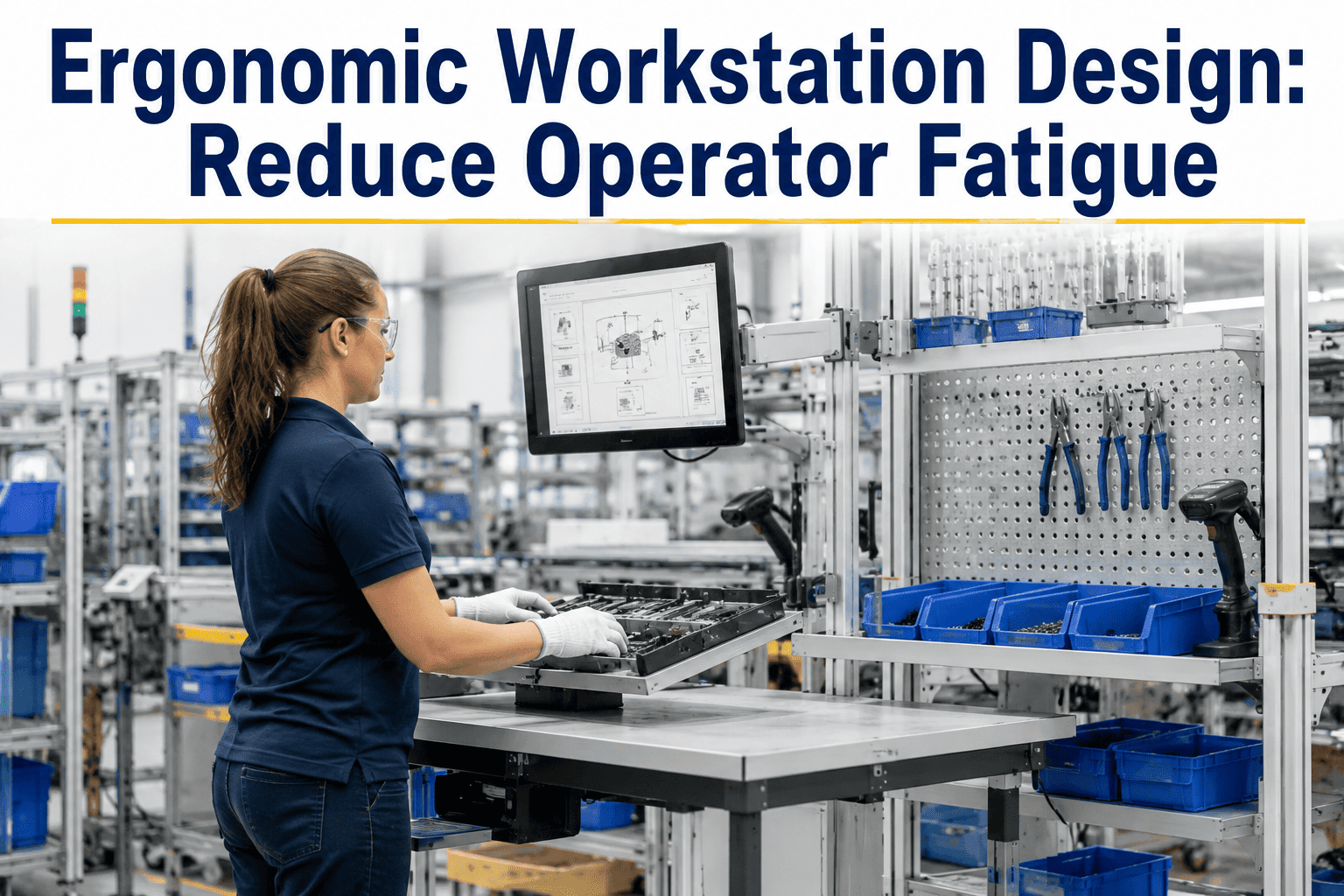
Ergonomic interventions are frequently treated as a soft, hard-to-quantify investment. In practice, structured before-and-after posture scoring shows measurable, sizable score reductions from relatively modest engineering changes.
The plants that struggle most with ergonomics programs aren't the ones lacking budget for engineering fixes — they're the ones scoring the wrong moment in the work cycle. I've watched safety teams walk a line, observe a worker in a relatively neutral posture, score it, and move on, missing entirely the twenty seconds every two minutes where that same worker reaches overhead into an awkward bin location. A single snapshot assessment almost always underscores the real risk. Sampling posture across the full cycle, and specifically capturing the worst moment rather than the average one, is the difference between a program that catches real risk and one that produces reassuring numbers that don't match the injury claims coming in six months later.
Priya Landsberg-Achebe
Certified Professional Ergonomist · 19 years conducting workplace ergonomic assessments across automotive, food processing, and warehouse operations
EHS Team Questions
Ergonomic Risk Assessment — Frequently Asked
How do we decide whether to use REBA or RULA for a specific job?
The distinguishing factor is whether the task is dominated by upper body posture or involves the whole body under unpredictable, awkward positions. Seated or standing assembly, inspection, and fine-motor packing tasks that primarily load the arms, wrists, neck, and trunk are well suited to RULA, which was built specifically around upper limb disorders. Tasks involving material handling, lifting, reaching into awkward spaces, or postures that shift significantly through the cycle are better captured by REBA, which scores the legs and full trunk position alongside the upper body. Some safety teams run both tools on borderline tasks and take the more conservative result, though this adds assessment time that isn't always necessary once the task type is clearly identified. Contact our support team for guidance on tool selection for your specific job types.
Should ergonomic assessment be based on an average posture or the worst moment in the cycle?
Both REBA and RULA are intended to be scored against the worst sustained posture observed during a work cycle, not an average or a convenient snapshot, because injury risk accumulates disproportionately from the most extreme postures a worker holds repeatedly, even if those moments are brief. A common assessment error is observing a worker for a short period, scoring whatever posture happens to be visible at that moment, and missing a genuinely awkward reach or bend that occurs only during a specific, recurring part of the cycle. Video-based sampling at short intervals across a full cycle, rather than live spot observation, catches these peak-risk moments far more reliably.
What score should trigger an actual engineering change versus just monitoring?
Action level tables for both REBA and RULA define a graduated response: scores in the negligible range require no action, low scores warrant investigation and possible change, and medium-to-high scores call for prompt investigation and change, with the highest scores requiring immediate intervention. In practice, most EHS teams prioritize their workstation redesign backlog by starting at the highest scores and working downward, since those represent both the greatest injury risk and typically the most straightforward cases for justifying engineering investment. Workstations in the medium range are worth tracking over time, since a small equipment or process change can sometimes push a job from medium into low risk without a major capital project.
How much does a typical ergonomic engineering fix actually cost compared to the injury it prevents?
Engineering fixes such as worktable height adjustment, material repositioning within a worker's natural reach zone, or introduction of an assistive lifting device are generally modest capital investments compared to the fully loaded cost of a musculoskeletal disorder claim, which typically includes medical treatment, lost work time, temporary replacement labor, and potential long-term disability costs. Published return figures on ergonomic engineering controls commonly cite a return of three to six dollars for every dollar invested, once reduced workers' compensation, absenteeism, and turnover are factored in, though the specific return depends on the severity of the risk being addressed and the cost of the intervention itself.
Can ergonomic risk assessment be done consistently across an entire plant, or does it require a consultant for every workstation?
A structured, repeatable assessment protocol — standardized video sampling, consistent scoring against the same tool for comparable task types, and a defined action-level threshold — allows an internal safety team to assess a large number of workstations consistently, rather than relying on a consultant to visit and score each one individually. External expertise is still valuable for validating the program initially and for particularly complex or borderline cases, but ongoing plant-wide coverage is generally more sustainable when built as an internal, repeatable process. Book a demo to see how a structured assessment protocol scales across a full facility.
Catch the Risk Before the Claim
Get Structured, Repeatable Ergonomic Assessment Across Your Full Plant
iFactory helps EHS teams run consistent REBA, RULA, and NIOSH lifting assessments across every workstation, prioritize the highest-risk jobs first, and track score reduction after each engineering fix — turning ergonomics from a reactive claims response into a proactive prevention program.