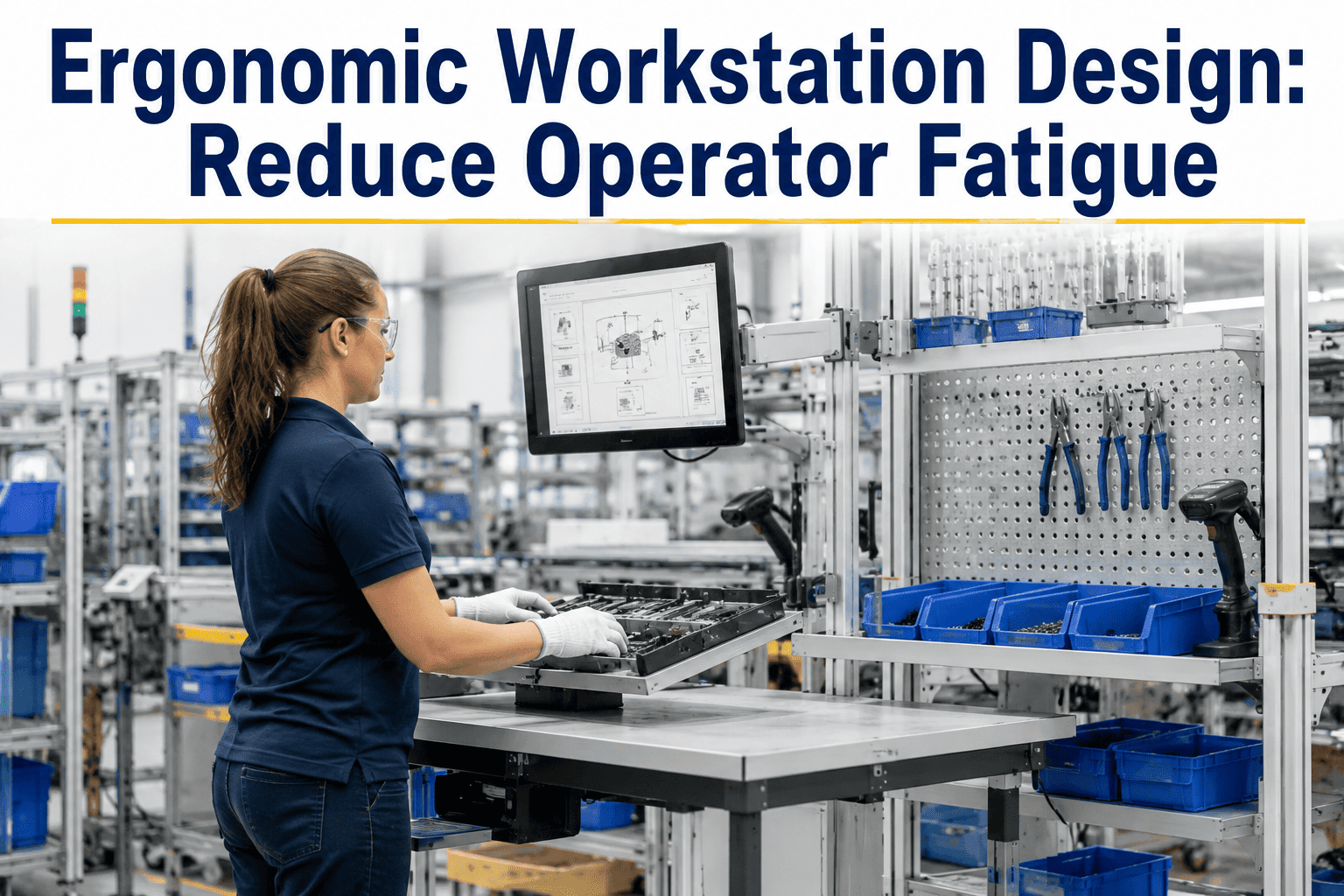
Ask a plant manager why the second shift's defect rate creeps up after lunch, or why a normally fast line loses ten minutes an hour to operators stretching their backs and shaking out their wrists, and the answer is rarely a skills problem. It's a bench height that was never adjusted, a bin placed just past comfortable reach, or a tool that forces a wrist twist a thousand times a shift. Operator fatigue is not a personality trait — it is a predictable, measurable output of workstation geometry, and it is one of the few safety and productivity problems that can be redesigned away with data instead of willpower. Teams ready to turn ergonomic assessment scores into an actual redesign plan can Book a Demo to see workstation ergonomics tracked alongside every other floor metric.
What Operator Fatigue Actually Costs a Plant
Fatigue-driven musculoskeletal disorders are one of the most expensive and least discussed line items in manufacturing safety budgets, largely because the cost accumulates quietly across hundreds of small movements a day rather than arriving as a single dramatic incident. By the time a strain claim is filed, the workstation geometry that caused it has usually been in place, unquestioned, for years.
The frustrating part for most plant leaders is that none of this requires new equipment or a line redesign to fix. The vast majority of fatigue drivers are geometry problems — the distance between an operator's hand and the part, the height of the work surface relative to their elbow, the angle a wrist has to bend to grip a tool — and geometry problems have known, published solutions.
There's also a compounding effect worth understanding before writing off ergonomics as a soft-benefit safety initiative. Fatigue accumulates across a shift, which means the last two hours of production on a poorly designed station are rarely as clean or as fast as the first two, even with the same operator giving full effort. A plant tracking hourly defect rates will often find a visible dip in quality precisely on the stations where reach and height are worst, and that dip disappears almost entirely once the geometry is corrected — a pattern that shows up in the data long before it shows up as a filed injury claim.
Reach Zones: Where Parts Should Actually Live
Every workstation has an invisible map of reach distances, and where a part or tool sits inside that map determines whether an operator's shoulder and back are working with them or against them all shift long. The zones below are grounded in standard anthropometric reach data used across industrial ergonomic design standards.
The single most common ergonomic error on a manufacturing floor is a high-frequency part sitting in the danger zone simply because that's where it fit on the bench when the line was first laid out. Moving that one bin into the primary zone often removes more cumulative strain over a year than any other single change available to a plant.
Reach zones also interact with each other in ways that a single-station view can miss. A part correctly placed in the primary zone for a right-handed operator can sit in the secondary or danger zone for a left-handed one working the same station on a different shift, and mixed-handedness crews are more common on most lines than layout designers tend to assume. Wherever a station is shared across a rotation, it's worth checking reach zones from both orientations rather than optimizing for whichever operator happened to be on shift during the original layout walkthrough.
Height Adjustment: Matching the Bench to the Elbow, Not the Task
Work surface height should be set relative to the operator's elbow, not to a fixed plant standard, because a bench height that suits a precision task under magnification is wrong for a heavy assembly task even for the same person. Three general height bands cover most manufacturing work.
Slightly Above Elbow
Fine assembly, inspection, and soldering tasks benefit from a surface just above elbow height, reducing the neck flexion needed to see close work clearly.
At Elbow Height
General assembly and packaging tasks perform best with the work surface at roughly elbow height, keeping shoulders relaxed and wrists in a neutral position.
Below Elbow Height
Tasks requiring downward force or heavier tools need a lower surface, giving the operator's body weight and larger muscle groups mechanical advantage instead of the wrist and forearm.
Sit-stand adjustable benches solve most of this in one purchase, since they let the same station serve a precision task in the morning and a heavier changeover in the afternoon without asking an operator to work outside their optimal height band for hours at a stretch. Where fixed benches are unavoidable, platform risers and seated stools with footrests can close much of the same gap at a fraction of the cost.
Operator height variation is the other piece of this puzzle that fixed-height benches simply cannot solve. A bench set for a taller operator forces a shorter operator into shoulder elevation and forward reach for an entire shift, while the reverse forces a taller operator into spinal flexion — both postures known to drive fatigue and long-term strain when sustained across thousands of repetitions. Any station rotated across a crew with meaningfully different statures is a strong candidate for adjustability, even if the task itself doesn't obviously demand it.
Choosing the Right Ergonomic Assessment Method
Not every station needs the same evaluation. Matching the assessment method to the type of risk on a given station avoids wasted time and produces scores that actually point to the right fix, rather than a generic score that leaves the redesign team guessing.
| Method | Best For | What It Outputs |
|---|---|---|
| RULA | Seated or standing upper-body, static or repetitive work | 1-7 posture risk score for neck, shoulder, arm, wrist |
| REBA | Whole-body tasks involving posture, force, and duration together | Overall risk score spanning trunk, legs, and upper body |
| Revised NIOSH Lifting Equation | Two-handed lifting or lowering of a stable load | Recommended Weight Limit and Lifting Index |
| Strain Index | Repetitive, hand- and wrist-intensive tasks | Risk estimate for hand, wrist, and forearm disorders |
A practical workflow most plants settle on is screening broadly with RULA or REBA across every station, then following up with the quantitative tool that matches whatever risk the screen flags — NIOSH for a station with heavy lifting, Strain Index for a station built around a hand tool used all shift. This two-step approach turns a plant-wide ergonomic audit into a prioritized, evidence-backed redesign list instead of a subjective walkthrough.
The value of scoring numerically rather than describing a station as simply "uncomfortable" is that it turns ergonomics into a language engineering and finance teams already speak. A station that scores in the highest RULA risk band is a concrete, prioritizable line item next to throughput and scrap numbers, not a vague complaint competing with every other request for budget. Plants that adopt formal scoring consistently find it easier to justify redesign spend precisely because the case no longer rests on anecdote.
Tool Presentation and Motion Economy
How a tool is presented to an operator's hand matters almost as much as the tool itself. A well-designed tool used from an awkward position still generates strain, while a modest tool presented correctly can remove most of the fatigue a task would otherwise cause.
Suspend or Balance Repetitive Tools
Tool balancers and articulating arms remove the static weight-holding load from an operator's shoulder between uses, which is often a larger fatigue contributor than the actual task motion itself.
Keep Both Hands Working Symmetrically
Stations designed so both hands perform similar, simultaneous motions distribute load evenly and reduce the compensating trunk rotation that develops when one side of the body does most of the work.
Eliminate Wrist Deviation at the Point of Use
Angled tool handles and part orientation should let the wrist stay straight when the tool actually engages the part, not just when it's picked up — deviation at the point of force is what drives cumulative strain.
Sequence Motions to Avoid Backtracking
Laying out the sequence of pick-up, use, and placement in one continuous arc avoids the reversals and reaches-behind that add unnecessary trunk twisting to an otherwise well-positioned task.
Anti-Fatigue Flooring: The Overlooked Variable
Standing surface matters as much as bench height for any station where an operator is on their feet for a full shift, and it is one of the cheapest fixes available relative to the fatigue it removes. Not all matting delivers the same benefit, though, and matching the mat to the station type matters.
General Purpose Mats
Suited to dry assembly stations with light foot traffic, offering enough cushion to reduce leg and lower-back fatigue without interfering with cart or pallet jack movement nearby.
Grease and Oil-Resistant Mats
Needed anywhere lubricants or coolant are present, since standard foam mats degrade quickly in these environments and lose their anti-fatigue properties well before they visibly wear out.
ESD-Safe Mats
Required at electronics assembly stations, combining static dissipation with cushioning so ergonomic benefit doesn't come at the cost of component protection.
Mat thickness also carries a tradeoff worth understanding before purchasing. Too thin and the cushioning benefit disappears; too thick and it introduces a trip hazard or destabilizes an operator lifting a heavy part. A beveled edge and a thickness in the range most manufacturers settle on after trial periods tends to balance both concerns better than either extreme.
Matting is also one of the few ergonomic interventions worth piloting before a plant-wide purchase, since operator preference varies more here than on almost any other geometry decision. Running a short trial with two or three mat options on a single line and collecting direct operator feedback typically produces a better final choice, and higher long-term compliance with actually using the mat, than a single top-down purchasing decision made without floor input.
The Workstation Ergonomics Checklist
Before scheduling a full formal assessment, this checklist catches the majority of common ergonomic issues in a single walkthrough. Any station failing three or more of these items should move to the top of a redesign priority list.
Rolling Out Ergonomic Redesigns Without Stopping Production
A full ergonomic overhaul does not need to happen station by station in isolation, or all at once across the whole plant. A phased approach lets the team learn from early wins and prioritize spend where the injury and fatigue data actually points.
Communication during rollout matters more than most plants expect going in. Operators who see benches, bins, and tooling change without explanation often assume the redesign is about speeding them up rather than protecting them, which breeds resistance to a program that's actually working in their favor. Framing each redesign around the specific assessment score it addresses, and sharing the re-score results once a change goes live, tends to build the kind of buy-in that keeps operators actively flagging the next station worth fixing instead of quietly tolerating discomfort until it becomes a claim.
Screen Every Station
Run a fast RULA or REBA screen across the full line to build a ranked list of stations by risk score rather than relying on complaint frequency alone.
Fix the Highest-Risk Stations First
Target the top-scoring stations with height, reach zone, and tool presentation changes, most of which require no capital equipment purchase at all.
Re-Score and Compare
Re-run the same assessment method after each redesign to confirm the score actually improved before moving budget to the next station on the list.
Build It Into New Line Design
Apply reach zone and height standards at the design stage for any new or reconfigured line, so future stations start compliant instead of needing retrofit years later.
What Plants See After an Ergonomic Redesign
The return on ergonomic redesign work tends to show up faster than most safety investments, because the same geometry changes that reduce injury risk also remove the small daily frictions that slow a cycle down. Plants that complete a phased rollout consistently report the following shifts.
None of these gains require replacing the workforce or the equipment already on the floor. They come from treating workstation geometry as a design variable with known, measurable standards, rather than an unquestioned fixture that has simply always been there.
The broader shift most plants describe after a full rollout is cultural as much as it is mechanical. Once operators see that a reported discomfort leads to a measured assessment and an actual redesign rather than a generic safety reminder, reporting rates for early-stage discomfort tend to rise — which sounds counterintuitive until you realize that's exactly the outcome a healthy ergonomics program wants. Catching a strain risk while it's still just discomfort, before it becomes a recordable injury, is the entire point of building a system that measures and acts on this data continuously rather than treating each station as fixed for good the day it was installed.
Frequently Asked Questions: Ergonomic Workstation Design
How do we know which stations need an ergonomic assessment first?
Start with stations that already show signals — a history of strain reports, high absenteeism, slower-than-expected cycle times, or frequent operator rotation requests. Where injury history is sparse, a fast RULA or REBA screen across every station on the line produces a ranked risk list far more reliably than relying on complaints alone, since many operators normalize discomfort long before it becomes a reported injury. Prioritizing by score rather than by squeaky wheel ensures budget goes to the stations carrying the most actual risk.
Do ergonomic redesigns require expensive new equipment?
Not usually. The majority of high-impact fixes — relocating a bin from the danger zone to the primary reach zone, adjusting a bench height with a platform riser, angling a tool handle, or resequencing a task to remove backtracking — cost very little and can often be completed within a single shift change. Capital items like sit-stand adjustable benches or tool balancers tend to be reserved for the highest-risk stations identified during the screening phase, not applied plant-wide as a default first step.
What's the difference between RULA, REBA, and the NIOSH lifting equation?
RULA focuses on upper-body posture for seated or standing repetitive work and produces a 1-7 risk score. REBA extends that same idea to the whole body, adding legs and overall posture into a single score, and is better suited to tasks combining posture, force, and duration. The Revised NIOSH Lifting Equation is a different tool entirely, built specifically for two-handed lifting and lowering tasks, and it outputs a Recommended Weight Limit rather than a general risk score. Most plants screen broadly with RULA or REBA and bring in NIOSH only for stations where lifting is the dominant task.
How often should workstations be re-assessed after a redesign?
A re-score immediately after any redesign confirms the change actually improved the risk score rather than just feeling better anecdotally. Beyond that, an annual review catches drift caused by product changes, new tooling, or operators who have quietly modified their own setup over time. Any station with a new product introduction, a tooling change, or a reported strain incident should be re-assessed off-cycle rather than waiting for the annual review. Teams setting up a recurring assessment schedule can contact iFactory Support for guidance on tracking cadence.
Can ergonomic improvements actually speed up cycle time, not just reduce injuries?
Yes, and this is often the argument that gets ergonomic redesign funded when injury statistics alone don't move budget. Every unnecessary reach, awkward wrist angle, or backtracking motion a poor layout forces onto an operator also adds seconds to the cycle, seconds that compound across thousands of repetitions a shift. Plants that redesign around reach zones and motion economy typically see cycle time improve alongside the reduction in reported strain, because the same geometry changes address both problems simultaneously.