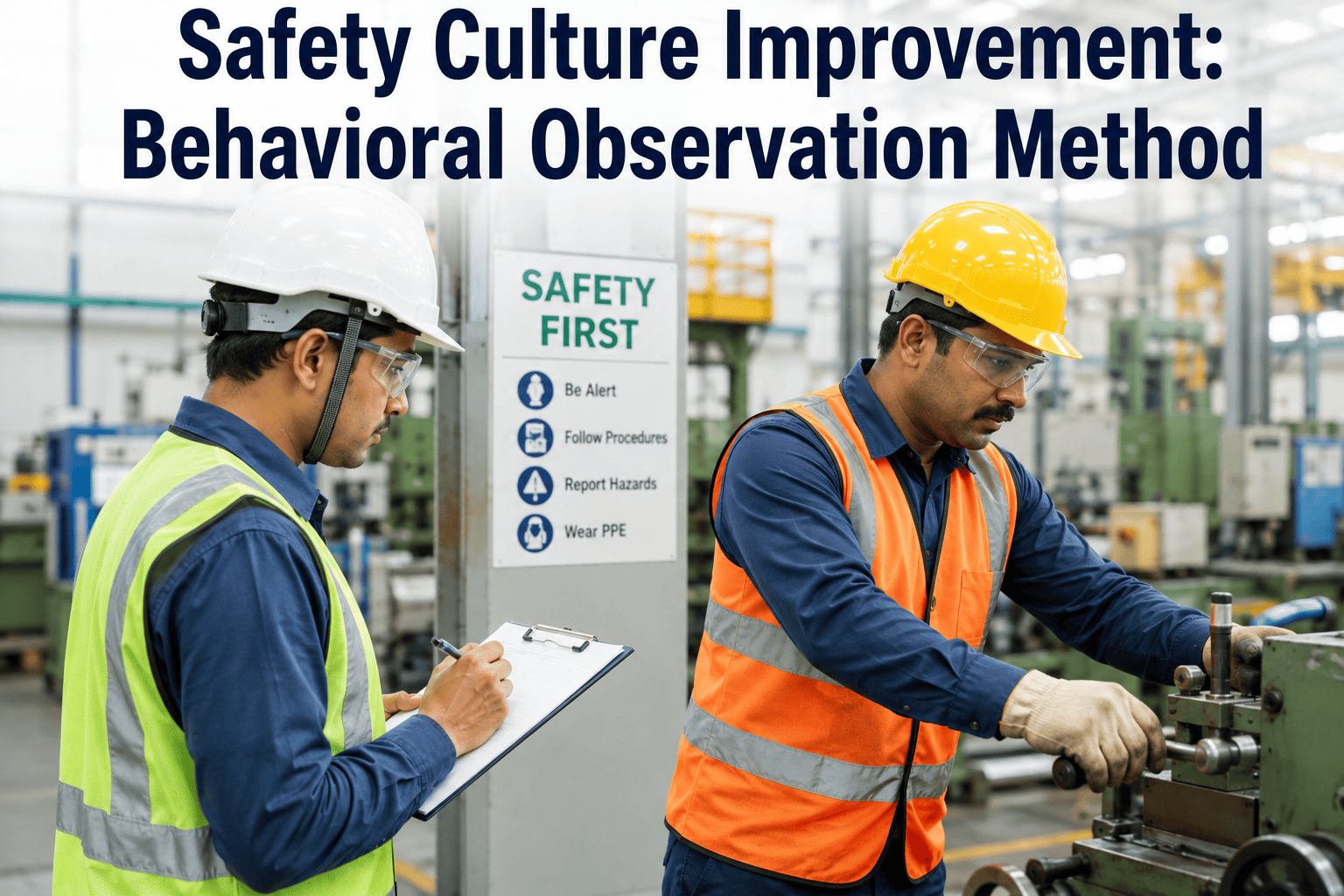
Most plants can tell you exactly how many observation cards got filed last quarter, and almost none of them can tell you whether the floor actually got safer because of it. That gap between activity and outcome is where behavior-based safety programs quietly fail, not because observers stop watching but because nobody closes the loop between what gets seen and what gets fixed. A card filed and filed away is not a corrected hazard, it is just paperwork with good intentions. Programs that survive past their first year are the ones that treat the observation as the start of a process rather than the end of one, and that shift in mindset is exactly what separates a safety culture that improves year over year from one that plateaus, as this reliability demo can show against your own plant's observation data.
Your Safety Cards Are Filed, the Question Is Whether Anything Changed Because of Them
iFactory turns behavioral observation from a paper ritual into a closed-loop system, capturing at-risk and safe behaviors digitally, routing findings to a fix, and measuring the culture shift with data instead of a gut feeling.
Why Filing Thousands of Observations a Year Still Leaves Injury Rates Flat
A behavior-based safety program that measures itself by card count rewards the wrong behavior in the program itself. Observers hit their quota, dashboards stay green, and leadership sees a number trending up quarter over quarter, yet the recordable injury rate barely moves because volume was never the thing keeping people safe. What actually reduces risk is whether an observed at-risk behavior gets fed back to the worker, whether the underlying hazard or process gap gets corrected, and whether someone verifies the fix held on the next pass. Most paper-based and spreadsheet-based BBS programs have no mechanism to track that last mile, so the same at-risk behavior gets observed, logged, and observed again next month with nothing structurally different in between.
The workforce notices this pattern faster than leadership usually does. An observer who flags the same guard left open, the same shortcut on a lockout step, or the same missing eye protection three shifts running eventually stops filing the card at all, not because they stopped caring but because the program taught them the report goes nowhere. That quiet disengagement is how a well-intentioned safety program becomes a paperwork exercise, and it rarely shows up as a formal complaint, it just shows up as declining participation numbers a few quarters later. Rebuilding that trust takes longer than building it the first time, which is exactly why the closure mechanism matters as much as the observation itself.
What Turns a Card-Filing Habit Into an Actual Culture Shift
Behavioral observation only changes outcomes when it runs as a full cycle, not a single step. iFactory structures every observation program around five pillars, each one closing a gap where traditional paper-based BBS programs typically break down, and each one reinforcing the ones around it so a weak spot in any single pillar doesn't quietly undermine the rest of the cycle.
From a Floor Observation to a Verified Fix in Four Steps
The platform sits alongside the observation habits your plant already has, digitizing the parts that used to live on a clipboard and adding the closure step most programs never built.
Because categorization and routing happen automatically, a supervisor reviewing last week's findings sees which work areas are trending at-risk before it shows up as a near-miss, not after an incident forces the conversation. That earlier visibility is the practical difference between a program that reacts to incidents and one that prevents them, and it's the reason plants that adopt closed-loop tracking tend to see their near-miss ratio shift favorably well before their recordable rate moves, since near-misses are where the leading indicators show up first.
Stop Measuring Your Safety Culture by How Many Cards Got Filed
iFactory closes the loop between observation, coaching, and corrective action, so your program measures what actually changed on the floor. Book a demo and see it running against a sample of your observation data.
Paper Cards, Spreadsheet Tracking, or a Closed-Loop Digital Program
Most plants run one of three approaches to behavioral observation today, and the difference between them is not how the observation gets captured, it's what happens to the finding afterward.
| Approach | Best Fit | Key Trade-Off |
|---|---|---|
| Paper Observation Cards | Small sites just starting a formal safety program | Low cost to start, but findings rarely get tracked to closure and trends are invisible |
| Spreadsheet Tracking | Mid-size plants trying to add structure without new software | Better visibility than paper, but manual entry lags reality and categorization stays inconsistent between observers |
| Closed-Loop Digital Program | Any plant wanting observations to actually change outcomes | Requires a short rollout period, but every finding gets tracked, coached, and verified automatically |
The shift toward closed-loop digital observation mirrors what already happened with quality management, where inspection findings without a corrective action workflow used to disappear the same way safety cards do today. Safety programs are following the same maturity curve, a few years behind.
Four Places a Closed-Loop Observation Program Changes the Numbers
Once the observation-to-closure loop is running, it applies across every part of a plant where a behavior, not just a piece of equipment, drives the risk. Safety teams that start with one high-risk area typically expand coverage plant-wide within a couple of quarters, once the closure data proves out the approach in the highest-consequence zones first.
A Culture Score Is Only as Honest as the Loop Behind It
Most plants that struggle with safety culture haven't failed to observe behavior, they've failed to close the loop on what they observed. An observer who reports the same at-risk behavior three months in a row and sees nothing change learns a lesson the program never intended to teach, that reporting doesn't lead anywhere. That erosion of trust is quieter than a missed audit, but it's more damaging, because it teaches the workforce to stop engaging with the exact system meant to protect them.
A closed-loop program flips that dynamic. Every observation gets a visible next step, whether that's a coaching conversation logged the same shift or a corrective action with an owner and a due date, and every worker who files a finding can see it move rather than disappear. That visibility is what rebuilds the trust a paper-card system slowly wears down, and it's why plants that switch to closed-loop tracking typically see participation climb even as the program gets more rigorous about follow-through, not less.
This same visibility changes how leadership talks about safety culture internally. Instead of presenting a raw count of observations filed, a safety manager can show a trend line of at-risk findings that actually got corrected, broken down by work area or shift, and point to which coaching approaches are moving the number. That shift, from an activity metric to an outcome metric, is usually what convinces plant leadership to fund the next phase of a program rather than treating safety observation as a compliance checkbox that happens to also generate paperwork for an audit file.
What Plants Report After Moving to Closed-Loop Behavioral Observation
These figures reflect outcomes reported by manufacturing sites after shifting from card-counting to closed-loop, coaching-based observation programs, measured over the first two to three quarters following rollout.
How Plants Introduce a Closed-Loop Program Without Disrupting an Existing One
A closed-loop observation program works best layered onto whatever behavioral safety habits a plant already has, rather than asking the workforce to learn an entirely new process on day one. Plants that try to redesign their observation categories, their feedback approach, and their metrics all in the same rollout tend to overwhelm both observers and the workers being observed, so a phased approach protects the trust the program depends on from the start.
Questions Safety Teams Ask Before Rolling Out a Closed-Loop Program
Make Every Observation Lead Somewhere Instead of Into a Filing Cabinet
iFactory closes the loop between behavioral observation, coaching, and verified correction, turning a paper habit into a measurable culture shift. Book a demo and see your own observation categories running on the platform.