A single underperforming supplier can shut down a production line, trigger a customer recall, or quietly bleed margin through rework for years before anyone traces the cost back to where it started. Supplier quality management exists to catch that risk before a vendor ever ships a part, then keep watching after approval so a supplier that passed its qualification three years ago hasn't drifted since. Manufacturers who treat this as a structured, evidence-based system — not a one-time onboarding form — spend far less time firefighting incoming-inspection failures and far more time running production. Teams looking to formalize their approved vendor list and scorecard process can walk through the setup with iFactory's support team.
Your Approved Vendor List Is Only as Strong as the Evidence Behind It
Qualification checklists, incoming inspection data, SCAR responses, and a scorecard that actually gets reviewed — supplier quality management turns "we trust this vendor" into something you can defend in an audit and act on before a defect reaches your line.
The Supplier Lifecycle, From First Evaluation to Requalification
Supplier quality is not a single gate — it's a lifecycle with four distinct stages, and skipping or shortcutting any one of them is where most supply-chain quality failures actually originate.
Qualification
Assess financial stability, production capacity, certifications such as ISO 9001 or IATF 16949, and past performance before a vendor is even considered for the approved list.
Approval
Add the supplier to the Approved Vendor List with a defined scope — specific parts, materials, and processes — and flow down documented specifications, tolerances, and packaging requirements.
Active Monitoring
Incoming inspection, PPM tracking, and scorecard reviews run continuously, with first production lots typically held to 100% inspection before transitioning to skip-lot sampling as trust is earned.
Requalification
Periodic audits, typically annual, confirm the supplier's quality system hasn't drifted since approval — an approval earned once is not an approval that holds forever.
Building a Qualification Checklist That Actually Screens Risk
A qualification checklist prevents unqualified vendors from ever entering the supply base, but only if it goes beyond a certificate check. The strongest checklists combine documentation review with evidence of how the supplier actually performs under pressure.
Quality System Evidence
Current ISO 9001, IATF 16949, or AS9100 certification, plus the underlying SOPs rather than just the certificate itself.
Capacity and Financial Stability
Production capacity against your expected volume, and financial health checks that flag a vendor unlikely to still be operating in two years.
Process Capability
First Article Inspection or PPAP-style submission proving the supplier's process can hold the tolerances your specification requires, not just that it can produce a sample.
Past Performance Record
Reference checks or historical data from other customers where available — a vendor's track record on delivery and defect rate is a better predictor than its sales pitch.
Turn Supplier Qualification Into a Repeatable, Auditable Workflow
iFactory structures qualification evidence, approval scope, and requalification dates into one controlled record — so "approved" means something you can prove, not something buried in an email thread.
Incoming Inspection: The First Real Test of an Approval
Qualification paperwork tells you what a supplier claims it can do. Incoming inspection tells you what actually shows up at your receiving dock, and the transition between the two is where a program either holds together or quietly falls apart. New suppliers, or new part numbers from an existing supplier, typically start under full inspection until a track record justifies easing off.
100% Inspection at Launch
First production lots are checked in full, regardless of how strong the PPAP submission looked, because a sample run and a sustained production run are not the same test.
Transition to Sampling
Once a defined number of consecutive lots pass clean, inspection can step down to a statistical sampling plan sized to the part's risk tier.
Skip-Lot or Dock-to-Stock
Low-risk, consistently performing suppliers can eventually move to dock-to-stock receiving, freeing inspection capacity for higher-risk parts.
Reversion on Any Signal
A single significant nonconformance, a process change, or a scorecard dip should trigger an immediate return to full inspection rather than waiting for a scheduled review to catch it.
Tiering Suppliers by Risk Instead of Treating Them All the Same
Not every supplier carries the same risk to your product. A tiered approach concentrates inspection and audit resources where a failure would actually hurt, instead of spreading the same level of scrutiny evenly across every vendor.
Safety-critical or high-value components. Full PPAP, 100% incoming inspection at onboarding, annual on-site audits, and monthly scorecard review.
Functional components with moderate impact. Sampling-based incoming inspection, quarterly scorecard review, audits on a defined multi-year cycle.
Commodity items with low failure impact. Documentation review at approval, dock-to-stock receiving, and periodic performance spot-checks.
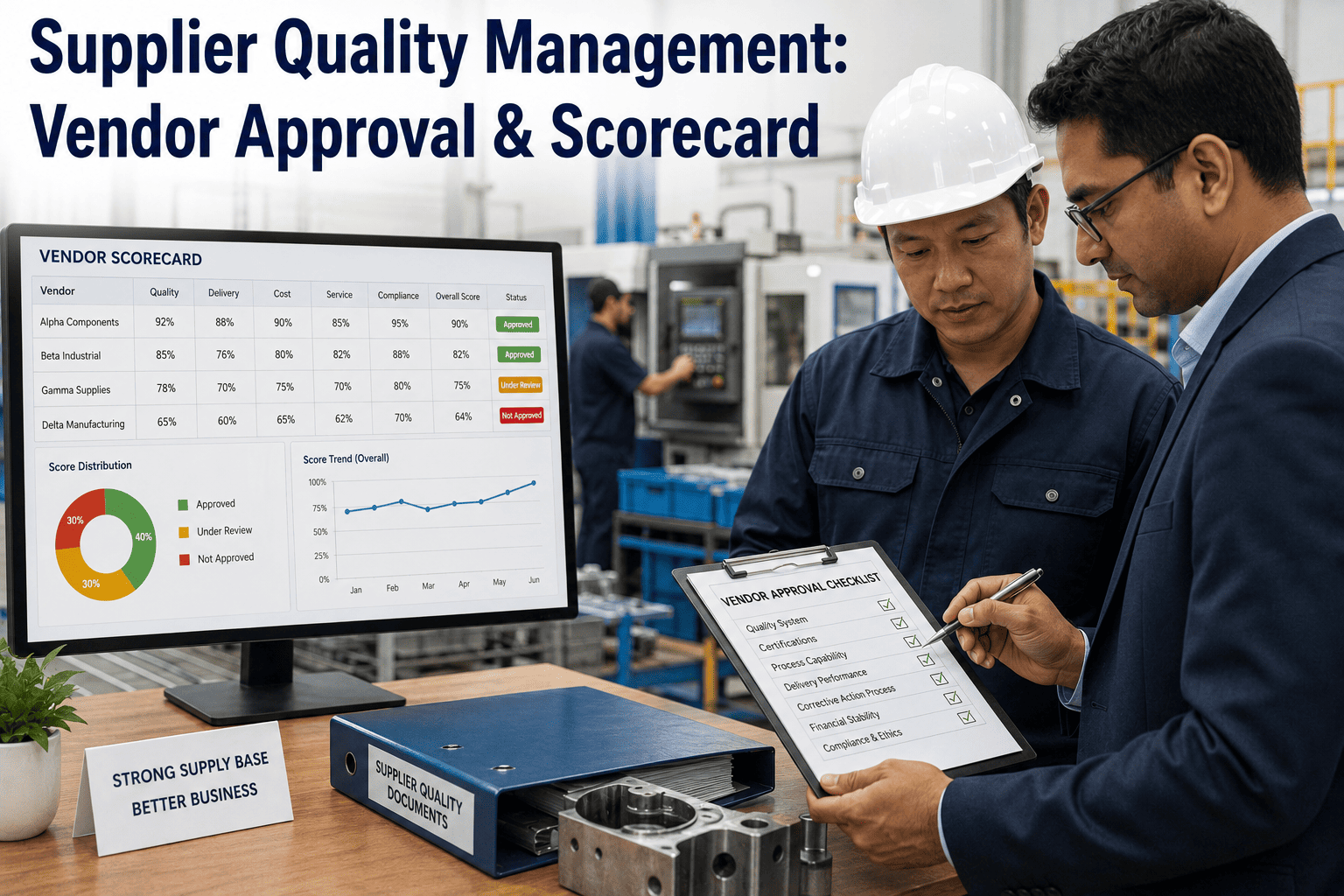
The Scorecard: Turning Receiving Data Into a Score
A supplier scorecard is only useful if it's built from the same data set every time and reviewed on a fixed cadence — not reconstructed differently each quarter depending on who's building the slide deck.
| KPI | Typical Weight | Data Source | What It Signals |
|---|---|---|---|
| On-Time Delivery | 30% | PO due date vs. actual receipt date | Schedule reliability and production-line risk |
| On-Time-In-Full (OTIF) | 25% | Quantity ordered vs. quantity received on time | Combined delivery and fulfillment accuracy |
| Incoming Defect Rate (PPM) | 25% | Incoming inspection rejection records | Process control at the supplier's own facility |
| SCAR Responsiveness | 10% | Time to close corrective action requests | How seriously the supplier treats a raised issue |
| Documentation Compliance | 10% | Certificates of conformance, required paperwork completeness | Administrative discipline behind the physical product |
Six data fields cover the minimum set most of these KPIs need: supplier ID, PO due date, actual receipt date, quantity ordered, quantity received, and quality rejection records. Manufacturers who audit their ERP for these fields before building a scorecard avoid the more common failure — a scorecard that looks sophisticated but is quietly built on incomplete receiving data.
When a Score Drops: SCAR, CAPA, and the Escalation Path
A scorecard that flags a problem is only half the system — someone has to own what happens next, and that ownership has to be defined before the alert fires, not decided in the moment.
A Composite Scenario: Catching Drift Before It Became a Recall
A precision components manufacturer had approved a Tier 2 supplier three years earlier with a clean PPAP submission and a strong first-year scorecard. Quarterly reviews had gradually become annual as the relationship matured, and incoming inspection had shifted to a lighter sampling plan once the supplier's PPM stayed low for six consecutive quarters.
A routine scorecard refresh — prompted by a new plant manager reinstating quarterly cadence — showed OTIF had quietly slipped from 98% to 84% over the prior year, masked because on-time delivery alone still looked acceptable. An audit visit found the supplier had subcontracted a finishing step to a second-tier vendor without notifying the buyer, a change that violated the original approval scope. Reinstating 100% incoming inspection on the affected part number caught two defective lots before they reached the assembly line, and the supplier was required to either bring the finishing step back in-house or submit the subcontractor for its own qualification.
Mistakes That Undermine Even a Well-Designed Program
Letting Review Cadence Stretch as Trust Grows
A supplier's good first year doesn't guarantee a good third year. Stretching quarterly reviews to annual because performance looked fine is how drift goes undetected.
Approving a Vendor Without a Defined Scope
An approval that doesn't specify exactly which parts, materials, and processes it covers leaves room for a supplier to expand into unapproved work without anyone noticing.
Building the Scorecard From Incomplete ERP Data
A scorecard missing quantity-received or rejection-record fields produces numbers that look precise but are quietly wrong, and nobody catches it until a dispute forces a manual reconciliation.
No Defined Owner for a Failed Score
An alert that fires with no assigned response owner or SLA gets ignored the same way an email without a clear "to" line does — define the escalation path before automation goes live.
Treating Every Supplier the Same Regardless of Risk
Applying Tier 1 scrutiny to a low-risk commodity vendor wastes inspection resources, while applying Tier 3 scrutiny to a safety-critical component is the mistake that actually causes a recall.
Closing a SCAR Without Verifying the Fix
Marking a corrective action closed once the supplier responds, without checking the next few lots for the same defect, is why the same nonconformance often reappears within a year.
Quality Agreements: Putting Expectations in Writing Before Parts Ship
A verbal understanding of "acceptable quality" is not a defensible position when a defect reaches your line and the supplier disputes responsibility. A written quality agreement, established at approval and referenced in every purchase order, removes the ambiguity before it becomes a dispute.
Specifications and Acceptance Criteria
Exact tolerances, material certifications, and inspection methods the supplier must meet, referenced by revision number so a spec change can't quietly slip through unnoticed.
Change Notification Requirements
A requirement that the supplier notify the buyer before changing a process, material source, or subcontracted step — the exact gap that let an unapproved subcontractor slip into the composite scenario above.
Audit Rights and CAPA Responsibilities
The buyer's right to conduct or request an audit, and the supplier's obligation to respond to a SCAR or CAPA within a defined window, spelled out as a contractual term rather than a goodwill expectation.
Frequently Asked Questions
What is the difference between supplier qualification and supplier approval?
Qualification is the evaluation phase, where a manufacturer reviews a candidate vendor's quality system, certifications, capacity, and past performance to decide whether the vendor is even a viable option. Approval is the outcome of a successful qualification — the supplier is formally added to the Approved Vendor List with a defined scope covering specific parts, materials, or processes, and documented quality requirements are contractually flowed down from that point forward. A vendor can be qualified for one part family and not another, which is why scope matters as much as the approval itself. Teams building this workflow can review their qualification criteria with iFactory's support team.
How often should a supplier scorecard be reviewed?
Review frequency should scale with supplier risk tier rather than following a single company-wide default: critical Tier 1 suppliers typically warrant monthly review, standard Tier 2 suppliers quarterly, and low-risk Tier 3 suppliers a lighter periodic check. Stretching review cadence simply because a supplier has performed well historically is one of the most common ways performance drift goes undetected until it surfaces as a defect on the production line rather than in a scorecard trend line.
What data does a supplier scorecard actually need?
At minimum, a usable scorecard needs six data fields per purchase order: supplier ID, PO due date, actual receipt date, quantity ordered, quantity received, and quality rejection records. These support the core KPI set — on-time delivery, on-time-in-full, incoming defect rate, SCAR responsiveness, and documentation compliance. Scorecards built without complete receiving and rejection data tend to look precise while actually understating risk, since gaps in the underlying data set get silently treated as passing performance.
When does a supplier corrective action escalate to a full CAPA?
A single Supplier Corrective Action Request typically covers an isolated nonconformance with a defined response window for root cause and containment. Escalation to a full Corrective and Preventive Action process usually happens when the same defect recurs after a SCAR was closed, when the nonconformance affects a safety-critical component, or when multiple SCARs accumulate against the same supplier without sustained improvement. The distinction matters because a CAPA requires documented verification that the fix held over subsequent lots, not just a supplier's written response.
Can supplier quality tracking be automated instead of managed through spreadsheets?
Yes, and it typically closes the exact gaps that spreadsheet-based tracking tends to create — inconsistent scorecard construction quarter to quarter, SCARs that fall through email threads, and requalification dates that quietly pass unnoticed. An automated system can pull receiving and inspection data directly, apply consistent KPI weighting, and flag a supplier the moment its score crosses a defined threshold. Manufacturers ready to move off manual tracking can book a demo to see how iFactory structures supplier qualification, scorecards, and SCAR workflows in one system.
Stop Discovering Supplier Drift During a Recall Investigation
iFactory connects qualification records, incoming inspection data, and scorecard trends into one supplier quality view, so a slipping vendor gets caught in a routine review — not after a defect reaches the line. Book a walkthrough to see it running with your supplier base.