JIT Supply Chain for Manufacturing: Delivery Optimization
By Johnson on August 17, 2026
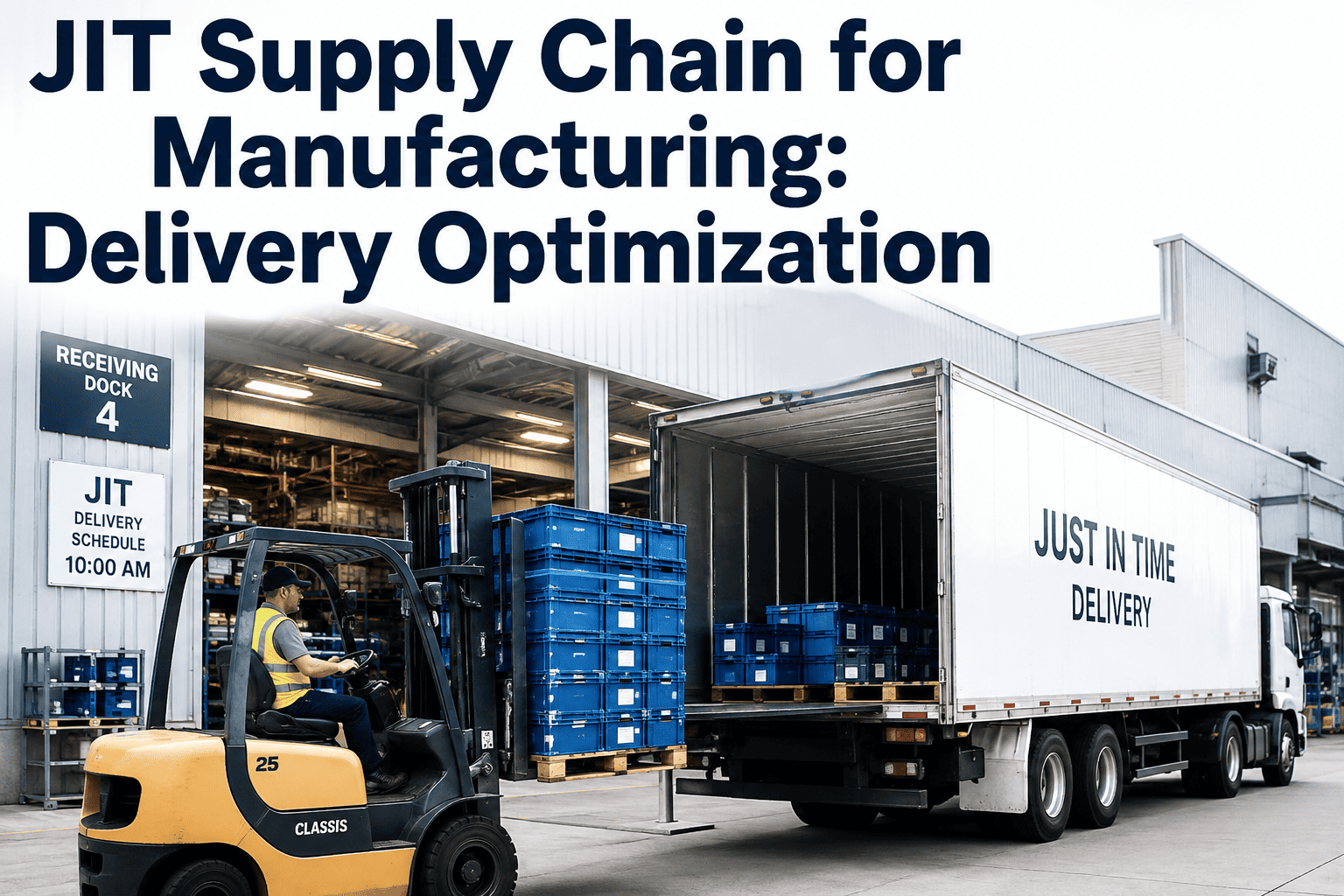
Most plants that claim to run just-in-time delivery are actually running just-in-case with shorter lead times — buffering inventory at receiving docks, staging areas, and line-side supermarkets because their supplier scheduling cannot hold a reliable delivery window within thirty minutes. The difference between a JIT supply chain that actually works and one that just carries the label comes down to delivery precision at the dock, not philosophy at the executive level. This breaks down the specific scheduling, logistics, and floor-level execution mechanisms that make JIT delivery hold up under real production pressure — and where to get help building one that actually tightens your inventory rather than just relocating it. Book a demo to see how your current delivery data translates into a working JIT schedule.
Supply Chain · JIT Delivery
JIT Supply Chain for Manufacturing: Delivery Optimization That Actually Reduces Inventory
A practical framework for building supplier delivery schedules, milk-run routes, and dock-to-line flows that cut floor inventory without starving your production lines.
Why Most Manufacturing JIT Programs Are Just Renamed Buffer Stock
The original Toyota Production System defined just-in-time as receiving exactly what is needed, exactly when it is needed, in the exact amount needed. Most plants that adopted the label kept the receiving dock, kept the staging area, and kept the line-side supermarket — they just shrank the quantities and called it lean. The inventory moved from a weeks-of-supply buffer to a days-of-supply buffer, which looks better on a dashboard but still ties up capital and floor space that a true JIT delivery system would free. The gap is not in the concept but in the scheduling precision between supplier departure and line consumption. A supplier that delivers within a four-hour window cannot support two-hour line-side inventory targets without a buffer in between. Closing that gap requires delivery window discipline measured in minutes, not hours, and that is where most implementations break down because the logistics infrastructure and supplier coordination to support it were never actually built.
Visual Comparison
Traditional Receiving vs. True JIT Delivery Flow
Traditional Receiving Flow
True JIT Delivery Flow
Delivery Scheduling Framework
Six Steps to Build a JIT Delivery Schedule That Holds on the Floor
1
Classify Every Part by Consumption Rate and Criticality
Not every part deserves JIT delivery — high-volume, high-frequency consumption parts with stable demand are the candidates, while low-volume or highly variable parts may still need periodic bulk delivery with smaller line-side pulls. Build the classification before designing any delivery route, because mixing part types on a JIT schedule is the most common cause of schedule instability and missed windows.
2
Define Delivery Windows in Minutes, Not Days
A supplier agreement that says delivery by noon is not a JIT window — it is a traditional purchase order with a tighter deadline. True JIT delivery windows specify a thirty-minute arrival slot tied directly to production consumption timing, so the material moves from dock to line without staging delay. This requires calculating line consumption rates and working backward from the point of use to the dock arrival time.
3
Design Milk-Run Routes That Consolidate Multiple Suppliers
A single truck visiting three suppliers in a fixed sequence at fixed times replaces three separate deliveries with unpredictable arrivals. Milk-run design requires mapping supplier locations geographically, aligning their pick windows with the receiving dock schedule, and ensuring total route time fits within the plant consumption cycle so the dock is not waiting or overflowing between runs.
4
Establish Dock-to-Line Delivery Paths
The shortest path from dock to line-side is not always a straight line — it requires designated travel lanes, clear handoff points, and material handling equipment positioned to move material within the delivery window. Plants that skip this step end up with forklift traffic jams at the dock during delivery windows, which defeats the purpose of precise scheduling by adding unpredictable transit time between dock and line.
5
Set Line-Side Inventory Ceilings
Every line-side location gets a maximum quantity based on consumption rate and delivery frequency — when the ceiling is reached, no more material is delivered until consumption pulls it down. This prevents the gradual inventory creep that turns a JIT system back into a buffer stock system over time, which is the most common long-term failure mode of otherwise well-designed JIT programs.
6
Build the Exception Protocol Before Go-Live
Every JIT system will face a missed delivery, a quality hold, or a demand surge — the question is whether the response is scripted or improvised. Define what happens when a supplier misses their window, what the backup delivery option is, and what the escalation trigger is, so operators are not left making ad-hoc decisions that create cascading inventory problems across the floor.
Need Help Building Your JIT Schedule
See Your Delivery Data Mapped to a Working JIT Plan
iFactory takes your actual supplier lead times, consumption rates, and dock capacity to generate delivery windows and milk-run schedules — not a theoretical model, but one built from your real production data.
Where JIT Delivery Actually Saves Money — And Where It Does Not
Inventory Carrying Cost Reduction
This is the primary financial benefit — reducing days of inventory from fifteen to two on high-volume parts frees working capital that compounds across hundreds of SKUs. The savings are real but only materialize if the delivery system is reliable enough to sustain the lower inventory level without stockouts that cost more than the inventory savings.
Floor Space Reclamation
Staging areas, warehouse aisles, and line-side supermarkets all shrink when delivery frequency increases and buffer quantities decrease. In space-constrained plants, this recovered square footage can defer a facility expansion or enable a new production line that would not have fit otherwise, which is often a larger financial impact than the inventory carrying cost itself.
Increased Logistics Cost
More frequent deliveries mean more trucks, more dock labor, and more coordination overhead — this is the cost that most JIT business cases understate. Milk-run consolidation offsets some of it, but the net logistics cost per unit typically goes up even as inventory cost goes down, and the business case only works if the inventory savings exceed the logistics cost increase.
Quality Escalation Speed
Smaller, more frequent deliveries mean quality problems are detected closer to the production run that consumed the defective material, which reduces the scrap quantity and makes root cause tracing faster. This benefit is hard to quantify before implementation but often cited as one of the most valuable operational improvements by plants that have sustained JIT for more than a year.
Applied Example
Milk-Run Consolidation That Cut Receiving Dock Congestion by Sixty Percent
A mid-size consumer electronics assembly plant in the Midwest was receiving forty-two separate supplier deliveries per day across a four-dock receiving area, with arrivals clustered between 6 AM and 9 AM because supplier agreements specified morning delivery without specifying exact windows. The result was a three-hour dock bottleneck every morning followed by idle docks for the rest of the shift, with forklift traffic creating safety hazards and staging areas overflowing into adjacent production lanes. The plant redesigned its supplier delivery schedule around three milk-run routes — a northern route covering twelve suppliers, a southern route covering eighteen suppliers, and a local route covering the remaining twelve — with staggered arrival windows every forty-five minutes from 5 AM to 2 PM. Each route was assigned a fixed dock door and a dedicated unloading team. The total number of truck arrivals dropped from forty-two to fifteen, dock congestion during the morning peak dropped by sixty percent, and line-side stockouts actually decreased because the scheduled windows were more reliable than the previous first-come-first-served approach. The logistics cost per delivery went up slightly due to the milk-run routing, but the net cost improvement from reduced dock labor overtime, eliminated staging area expansion, and lower line-side inventory more than offset it within the first quarter.
"
The biggest misconception about JIT is that it is an inventory reduction strategy. It is not — it is a delivery precision strategy. Inventory reduction is the outcome that happens when delivery precision gets good enough to support it. Plants that start by trying to reduce inventory without first building the delivery infrastructure to sustain it always end up back where they started, just with more expediting costs and more supplier friction. The sequence matters: delivery reliability first, inventory reduction second.
Raymond Castellano
Supply Chain Operations Advisor · 19 years in automotive and electronics JIT implementation
Performance Metrics
Five KPIs That Reveal Whether Your JIT Delivery Is Actually Working
01
On-Time Dock Arrival Rate
Measured against the scheduled delivery window, not just the scheduled day. A supplier that arrives four hours late on the right day is not on time in a JIT system. Target is ninety-five percent or higher within the defined window, and anything below eighty-five percent signals that the schedule is not credible enough to support reduced inventory.
02
Dock-to-Line Transit Time
The elapsed time from material arriving at the dock to it being available at the point of use. In a well-executed JIT system this should be measured in minutes, and any consistent pattern above thirty minutes indicates a handoff or staging bottleneck that is adding hidden buffer into the system.
03
Line-Side Inventory Turns per Shift
How many times the line-side inventory for a given part is replenished during a single shift. Higher turns mean smaller buffers and tighter delivery coupling. If a part sits at line-side for an entire shift without being replenished, it is not running on JIT delivery — it is running on a daily batch with a JIT label.
04
Supplier Delivery Variance
The standard deviation in minutes of actual arrival times from the scheduled window center. Low average latency with high variance is worse than slightly higher average latency with low variance, because variance is what forces buffer stock. A plant with fifteen-minute average variance needs more safety stock than one with thirty-minute average latency but five-minute variance.
05
Expedite Frequency Rate
The number of unscheduled emergency deliveries or expedited shipments per week as a percentage of total deliveries. A healthy JIT system runs below two percent; anything above five percent indicates the scheduled system is failing and the plant is propping it up with unplanned logistics costs that do not show up in the JIT metrics.
Common Failures
JIT Implementation Failure Modes and What Actually Causes Them
Failure Symptom
Surface Explanation
Root Cause
Line-side stockouts increasing after JIT launch
Supplier reliability problems
Delivery windows were set based on average lead times without accounting for variance, so the schedule had no buffer for normal variability
Dock congestion worse after milk-run implementation
Truck scheduling issues
Milk-run routes were designed around supplier geography instead of dock capacity, so multiple routes arrived at overlapping times
Inventory crept back up within six months
Operator non-compliance with pull signals
Line-side inventory ceilings were set but never enforced, so gradual over-delivery accumulated without triggering corrections
Supplier quality problems causing line stops
Incoming inspection not catching defects
JIT removed the QC hold buffer without replacing it with supplier-certified quality processes, shifting the inspection burden to the production line
Logistics costs exceeded the business case projection
Fuel and labor cost increases
The business case assumed full truck utilization on milk runs but actual shipments ran below capacity because part classifications were too broad
Warning Signals
Signs Your Current Delivery System Is Not Ready for JIT
No Recorded Delivery Time Data
If your plant cannot pull a report showing actual versus scheduled arrival times for the last thirty days, you do not have the data foundation to design minute-level delivery windows. Building this tracking capability is the first step before any JIT scheduling work begins, because without it you are designing a schedule based on assumptions rather than evidence.
Suppliers Have No Visibility Into Your Consumption Schedule
A supplier that only knows your weekly order quantity cannot align their production and shipping to support thirty-minute delivery windows. JIT requires a two-way information flow where the supplier receives consumption signals — whether through kanban, EDI, or a shared portal — that let them ship based on your actual pull rather than their own batch logic.
Single-Dock Receiving for Multiple Production Lines
If all inbound material funnels through one dock door regardless of destination, the dock becomes a serialization point that prevents parallel delivery to different lines. JIT delivery to multiple lines requires either multiple dock doors with dedicated routes or a cross-dock layout that moves material directly from inbound to outbound without storage in between.
Quality Inspection Happens After Receiving, Not at the Supplier
A traditional incoming inspection process that holds material for hours or days before releasing it to the floor is incompatible with dock-to-line JIT delivery. Either the supplier must be certified to ship against quality standards that eliminate the need for incoming inspection, or the inspection must move to the point of receipt in a way that does not delay line delivery.
Implementation Sequence
The Right Order to Implement JIT Delivery — And Why Sequence Matters
1
Stabilize Demand Signals First
Before asking any supplier to deliver on a tight window, ensure your own production schedule is stable enough to generate reliable consumption signals. A plant that changes its daily build sequence three times per shift cannot ask suppliers to hit thirty-minute windows because the pull signal itself is unreliable. Schedule stability is the prerequisite that most JIT implementations skip.
2
Pilot with Five to Ten High-Volume Parts
Select a small set of parts that have stable consumption, single-source suppliers, and short transit times. Running the pilot on these parts lets you validate the delivery window math, the dock-to-line flow, and the exception protocol without risking a plant-wide disruption if something does not hold. Expanding before the pilot is proven is the most expensive mistake in JIT implementation.
3
Add Parts in Batches by Supplier, Not by Production Line
When expanding beyond the pilot, group new parts by supplier rather than by where they are used on the floor. Adding five parts from the same supplier lets you adjust one delivery window and one route; adding five parts that go to the same line but come from five different suppliers requires coordinating five separate delivery changes simultaneously, which multiplies the coordination complexity and failure risk.
4
Tighten Windows Only After Reliability Is Proven
Start with sixty-minute windows and tighten to thirty-minute windows only after the supplier has sustained ninety-five percent on-time arrival within the wider window for at least four weeks. Tightening prematurely forces expediting that undermines the cost case and supplier relationship, which takes months to repair.
5
Reduce Line-Side Inventory Ceilings Last
Inventory reduction is the reward for getting everything else right, not the first step. Reduce ceilings only after delivery reliability, dock-to-line transit time, and exception handling are all performing at target, because reducing inventory before the system is reliable just converts inventory cost into stockout cost, which is always more expensive.
Dock-to-Line Deep Dive
How Dock-to-Line Delivery Eliminates the Staging Layer
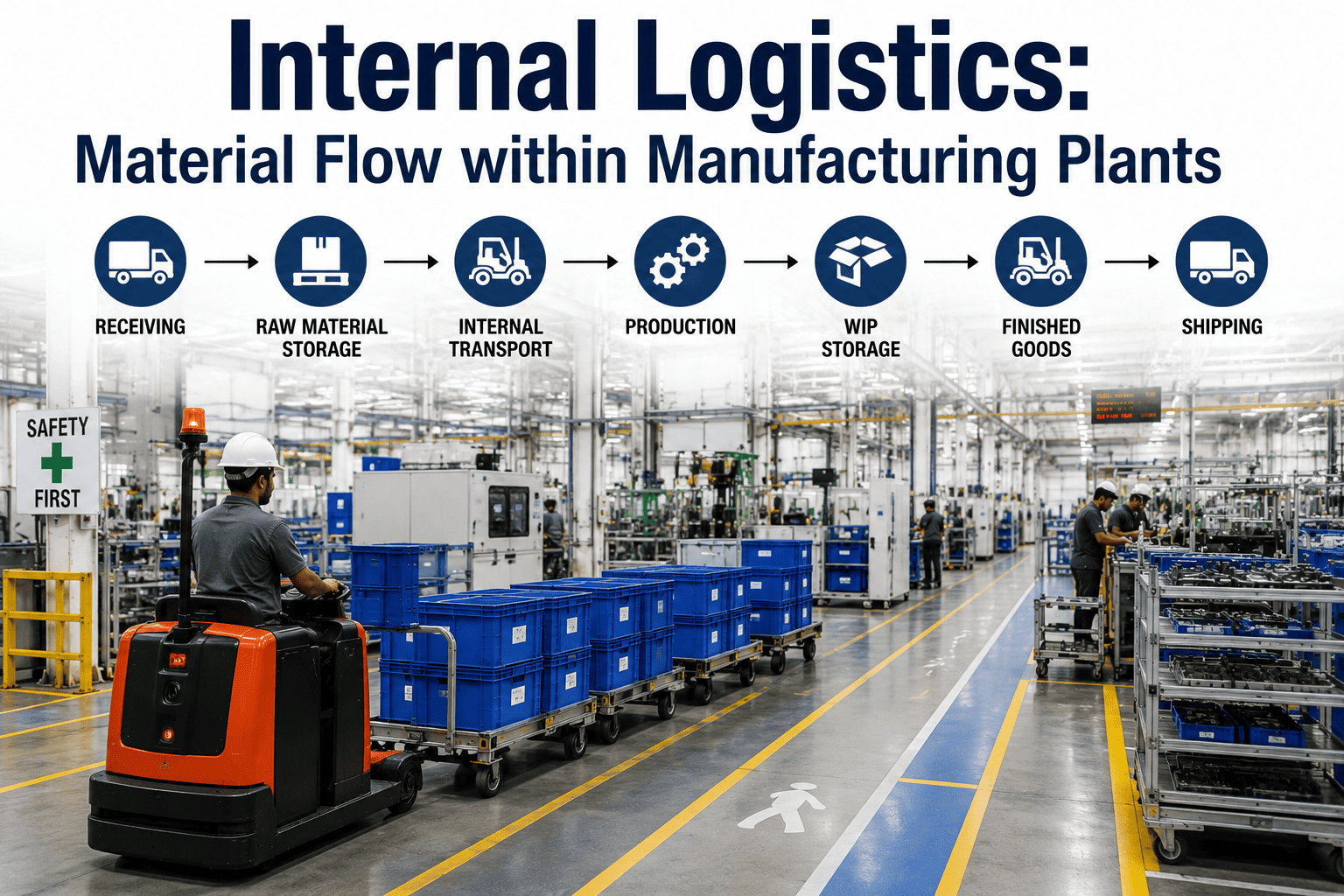
Dock-to-line delivery means material moves from the receiving dock directly to the point of use on the production line without passing through a warehouse or staging area in between. In practice this requires three conditions to work: the supplier delivery must arrive in production-ready packaging that does not require repacking or relabeling at the dock, the material handling path from dock to line must be dedicated and uncongested enough to guarantee transit within the delivery window, and the line-side replenishment signal must trigger the dock delivery rather than a separate warehouse pick. A large automotive components manufacturer implemented dock-to-line for thirty-eight of its highest-volume parts by standardizing supplier packaging to fit directly on AGV carts, designating a dedicated AGV lane from the receiving dock to two assembly lines, and connecting the line-side kanban signal to the dock scheduling system so that an empty bin at line-side generated a dock delivery task rather than a warehouse replenishment task. The staging area for those thirty-eight parts was eliminated entirely, freeing four thousand square feet of floor space and removing eight hours of average staging inventory. The keys to making it work were the packaging standardization — which required six months of supplier negotiation — and the dedicated AGV lane, which required re-routing other traffic away from the dock-to-line path. Without both, the material would have still needed to stop somewhere between dock and line, recreating the staging bottleneck under a different name.
Technology Requirements
Systems Needed to Support Minute-Level Delivery Scheduling
System Capability
Why It Matters for JIT
What Happens Without It
Real-time consumption tracking at line-side
Generates the pull signal that triggers supplier delivery
Schedules are based on forecasts rather than actual consumption, creating timing drift
Delivery window scheduling with minute precision
Assigns each supplier a specific arrival slot tied to consumption timing
Suppliers self-schedule within broad windows, causing dock congestion and buffer accumulation
Supplier portal or EDI consumption sharing
Gives suppliers visibility into real-time pull so they can align shipping
Suppliers ship on their own batch schedule, not your consumption schedule
Dock door assignment and dock-to-line routing
Ensures material has a clear, uncongested path from dock to point of use
Material sits at the dock waiting for a forklift or a clear path, adding hidden buffer time
Exception alerting and escalation workflow
Catches missed deliveries or quality holds before they become line stops
Problems are discovered at line-side when the bin is empty, which is too late for a scheduled response
JIT Delivery Questions
Frequently Asked
How do I know if my plant is ready for JIT delivery implementation?
Your plant is ready for JIT delivery when you have at least three months of stable production scheduling data, can measure actual supplier arrival times against scheduled windows, and have at least a small set of high-volume parts with single-source suppliers and short transit times to use as a pilot group. Without these prerequisites, the implementation will generate more disruption than improvement because the delivery schedule will be built on assumptions rather than evidence. Book a demo to assess your readiness using your actual data.
What is the difference between milk-run delivery and standard supplier shipping?
Standard supplier shipping means each supplier sends a truck independently on their own schedule, which creates unpredictable arrival patterns at your dock. Milk-run delivery means a single truck visits multiple suppliers in a fixed sequence on a fixed schedule, consolidating several deliveries into one predictable arrival. The consolidation reduces total truck traffic, creates reliable arrival windows, and gives you control over dock scheduling that independent shipments never provide. Contact support to model milk-run routes for your supplier base.
Can JIT delivery work with overseas suppliers or is it limited to local sourcing?
True minute-level JIT delivery is limited to suppliers within driving distance because transit time variability from overseas shipping cannot support tight delivery windows. However, overseas-sourced parts can still participate in a JIT framework by using a local warehouse or cross-dock facility near the plant as a buffer decoupling point, with the final leg from local warehouse to line-side operating on JIT principles. This hybrid approach is common in electronics and automotive plants that cannot source all components locally. Book a call to design a hybrid JIT model for your supply base.
How much inventory reduction can I realistically expect from JIT delivery?
For high-volume parts with stable demand and local suppliers, inventory reduction from fifteen days to one to two days of supply is achievable within six to twelve months of a well-executed implementation. For parts with longer lead times or more demand variability, the reduction will be smaller and the timeline longer. The key variable is not the part itself but the delivery reliability that the supply chain can sustain — inventory reduction follows reliability, and trying to force reduction before reliability is proven always backfires. Talk to our team to estimate realistic targets for your specific parts.
What happens when a supplier misses their JIT delivery window?
A missed window triggers the exception protocol, which should define exactly what happens next: a backup supplier is activated, a safety stock buffer is drawn down, or the production schedule is adjusted to sequence around the shortage. The critical point is that the response must be pre-defined rather than improvised, because ad-hoc responses to missed deliveries are what cause cascading disruptions across the floor. Plants with strong exception protocols absorb missed deliveries with minimal impact; plants without them treat every miss as an emergency. Book a demo to see how iFactory handles exception workflows.
Stop Running JIT on Paper While Buffering in Practice
Build a Delivery Schedule Backed by Your Actual Floor Data
iFactory maps your supplier lead times, consumption rates, and dock capacity into minute-level delivery windows and milk-run schedules — so your JIT system works on the floor, not just in the presentation.