A forklift moving through a narrow aisle at eight miles per hour weighs several times more than the car most people drive to work, and it can pin a pedestrian against a rack in the time it takes to glance down at a phone. Powered industrial trucks remain one of the most frequently cited OSHA standards year after year, and manufacturing facilities carry a disproportionate share of those citations because forklifts, pedestrians, and tight aisles are packed into the same square footage every shift. Most programs already have a training binder and a laminated pre-shift checklist taped to the wall, yet incidents keep happening in the same blind corners and loading dock approaches. Building a forklift safety program that actually holds up on the floor starts with booking a forklift safety assessment with iFactory's EHS team.
Find Your Facility's Actual Collision Hot Spots
iFactory's AI vision platform can map where forklift and pedestrian paths actually cross on your floor, using your existing camera feeds.
What Actually Causes Forklift Injuries and Fatalities
Not every forklift hazard carries the same weight. Some incident types are frequent but rarely severe, while others happen less often and are almost always catastrophic when they do. Understanding where the real risk concentrates is what separates a safety program that checks boxes from one that actually prevents the worst outcomes.
The pattern in national injury data is remarkably consistent year over year. Tip-overs remain the deadliest single incident type, largely because an operator who is not wearing a seatbelt or who tries to jump clear during a tip is exposed to the full weight of the truck. Pedestrian struck-by incidents are the other dominant fatality cause, and what makes them so dangerous is how disproportionate the risk is: pedestrians are involved in a much smaller share of total accidents than of total deaths, meaning that when a forklift does strike a person, the outcome is far more likely to be severe than in almost any other type of workplace incident.
What 29 CFR 1910.178 Actually Requires
OSHA's Powered Industrial Trucks standard is specific about what a compliant program looks like, and the most frequently cited violations map directly to the requirements employers skip or let lapse. Here is what the standard actually calls for.
The pattern behind the citation data is telling. The single most cited provision covers safe operating practices like speed, load handling, and pedestrian awareness, which points to a gap between what operators are taught in a classroom and what actually happens once they are alone on a truck during a busy shift. The next most common citations involve refresher training and documentation, both of which tend to slip not because employers disagree with the requirement but because tracking renewal dates and evaluation records manually across a large operator roster is genuinely hard to sustain without a system built for it.
Formal Training and Evaluation
Operators need formal instruction, hands-on practical training, and a documented performance evaluation before operating unsupervised, and again at least once every three years.
Refresher Training Triggers
Refresher training is required after an accident or near-miss, an unsafe operation observation, a poor evaluation, a change to a different truck type, or a workplace condition change affecting safety.
Certification Recordkeeping
Documentation of each operator's training, evaluation date, and certification must be maintained and available, since missing records are among the most cited violations under the standard.
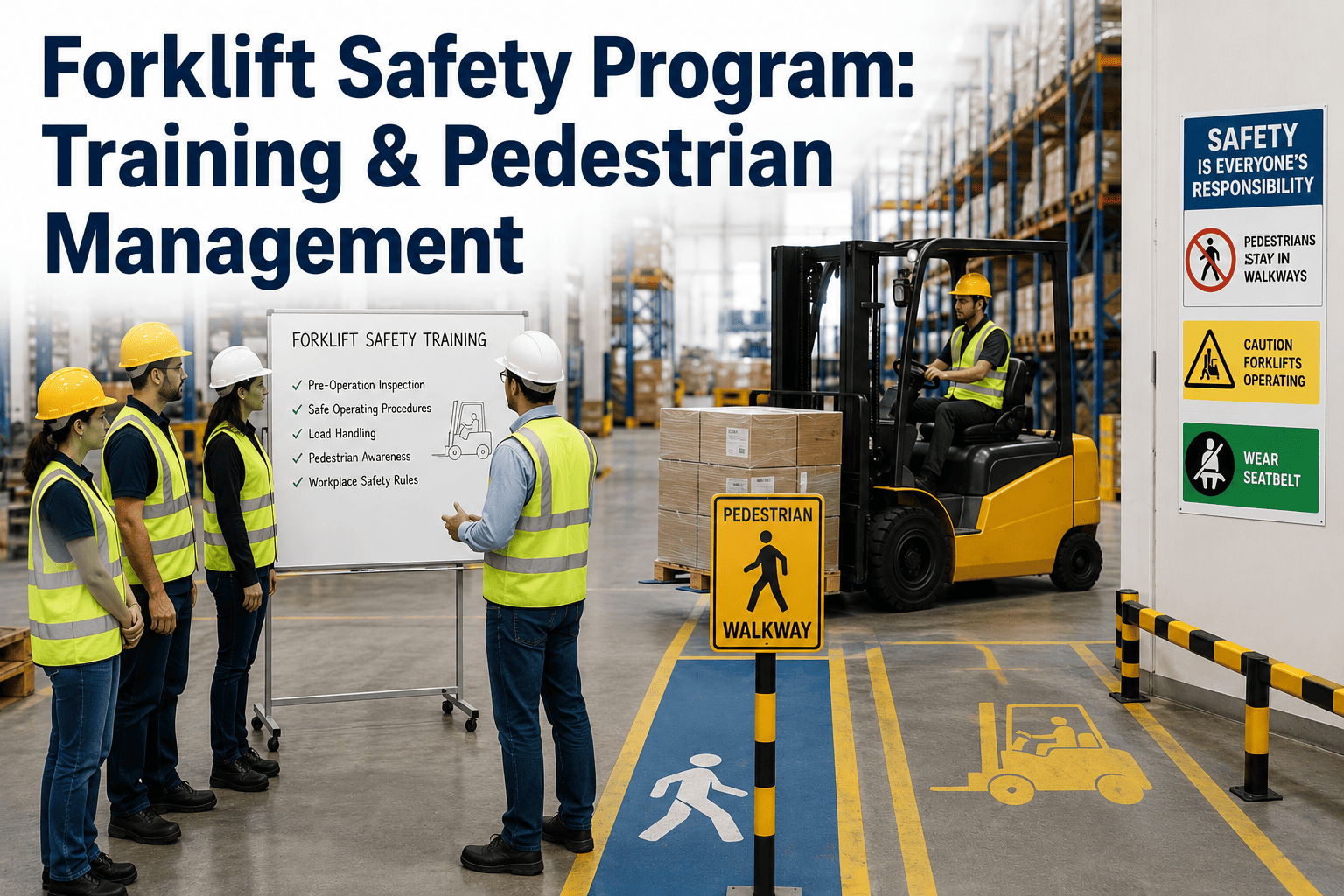
Pedestrian Traffic Separation
Marked walkways, barriers, and traffic controls must separate pedestrian and vehicle paths wherever practical, with visible, well-maintained markings rather than faded lines nobody has repainted.
Where Pedestrian-Forklift Collisions Actually Happen
Collisions rarely happen on a long, open aisle where everyone can see everyone else coming. They cluster around a handful of predictable hot spots where visibility drops and traffic converges.
What makes these hot spots so persistent is that they are usually structural, not behavioral. A blind corner stays blind no matter how well an individual operator has been trained, and a dock approach with poor lighting creates the same risk on every shift regardless of who is driving. That is precisely why relying only on training and signage tends to plateau after the first year or two of a program: the remaining risk lives in the physical layout and the moment-to-moment interactions at these specific locations, not in a gap in anyone's knowledge of the rules.
Blind Corners and Intersections
Racking and stacked material block sightlines exactly where aisles cross, so neither the operator nor the pedestrian sees the other until it is too late to react.
Loading Dock Approaches
Trucks, forklifts, and dock workers converge in a small footprint, often with reversing trucks and limited lighting compounding the visibility problem.
Narrow Aisles Near Workstations
Pedestrians step out from a workstation directly into an active travel lane, often without an established crossing point or warning signal.
Reversing and Backing Maneuvers
A forklift backing out of a rack aisle has the least operator visibility of any maneuver, and pedestrian foot traffic behind the truck is often outside the mirror's field of view.
Mapping these four zones against your actual incident and near-miss history, rather than assuming every facility shares the same layout risk, is usually the fastest way to find where a barrier, mirror, or camera would change the outcome of the next close call. Facilities that run this mapping exercise consistently find that a small number of locations account for the majority of their pedestrian-related risk, which makes targeted investment far more effective than a blanket policy change applied evenly across the whole floor.
Paper-Based Forklift Program vs an AI-Monitored Program
Most facilities already run some version of a forklift safety program: a training binder, a laminated inspection checklist, and painted floor lines. The gap is what happens between those checkpoints, on the actual floor, during the actual shift.
The honest answer most EHS managers give when asked how their program is actually performing is that they know what happened after an incident report gets filed, but very little about the near-misses that never rise to that level. That blind spot is exactly where risk accumulates quietly for months before something finally goes wrong. A monitored program does not replace training, floor markings, or physical barriers; it closes the visibility gap around them, so a supervisor can act on a pattern of close calls at one intersection instead of waiting for that pattern to eventually produce an injury.
Swipe left to see the full comparison
What the iFactory Forklift Safety Platform Does
The platform is built around one idea: the gap between a training binder and what actually happens on the floor should be as small as possible, and closing it should not require a new fleet of hardware.
Each capability below is designed to answer a specific question an EHS manager is already asking, whether that is which intersection needs a barrier, which operator is overdue for a refresher, or whether last month's near-miss data actually supports the layout change that has been proposed for next quarter's budget.
AI Pedestrian Detection
Camera-based detection identifies pedestrians in forklift travel paths and flags close-proximity events at blind corners and intersections in real time.
Speed and Zone Monitoring
Travel speed is tracked against zone-specific limits, with automatic flags when a truck exceeds a safe speed near a pedestrian crossing or dock approach.
Digital Pre-Shift Inspection
Operators complete a structured digital checklist before every shift, with photo verification and automatic escalation the moment a defect is flagged.
Operator Certification Tracking
Training dates, evaluation results, and refresher triggers are tracked automatically, with alerts before a certification lapses or a truck-type change requires new training.
Near-Miss Detection and Logging
Close calls that never rise to a reportable incident are captured automatically with time-stamped imagery, giving EHS teams visibility they never had before.
Traffic Pattern Analytics
Aggregated travel and pedestrian-crossing data highlights the specific intersections and aisles generating the most risk, so layout changes target the right spot.
From the Camera on the Rack to the EHS Compliance File
A forklift safety platform is only useful if the data it captures reaches the people responsible for acting on it. iFactory connects the camera feed on the floor all the way to the compliance record your EHS team files.
Camera and Sensor Feed
Existing overhead and rack-mounted cameras feed continuous imagery into the AI detection engine, with minimal new hardware required in most retrofits.
Pedestrian and Speed Analysis
Proximity events, speed violations, and near-misses are detected continuously and correlated against zone, shift, and operator to identify patterns.
Compliance and Incident Reporting
Inspection records, certification status, and near-miss logs roll up into exportable reports for internal EHS review and OSHA recordkeeping. Talk to a specialist about your reporting requirements before scoping a rollout.
What Changes Once Pedestrian Zones Are Actively Monitored
Facilities that move from a paper-based program to continuous AI monitoring consistently see the same pattern: near-misses get caught and corrected before they become incidents, and the compliance file writes itself instead of being reconstructed under deadline pressure.
None of this replaces the fundamentals of a strong safety culture. Training, physical barriers, and a supervisor who walks the floor still matter enormously. What changes is the feedback loop underneath all of it: instead of learning about a risky intersection after an incident report, a plant manager sees the pattern building over weeks and can act on it while it is still a near-miss trend rather than a lost-time injury.
Perspective From the Field
We had painted lines and a training binder for years, and we still had close calls at the same two intersections every quarter. Once we could actually see how often forklifts and pedestrians came within a few feet of each other at those corners, the pattern was obvious in a way it never was from an incident report. We didn't need more posters, we needed to physically change the layout at those two spots, and the data made that case instantly to plant leadership.
— Marcus Feldman, EHS Manager, automotive parts manufacturing facility
of forklift accidents estimated to be preventable through proper training and awareness
of forklift fatalities involving a pedestrian struck or pinned by a truck
pedestrian and speed monitoring replacing a once-per-shift visual check
Frequently Asked Questions
What does OSHA actually require for forklift operator training?
Under 29 CFR 1910.178, every operator needs formal instruction covering truck-specific and workplace-specific topics, hands-on practical training, and a documented evaluation of their performance before they can operate unsupervised. That evaluation has to be repeated at least once every three years, and refresher training is required sooner if an operator is observed operating unsafely, is involved in an accident or near-miss, receives a poor evaluation, moves to a different type of truck, or if workplace conditions change in a way that affects safe operation. Missing or incomplete documentation of this process is consistently one of the most cited violations under the standard. Book a call to see how automated tracking keeps this from slipping.
Why do pedestrian-forklift collisions keep happening even with marked walkways?
Marked walkways and barriers reduce risk, but they rely on being visible, well maintained, and actually followed under real shift pressure. Faded floor lines, worn signage, or a shortcut a worker takes to save thirty seconds all erode the separation the marking was meant to provide, and blind corners or reversing maneuvers can put a pedestrian in an operator's path even when both are technically following the rules. This is why continuous monitoring adds real value on top of physical controls: it catches the moments where the plan on paper and the reality on the floor drift apart, before that drift turns into an incident.
Do we need new hardware to add AI pedestrian detection to our facility?
In most cases, no. The detection engine is designed to run on top of overhead or rack-mounted cameras that many facilities already have installed for general security or operations monitoring, so a rollout typically means adding the software and dashboard layer rather than a new camera network from scratch. Where coverage gaps exist at a specific hot spot, additional cameras can be scoped as part of the rollout plan. Talk to a specialist and bring your current camera layout so we can map what is reusable.
How does the platform decide which intersections or aisles are the highest risk?
Every detected close-proximity event, speed violation, and near-miss is logged with its location, time, and the operator or zone involved, and that data accumulates into a pattern over days and weeks rather than a single anecdote. A corner that generates frequent close calls across multiple shifts and operators is a structural risk that layout or process changes can address, which is very different from a one-time event caused by an individual lapse. Facilities typically use this pattern data to prioritize where to invest in barriers, mirrors, or traffic pattern redesign rather than guessing based on memory.
How long does it take to get a forklift safety monitoring pilot running?
Most single-facility pilots move from kickoff to a live monitoring dashboard within a matter of weeks, since the platform typically connects to camera infrastructure that is already installed rather than requiring new construction or extensive downtime. The exact timeline depends on the number of zones being monitored, existing camera condition and coverage, and how much integration with your current EHS reporting system is needed. Book a scoping call to get a timeline specific to your facility.
Don't Wait for an Incident Report to Find Your Blind Corner
Book a 30-minute scoping call and iFactory will walk through your forklift fleet, camera infrastructure, and pedestrian traffic patterns to build a monitoring rollout plan for your facility.