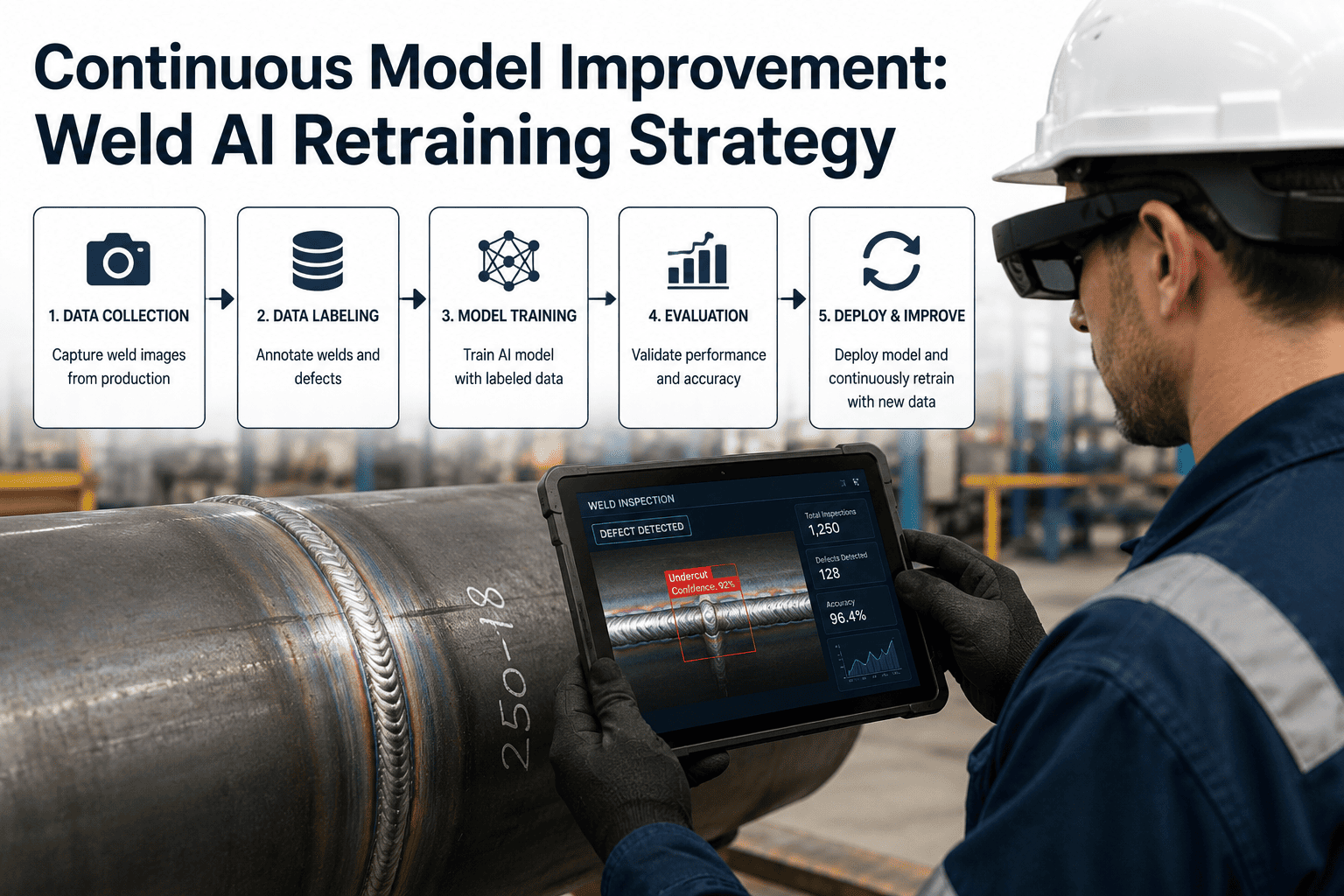
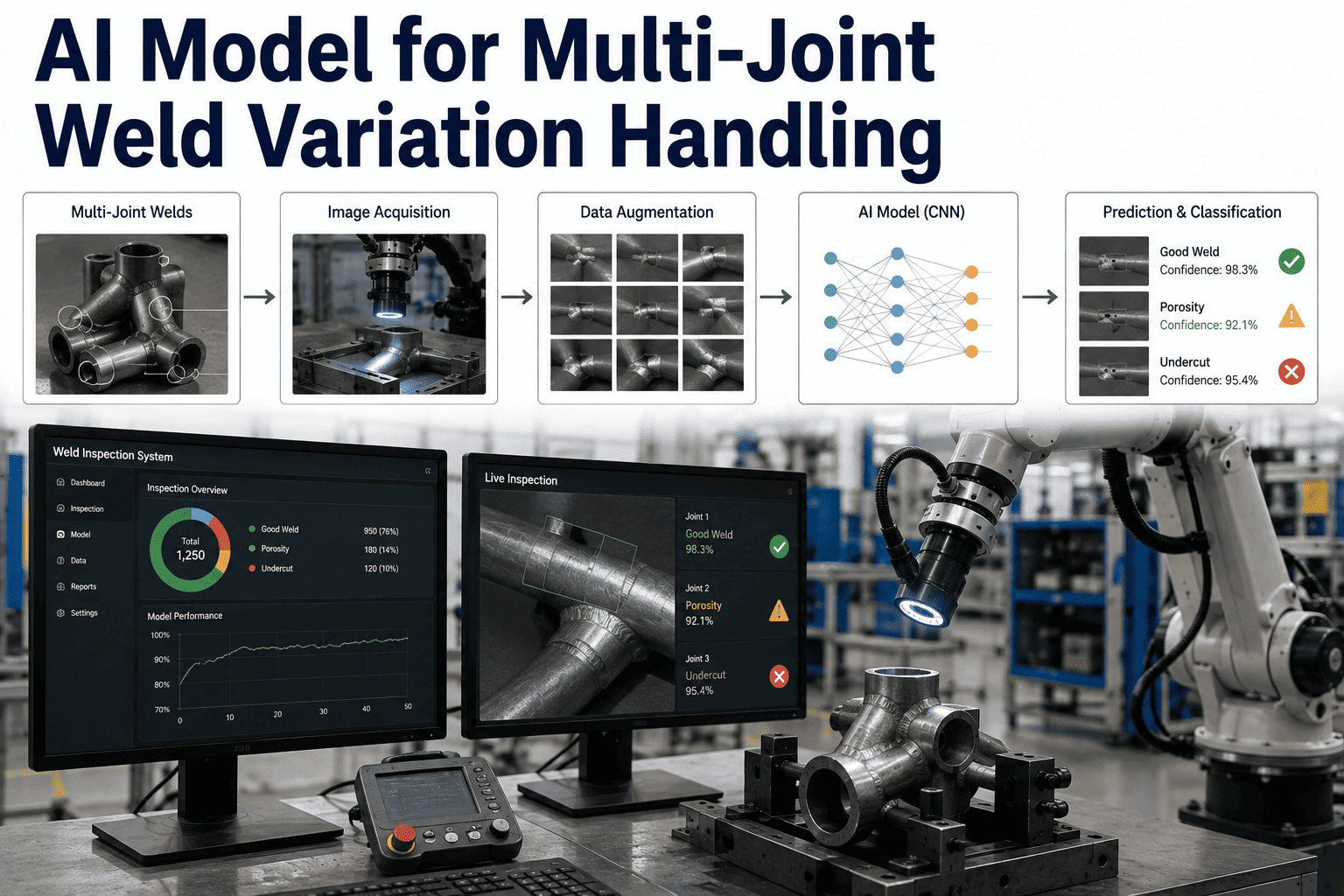
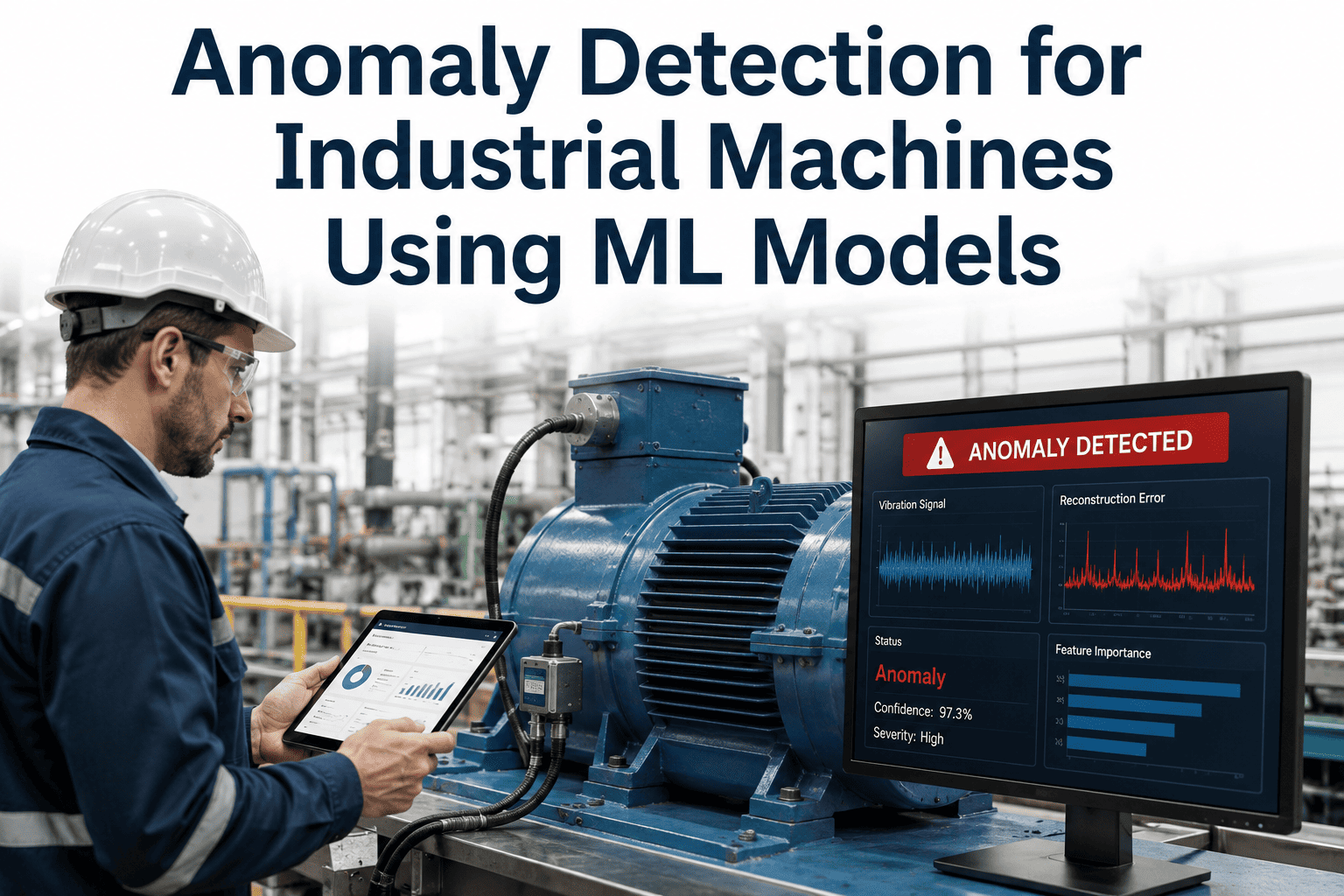
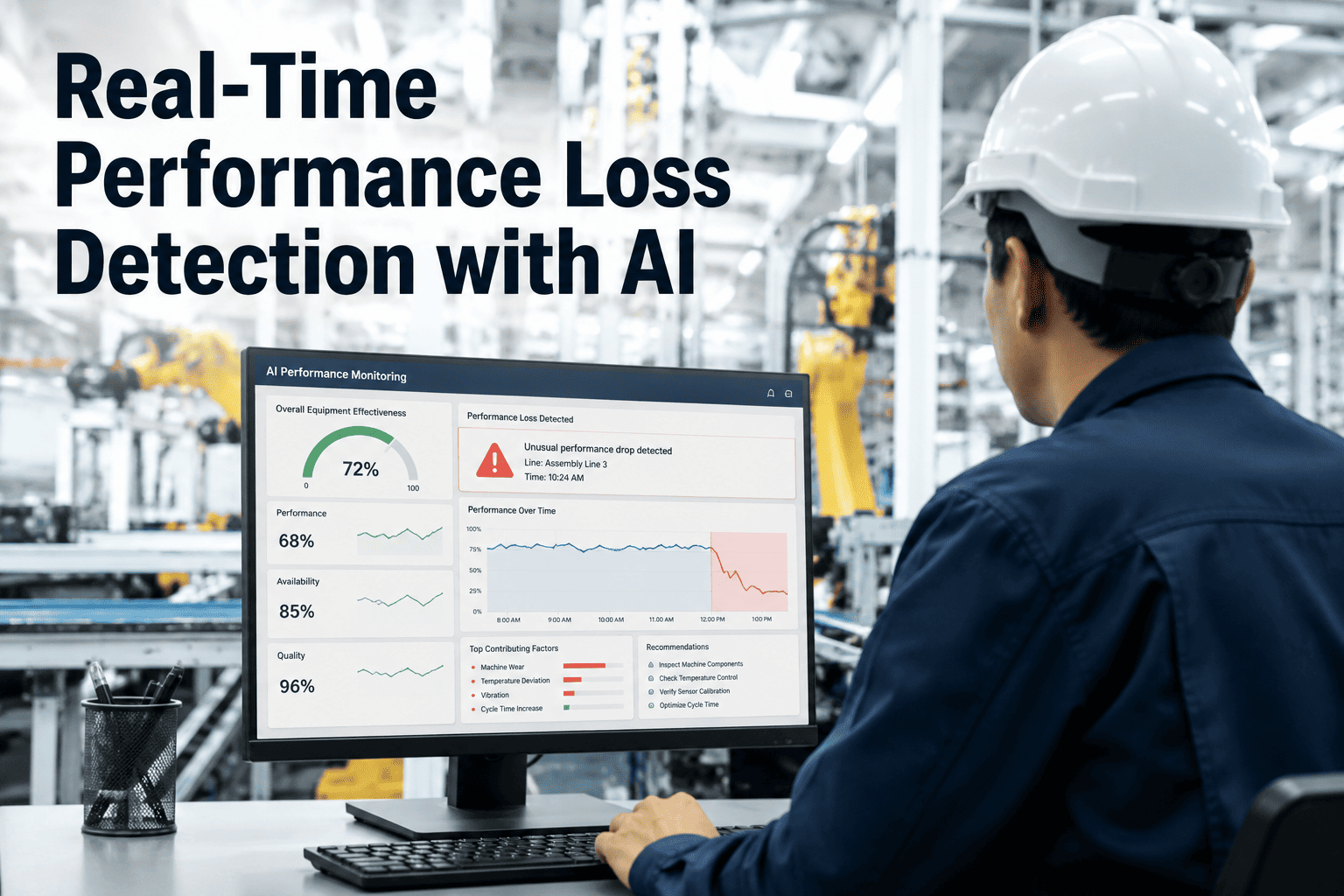
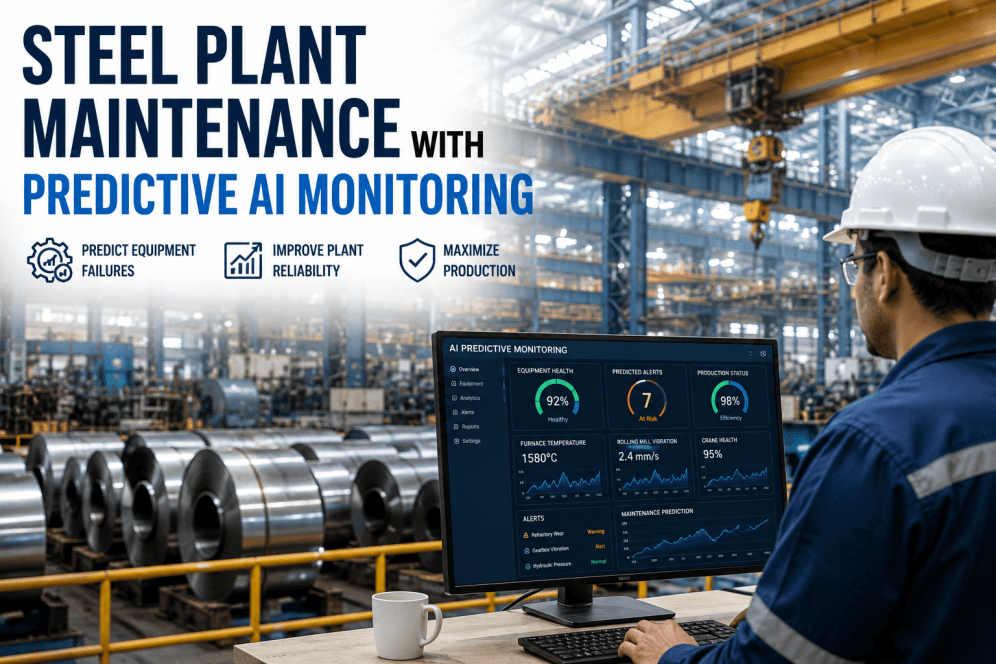
A weld inspection model that hit 98% accuracy at go-live doesn't stay at 98% forever. New joint geometries enter production, a material supplier changes alloy composition, camera lenses pick up dust, and accuracy quietly erodes until operators start distrusting its calls. This is model drift, and it's an ongoing maintenance obligation, not a one-time deployment risk. A structured detect-diagnose-retrain loop keeps a weld inspection model as accurate on day 500 as it was on day one. Book a demo to see how model performance is tracked over the life of a deployment.
AI WELD QUALITY INSPECTION · MODEL MAINTENANCE
Go-Live Isn't the Finish Line. It's the Starting Baseline.
A model's accuracy on day one is not a permanent property, it's a snapshot of conditions that existed at training time. Without a retraining strategy, drift erodes that accuracy quietly, one shift at a time.
91%
Of tested model-dataset combinations showed measurable temporal degradation in peer-reviewed research
<2%
Target false-positive rate to maintain operator trust in flagged welds
4-8 wks
Typical retraining timeline for a genuinely new joint geometry or material
WHY ACCURACY DOESN'T STAY PUT
The Conditions the Model Learned Are Not the Conditions It Will Always See
A weld inspection model is trained on a fixed snapshot of production conditions, specific joint geometries, specific materials, specific lighting and camera setups. Peer-reviewed research testing over a hundred model-dataset combinations across multiple industries found temporal degradation in the overwhelming majority of them, a phenomenon researchers now call AI aging. Manufacturing environments change constantly, a new part variant, a different steel supplier, a camera lens that's accumulated dust, and every one of those changes moves the model further from the conditions it was actually trained on. This isn't a defect in the model, it's the expected behavior of any model deployed into a world that keeps moving.
New Joint Geometries
A new product introduces weld joint shapes the model never saw in training, and its confidence on those welds is genuinely uncertain, not just untested.
Material or Supplier Changes
A different steel supplier or alloy composition shifts surface reflectivity and weld pool appearance in ways the model wasn't trained to interpret.
Camera and Lighting Drift
Lens dust, LED degradation, or a fixture that's shifted slightly all change what the camera actually captures compared to training-time conditions.
Process Parameter Changes
A change in weld current, travel speed, or shielding gas alters what a good weld looks like, shifting the boundary between acceptable and defective.
THE INDUSTRY-STANDARD DRIFT-MANAGEMENT CYCLE
Detect, Diagnose, Retrain, Not a One-Time Fix
Drift management isn't a single event, it's a continuous loop, and the discipline of running that loop correctly is what separates a model that stays reliable from one that quietly degrades until an operator finally stops trusting its calls. Each stage exists to prevent a specific failure, either missing real drift or retraining in response to noise that didn't actually need it.
1
Detect
Statistical monitoring flags when input data or output performance shifts from baseline.
2
Diagnose
A human reviews the flagged drift to confirm it's real and identify the actual cause before acting.
3
Retrain
The model is updated on new labeled data, validated, and deployed with a versioned rollback path.
DATA DRIFT VS CONCEPT DRIFT
Two Different Problems That Look Similar From the Outside
Not all drift is the same problem, and confusing the two leads to the wrong fix. Data drift means the incoming welds look different from training data, a new camera angle, a different surface finish. Concept drift means the actual relationship between what the model sees and what counts as a defect has changed, the same visual pattern that used to be acceptable is now a real problem, or vice versa. Telling them apart determines whether the fix is retraining on more examples or genuinely redefining what "defective" means for this weld.
| Aspect | Data Drift | Concept Drift |
| What changed |
The input images look different |
The relationship between image and label changed |
| Typical cause |
New camera, lighting, material batch |
New defect tolerance, updated acceptance criteria |
| How it shows up |
Rising false positives on otherwise-normal welds |
Model confidently wrong on welds it used to get right |
| Correct fix |
Retrain on new visual examples |
Re-label ground truth, then retrain |
WHY NOT JUST RETRAIN CONSTANTLY
Not Every Drift Signal Needs a Retrain
The instinct to retrain the moment any alert fires is understandable, but it's the wrong default. Retraining is expensive, compute-intensive, and requires validation before redeployment, and firing it off for every statistical blip trains the team to ignore alerts entirely. The discipline is confirming that a detected shift actually affects real-world accuracy before committing to a retraining cycle, which is exactly what the diagnose step in the loop exists to do.
REACT TO EVERY ALERT
Any statistical fluctuation triggers a full retraining cycle, burning compute time and engineering effort on noise. Operators see the model updated frequently for reasons they can't see any actual accuracy problem behind, which erodes confidence in the whole maintenance process rather than building it.
DETECT, THEN CONFIRM, THEN ACT
A statistical alert routes to human review before any retraining decision is made, confirming the drift is real and identifying its actual cause. Retraining happens when it's genuinely needed, with clear before-and-after accuracy numbers that build trust in the process rather than treating every model update as a black box.
FROM ALERT TO VALIDATED MODEL
How a Retraining Cycle Actually Runs
This is the sequence that turns a drift alert into a deployed, validated model update, with a rollback path preserved at every step in case the new model underperforms.
1
Drift detected against baseline. Statistical monitoring compares current input data and model performance against the established training-time baseline.
2
Human confirms real drift. A reviewer examines the flagged shift, ruling out normal noise and identifying whether it's data drift, concept drift, or a false alarm.
3
New examples collected and labeled. Recent production imagery representing the drifted condition is gathered and labeled to ground truth by a qualified reviewer.
4
Model retrained and validated. The model is updated on the new dataset, then tested against a held-out validation set before it's cleared for deployment.
5
Versioned deployment with rollback. The new model version is deployed with the prior version preserved, so a rollback is immediate if real-world performance underperforms validation.
THE COST OF SKIPPING THIS
What Happens Without a Retraining Strategy
A model with no maintenance plan doesn't fail dramatically, it fails quietly, which is exactly what makes it dangerous. These are the recurring failure patterns in weld inspection deployments that never established a drift-management discipline.
Rising false positives erode operator trust
Once flag rates climb past what operators consider reasonable, they stop reviewing alerts carefully, and real defects start slipping through unnoticed.
New joint types run on a mismatched model
A model never updated for a new product's joint geometry is making low-confidence calls it was never actually validated for.
No baseline to measure degradation against
Without a documented starting accuracy, there's no way to know how much the model has actually drifted or whether a retrain even helped.
Retraining without version control
A retrained model deployed without preserving the prior version leaves no rollback path if the update underperforms in production.
Concept drift mistaken for data drift
Retraining on more visual examples doesn't fix a problem caused by acceptance criteria actually changing, wasting the retraining cycle entirely.
No feedback loop from operator overrides
Operator corrections to the model's calls are one of the richest sources of drift signal, and going uncaptured means losing that signal entirely.
Build a Retraining Strategy Before Drift Costs You Trust
We'll walk through what a detect-diagnose-retrain loop looks like against your specific weld types and current model performance.
BEFORE YOU START
Readiness Checklist for Ongoing Model Maintenance
A drift-management program runs smoothly when these basics are established before the first alert ever fires.
Baseline accuracy and false-positive rate documented at go-live, against a defined validation set
Drift detection thresholds set for both input data statistics and output performance metrics
Labeling process and reviewer access defined for confirming and re-annotating drifted examples
Model versioning and rollback procedure established before the first retraining cycle is needed
TURNKEY AI DEPLOYMENT
iFactory Includes Drift Monitoring, Not Just Initial Training
iFactory's turnkey deployment treats model maintenance as part of the delivered system, not a separate project you have to build later. A pre-configured NVIDIA AI server ships racked and ready, with drift monitoring, versioned model management, and a defined retraining process built into the platform from day one, not bolted on after the first accuracy complaint.
Pre-configured NVIDIA edge AI hardware, racked and shipped ready to install
Baseline accuracy and false-positive rate documented and tracked from go-live
Continuous drift monitoring on both input data and output classification performance
Human-review routing for confirming genuine drift before any retraining decision
Versioned model deployment with immediate rollback path
Twenty-four seven remote monitoring from day one of production
DEPLOYMENT TIMELINE
Live in 6 to 12 Weeks, With Maintenance Built In From Go-Live
Drift monitoring isn't an afterthought added post-launch, it's active from the same day the model goes live, establishing the baseline everything else measures against.
Weeks 1-4
Ship, Train, and Baseline
Hardware ships pre-racked. Model trained on your weld types, baseline accuracy and false-positive rate documented against a held-out validation set.
Weeks 5-8
Pilot and Drift Threshold Tuning
Runs in shadow mode alongside existing inspection, with drift detection thresholds tuned to your specific production variability.
Weeks 9-12
Go-Live With Active Monitoring
System takes over full inspection with drift monitoring active from day one, plus twenty-four seven remote monitoring and a defined retraining process ready.
FREQUENTLY ASKED QUESTIONS
Questions Teams Ask About Model Maintenance
How often does a weld inspection model actually need retraining?
There's no fixed universal schedule, retraining frequency should be driven by detected drift rather than an arbitrary calendar interval, since a model facing stable production conditions may not need retraining for a long stretch while one facing frequent product changeovers might need it every few weeks. The discipline is monitoring continuously and retraining when drift is confirmed and shown to actually affect accuracy, not on a fixed schedule regardless of whether anything has actually changed.
Book a demo to see what drift patterns look like on production similar to yours.
How long does retraining take for a genuinely new weld type?
A novel joint geometry or unusual material combination typically requires 1,000 to 3,000 labeled examples and four to eight weeks to reach production-grade accuracy, since it's effectively extending the model's coverage rather than making a minor adjustment. A minor drift correction on a joint type the model already knows well is considerably faster, since it's refining existing knowledge rather than teaching the model something entirely new.
What happens if a retrained model performs worse than the version it replaced?
Versioned deployment exists specifically for this scenario, the prior model version is preserved and rollback is immediate if the new version underperforms validation once it's exposed to real production conditions. This is why validation against a held-out dataset happens before deployment and why the prior version is never simply discarded the moment a new one goes live.
Contact our support team to discuss validation and rollback procedures for your deployment.
How does operator feedback factor into the retraining process?
Operator overrides, where a human disagrees with the model's call, are one of the richest sources of drift signal available, since they represent real-world disagreement between the model and ground truth rather than a statistical abstraction. A well-designed feedback loop captures every override as a labeled data point, feeding directly into the diagnose step of the drift cycle rather than that correction disappearing the moment the operator moves past the alert.
Can we keep false positives low without missing real defects?
Yes, this tradeoff is managed through confidence thresholding, tuned to keep false positives below roughly 2% while maintaining high sensitivity to genuine defects, and it's re-tuned as part of the retraining process rather than set once and forgotten. Getting this balance wrong in either direction has a real cost, too many false alarms and operators stop trusting the alerts, too few and real defects start slipping through undetected.
Book a demo to see current false-positive and detection-rate benchmarks on real weld data.
Keep Your Weld Model as Accurate on Day 500 as Day One
iFactory builds drift monitoring, human-confirmed retraining, and versioned rollback into every deployment from go-live. Book a demo and see the maintenance process running on real weld data.