A weld inspection model trained exclusively on butt joints in mild steel will struggle the moment it meets a fillet weld in stainless, a lap joint in aluminum, or the same joint type welded from a different fixture angle — not because the underlying defects are fundamentally different, but because the model never learned what those variations look like. Building a single AI system that holds accuracy across joint types, materials, and welding positions takes deliberate architecture choices, not just a larger training set, which is the exact engineering problem behind iFactory's multi-process weld inspection deployments.
Why One Weld Model Rarely Survives Contact With a Real Production Floor
Research datasets used to benchmark weld defect detection models are typically narrow by necessity — a fixed joint type, a single material, one welding process, captured under controlled lighting. Real production floors are the opposite: the same inspection station might see butt joints one shift and fillet joints the next, mild steel parts followed by stainless variants, and welds captured at several fixture angles depending on which jig is loaded. A model that only performs well on the narrow slice it was trained on quietly degrades everywhere else, which is often invisible until defect escape rates start climbing on the joint types nobody explicitly tested.
The Four Axes of Variation a Weld Model Has to Handle
Weld variation is not one problem — it is several independent sources of variation stacked on top of each other, and a robust model needs a strategy for each axis rather than a single blanket fix.
Joint Type
Butt, fillet, lap, and corner joints each present different geometry and defect signatures, so a defect that looks like porosity on one joint type may look entirely different on another.
Welding Position
Flat, horizontal, vertical, and overhead positions change how gravity affects the weld pool and how the camera's fixed angle frames the bead, shifting what a "normal" weld looks like on camera.
Base Material
Mild steel, stainless steel, and aluminum reflect light and oxidize differently, meaning the same physical defect can present with very different visual contrast depending on the metal.
Welding Process
MIG, TIG, resistance spot, and laser welding each produce distinct defect signatures and imaging conditions, since the process itself shapes both the weld and how it can be photographed.
The Model Strategy, Step by Step
Handling multi-joint variation well is a sequence of deliberate modeling decisions, each building on the last, rather than a single algorithm swapped in for another.
Representative Data Collection
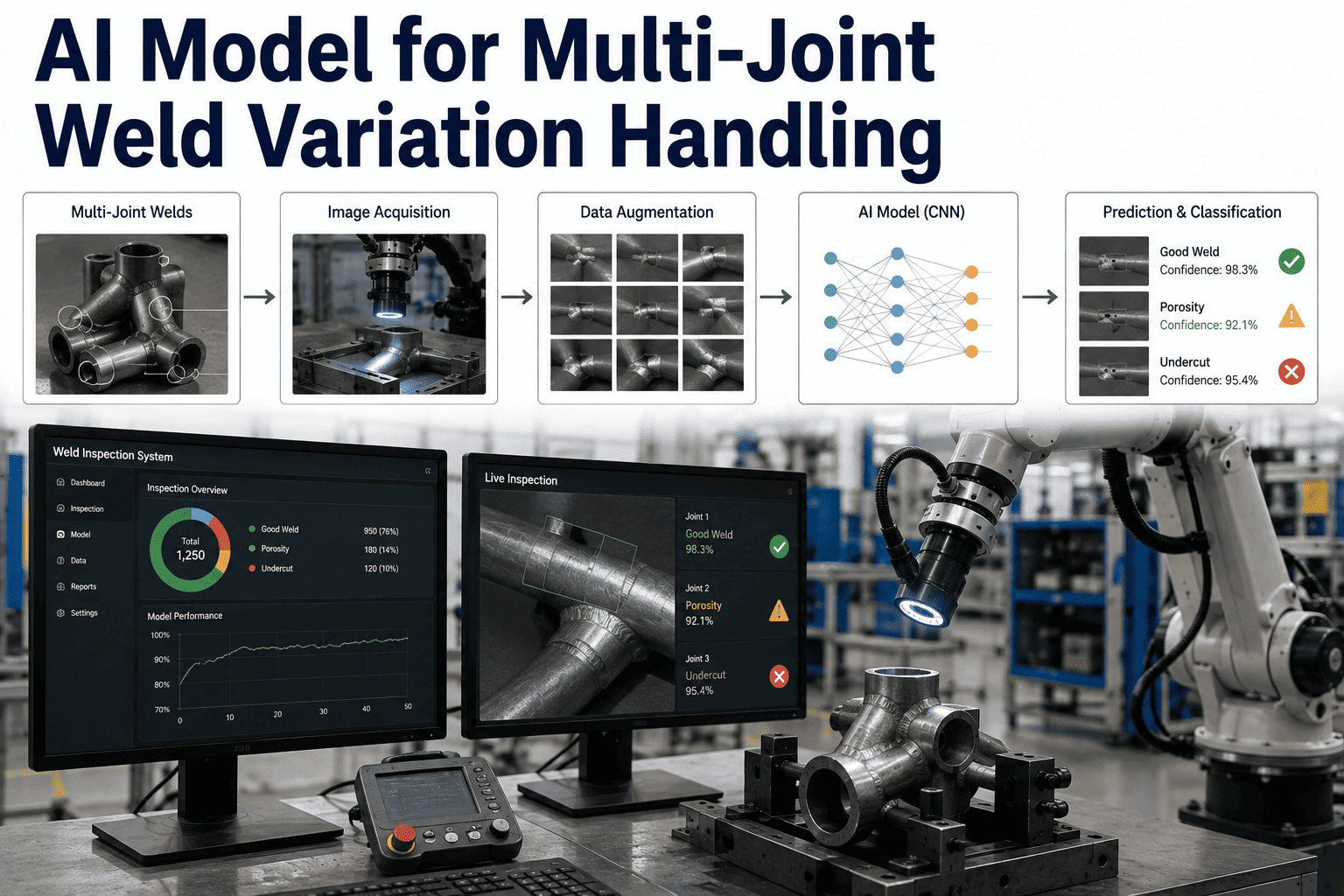
Training data is deliberately sampled across every joint type, position, and material combination the line actually produces, not just whichever samples were easiest to collect first.
Transfer Learning From a Pretrained Backbone
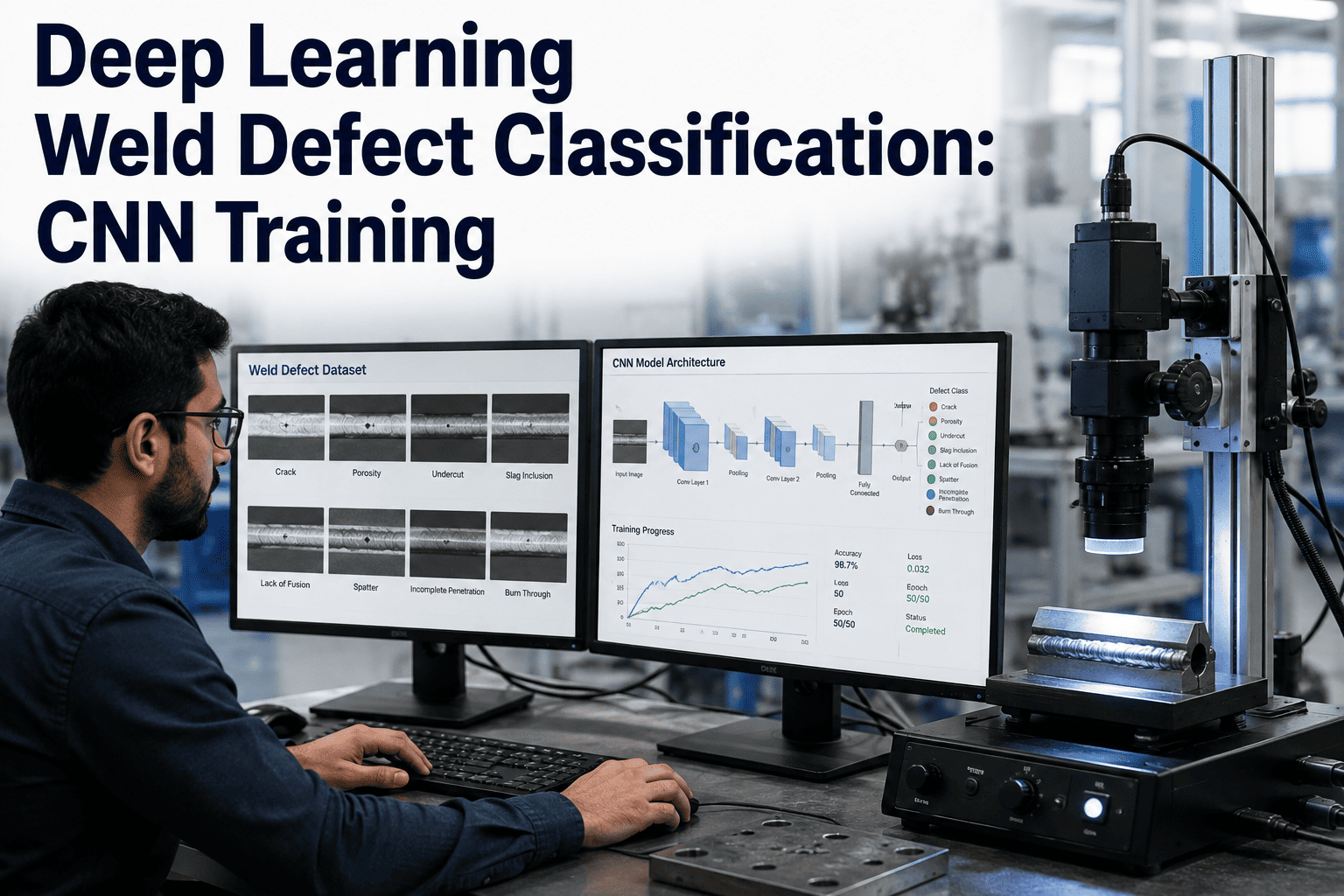
Starting from a network already trained on a large general image dataset gives the model a head start on edge and texture features, reducing how much joint-specific data is needed to reach usable accuracy.
Domain Adaptation Across Conditions
Adaptive fine-tuning techniques adjust the model's learned features to account for lighting, material, and camera-angle differences between joint types, rather than assuming one visual domain transfers cleanly to another.
Multi-Class Detection Architecture
A single model head trained to recognize defect classes across joint types outputs both a defect classification and a confidence score, with low-confidence cases routed for human review instead of a forced pass or fail call.
One Generalized Model Versus a Model Per Joint Type
Plants weighing whether to build a single generalized model or maintain separate models per joint type are really weighing maintenance overhead against raw peak accuracy on any one narrow case.
| Approach | Strength | Tradeoff |
|---|---|---|
| Single Generalized Model | One model to maintain, retrain, and version across the whole line | Slightly lower peak accuracy on any single narrow joint case |
| Per-Joint-Type Models | Can reach marginally higher accuracy for a single, stable joint configuration | A separate training, validation, and maintenance cycle for every new combination |
| Hybrid Multi-Head Model | Shared backbone with joint-specific classification heads balances both concerns | More complex to deploy and version than a single flat model |
Signs a Model Is Actually Generalizing, Not Just Memorizing
A model can look accurate on paper and still fail in production if its apparent accuracy comes from memorizing the training set's specific conditions rather than learning the underlying defect signature.
Accuracy holds steady when tested against a joint type or material combination deliberately withheld from training, rather than dropping sharply on anything unfamiliar.
Confidence scores correlate with actual correctness — the model expresses uncertainty on genuinely ambiguous cases instead of being equally confident about everything.
Performance on a new, previously unseen joint configuration improves quickly with a small amount of fine-tuning data rather than requiring a full retrain from zero.
Governing a Model That Keeps Learning New Joint Types
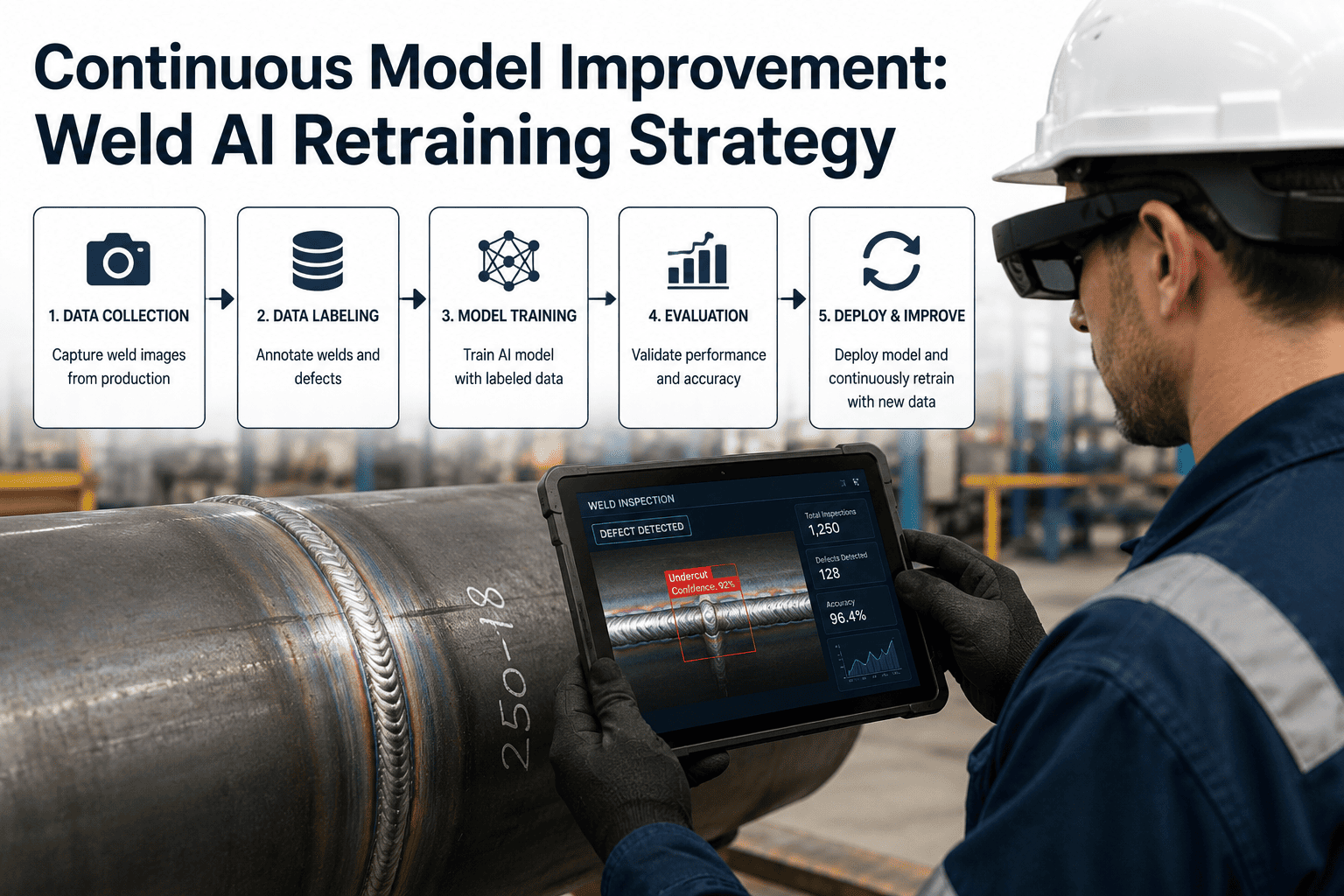
A model built to generalize across joint types is never really finished, since a plant's product mix keeps evolving with new parts, new suppliers, and new welding processes. Treating the model as a versioned, monitored asset rather than a one-time deployment is what keeps accuracy stable as the joint mix shifts underneath it. That means every fine-tuning update is validated against the full existing variation set before going live, not just against the new joint type it was added to handle, since a fix for one configuration can quietly degrade another if it is not checked broadly.
Every model version is benchmarked against a held-out validation set spanning all known joint types, materials, and positions before it replaces the version currently running in production.
Per-segment accuracy is tracked continuously in production, not just at validation time, so a slow drift on one joint configuration is caught before it becomes a defect escape problem.
A rollback path is kept ready for every deployed version, since a fine-tuning update that looks fine on paper can still behave unexpectedly once it meets real production variation.
Frequently Asked Questions
Do we need thousands of images for every joint type before the model can handle it reliably?
Transfer learning and domain adaptation substantially reduce the data requirement for a new joint type, since the model is adapting existing learned features rather than starting from nothing. A well-designed pipeline can bring a new joint type to usable accuracy with a modest, targeted dataset rather than the volume a from-scratch model would need.
What happens when the plant introduces a genuinely new welding process the model has never seen?
A generalized model handles a new process as a fine-tuning task rather than a rebuild, using a smaller, targeted dataset from the new process combined with the existing backbone's learned features. This is one of the areas worth reviewing directly with ifactory Support before a new process goes live on the floor.
How do you know if the model's accuracy numbers are trustworthy across all our joint types, not just the common ones?
Accuracy should be reported and monitored separately per joint type, material, and position combination rather than as one blended number, since a blended average can hide poor performance on a less common but still important configuration. Segmented reporting is standard practice in any properly validated multi-joint deployment.
Can this approach work if our line runs a mix of manual and robotic welding?
Yes — variation between manual and robotic welding shows up primarily as consistency differences in bead geometry and camera framing, both of which the same domain adaptation techniques used for material and position variation can accommodate. A scoping conversation is the fastest way to confirm this for your specific mix of manual and automated stations.
How often does a generalized model need to be retrained once it is in production?
Retraining cadence depends on how quickly the plant's joint mix evolves, but most deployments run a scheduled review every few months alongside event-driven updates whenever a genuinely new joint type, material, or process is introduced. Continuous per-segment accuracy monitoring is what actually determines when a retrain is needed, rather than retraining on a fixed calendar regardless of whether performance has drifted.