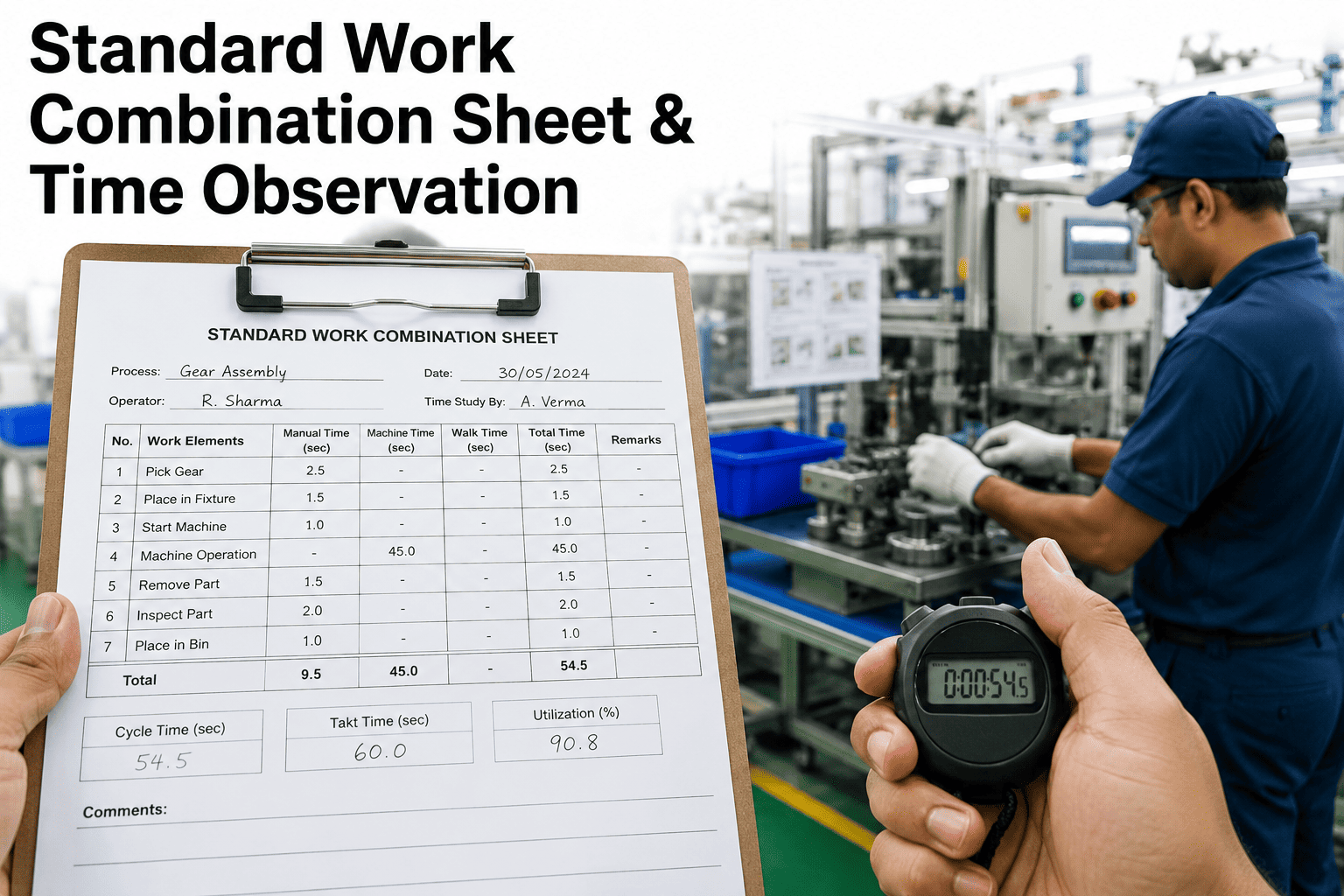
Ask three operators running the same cell how long their cycle takes and you will usually get three different answers, none of them backed by a stopwatch. Without a real time observation study, imbalance hides inside averages, one operator quietly absorbing more walking and waiting than the others while the line still hits its daily number. A standard work combination sheet exists to make that imbalance visible, plotting manual work, walking, machine time, and wait time against takt so a supervisor can see exactly where the cycle is overloaded or starved. iFactory's time study module captures those observations digitally on the floor and builds the combination sheet automatically, and you can book a walkthrough of how it works against one of your own work cells.
See Your Own Cycle Plotted Against Takt Time
iFactory captures manual, walk, machine, and wait time directly from the floor and builds the combination sheet for you, no stopwatch spreadsheet required.
What a Combination Sheet Actually Plots
A standard work combination sheet, sometimes called a standardized work combination table, breaks a single operator's cycle into four categories of time and lines them up against a timeline. It is a more precise design tool than a simple operator balance chart because it shows exactly when manual work, walking, and machine cycles overlap, not just how much of each exists in total. The example strip below represents one operator cycle at a two-machine cell, with each segment sized to its share of the total cycle time.
Manual Work Time
Time the operator spends hands-on: loading, unloading, inspecting, deburring, or any task that requires direct human involvement at the station.
Walk Time
Time spent moving between machines or workstations, easy to underestimate and often the largest hidden contributor to an unbalanced cycle.
Machine Time
Time the equipment runs its automatic cycle while the operator is free to move to the next task, ideally overlapped rather than watched.
Wait Time
Periods where neither the operator nor the machine is producing value, the clearest form of waste a combination sheet is designed to expose.
Building a Time Observation Study, Step by Step
A combination sheet is only as reliable as the observation behind it. Rushing the study, or timing a single cycle and calling it standard, is the single most common reason a documented standard time does not match what actually happens on the floor a month later. These are the steps a proper time observation study follows before a single number gets written onto the sheet.
Break the Cycle Into Elements
The full cycle is split into a standard sequence of work elements, each with a clear breakpoint that marks exactly when it starts and ends.
Observe 10 to 12 Cycles
Each element is timed across ten or more repetitions on the same sheet, since a single observation cannot separate normal variation from a real outlier.
Record the Lowest and Highest Time
For each element, the lowest and highest observed time are captured, and the difference between them shows how much the element actually fluctuates.
Calculate the Standard Time
The lowest observed cycle time, minus the sum of the lowest element times, is distributed across the elements most prone to fluctuation to set a fair standard.
Plot Manual, Walk, and Machine Time
Every element is classified as manual, walk, machine, or wait and laid onto the combination sheet timeline so overlaps and gaps become visible.
Compare Against Takt Time
The total cycle is checked against takt time, and any element that pushes the operator's manual work past that line flags the cell for rebalancing.
Guessing at Balance vs a Formal Time Observation
Most cells already have an informal sense of who is busiest and who has slack, based on watching the floor for a few minutes. That impression is usually close on an average day and badly wrong on a day when a machine runs slow, a part is misplaced, or a new operator is still learning the sequence. A documented time observation study replaces that impression with numbers everyone can check.
Swipe left to see the full comparison
Six Signs the Work Is Not Actually Balanced
A line can hit its daily production number and still be badly out of balance underneath, with one operator absorbing the slack that keeps the whole cell running. These are the patterns a proper combination sheet study tends to surface first.
Manual Line Crosses Takt Time
When the plotted manual work extends past the takt reference line, the operator is structurally overloaded no matter how hard they work.
Cycle Times Vary Widely Between Operators
A large spread between the fastest and slowest observed cycle usually points to an undocumented sequence rather than a skill gap.
Walking Dominates the Cycle
If walk time makes up a large share of the total cycle, a layout or station-order change often frees up more time than any process fix.
Machine Time Is Watched, Not Overlapped
An operator standing in front of a running machine instead of prepping the next task is wait time hiding inside what looks like productive work.
No Documented Standard Exists
If the work sequence lives only in an experienced operator's head, training a replacement means re-learning the balance from scratch.
Output Holds but Overtime Creeps Up
A cell that keeps hitting its number only by running late is compensating for an imbalance the daily count never reveals on its own.
Stop Letting Standard Work Drift From Reality
See how iFactory captures manual, walk, and machine time on the floor and keeps your combination sheets current every time the process changes.
Who Gets the Most Value From Combination Sheets
Standard work combination sheets matter most wherever an operator moves between more than one machine or station, since that is exactly where manual, walk, and machine time need to interleave correctly to avoid waste.
Multi-Machine Cell Operators
Anywhere one person tends more than one machine, the combination sheet is the tool that proves the choreography actually fits within takt.
Assembly Line Balancing Teams
Line balancing depends on knowing exactly how much manual time each station carries, not just the overall line rate.
Industrial and Process Engineers
A documented time study is the engineering foundation used to prove a new cell layout will work before it goes into production.
Training and Onboarding Teams
A combination sheet doubles as a training reference, showing a new operator the exact sequence and pace the job was designed around.
From Stopwatch Study to a Living Combination Sheet
A paper time study captures one snapshot of a cycle and rarely gets updated once conditions change. iFactory keeps the observation current by connecting the capture, analysis, and documentation steps into one workflow instead of three separate tools.
Digital Element Timing on the Floor
Elements are timed and tagged as manual, walk, machine, or wait directly on a tablet or station terminal, replacing a stopwatch and a paper observation sheet.
Automatic Takt Comparison
Standard time is calculated from the recorded cycles automatically and checked against the current takt time, flagging any element that pushes the operator over the line.
Auto-Generated Combination Sheet
The finished combination sheet and standard work chart are generated directly from the observation data. Talk to a specialist about your current time study process before scoping a rollout.
What Changes When Time Studies Move Off Paper
Teams that digitize their time observation studies tend to see the same shift: the combination sheet stops being a one-time document from a launch project and becomes something that gets rechecked whenever the process actually changes.
Perspective From the Field
We used to build a combination sheet once, during a launch, and then never touch it again even after we moved a machine or changed a part number. The old sheet just sat on a binder while the real cycle drifted away from it. Now the observation gets rerun in minutes whenever something changes, and the sheet on the wall actually matches what the operator is doing that shift. It turned standard work from a poster into something the team actually trusts.
— Marcus Webb, Lean Manager, Great Lakes Fabrication
manual, walk, machine, and wait time tracked separately on every combination sheet
the typical number of timed observations behind a defensible standard time
typical time to regenerate a combination sheet after a documented process change
Frequently Asked Questions
What is the difference between a standard work chart and a combination sheet?
A standardized work chart is used for purely manual operations and mainly shows the operator's walking path and work sequence within the cell layout. A standard work combination sheet is used whenever an operator is synchronizing with one or more machines or a moving line, and it adds the timeline view showing exactly how manual work, walking, and machine cycles overlap against takt time. Most single-station manual jobs only need the chart, while any multi-machine or line-paced job benefits from the combination sheet's more detailed timing view. Book a demo to see both document types generated from the same observation data.
How many cycles do we actually need to observe before setting a standard time?
Ten to twelve observed cycles per work element is the commonly used guideline, since a single timing cannot distinguish normal variation from a genuine outlier caused by a misfeed, a missing part, or an interruption. Machine time is the exception, since it rarely varies once a program is set, so one or two observations of a fully automatic cycle are usually enough. The manual and walk elements are where most of the real fluctuation lives, and those are the ones worth timing repeatedly before committing to a number.
Does a combination sheet replace our existing work instructions?
No, it complements them rather than replacing them. The combination sheet documents the timing and sequence relationship between the operator and the machines, while a work instruction typically covers the detailed how-to for each task, including quality checks and safety steps. Many teams post both at the station, with the combination sheet used mainly for training, balancing, and improvement work rather than as the step-by-step reference an operator follows during the shift. Talk to a specialist about how it fits alongside your current documentation.
How does this help if our cell layout changes fairly often?
A frequently changing layout is actually the strongest case for digitizing the observation process, since a paper time study becomes outdated the moment a machine moves or a task is reassigned. When the capture and calculation steps are already connected to a system, rerunning the study after a change takes minutes rather than requiring someone to schedule a new stopwatch session and redraw the sheet by hand. That keeps the posted standard matching what is actually happening on the floor instead of describing a layout that no longer exists.
Can this be used for training new operators, not just process design?
Yes, a documented combination sheet is one of the clearest training tools available, since it shows a new operator the exact sequence, pace, and overlap with machine cycles the job was designed around, rather than leaving them to pick up the rhythm by shadowing someone for a few shifts. Because the sheet is generated from real timed observations rather than a supervisor's description, it also gives the trainer an objective reference to check a new operator's technique against. Book a scoping call to see the training view alongside the engineering one.
Turn Every Time Observation Into a Trusted Combination Sheet
Book a 30-minute scoping call and iFactory will walk through your current cells, takt targets, and documentation process to build a rollout plan for your industrial engineering team.





.png)