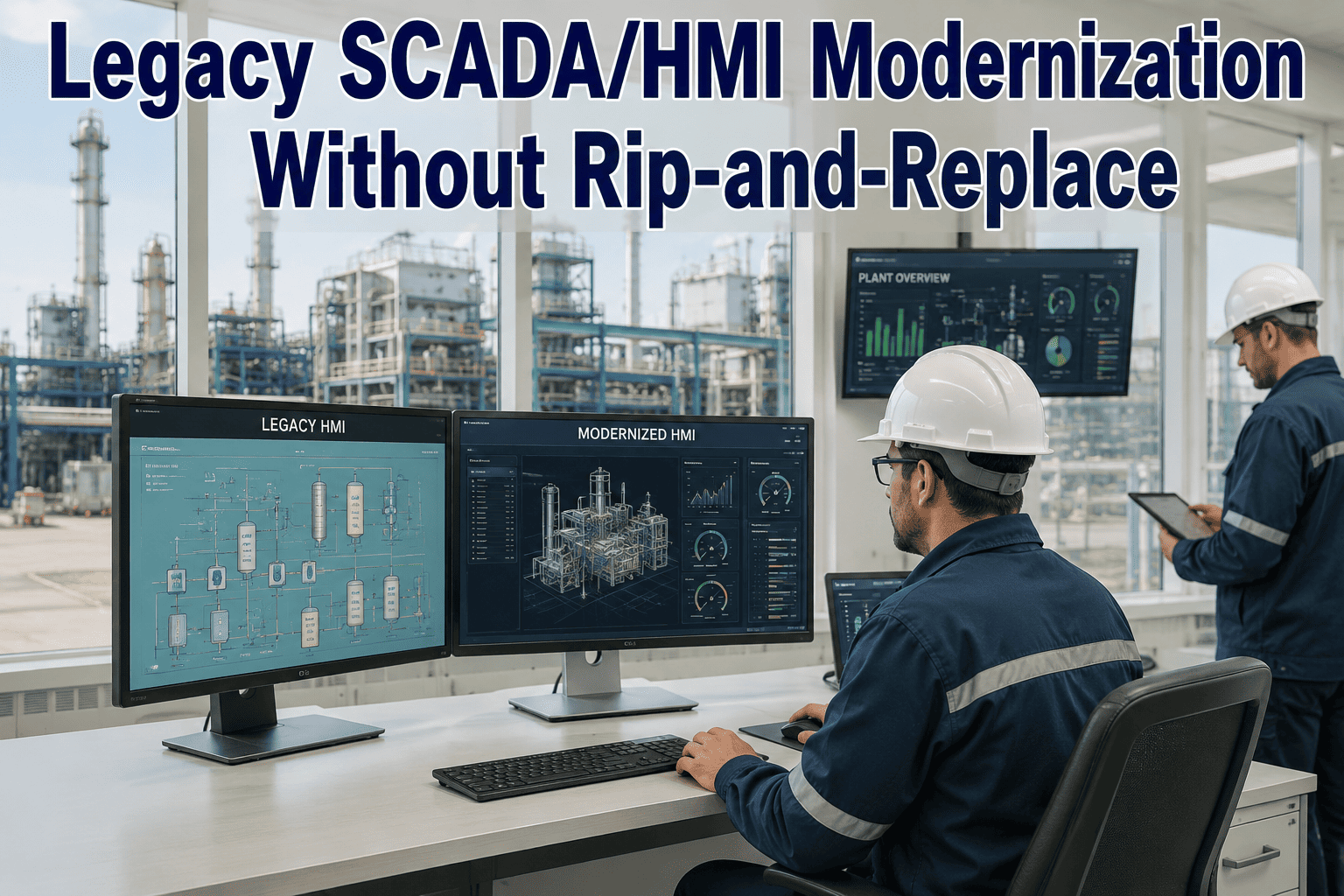
A fifteen-year-old SCADA system running on Windows Server 2008, controlling a plant that shipped product on time last week, is not the problem most control rooms think it is — the problem is the pressure to rip it out and replace it with something modern before anyone has actually mapped what a controlled, non-disruptive path forward would look like. Rip-and-replace SCADA projects routinely stretch to 18 months, run past budget, and force plants to operate on a parallel system during cutover — all to gain benefits that an overlay architecture can deliver in a fraction of the time, at a fraction of the risk, without touching a single working PLC tag. The modernization conversation in 2026 has shifted decisively toward this overlay-first approach: keep the control layer that works, add a modern data, analytics, and access layer on top, and only migrate the underlying SCADA when the business case is genuinely there. Plant leaders exploring this path can book a demo to see how iFactory sits on top of an existing SCADA stack.
LEGACY SCADA + HMI MODERNIZATION + OVERLAY ARCHITECTURE
Legacy SCADA and HMI Modernization Without Rip-and-Replace
Add AI analytics, mobile access, cloud connectivity, and unified data on top of the SCADA you already own. No control system replacement. No production shutdown. No 18-month project timeline.
The Real Cost of a Rip-and-Replace SCADA Project
Most plant managers already know a full SCADA replacement is expensive. What is less understood is how the true cost distributes across categories that never appear in the initial vendor quote — parallel-running two systems for months, retraining every operator, re-validating every batch record, rebuilding every custom report, and absorbing the production risk of a cutover weekend that does not go according to plan. When these hidden line items get added to the license and integration fees, the total ownership number for a rip-and-replace project consistently lands two to three times higher than the sticker price a vendor presented in the sales cycle.
18 mo
Average enterprise SCADA rewrite timeline, which frequently doubles when systems are air-gapped or running on decades-old hardware
40 hrs
Engineering time consumed per legacy HMI screen just to map state transitions and hidden business logic before rewrite
2-3x
Multiplier between vendor sticker price and true total cost once parallel running, retraining, and validation are added
Weeks
Time an OT overlay takes to deliver comparable analytics, mobile access, and cloud connectivity without a control cutover
What Overlay Architecture Actually Means
Overlay architecture is not a euphemism for a workaround. It is a specific, well-defined pattern where a modern data, analytics, and visualization layer sits above the existing SCADA and HMI, reading tag values through a non-invasive gateway and publishing them into a unified namespace that modern tools can consume. The control layer — the PLCs, the SCADA server, the operator HMIs that people already know how to use — stays exactly as it is. What changes is what you can do with the data that layer produces: mobile dashboards, AI-driven anomaly detection, cross-plant benchmarking, cloud-based reporting, and integration with MES and ERP systems, all without a single change to the code that actually controls the process.
The Four-Layer Overlay Stack
Layer 4
Presentation and Analytics
Mobile dashboards, AI anomaly detection, KPI reporting, MES and ERP integration, executive views — all consumed from the unified namespace, delivered on any device, without touching operator screens.
Layer 3
Unified Namespace and Historian
A single, semantically modelled data structure — typically OPC-UA or MQTT Sparkplug B — that gives every downstream tool a consistent view of every tag from every controller, with engineering units and quality codes preserved.
Layer 2
Edge Gateway and Protocol Translation
A hardened edge device sits between the OT network and the modern data layer, translating Modbus, EtherNet/IP, PROFINET, DNP3, and proprietary serial protocols into OPC-UA, with TLS encryption and certificate-based authentication.
Layer 1
Existing SCADA, HMI, and PLCs (Unchanged)
The control layer you already own and trust — Wonderware, iFIX, Ignition, RSView, or a proprietary DCS. No PLC code changes. No HMI screen rebuilds. No operator retraining on the control interface.
Rip-and-Replace vs Overlay: A Side-by-Side View
The comparison that matters is not feature-for-feature between old and new SCADA platforms — it is between the two paths to getting modern capability into a plant. Overlay wins on almost every axis that a plant leader actually cares about: speed to value, production risk, operator disruption, and capital exposure. The one place rip-and-replace can still win is very-long-horizon control-layer consolidation across a plant with more than three or four incompatible SCADA vendors, and even then, overlay is usually the right first step before any control consolidation begins.
| Dimension | Rip and Replace | Overlay Architecture |
| Time to first value |
12 to 24 months |
4 to 8 weeks |
| Production disruption |
Cutover weekend plus parallel running |
Zero — read-only until go-live |
| Operator retraining |
Every operator, every screen |
None on control interface |
| Capital exposure |
Full project committed upfront |
Phased, cancellable at any layer |
| PLC code changes |
Frequently required |
None |
| Existing SCADA licensing |
Written off |
Preserved and extended |
| Cybersecurity posture |
Modernised end-to-end |
Modern gateway with segmented OT |
| Rollback if project fails |
Near impossible after cutover |
Disable gateway, nothing lost |
See an Overlay Architecture Running on a Real Plant
iFactory's implementation team walks through overlay reference deployments across food, discrete manufacturing, and process industries — tuned to your specific SCADA vendor and PLC mix.
Which Legacy Symptoms Actually Signal Modernization Pressure
Not every aging SCADA needs immediate attention. The plants that genuinely benefit from an overlay-first modernization tend to share a specific pattern of operational symptoms — the ones that show up quietly at first, then compound until they force an emergency decision under pressure. Recognizing these signals early is what separates a controlled overlay project from a panicked rip-and-replace triggered by a single hardware failure that leaves the plant blind for 72 hours.
01
Spare parts hunt takes weeks
HMI panels or SCADA server hardware need to be sourced from secondary markets because the OEM ended support. Lead times stretch from days to weeks, and a single failure risks days of blind operation.
02
Data lives on the SCADA server only
Historical trends are trapped inside a proprietary historian that no modern analytics tool can query, and pulling any cross-line report requires a controls engineer to write a custom export by hand.
03
No mobile or off-site visibility
Plant leadership cannot see live production status without physically walking to the control room, and off-shift on-call decisions get made based on phone calls to the operator on duty instead of live data.
04
OS is out of security support
The SCADA server runs Windows Server 2008, 2012, or another OS that no longer receives security patches, which increases cyber exposure and often blocks corporate IT audits or cyber-insurance renewals.
05
Every new integration is a custom project
Adding a new MES connection, ERP feed, or cloud dashboard means paying a system integrator to write a bespoke driver, because the SCADA has no modern open interface like OPC-UA or MQTT.
06
Institutional knowledge is retiring
The one or two people who understand the SCADA configuration are within a few years of retirement, and the underlying platform is niche enough that no younger engineer on the market has hands-on experience with it.
The 90-Day Overlay Rollout, Phase by Phase
Overlay deployments follow a predictable rhythm that is fundamentally different from a rip-and-replace project. Every phase produces a working, testable capability before the next phase begins, and any phase can be paused or reversed without unwinding what came before it. The full sequence below is what a typical single-plant overlay rollout looks like end to end, from first site visit to full analytics enablement, with mobile access and cloud reporting live for plant leadership.
Weeks 1-2
Discovery and Tag Mapping
Full inventory of SCADA nodes, PLC types, protocols in use, network segments, and the tag list that will be exposed to the overlay layer. Zero connections made to the OT network in this phase.
Weeks 3-4
Edge Gateway Install
Hardened edge gateway installed on the OT network with read-only access, configured with protocol translators for each PLC family in scope, and validated against a small pilot tag set before broader rollout.
Weeks 5-6
Namespace and Historian
Unified OPC-UA namespace published, tags modelled with engineering units and quality codes, and a modern historian begins recording, running in parallel with the existing SCADA historian for validation.
Weeks 7-8
Dashboards and Mobile Access
Role-based dashboards deployed for operators, supervisors, and plant leadership, with mobile access for off-site on-call staff. Users trained on the new views, control interface stays untouched.
Weeks 9-10
AI Analytics and Alerts
Anomaly detection models tuned to the specific process, predictive maintenance triggers configured on high-criticality assets, and alerts routed to the right roles by shift and severity.
Weeks 11-12
MES, ERP, and Cloud Integration
MES production orders, ERP maintenance work orders, and cloud reporting for corporate KPIs all connected via the unified namespace, with the overlay handed over to plant IT for steady-state operation.
What the Overlay Actually Unlocks — Beyond the Buzzwords
The value case for an overlay is not "AI" or "cloud" as generic capabilities — it is a specific set of operational outcomes that a well-designed overlay makes possible within the first quarter of live operation. These outcomes tend to compound: mobile access alone changes off-shift decision quality, but combined with anomaly detection and MES integration, the same overlay begins driving OEE improvements, maintenance cost reductions, and quality investigation speed-ups that a rip-and-replace project would not deliver for another 12 months at minimum.
Visibility
Live Plant State on Any Device
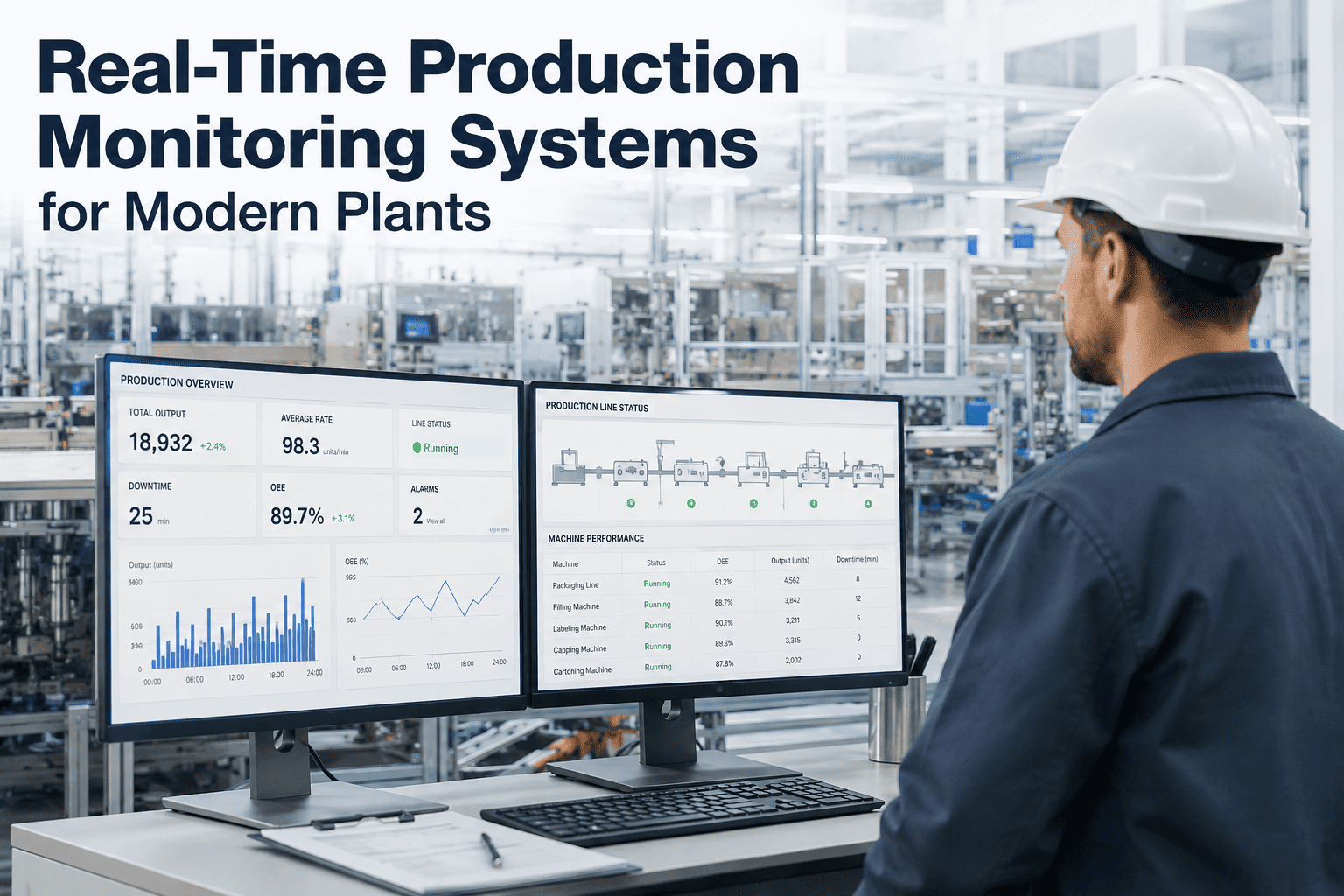
Every leader, every shift lead, every on-call maintenance planner sees the same live view — line status, throughput, downtime reason codes — on a phone, tablet, or browser, without ever logging into the SCADA. Decisions move from "call the operator" to "check the dashboard."
Prediction
AI Anomaly Detection on Existing Tags
The same tag stream the SCADA has always produced now feeds anomaly detection models that flag developing problems — bearing wear, valve stiction, drifting setpoints — hours or days before an operator would notice, without any new sensors installed on the plant floor.
Reporting
Cross-Line and Cross-Plant Benchmarking
OEE, downtime, quality, and energy metrics normalised across every line and every site, so a corporate operations team can compare performance and share improvements without waiting for each plant to email a monthly Excel report by the tenth of the following month.
Integration
MES and ERP Without Custom Drivers
Production orders flow from MES to the plant, work orders and part usage flow back from the plant to ERP, and financial reporting reconciles automatically — all through the unified namespace instead of one-off integrations that fail whenever a system version changes.
A Decision Framework: Overlay, Hybrid, or Full Replacement
Overlay is the right first move for most plants, but not for all of them. A small number of legacy environments genuinely require a full replacement, and a slightly larger group is best served by a hybrid path where the overlay handles the plant for two to three years while a controlled control-layer migration runs in the background. The framework below is the same one iFactory's implementation team walks a plant through in the first assessment call, and it consistently sorts environments into one of the three paths within a single working session rather than dragging out into a multi-week evaluation.
Path A
Overlay Only
When it fits: SCADA is stable, PLCs are within OEM support, hardware is sourceable, but data is trapped and integrations are missing. The plant needs modern capability, not new control.
Outcome: Full modern data, analytics, and access layer live in 8 to 12 weeks. Control layer untouched for the foreseeable future.
Path B
Overlay Now, Controlled Migration Later
When it fits: SCADA is aging and specific PLC families are approaching end-of-support, but not urgently. Plant needs modern capability immediately and control-layer migration eventually.
Outcome: Overlay live in weeks. Control migration runs in the background over 18 to 36 months, one line or cell at a time, with the overlay bridging old and new throughout.
Path C
Full Replacement
When it fits: PLCs are unsourceable, control code is unrecoverable, cyber exposure blocks insurance renewal, or a major capacity expansion is forcing greenfield anyway. Overlay cannot delay the inevitable.
Outcome: Full rip-and-replace project, but with overlay principles used during the transition to reduce cutover risk and preserve production continuity through the migration weekend.
Cybersecurity: The One Area an Overlay Has to Get Exactly Right
The single largest legitimate objection to overlay architecture is cyber exposure — the concern that adding a data layer above an air-gapped OT network creates a new attack surface. This concern is real and it is solvable, but only with a specific set of architectural choices that need to be present from day one. Any overlay proposal that does not explicitly address each of the controls below should be treated as incomplete, because retrofitting cybersecurity after the fact is significantly harder than building it in during initial gateway configuration.
1
Read-Only by Default
The edge gateway reads tag values from PLCs and SCADA but has no write capability enabled unless a specific control use case justifies it — and even then, writes go through a separate, audited approval path.
2
One-Way Data Diode Option
For high-security environments, data flows out of the OT network through a hardware-enforced one-way diode, physically preventing any inbound connection regardless of software configuration or firewall rules.
3
TLS and Certificate Authentication
Every OPC-UA connection uses TLS 1.3 encryption and X.509 mutual certificate authentication, meeting IEC 62443 requirements for industrial network segmentation and identity verification.
4
Segmented Network Zones
The gateway sits in an industrial DMZ, not directly on either the OT or IT network, with separate firewall rules for each zone and no shared credentials across segments.
5
Audited and Logged Access
Every user session, every tag read, every configuration change is logged to a tamper-evident audit trail that satisfies cyber insurance requirements and internal IT security reviews.
6
Patch Discipline on the Gateway
The gateway itself runs a hardened, minimal OS with a documented patch cadence, so the modernization layer does not become the weakest link in the plant's overall cyber posture.
Frequently Asked Questions About Legacy SCADA Modernization
Will an overlay work with our specific SCADA and PLC vendors?
In practice, yes — for essentially every SCADA platform released in the past two decades, and for every PLC family that speaks Modbus, EtherNet/IP, PROFINET, DNP3, BACnet, or a documented serial protocol. Truly proprietary or unsupported protocols occasionally need a custom driver, but even those are usually solvable within the discovery phase rather than becoming a blocker. Plants running mixed environments across Rockwell, Siemens, Schneider, Mitsubishi, and legacy DCS platforms are the norm, not the exception, and are exactly what unified namespace architecture was designed to handle. Teams uncertain about a specific vendor combination can
talk to support for a compatibility check.
Does an overlay require operators to learn a new HMI?
No. The whole point of overlay architecture is that operators keep using the SCADA and HMI screens they already know, without a single change. The new dashboards, mobile access, and analytics views are for supervisors, plant leadership, off-shift on-call staff, and corporate operations teams — people who previously had no live plant visibility at all. Operators may eventually adopt some of the new views for their own workflows, but that is optional and driven by their preference, never forced as part of the rollout. This is one of the largest single differences from a rip-and-replace project, where every operator on every shift has to be retrained before go-live.
What happens to our existing SCADA licenses and support contracts?
They stay in place, exactly as they are. The overlay does not consume additional SCADA client licenses because it connects at the tag level through the gateway, not as another HMI client on the SCADA server. Support contracts with the existing SCADA vendor continue unaffected — in fact, most overlay deployments actively extend the useful life of the underlying SCADA by reducing the pressure to replace it, which lets the plant amortise its original investment over a longer horizon and defers the capital cost of a full replacement by years.
How does the overlay handle the moment we do eventually replace the SCADA?
This is where the overlay pays a second dividend. Because dashboards, analytics, MES integration, and mobile access all consume from the unified namespace rather than directly from the SCADA, replacing the underlying SCADA becomes a gateway reconfiguration rather than a full modernization project. The new SCADA gets pointed at the same tag structure, the gateway maps to it, and every downstream view keeps working without change. The eventual replacement, when it happens, is a control-layer swap — not a top-to-bottom rebuild — which is dramatically less risky and far cheaper than a traditional replacement would have been.
What is a realistic budget range for an overlay compared to full replacement?
Overlay projects consistently land in the range of 15 to 30% of the fully-loaded cost of an equivalent rip-and-replace program, once hidden costs like parallel running, retraining, and validation are properly accounted for in the comparison. Exact numbers depend on plant size, PLC diversity, and analytics scope, but the ratio holds across most environments. More importantly, the overlay budget is phased and reversible — a plant can commit to phase one, evaluate results, and only then approve phase two — where a rip-and-replace commitment is essentially all-or-nothing once the project starts. Plants wanting a tailored estimate can
book a demo for a scoped assessment.
Modernize Your SCADA Without Replacing It
iFactory deploys the full overlay stack — edge gateway, unified namespace, historian, dashboards, mobile, AI analytics, and MES/ERP integration — live in 8 to 12 weeks, tuned to your specific SCADA vendor and PLC mix. No control cutover. No operator retraining. No production risk.