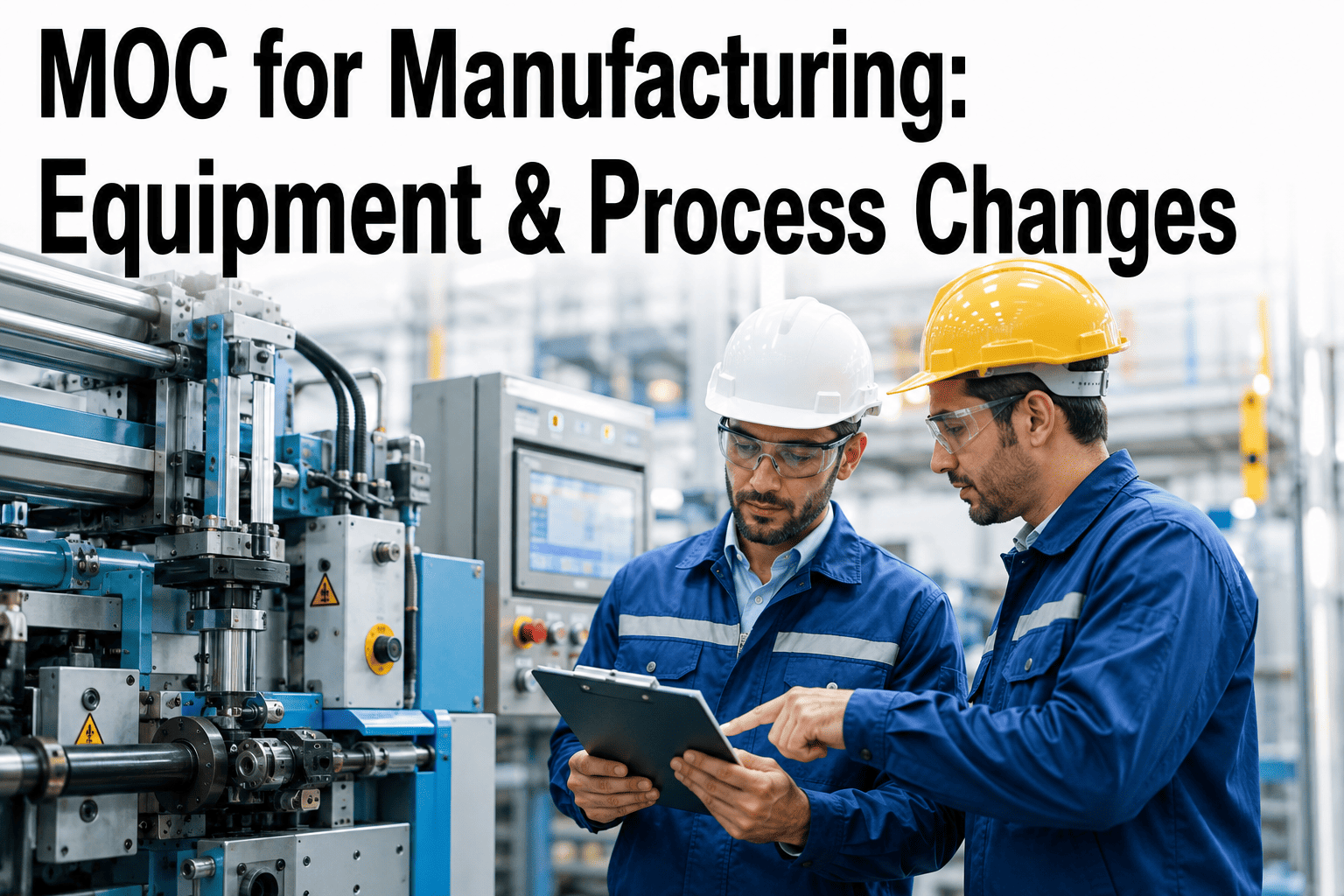
MOC for Manufacturing: Equipment & Process Changes

By Johnson on August 18, 2026

management-of-change-moc-manufacturing-equipment

Somewhere on your plant floor right now, a maintenance technician is probably swapping a part for "something close enough" because the exact spec was out of stock, or an engineer is tweaking a process parameter to hit a shift target before anyone signs off on it. Most of the time nothing happens. Then once in a while that same shortcut is the one that shifts a pressure rating past its limit, sends a control loop into a state nobody tested, or introduces a hazard that only shows up three shifts later when a different operator is running the line. Management of Change exists precisely because "it's basically the same" is a judgment call, not a fact, and plants that treat it as a fact are the ones that end up explaining an incident to a regulator. See how iFactory turns MOC into a trackable digital workflow at ifactory support.

iFactory Management of Change

Every Equipment or Process Change, Reviewed Before It Becomes an Incident

A structured, documented MOC workflow for equipment modifications, process parameter changes, and material substitutions — so nothing gets implemented on the floor without the right people signing off on the risk first.

Equipment Modifications
Process Parameter Changes
Material Substitutions
Temporary Changes

What Happens When Changes Skip the Review

Every plant already has some version of change control, even if it is nothing more than a verbal "go ahead" from a shift supervisor. The gap between that informal approval and a real MOC process is where the risk actually lives, because a verbal approval does not require anyone to check whether the change affects a safety interlock, a pressure limit, or a procedure that three other departments depend on. Regulators built formal MOC requirements, including OSHA's Process Safety Management standard, specifically because unreviewed changes to equipment, chemicals, technology, and procedures have been traced back to some of the most serious industrial incidents on record. The pattern is almost always the same: a change that looked small in isolation interacted badly with something nobody thought to check.


Change made informally
A part is swapped, a setpoint is adjusted, or a step is skipped, with no documentation and no formal sign-off.

Downstream effect goes unnoticed
The interaction between the change and an existing safeguard, procedure, or spec is never checked because no review was triggered.

A different shift inherits the risk
The team that made the change knew the context; the crew running the line two shifts later does not.

The gap surfaces as an incident or audit finding
What started as a reasonable-seeming shortcut becomes the root cause line in an investigation report.

The Five Change Types That Should Trigger an MOC

Not every action on a plant floor needs a formal MOC — a true replacement in kind, where the new part matches the original specification exactly, does not. The judgment call plants get wrong most often is assuming a change is "close enough" to a replacement in kind without actually checking the spec sheet. The five categories below cover the change types that should route through a formal review every time, regardless of how routine or minor the change appears at the moment someone decides to make it.

01
Equipment Modification
Installing new machinery, altering a guard or safety device, or changing a component to a different make, model, or material than the original.
02
Process Parameter Change
Adjusting temperature, pressure, speed, or flow setpoints beyond the range the original process design and safety case were built around.
03
Material Substitution
Swapping a raw material, chemical, or component supplier, even when the replacement is marketed as functionally equivalent.
04
Procedure or SOP Update
Changing the sequence, timing, or method behind an existing standard operating procedure, including ones that look purely administrative.
05
Temporary or Emergency Change
A short-term workaround during a breakdown or shortage that still needs a defined end date and a formal path back to the original state.
Bring Your Own Change

See How a Real Change Would Move Through the Workflow

Bring a recent equipment swap, setpoint change, or material substitution to the call. We will walk it through the review, risk scoring, and approval steps live so you can see exactly what your team would fill out.

Replacement in Kind vs. a Change That Needs Review

The single most common MOC failure is a technician or engineer deciding, in the moment, that a substitution counts as a replacement in kind when it actually does not. The table below lays out the practical distinction, because the line between the two is rarely obvious from the part number alone — it depends on whether every relevant specification actually matches, not just whether the part fits in the same slot.

Where the Line Actually Sits
Question Replacement in Kind Requires Formal MOC
Specification match Identical make, model, rating, and material to the original Any difference in rating, material, capacity, or design
Effect on safety systems No interaction with interlocks, alarms, or relief devices Any possible interaction with an existing safeguard
Documentation needed Standard work order and maintenance log entry Risk assessment, technical review, and formal approval
Who can authorize it Maintenance technician or supervisor, per standard procedure Cross-functional review with a defined change owner
Typical failure point Rarely an issue when the spec truly matches Assuming a "close enough" part matches without checking the full spec

The Eight-Step MOC Workflow

A management of change process only works if every step happens in order, every time, regardless of how confident the requester is that the change is safe. Skipping ahead — implementing before the risk assessment is complete, or starting up before training is finished — is how MOC programs fail in practice, and it is usually the step that gets skipped under schedule pressure that turns out to matter most. The eight steps below reflect the structure most process safety and quality frameworks converge on, adapted for a discrete or process manufacturing floor.

1
Request & Describe
The requester documents what is changing, why, and which asset, process, or procedure it affects, creating a traceable record from the first moment.
2
Screen for MOC Applicability
A quick check confirms whether this is a true replacement in kind or a change that needs the full review path.
3
Assess Risk & Hazards
The change is evaluated for impact on safety, quality, environment, and cost, including how it interacts with existing safeguards.
4
Technical Review
Engineering, maintenance, and quality confirm the change is technically sound and compatible with the rest of the system it touches.
5
Approve & Authorize
A named change owner and the relevant stakeholders formally sign off, with the approval routed based on the assessed risk level.
6
Update Procedures & Train
SOPs, drawings, and safety documentation are updated, and every affected operator is trained before the change goes live.
7
Pre-Startup Safety Review
Before the change is put into service, a final check confirms the physical change matches what was approved and that training is complete.
8
Implement & Close Out
The change goes live, the owner confirms it performs as expected, and the record is formally closed with every document attached.

Not sure whether a recent change on your floor should have gone through this workflow? Send us the details and we will help you work out where it falls.

Scoring Risk So Approval Routing Actually Matches the Stakes

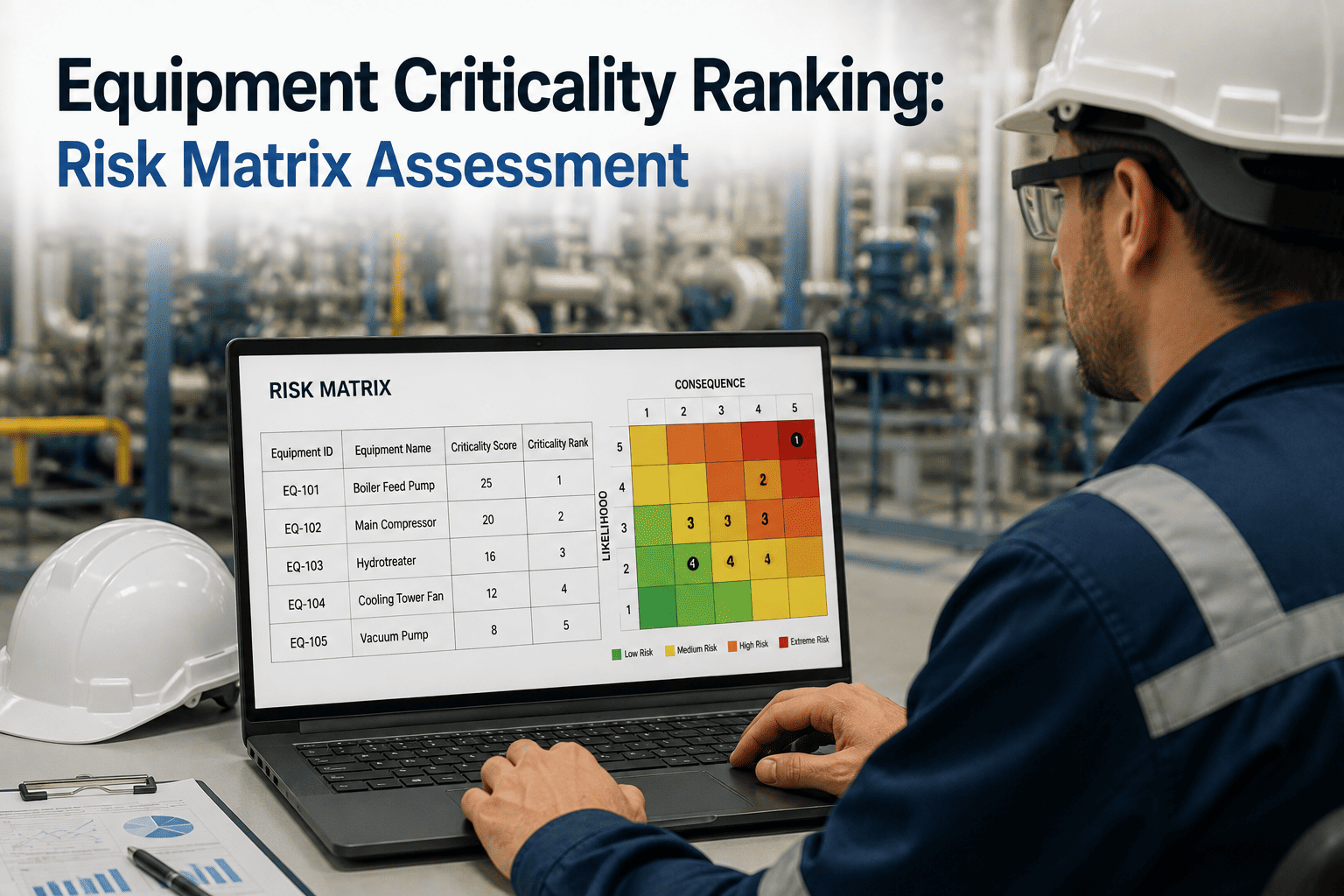
Not every change carries the same risk, and routing a low-risk sensor swap through the same five-person approval chain as a pressure-rated equipment modification just trains people to see MOC as a bottleneck rather than a safeguard. A risk matrix that scores likelihood against severity lets a plant route minor changes through a fast, lightweight path while reserving full cross-functional review for the changes that actually warrant it.

Likelihood vs. Severity: How Risk Level Sets the Approval Path

Low Severity
Medium Severity
High Severity
High Likelihood
Medium
High
Critical
Medium Likelihood
Low
Medium
High
Low Likelihood
Low
Low
Medium
Low — supervisor sign-off, standard timeline
Medium — department lead review required
High — cross-functional review and EHS sign-off
Critical — full review, plant manager approval, pre-startup check

What a Structured MOC Program Actually Delivers

The value of formalizing MOC is not paperwork for its own sake — it is measurable reduction in the specific failure modes that unreviewed changes tend to cause. Plants that move from an informal, verbal approval culture to a documented workflow are not just protecting themselves in an audit, they are closing the exact gap where most preventable incidents originate: a change that looked reasonable to the person making it, but was never checked against everything else it touched. The ranges below reflect what manufacturers have reported after moving from informal or paper-based change control to a structured, tracked MOC workflow.

35-50%
Fewer incidents traced to unreviewed changes
Formal risk screening catches interactions with existing safeguards before the change ever reaches the floor.
60%+
Faster approval cycle for low-risk changes
Risk-based routing keeps minor changes from sitting in the same queue as major modifications.
100%
Of changes with a traceable audit record
Every request, approval, and training record lives in one system instead of scattered emails and paper forms.
Same-Day
Visibility into open and overdue change requests
Supervisors and EHS leads see exactly where every pending change sits in the review process.

Common Mistakes That Undermine an MOC Program

The most frequent failure is not a missing process, it is a process that exists on paper but gets routinely bypassed under schedule pressure. A technician facing a stalled line at two in the morning is not thinking about audit trails, they are thinking about getting production moving again, and if the MOC path feels slower than just making the fix, it will get skipped. The fix is not lowering the bar on review, it is making the low-risk path genuinely fast, so following the process is never the reason a line sits down longer than it has to.

A second common mistake is treating MOC as a one-department responsibility, usually EHS, rather than a shared discipline that maintenance, engineering, and operations all own together. When only one department is accountable for the process, everyone else treats it as someone else's paperwork rather than a genuine safeguard, and requests pile up waiting on a single reviewer who becomes the bottleneck for the entire plant. Spreading ownership across the roles that actually touch each change, with a system that tracks who is responsible for what at every step, is what keeps the process moving without concentrating all the risk-checking on one overloaded person.

Who Owns What in the MOC Process

A change request with no clear owner tends to drift for weeks, stuck between departments that each assume someone else is driving it forward. Assigning specific roles to specific steps is what keeps a change moving instead of stalling in someone's inbox, and it also creates the accountability an auditor will look for when reviewing how a plant actually manages risk day to day.

Requester
Identifies the need for a change, documents the initial scope and reason, and stays available to answer questions during the review.
Change Owner
Drives the request through every step, confirms all required reviews are complete, and formally closes the record once implementation is verified.
Technical Reviewer
An engineer or subject-matter expert who confirms the change is technically sound and compatible with connected systems.
EHS Lead
Evaluates safety, health, and environmental impact for any change that could affect a hazard, interlock, or regulated process.
Approver
Authorizes the change based on its assessed risk level, ranging from a department supervisor to the plant manager for critical changes.
Trained Operators
Every person who works with the changed equipment, material, or procedure, confirmed trained before the change goes live.

Frequently Asked Questions

How do we know if a change qualifies as a true replacement in kind?
A true replacement in kind means the new part or material matches the original across every relevant specification — rating, material, capacity, dimensions, and design — with no difference that could affect performance or safety. If any specification differs, or if you are not certain because the original spec sheet is not readily available, the safest default is to route it through the MOC screening step rather than assume it qualifies. Talk to our team about setting up a screening checklist that removes the guesswork for your maintenance staff.
Who should be involved in reviewing and approving a change?
The right reviewers depend on the risk level of the change, but a representative cross-functional review typically includes the requester's supervisor, an engineer familiar with the affected system, a quality representative, and an EHS lead for anything touching safety systems or hazardous materials. Higher-risk changes should route to the plant manager or a formally designated change owner for final authorization. Book a walkthrough to map out an approval matrix that fits your plant's structure.
What happens to a temporary change if nobody follows up to reverse it?
This is one of the most common ways informal change control fails — a temporary workaround during a breakdown or shortage becomes permanent by default because no one set an expiration date or assigned someone to revert it. A proper MOC record for a temporary change includes a defined end date and an automatic flag if that date passes without the change being formally closed or converted to a permanent, fully reviewed change. Reach out to our team to see how automated expiration tracking works in practice.
Does every material substitution really need a full MOC, even minor ones?
Every material substitution should at minimum pass through the screening step, because even a supplier switch marketed as functionally equivalent can carry different chemical purity, particle size, or reactivity that affects your process. Whether it needs a full cross-functional review from there depends on the risk score — a low-risk substitution can move through a lightweight path, but it should never skip the initial screening and documentation entirely. Book a demo to see how risk-based routing keeps minor substitutions from creating a bottleneck.
How does a digital MOC workflow actually reduce audit findings compared to paper forms?
Paper-based or email-driven MOC processes tend to produce incomplete records, because a form can be started and never finished, or an approval can happen verbally and never get logged. A digital workflow enforces the sequence of steps, time-stamps every approval, attaches supporting documents automatically, and flags any change that is missing a required sign-off before it can move forward, which is exactly the kind of traceable evidence an auditor is looking for. Contact our team to see a sample audit trail from a completed change record.
Close the Gap Before It Becomes an Incident.

Put Every Equipment and Process Change Through a Real Review

Bring a recent equipment modification, parameter change, or material substitution to the call. We will show you how it would move through risk scoring, approval routing, and pre-startup review in a live MOC workflow.
8 Steps
Request to close-out
5 Triggers
Change types covered
100%
Traceable audit trail
Risk-Based
Approval routing

Share This Story, Choose Your Platform!