The conversation around digital twins in manufacturing has shifted from whether to build one to how to build it, and the most consequential decision in that process is not which platform to buy but which modeling philosophy to follow. Physics-based twins use first-principles equations to simulate how a system behaves under any condition, while data-driven twins use machine learning to predict outcomes based on historical patterns, each approach carrying fundamentally different assumptions about what you need to know before the model can be trusted. Choosing the wrong approach for your use case does not just waste money, it produces a twin that looks impressive in a presentation but fails exactly when you need it most, during the unusual operating conditions and edge cases that define real manufacturing risk. Understanding the tradeoffs between these approaches, and knowing when a hybrid model that combines both is the right answer, is what separates facilities that get real value from their digital twin investment from those that end up with an expensive visualization tool. Book a demo to see how iFactory helps you select and implement the right digital twin approach for your specific manufacturing challenges.
Your Digital Twin Is Only as Reliable as the Assumptions Built Into It
Physics-based and data-driven digital twins are not interchangeable. One derives behavior from equations, the other from data. Picking the wrong approach for your process, data availability, and risk tolerance produces a model that works in the demo and fails on the floor.
Behavior Derived from Equations, Not History
A physics-based digital twin is built on the fundamental laws that govern how your process works: thermodynamics for thermal systems, fluid dynamics for flow networks, structural mechanics for load-bearing equipment, and electrochemical relationships for battery and corrosion modeling. Instead of learning what happens from data, the model computes what must happen based on known physical relationships, which means it can predict outcomes for conditions it has never observed because the underlying equations do not change when the operating point moves outside the historical range.
Behavior Learned from Patterns in Your Data
A data-driven digital twin uses machine learning algorithms to discover relationships between input variables and output behavior by training on historical operational data. The model does not know or care about the physics of your process, it simply learns that when certain input patterns appear, certain outputs tend to follow. This approach excels when the underlying physics are too complex to model with equations, when the system has many interacting variables that make first-principles formulation impractical, or when you have large volumes of high-quality data that capture the system's behavior across its full operating range.
What Happens Inside Each Twin When You Ask It a Question
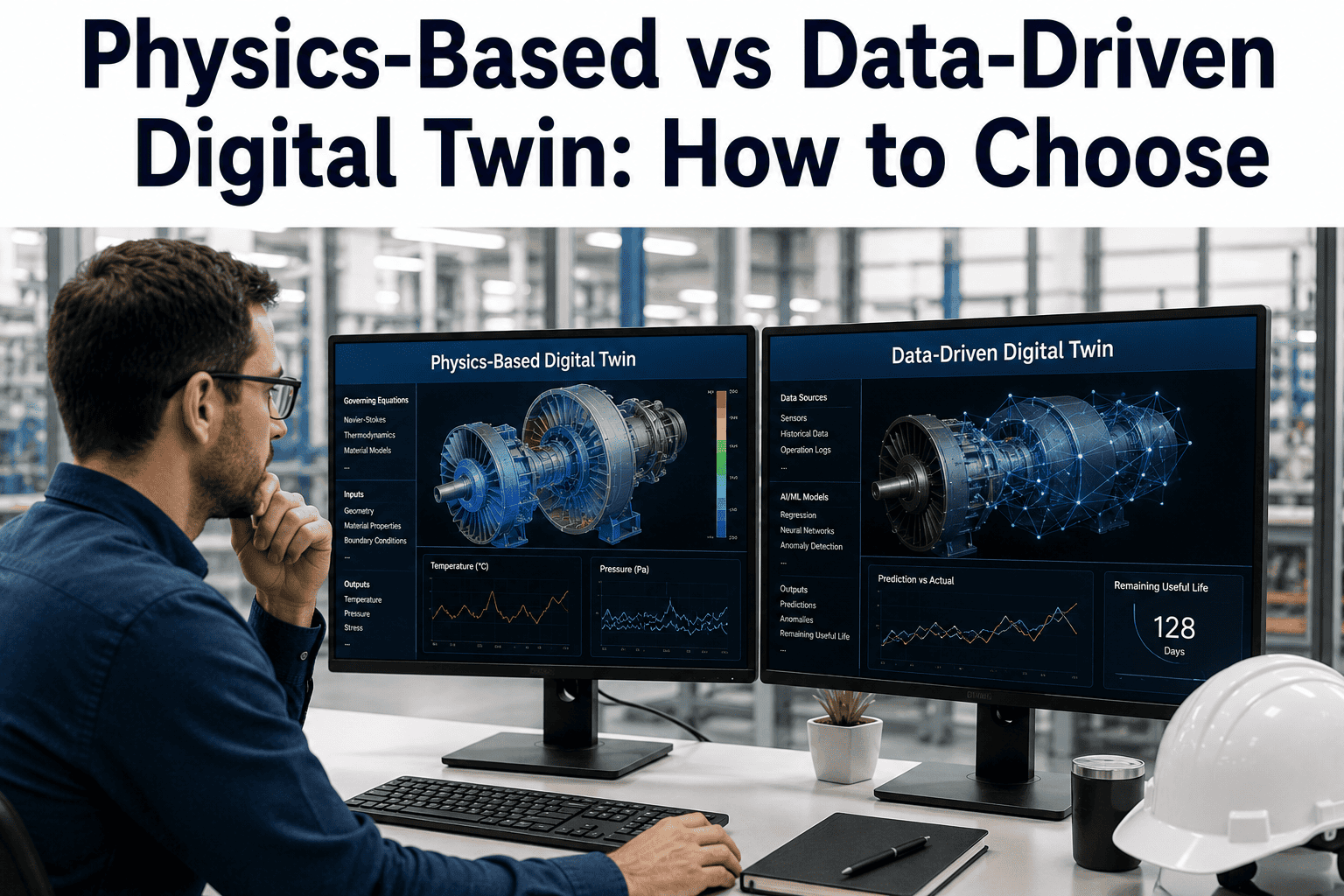
Understanding the internal architecture of each approach makes the practical differences much clearer. When you feed a new set of operating conditions into a physics-based twin, it runs those inputs through a system of equations that represent mass balance, energy balance, momentum transfer, and whatever other physical relationships are relevant to your process. Every output has a physical explanation that an engineer can trace back to a known law or principle. When you feed the same inputs into a data-driven twin, it passes them through a neural network or ensemble of models that map inputs to outputs based on the statistical patterns learned during training. The output may be accurate, but there is no physical explanation for why, only a mathematical one based on weight matrices and activation functions.
The critical difference in these two pipelines is not speed or complexity but what happens at the boundary of known conditions. The physics-based pipeline produces a result at any operating point because the equations are defined everywhere, while the data-driven pipeline produces a result that becomes increasingly unreliable as the input moves further from the conditions represented in the training data. This is not a flaw in data-driven models, it is a fundamental characteristic that must be understood and managed through proper uncertainty quantification and operating range constraints.
Head-to-Head Comparison Across the Dimensions That Actually Matter for Manufacturing
The table below compares physics-based and data-driven digital twins across the practical dimensions that manufacturing teams care about when deciding which approach to invest in. Each dimension is evaluated independently because the right choice is almost never all-or-nothing across the board, most facilities end up using different approaches for different subsystems within the same plant.
| Dimension | Physics-Based Twin | Data-Driven Twin |
|---|---|---|
| Data Required to Build | Equipment specs, material properties, geometry, boundary conditions | Large historical dataset covering full operating range with labeled outputs |
| Development Timeline | Weeks to months for complex systems with many coupled equations | Days to weeks once clean training data is available and preprocessed |
| Accuracy Within Training Range | High, limited by equation fidelity and parameter uncertainty | Very high, often matches or exceeds physics models within data range |
| Accuracy Outside Training Range | Reliable, equations remain valid beyond observed conditions | Unreliable, no statistical basis for extrapolation beyond training data |
| Explainability of Results | Full traceability to physical laws and model assumptions | Limited, results derive from opaque weight matrices and feature interactions |
| Adaptation to System Changes | Manual rework of equations and recalibration of parameters | Retrain on new data, automatic adaptation if data pipeline is maintained |
| Computational Cost at Runtime | High for transient simulations, moderate for steady-state solutions | Low, inference is fast once the model is trained |
| Regulatory Acceptance | High, physics models are standard in safety-critical and regulated industries | Low to moderate, regulators prefer explainable models for safety decisions |
| Handling of Complex Interactions | Limited by ability to formulate and solve coupled equation systems | Strong, neural networks capture complex non-linear interactions naturally |
| Maintenance Over Time | Periodic parameter recalibration based on new measurement data | Ongoing data pipeline maintenance, retraining schedules, drift monitoring |
The most important takeaway from this comparison is not that one approach is universally better but that the ranking flips depending on which dimension matters most for your specific use case. A facility building a twin for regulatory safety analysis needs explainability and extrapolation, which points to physics-based. A facility building a twin for real-time quality prediction on a well-characterized process with abundant data may get better accuracy and faster results from a data-driven approach. The mistake is assuming the same approach is optimal for every subsystem and every use case within a single plant.
The Right Twin Approach Depends on Your Process, Your Data, and Your Risk
iFactory evaluates your manufacturing systems, data maturity, and operational objectives to recommend and implement the digital twin approach that delivers reliable results for your specific situation, whether that is physics-based, data-driven, or hybrid.
Where Physics-Based Twins Deliver Results That Data-Driven Models Cannot
There are manufacturing scenarios where a data-driven approach is not just suboptimal but fundamentally unsuitable because the whole point of the twin is to predict behavior in conditions that have never been observed. In these scenarios, the physics-based approach is not a preference but a requirement, because no amount of historical data can prepare a statistical model for a situation it has never seen.
Where Data-Driven Twins Outperform Physics Models in Real Manufacturing
The cases where data-driven twins are the better choice share a common characteristic: the underlying physics are either too complex to model practically, too poorly understood to formulate as equations, or the system has so many interacting variables that a first-principles model would require more calibration parameters than the available data can support. In these situations, letting the model learn directly from data sidesteps the formulation problem entirely and often produces more accurate predictions than an oversimplified physics model could achieve.
The Hybrid Model: Using Physics for Structure and Data for Precision
The most practically effective digital twin architecture for manufacturing is not purely physics-based or purely data-driven but a hybrid that uses each approach where it is strongest. In a hybrid model, the physics-based component provides the structural skeleton of the twin, ensuring that the model behaves physically reasonably even in unobserved conditions, while the data-driven component fills in the gaps where physics alone is insufficient, correcting for model-form uncertainty, unmodeled dynamics, and calibration drift that accumulate over time. The hybrid approach is not a compromise between two imperfect methods but a genuinely superior architecture that produces a model with both the extrapolation capability of physics and the accuracy of data-driven learning within the training range.
The hybrid architecture works because it respects what each approach is genuinely good at. The physics model handles the parts of the system that are well-understood and need to extrapolate reliably, like heat transfer, fluid flow, and mass balance. The data-driven correction handles the parts that are poorly understood or process-specific, like fouling factors, sensor calibration drift, and the accumulated effect of minor unmodeled losses that are individually small but collectively significant. The result is a twin that is more accurate than either approach alone while retaining the extrapolation safety net that a purely data-driven model lacks.
A Five-Step Framework for Choosing the Right Twin Approach
The decision between physics-based, data-driven, and hybrid approaches should follow a structured evaluation rather than a default choice based on what your team is most comfortable with. The framework below walks through the five questions that determine the right approach for a specific use case, with each question narrowing the options until the recommended architecture is clear.
Implementation Pitfalls That Turn a Good Concept Into an Unreliable Model
Regardless of which approach you choose, the implementation process itself introduces risks that can undermine the twin's reliability if they are not anticipated and managed. The pitfalls below are the ones that appear most frequently in manufacturing digital twin projects, and they apply to all three approaches with slightly different symptoms depending on the modeling methodology.
Common Questions About Choosing Between Digital Twin Approaches
Can a data-driven digital twin be trusted for safety-critical applications in manufacturing?
In most regulatory environments, a purely data-driven twin is not accepted as the sole basis for safety-critical decisions because its predictions cannot be traced back to known physical principles and it cannot reliably predict behavior under conditions outside its training data. Safety-critical applications typically require a physics-based or hybrid model where the physics core provides the extrapolation safety net and explainability that regulators demand. The data-driven component in a hybrid model can improve accuracy within the training range, but the physics component must be strong enough to ensure the model produces physically reasonable results even in extreme scenarios. Book a demo to discuss safety-critical twin architecture for your facility.
How much historical data is needed to build a reliable data-driven digital twin?
There is no single threshold that applies to all processes, but as a practical guideline, you need enough data to represent the full range of normal operating conditions including seasonal variations, product changeovers, and known disturbance events, typically spanning at least six to twelve months of continuous operation at a sampling rate that captures the dynamics of interest. Processes with slow dynamics may need less frequent sampling but longer time spans, while fast processes need higher sampling rates but may achieve adequate coverage in shorter periods. The real constraint is not volume but coverage: a year of data that only represents one operating point is less useful than three months that capture the full range of conditions the twin needs to predict. Contact support for a data readiness assessment for your process.
Is a hybrid digital twin significantly more complex to build and maintain than a single-approach model?
A hybrid twin does add complexity compared to using a single approach, because you are building and maintaining two interconnected models instead of one, but the incremental complexity is often less than it appears because each component can be simpler than it would need to be on its own. The physics core in a hybrid model can use simplified equations because the data-driven correction compensates for the simplification, and the data-driven component can be smaller and less prone to overfitting because the physics core handles the part of the behavior that is well-understood. Maintenance is also distributed: the physics model needs periodic parameter recalibration while the data model needs periodic retraining, but neither task is as intensive as it would be if that single model had to carry the full predictive burden alone. Book a demo to see how iFactory manages hybrid twin complexity.
Can I start with one approach and transition to another later as my data and requirements evolve?
Yes, and this is actually the recommended path for most manufacturing facilities. Starting with a physics-based model when you have limited data, then layering in data-driven corrections as operational data accumulates, is the natural evolution of a mature digital twin program. The physics model provides immediate value from day one by supporting design analysis and what-if scenarios, and the data-driven layer grows in capability over time without requiring any changes to the physics core. Transitioning in the opposite direction, from data-driven to physics-based, is less common but possible when new domain knowledge becomes available or when regulatory requirements change to demand explainable models. Contact support to plan a phased twin development roadmap.
What is the typical cost difference between physics-based, data-driven, and hybrid digital twin implementations?
Physics-based twins typically have higher upfront development costs because formulating, validating, and calibrating the governing equations requires specialized domain expertise and significant engineering time, but their ongoing maintenance costs are relatively low because the equations do not change. Data-driven twins have lower upfront costs if clean data is already available, but their ongoing costs can be higher due to the need for continuous data pipeline maintenance, retraining schedules, and drift monitoring. Hybrid twins sit in between, with moderate upfront costs because each component can be simpler, and moderate ongoing costs because both components need maintenance but neither carries the full burden alone. The total cost of ownership over three to five years often favors the hybrid approach because it delivers the best accuracy with the most balanced maintenance profile. Book a demo to get a cost estimate for your specific use case.
The Best Digital Twin Approach Is the One That Matches Your Process, Your Data, and the Decisions You Need It to Support
iFactory assesses your manufacturing systems, evaluates your data maturity, and implements the digital twin architecture, whether physics-based, data-driven, or hybrid, that delivers reliable, actionable predictions for your specific operational challenges.