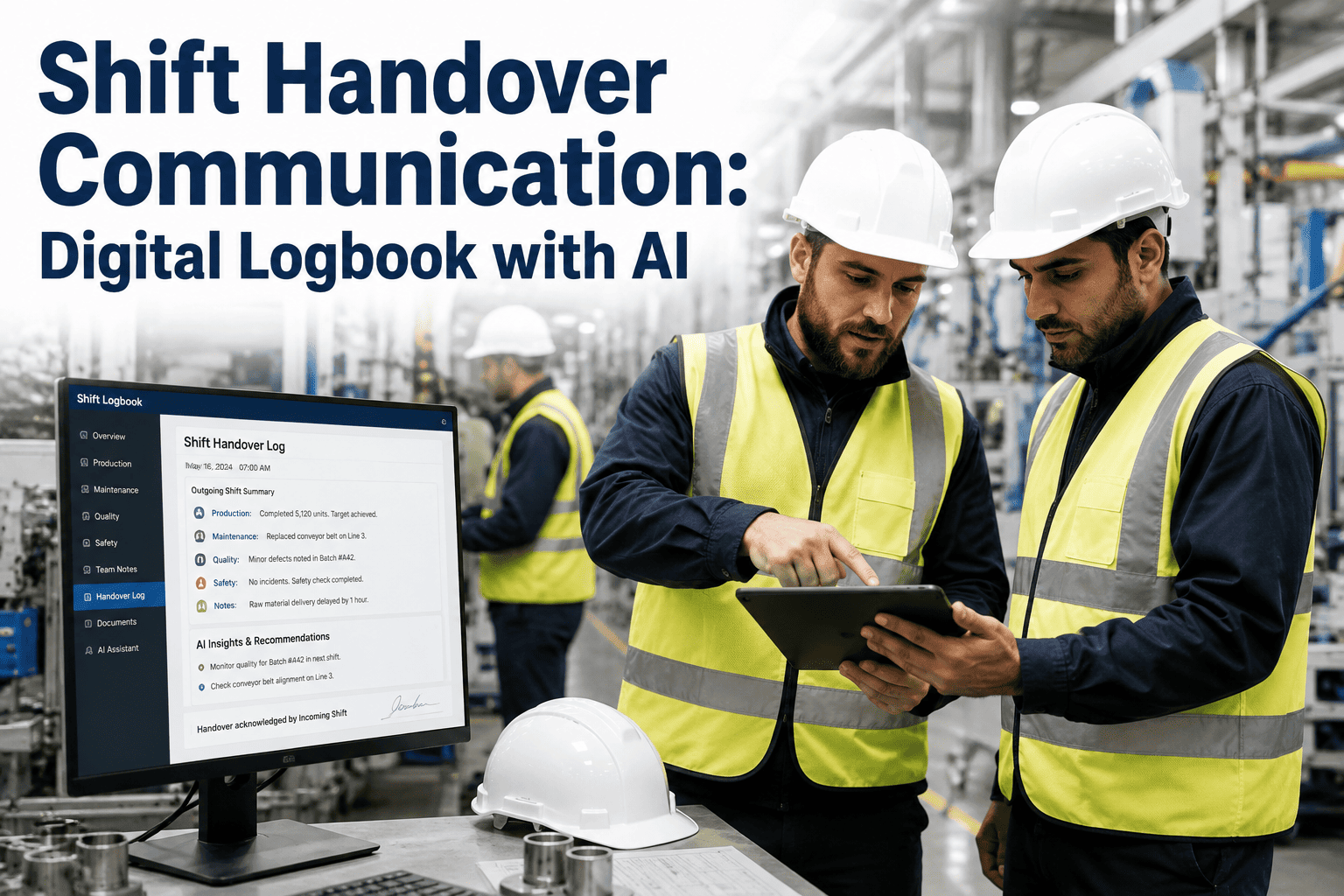
Shift handover takes up less than five percent of the time in a twenty-four hour operation, yet roughly forty percent of plant incidents happen during or immediately after it. That is not a coincidence. A supervisor relaying a dozen items verbally in a ten-minute changeover will inevitably bury the one that matters, a rising defect rate, a bypassed safety interlock, a half-finished repair under a quality trend mentioned fourth or fifth in the conversation. The incoming crew starts the shift missing exactly the piece of context they needed most. Digital shift handover systems with structured templates and AI-generated summaries close this gap by making sure every category gets covered every time, not just the items a tired supervisor happens to remember. See how iFactory AI structures shift handover by booking a demo with our team.
The Ten-Minute Window Where Forty Percent of Plant Incidents Happen
Shift handover is the highest-risk, lowest-attention moment in a 24/7 operation. Here's how structured digital logbooks and AI summaries close the gap.
The Communication Cliff: What Happens Every 8 to 12 Hours
Every industrial facility running around the clock faces the same recurring moment. Critical information about equipment health, safety status, and production targets is sitting in one supervisor's head, and in a few minutes it needs to transfer completely and accurately to someone who was not on the floor for the last eight hours and has no independent way to verify what they are being told. The clock below shows how that information typically degrades across a verbal-only handover, minute by minute, as more items compete for the same short window of attention.
What Poor Handover Communication Actually Costs
The financial and safety cost of a broken handover process is not abstract. It shows up as duplicated troubleshooting, delayed interventions, and in the worst cases, major industrial incidents where investigators later traced the root cause back to a shift change that never fully communicated what the outgoing team already knew was wrong.
Major industrial incidents, from refinery explosions to chemical release events, have repeatedly traced back to a handover that was verbal, incomplete, or never written down. iFactory AI's digital shift logbook makes that failure mode structurally impossible.
Structured Templates: Every Category, Every Time
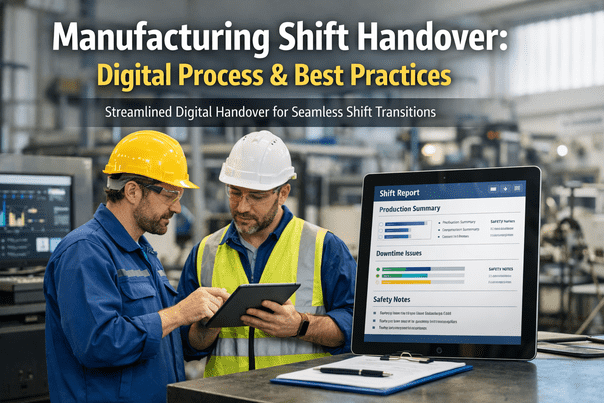
The core fix is simple in concept and hard to enforce with paper: make it structurally impossible to skip a category. A structured digital template mandates fields for every operational area before a handover can be marked complete, so nothing depends on what the outgoing supervisor happens to remember to mention.
Where AI Fits: Summarizing, Not Replacing, the Handover
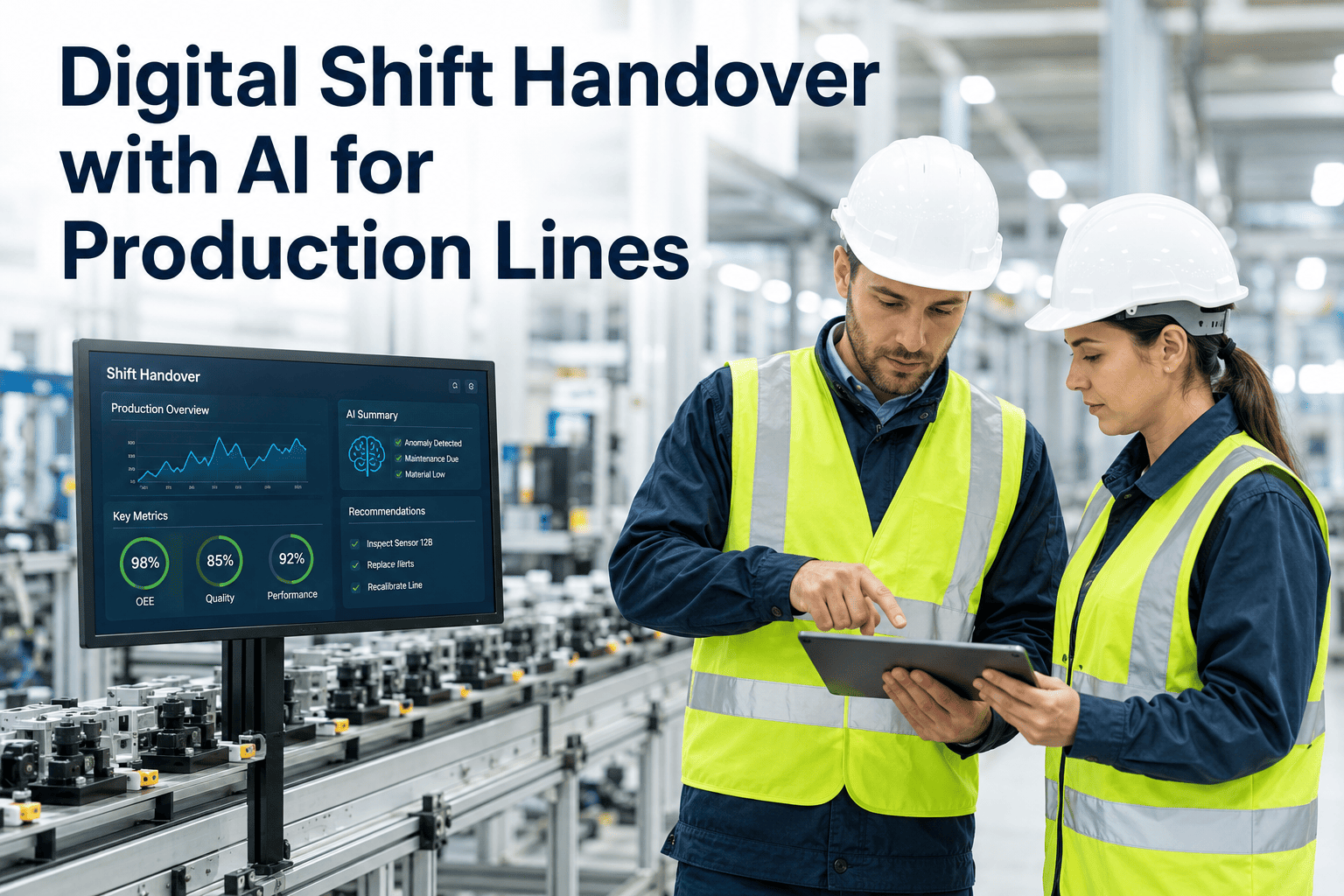
AI does not replace the human conversation at shift change, it makes that conversation sharper. Instead of a supervisor scrolling through a shift's worth of raw log entries, an AI-generated summary surfaces what actually changed and what needs attention, in the order that matters most.
This matters most on the third or fourth consecutive night shift, when the outgoing supervisor is fatigued and most likely to under-report exactly the item that turns out to matter. An AI summary built from structured log data does not get tired, and it does not forget to mention the pressure excursion because six other things happened first.
There is a second, less obvious benefit that only shows up once enough structured data accumulates: pattern recognition across shifts. A near-miss logged on the night shift and a pressure excursion recorded on the day shift, sixteen hours apart, may share the same underlying root cause, but two paper logs sitting in two different binders will never surface that connection. A structured digital record makes it possible to query across every shift, every area, and every crew for the same equipment tag or the same fault type, turning what used to be isolated anecdotes into an actual pattern a maintenance team can act on before the next failure.
Mandatory Sign-Off and Escalation Tracking
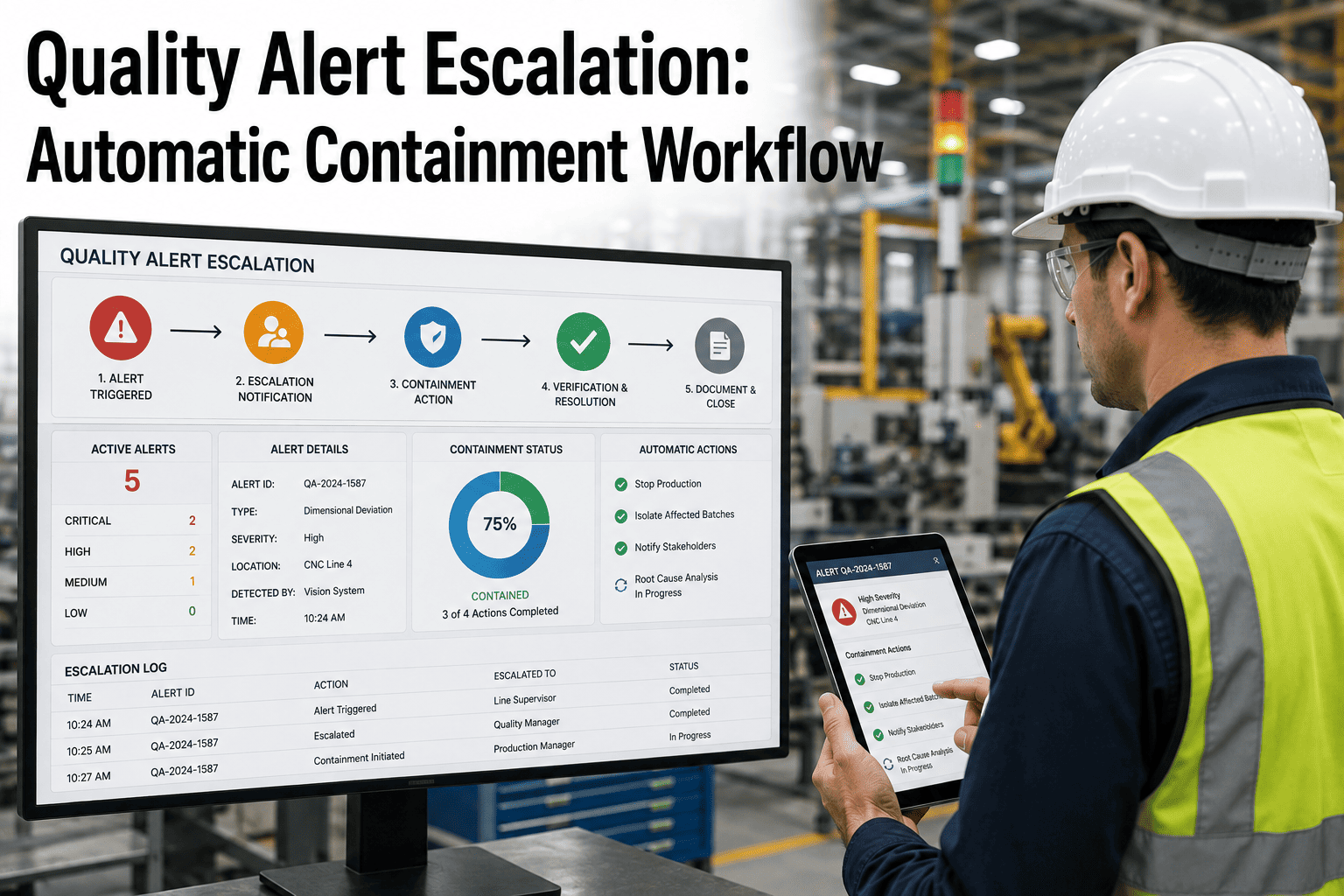
A structured template only works if completion is actually enforced, and enforcement is exactly where paper and spreadsheet-based processes tend to break down under real operational pressure. The workflow below shows how a mandatory sign-off process moves an open item from detection to resolution, with automatic escalation if nobody acts within a defined window, so a safety-critical issue can never simply sit unaddressed because everyone assumed someone else was handling it.
| Stage | Trigger | Escalation Window | Who Is Notified |
|---|---|---|---|
| Logged | Operator or supervisor records an issue in the shift log | Immediate | Assigned owner and shift supervisor |
| Acknowledged | Incoming shift reviews and signs off on the handover | Start of shift | Outgoing supervisor confirmation |
| Unresolved | Item remains open past its target resolution time | 2-4 hours | Area manager or maintenance lead |
| Escalated | Safety-critical item unresolved past the escalation window | Immediate | Plant manager and safety officer |
Paper Logs Versus Structured Digital Logbooks
Plants moving away from paper logbooks are usually not doing it because paper is old-fashioned. They are doing it because paper cannot enforce structure, cannot search, and cannot escalate. The comparison below reflects the practical difference crews experience during an actual shift change.
The gap between these approaches widens the moment an incident investigation happens. Regulators and internal safety teams reviewing a paper log after the fact are working from fragments, handwriting quality, missing entries, and no way to confirm who actually read what. A structured digital logbook produces a complete, timestamped, and legally defensible audit trail automatically, without anyone needing to have thought ahead to preserve it.
Frequently Asked Questions
Why is shift handover considered a high-risk moment industry-wide?
Shift handover concentrates an unusually high amount of critical information transfer into a very short window, typically under ten minutes, at a point when the outgoing team is fatigued and the incoming team has zero context for what happened during the previous shift. Regulatory bodies including the American Fuel and Petrochemical Manufacturers have documented that over forty percent of plant incidents occur during start-up, shutdown, or handover periods, even though these windows account for less than five percent of total operating time. Several major industrial disasters have listed incomplete or verbal-only handover as a contributing root cause, and safety regulators including the UK Health and Safety Executive treat shift handover as its own distinct category of safety-critical communication rather than a routine administrative task. Learn how iFactory AI structures this transition on our support page.
How is a digital shift logbook different from a shared spreadsheet?
A spreadsheet is a shared file, not a structured workflow. It has no mandatory fields, no automatic escalation, no AI summarization, and no enforced sign-off, which means it depends on the same individual discipline that makes paper logs unreliable in the first place. A purpose-built digital shift logbook enforces required categories before a handover can be marked complete, timestamps every entry automatically, and routes unresolved safety-critical items to the right person without anyone needing to remember to follow up. The difference shows up most clearly during an incident investigation, when a structured logbook produces a complete audit trail with timestamps, ownership, and acknowledgment records, while a spreadsheet often produces gaps, conflicting versions, and no reliable way to confirm who actually reviewed the entry before the next shift began.
Does an AI-generated summary replace the verbal handover conversation?
No, and it is not designed to. The verbal conversation between outgoing and incoming supervisors still happens, but it becomes far more effective when both people are looking at the same AI-ranked summary of what changed during the shift instead of relying entirely on memory. The AI's role is to surface the three to five items that matter most, ranked by safety impact and recency, so the human conversation focuses on the right things instead of working through a mental list under time pressure. Full raw log data remains searchable for anyone who needs more detail than the summary provides.
How quickly can a plant deploy a digital shift logbook?
Most facilities can deploy a structured digital shift logbook within roughly six weeks, covering template configuration, integration with existing equipment and sensor data where available, and training across all shifts and roles. Facilities running iFactory AI's deployment process commonly report a measurable increase in near-miss capture, often three to five times the prior rate, within the first month, as structured logging surfaces issues that a verbal-only process was previously missing entirely. Book a demo to see a realistic deployment timeline for your specific facility and shift structure.
Can a digital shift logbook integrate with our existing CMMS and quality systems?
Yes, and this integration is usually where most of the long-term value comes from. When a shift logbook connects to your CMMS, an equipment issue logged during handover can automatically generate or update a work order rather than requiring a second manual entry. The same applies to quality systems, where an out-of-spec reading noted in the shift log can trigger the appropriate quality hold workflow without a separate report. This closes the loop between what gets noticed on the floor and what gets acted on by the systems responsible for resolving it, eliminating the double data entry that causes maintenance and quality teams to fall behind during high-volume periods and reducing the chance that a flagged issue quietly falls through the cracks between departments.
The next shift change at your plant is a few hours away. See how iFactory AI turns that ten-minute window from your highest-risk moment into your most reliable one.