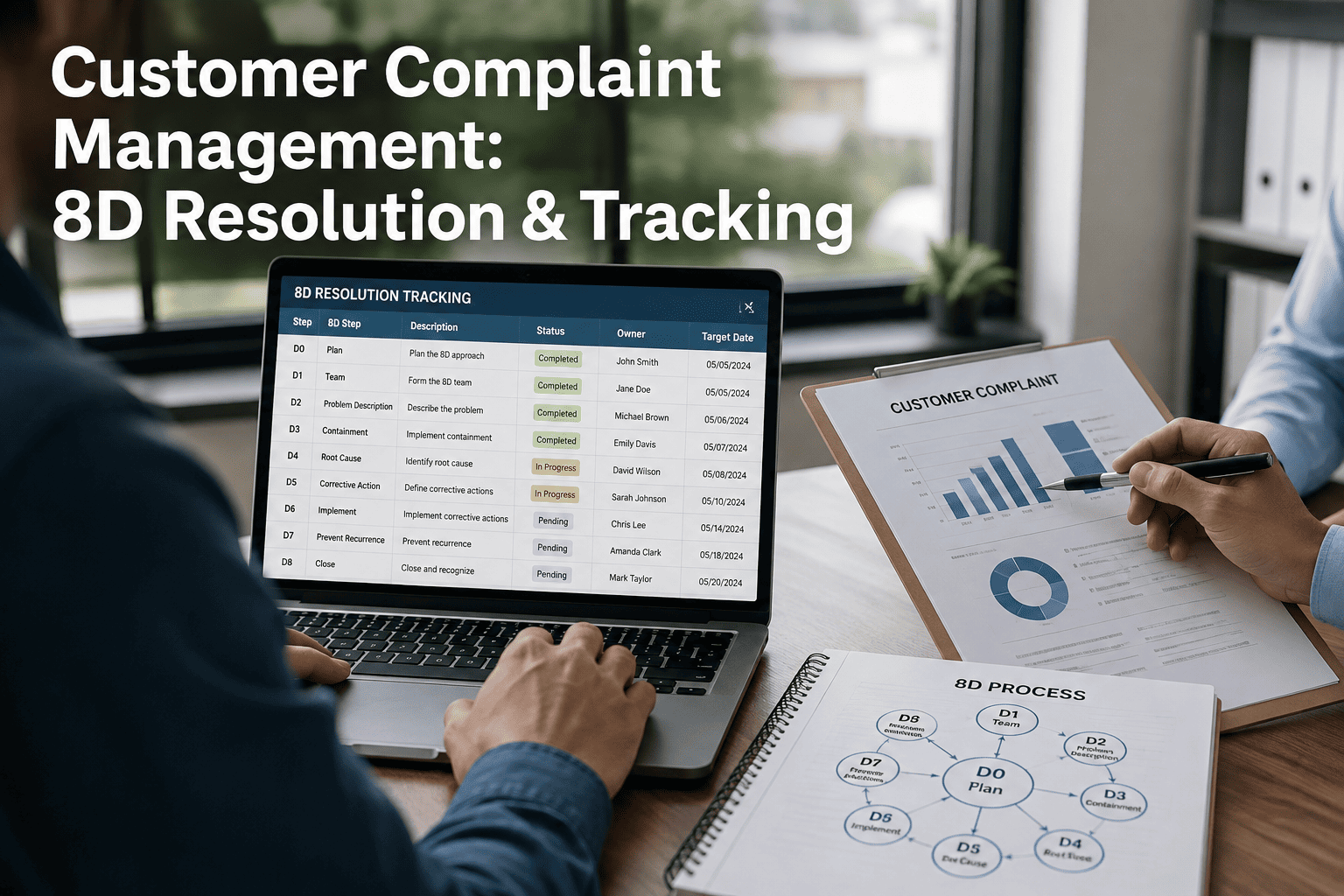
A customer complaint that takes three weeks to reach an engineer, gets logged in a spreadsheet nobody else opens, and closes with a vague note about retraining an operator is not resolved, it is postponed. The same defect quietly resurfaces at a different customer, under a different part number, months later, because nothing connected the two events. The 8D methodology exists to break that cycle, forcing a team to contain the problem immediately, prove the actual root cause with data instead of a guess, and verify the fix holds before the file is ever closed. iFactory's complaint management module builds that discipline into the platform itself, tracking every 8D from intake to closure so nothing depends on someone remembering to follow up, and you can book a walkthrough of the workflow in under thirty minutes.
Turn Every Complaint Into a Documented 8D, Automatically
iFactory logs intake, containment, root cause, and corrective action against one traceable case file, so your quality team spends time solving problems instead of formatting reports.
Why Ad Hoc Complaint Handling Keeps Costing You
Most quality systems already require a documented response to a customer complaint. ISO 9001 clause 10.2 calls for corrective action on nonconformities, and IATF 16949 goes further for automotive suppliers, making an 8D report the expected format whenever an OEM rejects a part or reports a field failure. The trouble is rarely the standard itself, it is the gap between what the standard requires and what a spreadsheet, an email thread, or a shared drive folder can actually enforce. Containment steps get skipped under deadline pressure, root cause sections get filled in from memory instead of evidence, and closed complaints quietly reopen under a new number because nobody noticed the pattern the first time.
typical reduction in recurring customer complaints organizations see within the first year of running a mature, disciplined 8D process
the window many automotive OEMs expect for the first containment response, covering disciplines D0 through D3, after a complaint is filed
the automotive quality standard that makes a completed 8D report the mandatory supplier response to a customer nonconformance
the structured sequence running from team formation through verified root cause to permanent corrective action and prevention
What a Complaint Record Should Actually Be Telling You
Every complaint carries five pieces of information that matter to a quality team, a customer, and an auditor alike. Most paper-based or spreadsheet systems capture one or two of them well and lose the rest along the way. A complaint record built around the 8D structure keeps all five attached to the same file, from the moment it opens to the moment it closes, so the full history travels with the case instead of living in someone's inbox.
Intake and Classification
Customer, part or process, lot or batch, severity, and source channel are captured the moment the complaint arrives, so nothing waits for someone to manually re-key it into a tracker later.
Containment Action
What protects the customer and downstream inventory right now, whether that is a sort, a quarantine, an inspection hold, or a shipment stop, is logged with a timestamp instead of being described after the fact.
Root Cause Investigation
Fishbone analysis, the 5 Whys, and an IS or IS NOT comparison are recorded against real production and inspection data, not filled in from a best guess written the night before a deadline.
Corrective Action and Validation
The permanent fix, whether it is a process change, a fixture redesign, or a revised work instruction, is tied to a validation run before it is marked complete, so a fix that looked good on paper gets proven on the floor.
Effectiveness Verification and Closure
A scheduled re-check after weeks or months confirms the same defect has not returned before the case is closed, instead of closure happening the same week the corrective action was written.
Spreadsheet Complaint Logs vs an 8D-Driven Tracking System
A spreadsheet can technically hold every field an 8D report needs. What it cannot do is enforce that those fields get filled in on time, in order, by the right person, with evidence attached. That gap is where recurring complaints, missed containment steps, and audit findings tend to originate. Here is what typically changes when complaint tracking moves off a shared file and into a structured system built around the eight disciplines.
Swipe left to see the full comparison
The Eight Disciplines, Step by Step
The 8D method was developed at Ford in the late 1980s under the name Team Oriented Problem Solving, and it has since become the standard response format for customer complaints across automotive, aerospace, medical device, and food manufacturing. Each discipline builds on the last, and skipping one, especially containment or verification, is where most complaint investigations quietly fall apart. Here is what each step is actually asking a team to do.
Establish the Team
A cross-functional group with real knowledge of the product, process, and equipment is assigned, so the investigation is not carried by one person working alone between other duties.
Describe the Problem
The team quantifies what happened using data rather than impressions, often with a 5W2H breakdown and an IS or IS NOT comparison to sharpen exactly where and when the defect occurs.
Develop Interim Containment Actions
Immediate action protects the customer and downstream stock while the investigation continues, whether that means a sort, a quarantine, an added inspection point, or a temporary shipment hold.
Determine and Verify Root Causes
Fishbone analysis and repeated Whys narrow the field of candidate causes, and the leading candidate is verified against real data before the team commits to it in writing.
Choose and Verify Permanent Corrective Actions
The team selects the fix that actually eliminates the verified root cause, and confirms through testing that it works before it is scheduled for rollout.
Implement and Validate Corrective Actions
The corrective action goes live on the production floor, and results are monitored against the original problem data to confirm the defect rate has actually dropped.
Prevent Recurrence
FMEAs, control plans, work instructions, and error-proofing devices are updated so the same failure mode cannot resurface on a different line, shift, or product variant.
Recognize the Team
The case is formally closed, lessons learned are documented for future reference, and the people who did the work are credited, a step that is often skipped but matters for sustaining the habit.
Where Complaint Investigations Quietly Fall Apart
Almost every 8D process looks correct on paper, with all eight sections filled in and a signature at the bottom. The failures that actually let a defect recur tend to hide inside those sections rather than in a missing step. These are the patterns that show up most often when a complaint history is reviewed after a repeat failure.
Containment Skipped or Undocumented
The team moves straight to root cause analysis without ever recording what protected the customer in the meantime, leaving a gap an auditor will find first.
Root Cause Guessed, Not Verified
A plausible cause is written down under deadline pressure and never checked against inspection or process data before corrective action is chosen.
No Link Between Similar Complaints
A near-identical failure at another plant or on another line opens as a fresh case, so the pattern that would justify a bigger fix stays invisible.
8D Closed Before Effectiveness Check
The case is marked resolved the same week the fix is implemented, with no scheduled follow-up to confirm the defect has actually stopped recurring.
FMEA and Control Plan Never Updated
The corrective action fixes the immediate case but the failure mode is never added back into the FMEA, so the next design or process change reintroduces it.
Customer Left Without Status Updates
Without a shared case file, the customer hears nothing between the initial acknowledgment and the final report, which damages trust even when the fix is solid.
Stop Reconstructing 8D Reports From Memory
See how iFactory links complaint intake, containment, root cause, and corrective action into one case file your whole quality team can trust.
Who Actually Needs a Structured 8D System
Not every complaint needs a full eight-discipline investigation, but for certain industries and supplier relationships, a documented 8D is not optional. These are the teams that tend to see the fastest return from moving off manual tracking.
Automotive and Tier Suppliers
IATF 16949 makes an 8D report the expected response format whenever an OEM rejects a part, and late or incomplete reports directly affect supplier scorecards.
Medical Device and Pharma Manufacturers
FDA cGMP and CAPA requirements demand the same rigor the 8D structure provides, with verified root cause and documented effectiveness checks before a case can close.
Food and Beverage Producers
Lot and batch traceability tied directly to a complaint record shortens the time it takes to scope a potential recall and prove containment to a regulator.
Multi-Plant Discrete Manufacturers
When the same part number is made at more than one site, a shared complaint history is the only way to catch a recurring defect before it spreads.
From Complaint Intake to Closed-Loop Corrective Action
An 8D system is only useful if it connects to where complaints actually enter the business and where the evidence to solve them already lives. iFactory links intake, production data, and outbound reporting so a case file builds itself as the investigation moves forward, rather than being assembled from scratch at the end.
Every Channel, One Case Number
Complaints arriving by email, customer portal, sales team, or incoming inspection all open as a single traceable case, with severity and customer classification applied at entry.
Production and Lot Data Correlation
Root cause fields pull directly from MES, inspection, and batch or lot records, so the D4 investigation is grounded in what actually happened on the line rather than recollection.
Customer and Audit-Ready Reports
Completed 8D reports export in the format your customer or OEM expects, with the full timeline of containment, root cause, and verification attached. Talk to a specialist about your reporting format before scoping a rollout.
What Changes When 8D Discipline Is Built Into the System
Teams that move complaint handling off spreadsheets and into a structured 8D workflow tend to see the same shift, regardless of industry: containment happens faster, fewer defects come back, and the report is already written by the time a customer or auditor asks for it. Here is the typical before-and-after on a mid-size manufacturing site.
Perspective From the Field
We used to find out a complaint had recurred when the customer mentioned it on a scorecard call, because the two cases had never been connected in our own system. Now every new complaint is checked against prior root causes before anyone even starts the investigation, and the 8D report is essentially built by the time we sit down to review it. It changed how our whole quality team thinks about closure, from a form to fill in to a fix we can actually prove.
— Priya Nair, Quality Manager, Precision Components Group
holds intake, containment, root cause, and closure for every complaint, from first entry to final sign-off
matching against prior root causes before a new investigation starts, catching repeat patterns early
typical time from kickoff to a live complaint tracking workflow connected to your existing QMS
Frequently Asked Questions
What exactly is an 8D report, and does every complaint need one?
An 8D report is a structured eight-step response to a customer complaint or quality issue, originally developed at Ford and now used widely across automotive, aerospace, medical device, and food manufacturing. It walks a team from forming the right group through describing the problem, containing it, verifying the root cause, and proving the fix works before closing the case. Not every minor complaint needs the full eight steps, and most quality systems reserve a complete 8D for recurring, complex, or customer-facing issues while handling small, one-off deviations through a lighter corrective action form. Book a demo to see how the platform lets you scale the process up or down by severity.
How is 8D different from a simple root cause analysis or the 5 Whys?
The 5 Whys and fishbone diagrams are tools used inside the 8D process, specifically during the D4 root cause step, rather than complete methodologies on their own. What 8D adds on top is the structure around that analysis: a defined team, an immediate containment action to protect the customer before the cause is even known, a verification step before the corrective action is rolled out, and a formal effectiveness check afterward. That containment discipline and closing verification are the pieces most ad hoc root cause investigations skip, which is exactly where recurring defects tend to slip back through.
Does this replace our existing quality management system?
No, it is built to sit alongside your QMS rather than replace it, pulling in the production, lot, and inspection data your existing system already holds so the root cause and containment fields are grounded in real records instead of manual re-entry. Most sites keep their QMS as the system of record for certifications and audits while using the complaint module specifically to run and track the day-to-day 8D workflow. Talk to a specialist about how it fits alongside the tools you already run.
Can it track complaints across multiple plants or business units?
Yes, that cross-site visibility is one of the main reasons manufacturers move off spreadsheets in the first place. A single dashboard surfaces complaints from every connected plant or product line, and new cases are automatically checked against prior root causes wherever they occurred, not just within the site where the current complaint was filed. This matters most for suppliers making the same part number at more than one facility, where a defect pattern can otherwise stay invisible for months.
How long does it take to get complaint tracking running on our current process?
Most single-site rollouts move from kickoff to a live workflow within a matter of weeks, since the platform is designed to map onto the complaint categories, severity levels, and approval steps your quality team already uses rather than forcing a new process on day one. The exact timeline depends on how many intake channels need to be connected and how much historical complaint data you want migrated in. Book a scoping call to get a timeline specific to your operation.
Give Every Complaint a Documented, Verified Resolution
Book a 30-minute scoping call and iFactory will walk through your current complaint volume, intake channels, and reporting requirements to build a rollout plan for your quality team.