A successful plant shutdown or turnaround isn't won on the floor—it's won in the planning room. Whether you're managing a 3-day outage or a 6-week full-plant turnaround, the margin between on-schedule, on-budget completion and costly overruns comes down to one thing: how rigorously you planned before the first valve was closed. This checklist walks your team through every phase—from pre-shutdown mobilization to post-turnaround review—so nothing falls through the cracks and your assets come back online safely, on time and at full performance.
Maintenance Planning Checklist
A phase-by-phase framework for U.S. plant managers, reliability engineers, and turnaround coordinators.
Why Shutdown Planning Is a Strategic Discipline
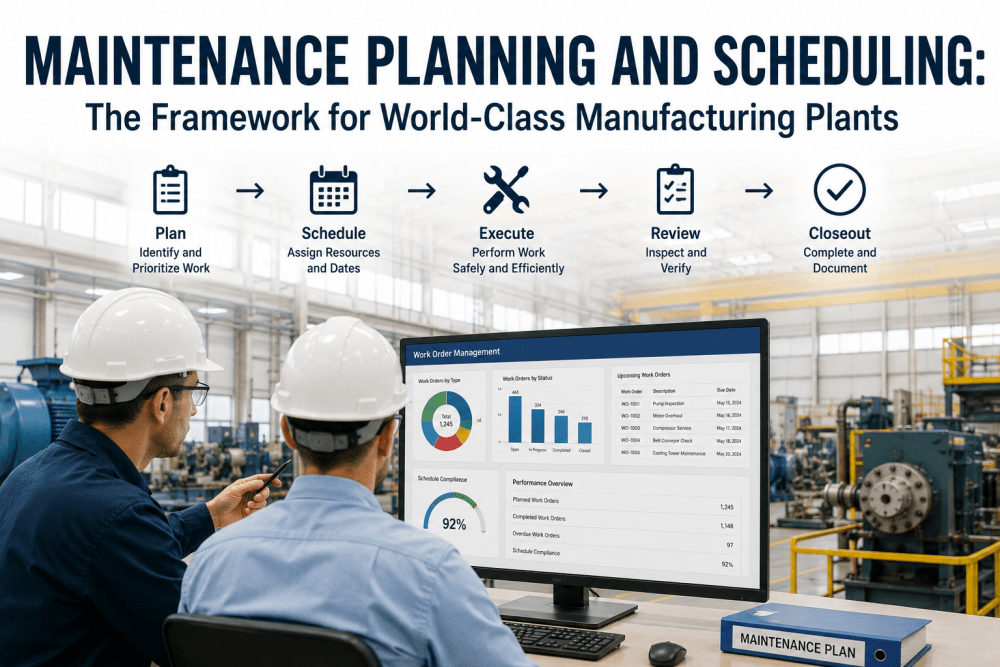
The average unplanned extension of a plant turnaround costs U.S. manufacturers more than $2 million per day in lost production, contractor overtime, and emergency procurement. Research from the Solomon Associates benchmarking studies consistently shows that plants completing turnarounds within scope and schedule are those with defined scope freeze dates at least 90 days out, integrated work order management, and dedicated turnaround coordinators—not larger budgets. iFactory AI's Work Order Management module gives turnaround teams a single source of truth for every task, permit, and resource across the entire shutdown lifecycle.
Turnaround Cost Benchmarks: Know Your Numbers Before You Plan
Understanding industry cost benchmarks gives your team the credibility to defend budgets and identify where your plant over- or under-spends relative to peers. The table below reflects 2025–2026 data from refinery and process plant turnarounds in North America. Use these as planning anchors, not targets—your actual numbers depend on plant age, scope complexity, and location.
| Metric | Under-Performing | Industry Average | Best-in-Class |
|---|---|---|---|
| Scope growth (% of original) | >20% | 10–15% | <5% |
| Schedule overrun | >15% | 5–10% | <2% |
| Rework as % of total man-hours | >8% | 3–6% | <2% |
| Punch list items at startup | >200 | 50–150 | <30 |
| Cost per work order (mid-size plant) | >$12K | $6K–$10K | <$5K |
| Cost overrun vs. budget | >25% | 8–15% | <3% |
The 4 Root Causes of Blown Turnaround Budgets
Post-mortem analysis of overrun turnarounds consistently points to four avoidable failure modes. These are not equipment problems—they are management and process problems, which means they are entirely fixable with discipline and the right tooling.
Late Scope Freeze
Every work order added after the scope freeze date compresses procurement, disrupts schedules, and creates field conflicts. Plants that freeze scope at T-60 days average 6% scope growth; those that freeze at T-30 average 18%.
Disconnected Work Management
When work orders live in spreadsheets, emails, and verbal agreements rather than a single CMMS, field supervisors lose visibility, parts get missed, and progress tracking breaks down within 48 hours of shutdown start.
Materials Not Ready at Day 0
An idle craft worker costs $85–$120 per hour fully loaded. When materials arrive late—or when the wrong part is staged—the cost compounds rapidly. Every long-lead item needs its own delivery milestone on the turnaround schedule.
No Baseline to Measure Against
Without a frozen baseline schedule, you cannot measure slip, justify recovery resources, or hold contractors accountable. Plants that skip baseline documentation cannot identify scope growth from execution inefficiency—and make the same mistakes next time.
How iFactory AI Supports Every Phase of Your Turnaround
iFactory AI is purpose-built for industrial asset management, giving turnaround teams the integrated platform that replaces the disconnected spreadsheets and paper-based work packs that cause most planning failures. Here is how the platform maps to each phase of your shutdown:
Work Order Management
Issue, track, and close every turnaround work order in one system. Field supervisors update status from mobile devices; coordinators see live progress across all work fronts.
Predictive Maintenance
AI-driven condition monitoring flags developing failures before shutdown, ensuring your scope is driven by actual equipment condition—not assumption or over-conservative estimates.
OEE & Production Analytics
Measure the production impact of your turnaround in real time. Track OEE recovery post-startup and compare against pre-shutdown baseline to prove the value delivered.
Parts & Inventory Control
Link every work order to a bill of materials. Track parts from PO to warehouse to field installation, with automatic stock alerts when quantities fall below turnaround minimums.
Smart Document Management
Store inspection reports, P&IDs, LOTO procedures, and as-built drawings in a searchable, version-controlled repository accessible to field teams on any device during the shutdown.
Automated Reporting
Generate daily progress reports, final turnaround performance reports, and post-shutdown KPI dashboards automatically—so your coordinator spends time managing work, not compiling spreadsheets.
See how iFactory AI's Work Order Management module integrates with your plant's existing systems. Book a Demo with our industrial operations team.
Expert Review: What Separates On-Time Turnarounds From Costly Overruns
After analyzing hundreds of turnaround post-mortems across refinery, chemical, and heavy manufacturing sites, the pattern is unmistakable: plants that finish on time share four disciplines. First, they freeze scope early and treat it as a hard contract, not a guideline. Second, every work order has an owner—not a group, not a department, one named individual. Third, materials are staged and kitted before Day 0, not arriving concurrent with labor. Fourth, the daily progress meeting is a decision meeting, not a status update—if something threatens the critical path, a recovery decision is made the same day, not next week. The technology to support all four of these disciplines exists today. The constraint is management commitment to use it consistently.
Conclusion: Execution Follows Planning
The most expensive shutdown mistake in U.S. manufacturing is not a failed weld or a missed inspection—it is entering the outage without a frozen scope, kitted materials, and a named owner on every work order. The checklist above gives your team a phased, actionable framework to plan and execute turnarounds that come in on time, on budget, and with assets returning to full production performance. The discipline is straightforward: measure before, plan rigorously, execute with accountability, and capture lessons every single time. Plants that follow this framework consistently report 25–35% reductions in turnaround cost overruns within two cycles. The checklist is the start—contact iFactory AI to see how our Work Order Management platform makes every item on it trackable, accountable, and auditable in real time.
Frequently Asked Questions
Put This Checklist to Work With iFactory AI
iFactory AI's Work Order Management platform makes every checkpoint in this checklist trackable, owned, and auditable—so your next turnaround finishes on time, on budget, and with full documentation for the post-shutdown report.