Every year the World Economic Forum names a fresh cohort of factories to its Global Lighthouse Network, and every year the gap between those sites and the rest of the industrial world gets discussed instead of measured. Most operations leaders read the case studies, nod at the productivity numbers, and go back to plant floors where the technology stack looks nothing like what a lighthouse runs. The real value hiding inside the network was never the recognition itself, it was the pattern behind more than a thousand documented use cases: which technologies get adopted first, in what sequence, and what actually moves the productivity needle versus what only sounds impressive in a press release. iFactory built its benchmarking approach directly against that pattern, and you can see where your own factory lands by choosing to book a demo with our team.
See Exactly Where Your Factory Stands Against the World's Most Advanced Production Sites
The Global Lighthouse Network now spans more than 230 sites across over 35 countries, each one publicly documenting the technology choices behind its performance gains. iFactory maps your current operation against that dataset so you know precisely which gaps are costing you the most, and where to invest first for the fastest measurable return.
What Actually Separates Lighthouse Factories From Everyone Still Stuck in Pilot Mode
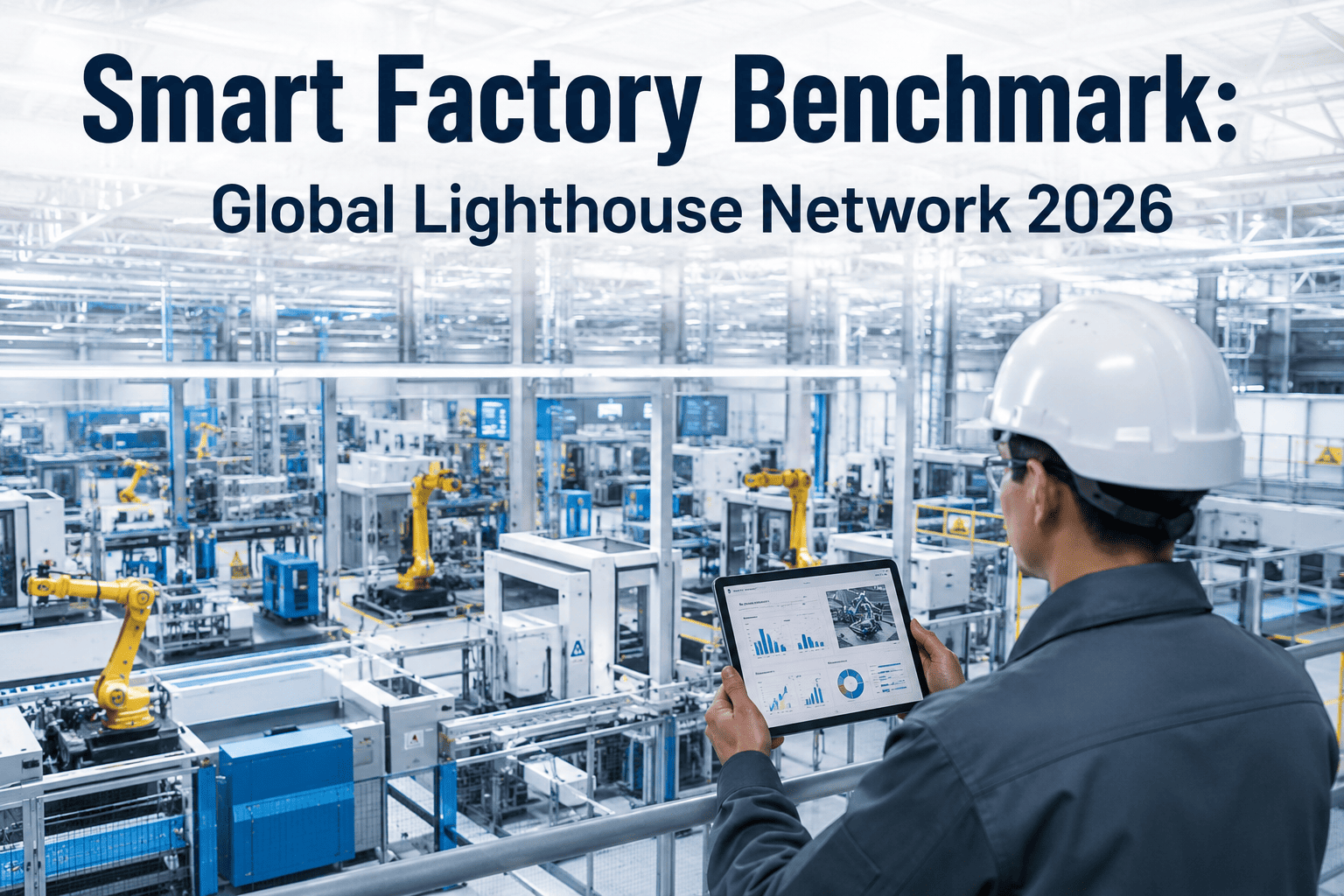
The Global Lighthouse Network is a joint initiative from the World Economic Forum and McKinsey that has run since 2018, when it launched with sixteen founding sites. Eight years and more than a dozen cohorts later, the network has grown roughly fifteen-fold, now recognizing over 230 factories and end-to-end value chains across more than 35 countries and 30 industries. What makes the network useful for benchmarking is not the badge each site receives, it is the shared library of over 1,200 documented fourth industrial revolution use cases that sit behind every recognition, covering everything from predictive maintenance to generative AI copilots on the shop floor.
Most manufacturers are not short on ambition, they are short on sequencing. Digital transformation budgets get spread across a dozen pilots that never connect to each other, while lighthouse sites concentrate investment in a smaller number of use cases that compound. The pattern across recognized sites is consistent: productivity, quality, and speed gains rarely come from a single flagship project, they come from stacking connected AI, IoT, and analytics use cases on top of a common data foundation until the whole production system starts behaving differently.
The applications window that produces each new cohort closes twice a year, and an independent panel of academics, technologists, and industry experts reviews every submission against documented, audited performance data before granting recognition. That review discipline is part of why the benchmark holds up: a site cannot claim a productivity gain without evidence tying it back to a specific set of deployed use cases, which is exactly the kind of rigor most internal transformation roadmaps skip entirely when they set targets based on vendor pitches instead of measured outcomes.
Where Lighthouse Factories Actually Spend Their AI and Automation Budget
When the technology choices behind Lighthouse recognitions are grouped by category, a clear hierarchy emerges, and it is not the one most factories are building toward. Analytical AI and machine learning, not generative AI, still dominate the highest-impact use cases, because the problems with the biggest payoff in a factory are prediction and optimization problems, not conversation problems. Generative AI is growing fast as a supporting layer, but it is layered on top of a mature analytical foundation rather than replacing it.
This ordering matters because it changes where a benchmarking exercise should point its budget. A factory that leads with a generative AI pilot before it has reliable, connected sensor data to feed it usually ends up with a well-written summary of a problem it still cannot solve. Lighthouse sites tend to do the opposite: they get the connected data layer and the analytical models producing trustworthy predictions first, then add generative interfaces on top once there is something worth summarizing or explaining to a frontline worker in plain language.
The Pattern Holds Across Very Different Factory Floors
One of the more useful things about the network for benchmarking purposes is how many different industries it now spans, from semiconductor fabs to consumer goods lines to steel and heavy industry. The specific equipment and product changes completely from one recognized site to the next, but the underlying transformation pattern does not, which is what makes it a fair comparison point regardless of what your own factory actually produces. Whatever your sector, the four examples below show how the same core practices get adapted to very different production realities.
Lighthouse Practice Versus Typical Factory Practice, Category by Category
Reading the case studies one at a time makes it hard to see the pattern. Laid out side by side, the difference between how a Lighthouse factory operates and how most factories still operate becomes obvious, and it points directly at where a benchmark exercise should start looking first. Use the table below as a scorecard, and be honest about which column actually describes your current operation in each row rather than the one you are aiming for next year.
| Benchmark Category | Lighthouse Practice | Typical Factory Practice |
|---|---|---|
| Maintenance Strategy | Condition-based, driven by live sensor data and failure prediction models | Fixed preventive schedule regardless of actual equipment condition |
| Quality Inspection | AI vision systems checking every unit at line speed | Manual sampling on a fixed percentage of units |
| Data Foundation | Unified data platform connecting machines, sensors, and enterprise systems | Data siloed across separate systems that rarely talk to each other |
| Use Case Rollout | Concentrated investment in connected use cases that reinforce each other | Scattered pilots across departments that never scale past one line |
| Workforce Model | Frontline teams trained to work alongside AI tools and dashboards daily | Technology introduced without a structured adoption or training plan |
Find Out Exactly Which Lighthouse Practices Your Factory Is Missing
iFactory benchmarks your current operations, data maturity, and technology stack against documented Lighthouse patterns, then shows you the fastest path to close the gap.
The Four Areas Every Lighthouse Recognition Is Actually Judged Against
Lighthouse sites are not recognized for having the most advanced technology in isolation, they are recognized for measurable outcomes across four pillars that map cleanly onto what any factory should be tracking, whether or not it ever applies to the network itself.
A Four-Step Framework for Benchmarking Your Own Factory Against Lighthouse Leaders
You do not need to apply to the network to benefit from what it has already proven. The same benchmarking discipline that gets a site recognized can be run privately against your own operations, using the published pillars as the scoring framework. The steps below are the same ones iFactory walks through with manufacturing teams during a benchmark engagement, and they hold regardless of plant size, industry, or how much legacy infrastructure is already on the floor.
What the Numbers Actually Look Like Once the Gap Starts Closing
These figures reflect outcomes documented across recent Global Lighthouse Network cohorts, and they are consistent enough across industries and geographies to use as a realistic target, not an outlier to admire from a distance. None of them depend on a factory being large, well funded, or already advanced, they depend on sequencing the right use cases on top of a data foundation that can actually support them.
Questions Manufacturing Teams Ask Before Starting a Lighthouse-Style Benchmark
Stop Guessing How Far Behind You Are, Get an Actual Benchmark
iFactory scores your operation against documented Global Lighthouse Network practices across productivity, data maturity, and technology adoption, then hands you a prioritized roadmap to close the gap.